

Automatics


The technology is here to encourage more people to get into riding.
Automatic motorcycles — or at least, motorcycles that don’t have a clutch lever — are more prevalent now than at any other time in motorcycling history. An automatic transmission allows a motorcycle to launch from a stop and then stop again with nothing more required than rolling on the throttle or hitting the brakes. A rider can go from zero to top speed without manually changing gears. Automatic bikes might use a torque-converter transmission (most automatic cars use this), a continuously variable transmission (CVT), a dual-clutch transmission (DCT), or an automated manual transmission. Semi-automatic motorcycles can start, stop and change gears without a clutch, but gear changes must be made manually (Honda minis have had this type of transmission for decades).
There are several reasons someone might want to be free of a clutch and manual gear changes. Perhaps it’s a simple lack of coordination; perhaps it’s a disability; perhaps it’s convenience. Regardless, there are now automatic-shifting motorcycles available from BMW, Honda, Kawasaki and Yamaha. The company with the most available automatic models is Honda, with six auto-shifting bikes in its lineup in 2025.
Honda’s first automatic motorcycle, the 1976 CB750A Hondamatic, had a torque-converter two-speed transmission. However, like the other automatic motorcycles available in the era, it was not a true automatic. While it could get moving and come to a stop without a clutch in either Low or Drive, when rolling, it did need to be shifted between the two speeds via a foot lever. Leaving it in Low would limit top speed; leaving it in Drive would make acceleration sluggish. The company followed up in 1978 with the CM400A Hondamatic, which it produced until 1983 (bumped to a 450 in the later years).
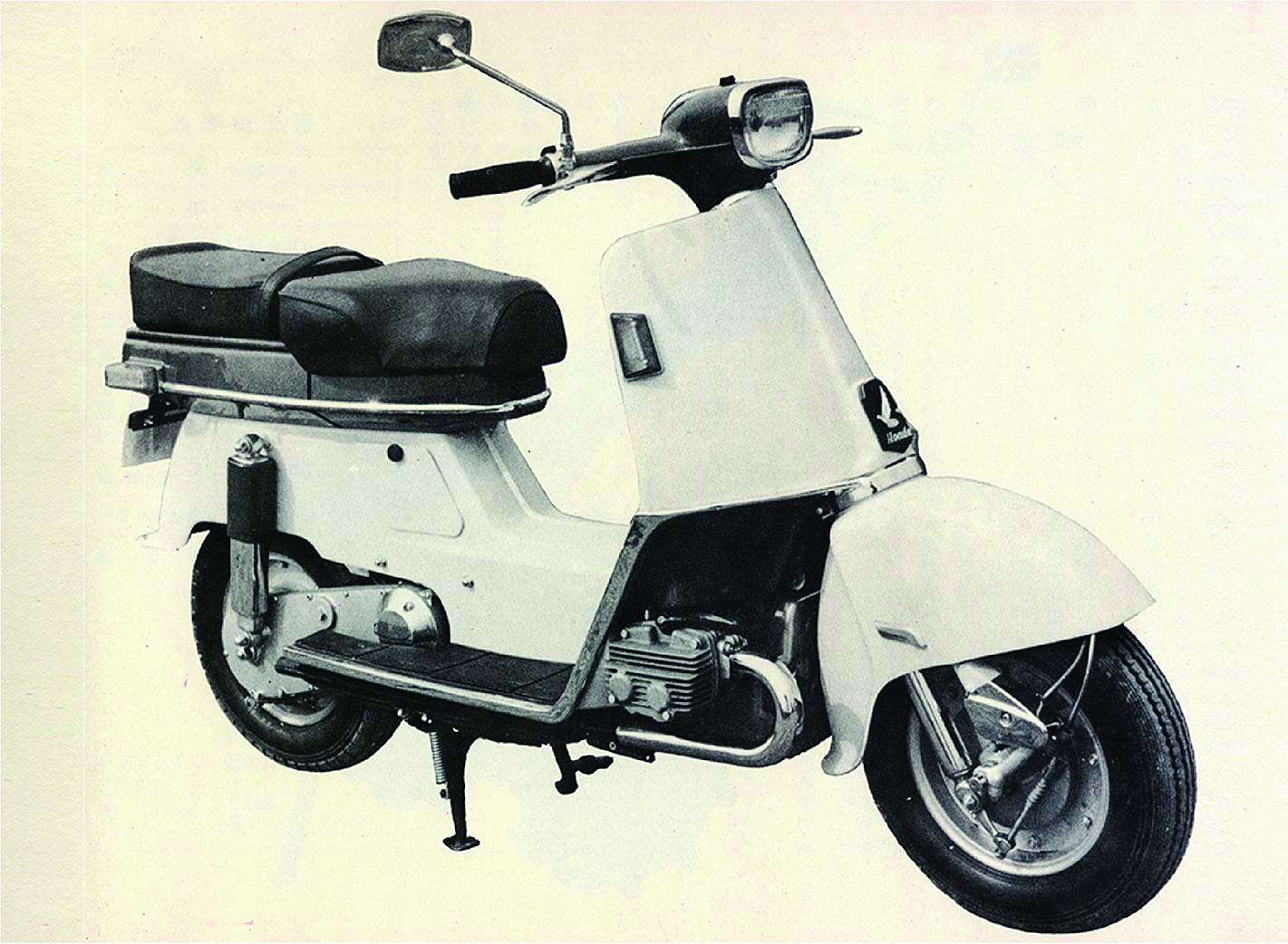
Honda actually produced its first automatic two-wheeler in 1961: the Juno M80 scooter, powered by an 11 horsepower, 124 cc horizontally opposed four-stroke twin mated to a Badalini automatic transmission. A Badalini transmission was a hydraulic-
mechanical transmission with infinitely variable ratios, developed in the mid-1950s Italy by Giovanni Badalini and patented in 1957. Honda improved Badalini’s design for use in the M80, and later in the 170-cc M85 scooter, but it sapped too much power, was prone to leak, and high patent fees eventually lead Honda to abandon it in 1964. The company later developed a torque-converter automatic for its cars and then adapted the technology to its mid-’70s automatic CB models.
Moto Guzzi actually produced the first modern automatic motorcycle, beating Honda by a year with the V1000 Convert. It used a two-speed transmission with a Sachs torque converter, though it also had a lever-operated multi-plate clutch. The clutch was used when starting the bike and when shifting between Low and Drive, but otherwise, a rider could launch and stop the bike without touching the clutch lever. The owner’s manual stipulated that Low was for “town or mountain riding” and that Drive was for “country or highway riding.” Guzzi produced the V1000 Convert from 1975 to 1982.
Other automatics throughout the years included the 1982 Suzuki GS450GA Suzukimatic (yes, Suzuki copied Honda by adding -matic to its name). It also had a two-speed torque-converter transmission, but it failed to sell any better than the Hondas and was produced for only two years. It was the last mainstream automatic motorcycle to hit the market until 2006, when Yamaha introduced the FJR1300AE, which featured Yamaha Chip Control Shift (YCC-S) that incorporated a manual five-speed gearbox with a computer-controlled clutch. This allowed fully automatic operation, or clutchless semi-automatic gear changes via a foot lever or by buttons on the left-hand switch assembly. Yamaha discontinued the automatic FJR1300AE in 2010, though the manual variation is still available today.
The Aprilia Mana 850 was introduced in Canada in 2009, powered by an 839-cc V-twin mated to a CVT. To make the ride more engaging it had a manual-shift mode, which locked the CVT in one of seven preset ratios until the rider initiated the next gear change via a foot shifter.
Many consider the 1910 Zenith Gradua, which used a CVT, to be the first automatic motorcycle in an era when motorcycles either had a direct drive or a lever-tensioned belt to disengage the engine, and either one or two speeds. However, the Zenith wasn’t really an automatic; the rider had to pull on a lever to change gear ratios.
Enter 2026, and there’s an abundant choice of automatic-shifting motorcycles. BMW’s latest R1300 models, Kawasaki’s Ninja 7 and Z7 hybrids, and Yamaha’s Tracer 9 Y-AMT all have computer-controlled clutches, much like the FJR1300AE of 2006. KTM is anticipating the release of at least one auto-clutch model this year. Honda’s automatics, on the other hand, utilize a DCT, which is more complex, heavier and more expensive to produce than an automated manual, but provides nearly seamless automatic gear changes.
While there may still be some stigma attached to automatics (“I can shift my own bike, thank you…”), the selection of clutch-free bikes is growing. And it looks like this time they’re here to stay.





Thanks for Reading
If you don’t already subscribe to Motorcycle Mojo we ask that you seriously think about it. We are Canada’s last mainstream motorcycle magazine that continuously provides a print and digital issue on a regular basis.
We offer exclusive content created by riders, for riders.
Our editorial staff consists of experienced industry veterans that produce trusted and respected coverage for readers from every walk of life.
Motorcycle Mojo Magazine is an award winning publication that provides premium content guaranteed to be of interest to every motorcycle enthusiast. Whether you prefer cruisers or adventure-touring, vintage or the latest models; riding round the world or just to work, Motorcycle Mojo covers every aspect of the motorcycle experience. Each issue of Motorcycle Mojo contains tests of new models, feature travel stories, compelling human interest articles, technical exposés, product reviews, as well as unique perspectives by regular columnists on safety or just everyday situations that may be stressful at the time but turn into fabulous campfire stories.
Thanks for considering a subscription. The Mojo team truly appreciates it.
