

Shoei Neotec 3 Versus Schuberth C5

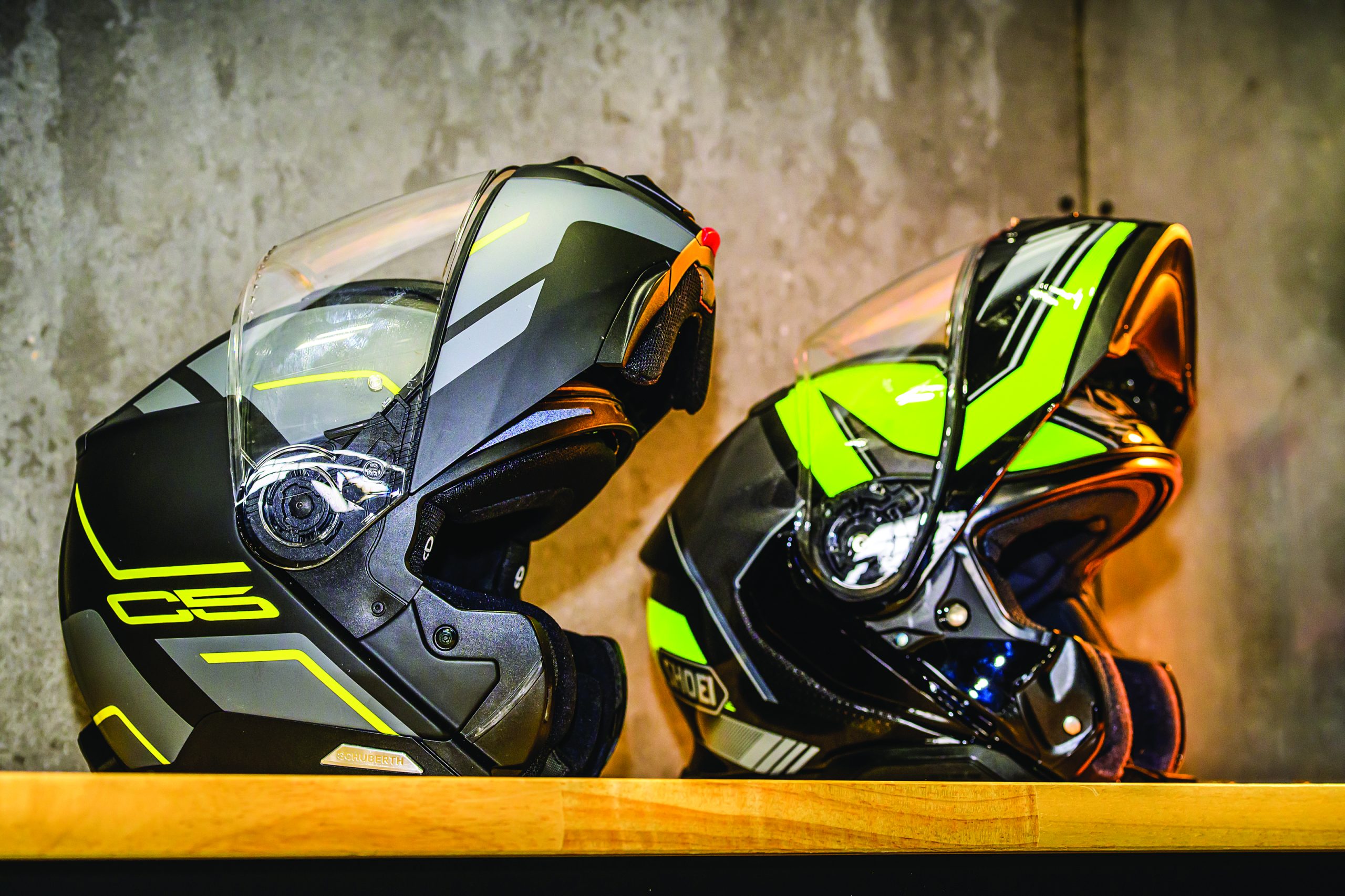

Even the best helmets on the market aren’t perfect for everyone.
Considering I just penned a paean (see The Last Word, page 68) to the primacy of fit as criteria for choosing one motorcycle helmet over another, it might seem odd for me to be now holding court on which of the two most popular modular helmets in the world has the best features and performance. Doubly so because, as you’ll read at the end of this story, only one of them fits me well enough that I can wear it for a whole day’s riding. In other words, I am the perfect admonishment for the fact that the biggest reason to choose one helmet over another is how well it fits your particular noggin. Indeed, if I were allotting a score of 100 for all helmet reviews, 50 per cent of those points would go to personal fit with the remaining 50 being shared amongst more traditional criteria — ventilation, visor, features, etc.
So why even bother testing those performance issues, you might ask?
Well, there are two reasons. One — and this is probably the hardest thing any reviewer needs to admit to themselves before they pen any opinion column — a vast number of you will dismiss any such advice as so much hogwash. I can rail all I like about comfort and fit — as I could the primacy of safety for riding wear or how you’ll have more fun riding a smaller-tired motorcycle with neutral steering than one wearing the latest, cred-generating 190/55-17 donut — but many of you will simply ignore it.
The second is actually more practical. The fact is that, while some helmet designs are so distinct — I’m thinking the shapes of Shoeis versus Arais here or Schuberth’s C3 versus its much-lamented C4 experiment — there may be more than one helmet that fits your noggin. If you are indeed so blessed — I, unfortunately, am not — then you need to make your purchase on traditional criteria: again, those are protection, ventilation, etc. So, after some 30,000 kilometres — two full years, in fact — testing these helmets, here’s my take of which one is actually built better.
SAFETY
Both these helmets are rated for the latest ECE22.06 standard which means they are amongst the safest motorcycle helmets money can buy, always a good point to start any helmet test. That said, while the new “06” standard does have a few more impact tests, its major claim, at least as it pertains to modular helmets, is that they are now certified in their chin-bar-open position as well as when it’s closed. Essentially, it ensures that, if you’re riding with the chin bar flipped up, it won’t inadvertently slip back down, obscuring your vision while riding.
As beneficial as that may seem, a full-faced helmet — modular or single piece — is always going to be much safer in a crash than one that is — or is emulating — an open-face helmet. If you’re buying a modular helmet so you can smoke a cigarette while cruising at a buck twenty, you’re kinda defeating the purpose. Besides, at that speed, the chin bar has turned into a sail and your neck will be getting sore quite quickly. And if you really are buying a skid lid for such shenanigans, you really need a “flip-back” helmet like the LS2 Advant X I’ll be writing about soon.
All that said, the SHARP (Safety Helmet Assessment and Rating Programme) website — an independent helmet safety rating organization — rates the Shoei slightly better in its impact tests than the Schuberth but then says the Schuberth’s chin bar stayed resolutely shut in its impact tests while the Shoei only did so 93 per cent of the time. Make of that what you will, but both helmets are near the top of SHARP’s list for this segment.
VENTILATION
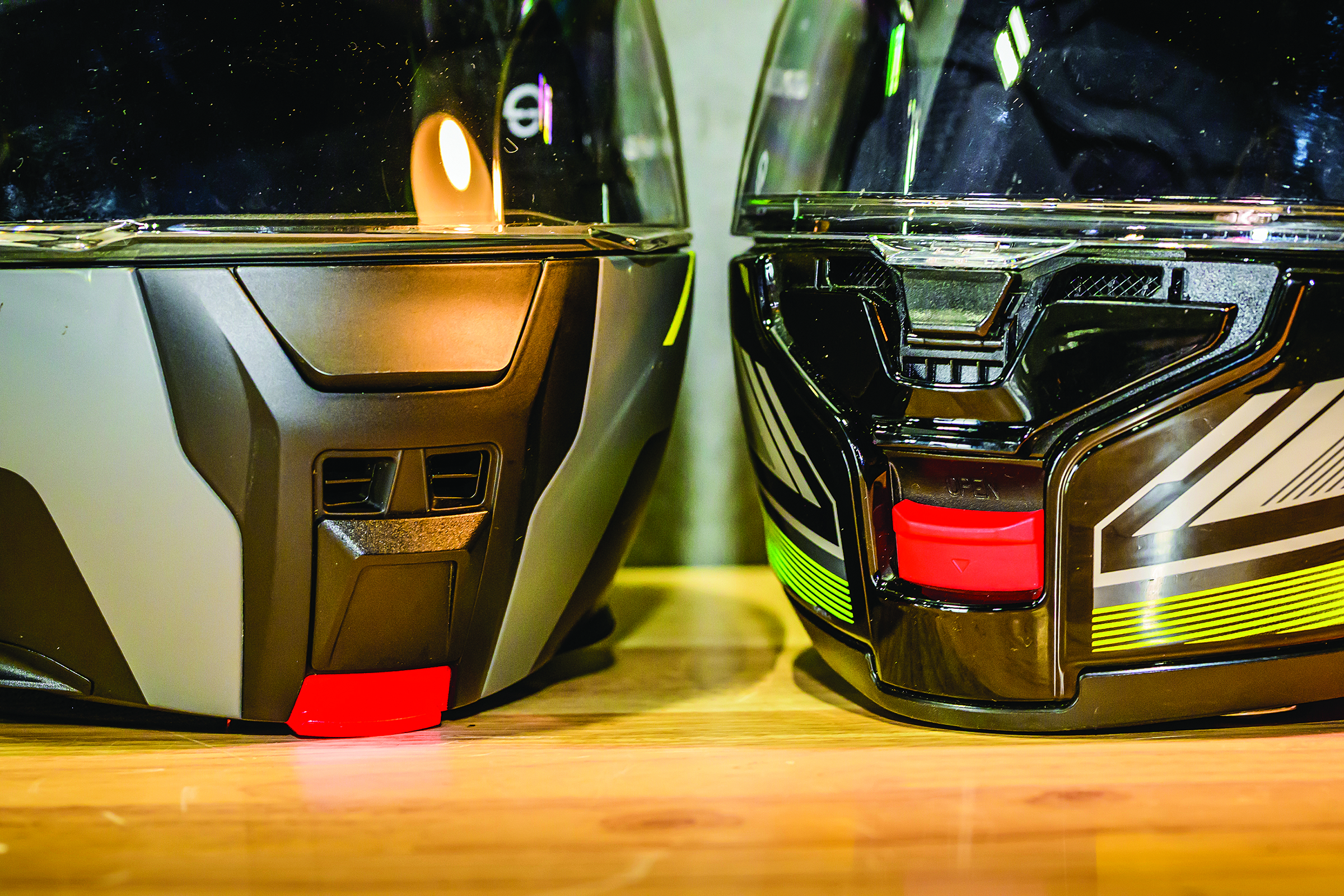
Both helmets have ventilation ports in the chin bar as well as another at the top of the helmet. Indeed, the major difference is that, while the Schuberth directs some of the chin bar’s forced air to your mouth and some to the visor (to reduce fogging), the Shoei directs all its flow to the visor. Also, while the Schuberth has a bug catcher in its upper venting, the Shoei does not. So, a minor advantage to the German helmet, then, even if the actual amount of ventilation isn’t much different between the two.
VISOR
Physically, the two helmets’ visors are distinguished by the Shoei having its single thumb tab — by which you raise the shield — in the middle while the Schuberth has one on each side. From one of point of view, that can be an advantage because you can use either hand to flick up the shield. On the other hand, over time, I’ve found that the uneven leverage twists the Scuberth’s shield in its mounts and then it gets difficult to seal properly. In the end, I found it more useful to open — and, more importantly, close — the Schuberth’s visor with both hands simultaneously. By comparison, opening the Shoei shield is a doddle. Indeed, my biggest wish for the C5 was that it too would have a central opening visor like the Shoei even if, as the company says, using a central locking system does block your vision for a moment when fiddling with the shield.
The Schuberth does get some of its mojo back by having the easiest visor of all modular helmets to change. Just tilt the shield all the way back, pull the latches on both sides and it pops right off. Putting a new one on is hardly more difficult. Changing the Shoei’s shield is hardly a travail, but it’s not nearly as easy as transplanting a C5’s visor.
Both have drop-down sunshields. I preferred the tint on the Schuberth’s, but it scratches a little more easily than the Shoei’s. So, yet another arena where the two are fairly evenly matched.
And for one final too-close-to-call comparison, the Neotec 3’s shield is better at staying just slightly “cracked” at speed — a boon when riding in the rain without fogging your glasses — but the Schuberth always returns the shield to its previous position after you flip the chin bar back, while the Shoei doesn’t. Seriously, there isn’t much in this fight.
LINERS
Both helmets seal around the neck well, though the C5 does it more elegantly and a little more tightly. Perhaps that’s why it’s a little quieter. Certainly, it’s at least part of the reason that there’s a few less decibels inside the C5 than the Neotec 3.
Both also have removable and customizable liners, and both offer different sized cheek pads and headliners to alter sizing. As I said in my column, these adjustable bits are capable of making a difference between “That’s okay” and “Oh my, that fits me perfectly,” but they can’t make a helmet with significant pinch points fit like a glove.
That admonishment aside, the Shoei’s pads are easier to remove and install than the C5’s, which can be a little fiddly. The Shoei (theoretically) also offers more adjustability. All sizes of the Neotec 3 offer both thinner and thicker cheek pads (standard is 35-mm, 39-mm and 31-mm versions are also available) as well as headliners (standard at 9-mm; options available are 13-mm and 5-mm). These are fairly easy to come by if you’re willing to order from overseas (I got mine from Motolegends in England).
I have a complete set, but despite much fiddling, I couldn’t get the Neotec to fit me quite right. The small, plastic-lined speaker hole — only on the right side, mind you — caused discomfort to my ear.
Shoei also offers thinner, thicker foam pads that go in between the EPS and the cheek pads/headliner. They are generally 2-mm thick and are meant to change the internal shape of the helmet (the oval-versus-oblong thing). I did not test these as they are extremely difficult to come by.
All that said, Shoei cheek pads and headliners are a doddle to change. Now that I’ve had much practice, I could almost do it with my eyes closed. Only the LS2 is as easy to take apart and put back together.
Optional cheek pads and headliners for the Schuberth are much easier to come by, the only problem being that, the last time I checked, they weren’t available for all sizes. Different sized cheek pads are available for all C5s, but it seems that the side and back pads (which affect the top-of-head fit) are only available for Medium-, Large- and XLarge-sized Schuberths.
Changing them out can also be a little more difficult than on the Neotec 3. Schuberth’s Anti Roll-Off System (AROS) strap that runs from the back of the helmet also cuts through the cheek pad. Changing them out is hardly an insurmountable problem, but it does require a little more patience — or swearing, depending on your predilection.
As I said in this month’s Last Word column, however, none of my machinations could make the Shoei fit my particular noggin while the C5 fit perfectly right from the get-go. For many, however, just the opposite will be true.
HOW QUIET ARE THEY?
Schuberth and Shoei both have their own wind tunnels, which explains why they are both renowned as quiet helmets. That feat is made especially notable considering that they are both essentially two-piece helmets. It’s worth noting that Schuberth says that, at 100 kilometres an hour on a naked bike, there’s about 85 dB of wind noise inside the C5. I cannot attest to those numbers, but, having actually been inside their wind tunnel with my own C5, I can attest to the company’s commitment to silent operation. Shoei makes no official claim for the Neotec 3, but it too is surprisingly quiet for a two-piece helmet.
Lesser modular helmets tend to suffer quite a bit in this category, however. In fact, the only other modulars I have tested that come even remotely close are the AGV Tourmodular (not sold in this country anymore, though they can be shipped to Canada from the EU surprisingly cheaply) and LS2’s Advant-X which seems to make up for its relatively loose-fitting chin bar with an especially tight neck opening. All others that I have tested have been noticeably louder.
QUALITY AND FINISH
Both helmets are amazingly well-built. The quality of their interior materials is first-rate as well. Indeed, the main significant differences were in the chin strap fastener and the paint.
Both C5 and Neotec3 use ratcheting tongues rather than a traditional double D-ring clasp. That said, the Shoei’s Micro Ratchet is made of steel and the Schuberth’s chin lock mechanism is made of plastic. I never noticed a difference in action so I won’t consider this difference in material significant. And I’ve owned a Schuberth E1 for years and have had no concerns with its fastener.
That said, it’s worth noting that a ratcheting system clasp was the subject of a recall for AGV’s Tourmodular — and the instigation for pulling it from the market — so, given the seeming impossibility of a D-ring system (at least if it’s correctly “tied”) coming apart, anyone worried about such a calamity might want to look elsewhere. On the other hand, I’ve never heard of any recall on either helmet’s chin straps.
Both feature the very best finishes in the business. My Schuberth was a matte Omega Yellow version, extremely attractive and as rugged a matte finish as I’ve ever seen on a helmet. The Neotec 3 was a Grasp TC-3 model with a similar black and fluorescent paint scheme, the main difference is that the Shoei had a nice, shiny clear coat. I don’t think I’ve ever seen a more durable paint finish on a motorcycle helmet, the Shoei’s finish surviving more than its fair share of ham-fisted handling (that means banging it into doors and having it roll off the seat not once, but twice, thankfully onto some cardboard). It’s worth noting that other helmets I’ve tested recently have not held up as well to the abuse as either of these. The fragility of its paint — a matte finish not dissimilar in hue to the Schuberth’s — is my biggest complaint with the Tourmodular.
PRICE
The current MSRP for my Scuberth C5 is $1,199. My Neotec 3 Grasp TC-3, meanwhile, retails for $1,529.95. Making that price difference even more dramatic is that the Schuberth’s price includes two 40-mm heavy-duty speakers and all the pre-wiring required for its specially designed Sena SC2 system which costs an extra $445. The Shoei, on the other hand, comes with no comms system paraphernalia pre-installed and the company wants $639.95 for its Sena SRL3 comm system. Do the math and a fully-tricked out Neotec 3 would set you back $2,169.90 while the C5, without discounts would cost $1,644. That’s a heck of a difference even if I do, fit aside, have a slight preference for the Shoei.
These are the very best modular helmets available today and they are remarkably similar in performance, The Schuberth is a little quieter and, in Canada at least, cheaper. The Shoei, on the other hand, is a little better built and, in my estimation has a better face shield.
All that said, buy the one that fits best.





Thanks for Reading
If you don’t already subscribe to Motorcycle Mojo we ask that you seriously think about it. We are Canada’s last mainstream motorcycle magazine that continuously provides a print and digital issue on a regular basis.
We offer exclusive content created by riders, for riders.
Our editorial staff consists of experienced industry veterans that produce trusted and respected coverage for readers from every walk of life.
Motorcycle Mojo Magazine is an award winning publication that provides premium content guaranteed to be of interest to every motorcycle enthusiast. Whether you prefer cruisers or adventure-touring, vintage or the latest models; riding round the world or just to work, Motorcycle Mojo covers every aspect of the motorcycle experience. Each issue of Motorcycle Mojo contains tests of new models, feature travel stories, compelling human interest articles, technical exposés, product reviews, as well as unique perspectives by regular columnists on safety or just everyday situations that may be stressful at the time but turn into fabulous campfire stories.
Thanks for considering a subscription. The Mojo team truly appreciates it.
