

Schuberth C5ANC Helmet

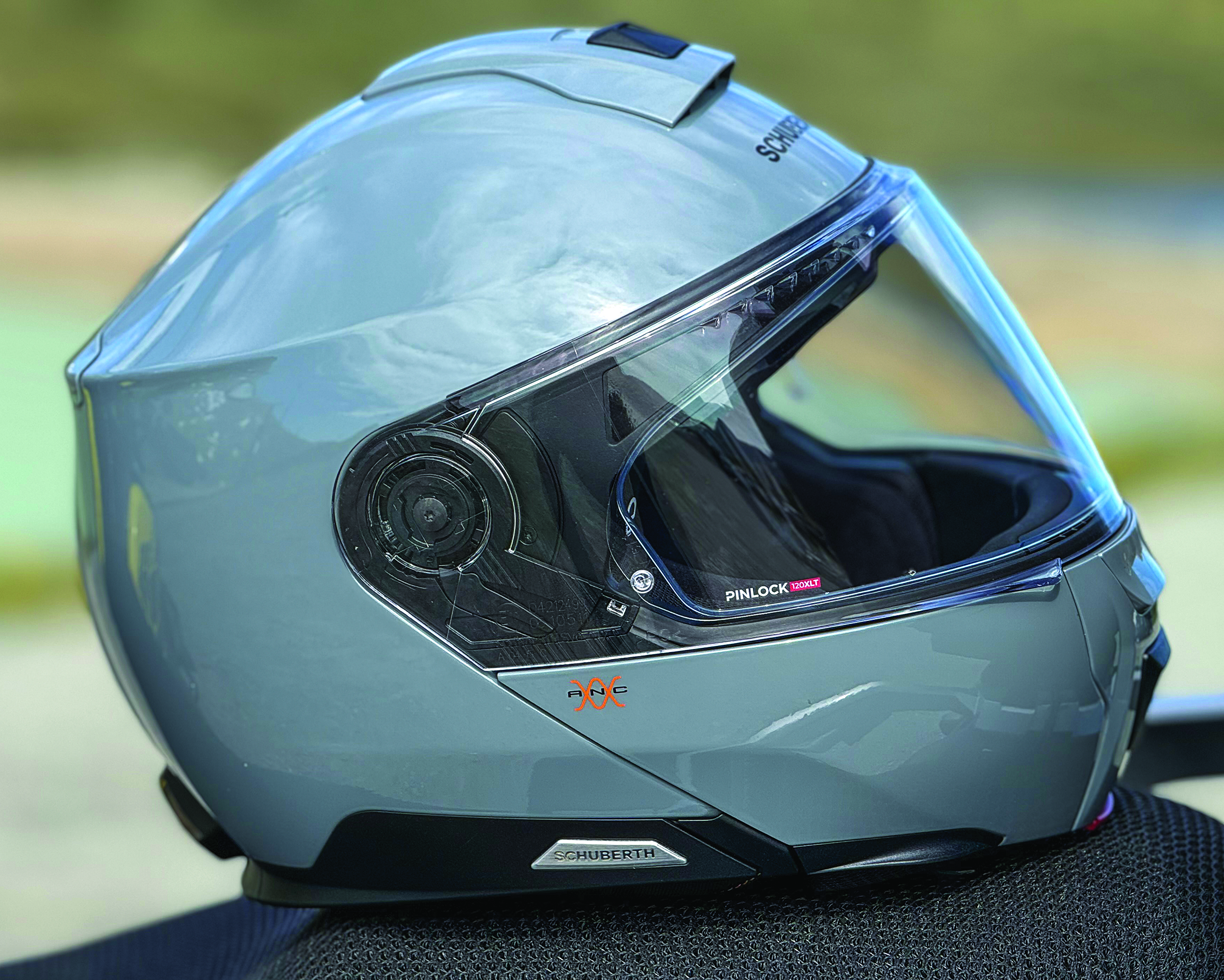
Cutting-edge noise cancellation allows you to ditch the ear plugs, if your pockets are deep enough.
The question I get asked most when other motorcyclists realize I’m wearing the new Active Noise Cancellation version of Schuberth’s estimable C5 modular helmet is, “Do you still have to wear earplugs?”
Oh, to be sure, I’ve had to respond to lots of question on price, almost as many on the sound quality of the ANC’s 53-millimetre speakers and even a few on its ability to make telephone calls more intelligible. But when it comes right down to it, what riders want to know is whether they still have to wear the earplugs that have become standard-issue for motorcyclists looking to make wind noise bearable.
The short answer is no, I don’t. I need to stress the “I” in that statement. My main bike, a 2018 Suzuki V-Strom 1000 XT, wears an exceptionally turbulence-free Givi Airflow screen and my sized large C5 is an almost-perfect fit for my particular cranium (meaning there’s no hollow points for wind noise to “boom”) and so I, for the first time in 30 (or is that 40?) years no longer wear earplugs when I head out for a ride. In fact, I did well over 12,000 kilometres this summer on my Strom — many of them at speeds on the Italian Autostradas that would get me thrown in jail here — and I wore no earplugs of any kind the whole time.
The longer answer is that there were still a few situations where I did wear earplugs with the ANC system engaged. For instance, the BMW R1150R in Schuberth’s wind tunnel had a deliberately defective fairing — to create (a lot) more turbulence — and I needed whatever additional noise attenuation I could get. Ditto on a few sport bikes I have ridden since. In each case, because of disturbingly inefficient aerodynamics, I needed some foam plugs as well as the magic of noise cancelling.
PROOF IS IN THE NUMBERS
So, you might ask, which gets rid of more noise, earplugs or fancy electronics?
According to Schuberth’s official numbers, noise inside its new ANC’ed C5 — or, at least, inside the new helmet’s ear chambers — is down some 10 decibels at 100 km/h which, according to experts, suggests a 50 per cent reduction in perceived noise.
It feels like more.
Now, trying to describe a level of noise is a lot like trying to describe how a banana tastes different from an apple to someone who’s eaten neither. Nonetheless, I’ll take a whack at it.
From a purely subjective point of view, with ANC on — again, wearing no earplugs — you still know that the wind is there, but you can’t really be sure of what you’re hearing. Switch it off and you can distinguish every little eddy and change in air pressure that curls past the upper lip of your fairing’s windscreen.
Another way to look at it may be that, on those bikes that I needed to wear earplugs and use Schuberth’s Active Noise Cancellation, it was ANC that quietened down the cacophony more than the earplugs. Indeed, in direct back-to-back testing, the C5 ANC without earplugs proved quieter than my standard C5 with them. Considering that the basic C5 is considered the quietest modular helmet on the market, that’s impressive. So is the fact that its advantage appears to increase with speed.
QUIET EVEN WITH FACE SHIELD OPEN
In fact, the ANCed helmet is passably silent with its face shield up and even with its chin bar locked in its open position (now technically legal since the C5 is now ECE 22.06 approved). Indeed, the only thing that appears to trip up all that noise cancelling is gusty side winds and opening the C5’s top vent at speed (because it pipes cooling air down to the ear area).
Its performance when playing music at the same speeds likewise impresses. Current helmets with communications systems — like my C5 with its SC2 comms system by Sena — face an uphill battle, its 40-mm speakers, smaller than the ANCs, having to overcome the sound-deadening of the ear plugs almost all riders wear even when listening to music over a built-in communications system.
Because the Schuberth’s adaptive noise control system is cancelling the unwanted noise, it means you don’t have to blare the Cardo system’s 53-mm speakers nearly as loud. The benefit is less audio distortion. Much less. While my C5’s 40-mm speakers were almost always at full blast, I seldom get my Apple Music past half throttle when riding with the C5 ANC. Best of all, you don’t have to increase the volume as speed increases, as all the wind noise is cancelled rather than simply overwhelmed by music volume. Such is the magic of ANC.
GOOD NOISE CANCELS BAD NOISE
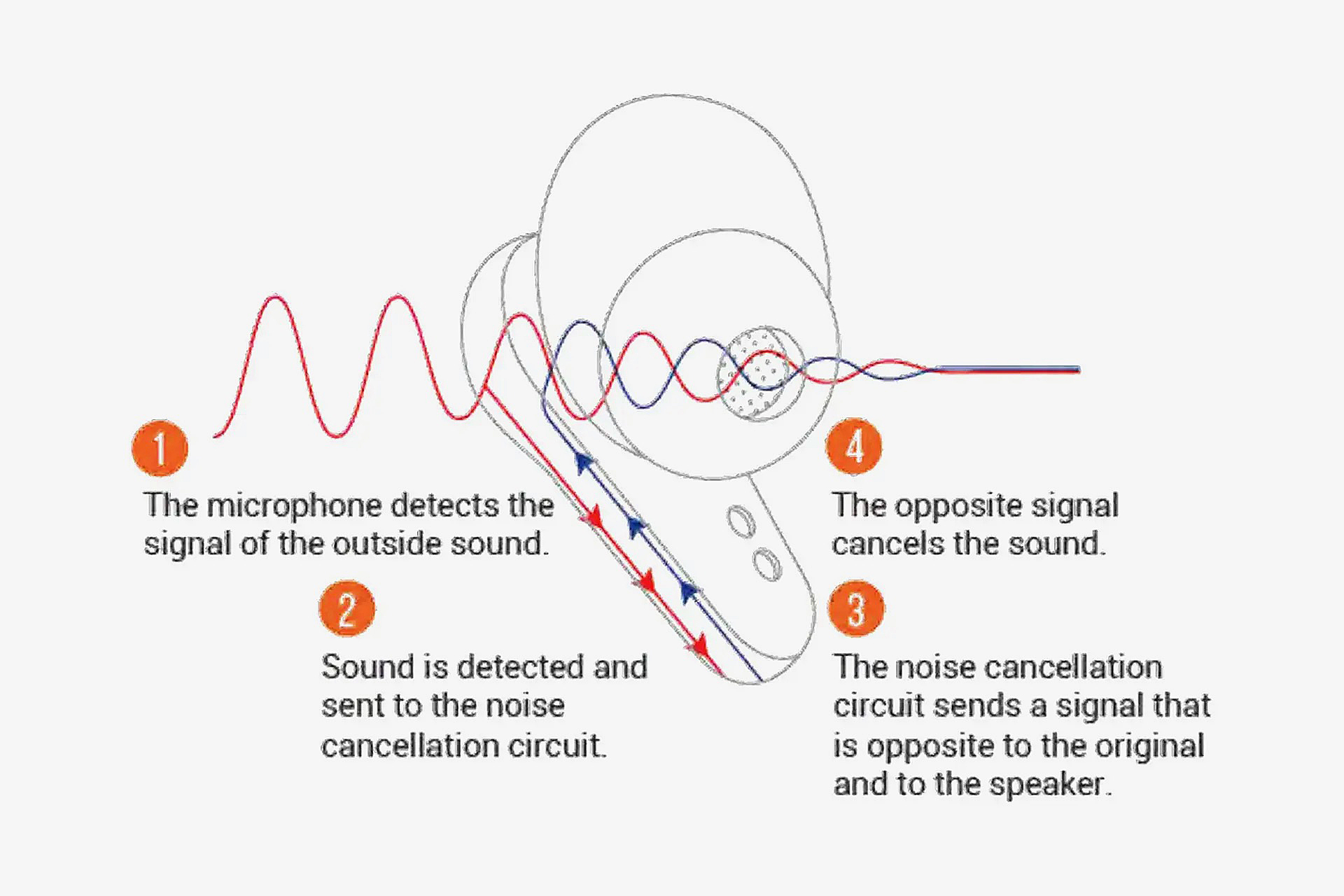
In theory, noise cancellation is pretty simple stuff. The pressure waves that cause sound are made of compressions and rarefactions. The loudness of that sound and its timbre are measured by its amplitude (basically its strength) and frequency (its pitch). All that active noise cancelling has to do, then, is produce an opposing pressure wave with the exact same frequency and amplitude and, theoretically, all that sound, troublesome or otherwise, would disappear.
In real life — at least in real motorcycle helmets — it’s not nearly so straightforward. First, there’s the fact that air hitting a helmet is particularly unstable. Motorcycles are particularly — often spectacularly — un-aerodynamic beasts and the rush of air that hits a rider’s helmet is not only turbulent but immensely variable. Designing a computerized system that can react quickly enough to frequency changes and with enough force (that amplitude thing) to counteract all the kerfuffle is not without its challenges.
That’s why the C5 ANC boasts those huge 53-mm speakers, the largest in the industry (non-noise-cancelling in-helmet motorcycle speakers tap out at 45-mm). It’s also why some incredibly compact microphones are built into the geometric centre of each speaker, their placement chosen so they are cancelling exactly what the ear is hearing.
FACTORY DEVELOPED
That much I already understood before visiting Schuberth’s research & development centre in Magdeburg, Germany, but I’ve got to admit that I was a little confused by the new — and very distinct — chamber that surrounds the new C5’s earholes. At first, I thought it was designed as some sort of pronounced muff to aid the ANC process by muffling some of the noise before it even got to the rider. But no, says, Christian Schmidt, one of Schuberth’s design engineers, it’s actually there to reduce the size of the chamber in which the ANC system must modify sound.
In its simplest terms, Schuberth’s engineers installed the biggest speakers possible into the smallest chamber they could make so that the entire system could respond with maximum quickness and force (that frequency and amplitude stuff again).
A major hurdle that Schuberth’s sound engineers had to overcome is how selective the noise reduction system needs to be. So, while it’s obvious that you do want to eliminate as much wind noise as possible, less obvious is the fact that you might not want to get rid of all external sound.
SOME NOISES ARE NECESSARY
Not being able to hear the sound of a bleating car horn, for instance, might be a little dangerous. Ditto for tires screeching, diesel trucks approaching or even dogs barking, each part of the mosaic of warning signals that the biker needs to be aware of should they want to remain sound of limb and limbic lobe. Hell, you need to be able to hear someone talking to you lest every conversation require removing your helmet.
This last point, says, Schmidt, proved exceedingly difficult. Basically, what the ANC system’s “tuners” had to do is differentiate the myriad frequencies attributed to the wind from the those of the human voice, a task Schmidt says was not easy because they’re not so very far apart. Indeed, one of the early problems with ANC’ing the C5 is that every time someone talked with you — whether it be in person or over the system’s built-in intercom — their voice sounded extremely tinny.
Does it work? Absolutely. While testing in Schuberth’s wind tunnel, Schmidt switched the Cardo system’s frequency response to neutral and the result was that any outside conversation sounded tinny, borderline unintelligible. Flipping to the ANC’s final iteration was like talking in a relatively empty Starbucks. Schmidt’s judicious manipulation of frequencies prevents you from sounding like you just inhaled a whole balloon full of helium.
REAL LIFE TESTING
As for more pedestrian considerations, the ones I could test — I ride almost exclusively on my own, so there was no testing of the ANC’s mesh performance — seemed most excellent. Cell calls came in crystal clear and the buttons that control such calls are almost identical to previous Schuberth systems.
The Cardo Connect app even has a voice recording function. For a minute there, I got really excited, thinking that I might be able record cell calls — imagining that, you know, the boss is about to fire you cause you’re riding your bike too much and you need to record the proceedings for your lawyers.
But, no, it’s mostly useful for connecting to (select) video recording cameras. It’ll also record intercom conversations with your riding buddies, but, as far as I can see, that’ll only get you in trouble with the only people in the world more dangerous than lawyers: the local constabulary and/or your spouse.
THE CARDO COMM SYSTEM
As for the Cardo Connect’s basic functions, I had a little bit of a hard time registering the app. It would not send the confirmation required to my primary email, but would allow me to register — and therefore always now log in — via my Apple identity. It must also be said that, if you’re not digitally fluent — i.e. if you think that tablets are the work of the devil — working all the admittedly plentiful functions Cardo’s system offers can be a handful.
Remembering, for instance, that tapping the “media” button once turns on music, a double tap repeats the previous tune and three taps tells the phone to call a preset phone number is not something I’m likely to bother learning. Indeed, I counted more than 40 different ways you can tap or hold the four buttons on the remote control on the left side of the helmet.
Thankfully, that includes the intercom and radio station functions, which I’ll never use, so I got the commands I will use down to a useful number. There are voice commands as well, but they are limited and also require that you use specific verbiage. There will be those that learn the myriad possibilities that being connected to everyone all the time demands, but thankfully for those of short attention span, the basics are pretty easy to pick up quickly.
C5 ANC OR REGULAR C5?
As for ordinary, analogue helmet stuff, since the ANC is based on the regular C5, it is very similar. It is, like the base C5 — which Schuberth says it will continue selling — is ECE 22.06 approved, which means it is built to the very latest safety standards. The build quality is excellent and its paint is very durable (I know ’cause I’ve already dropped the freakin’ thing). Venting is essentially the same and the face shields are interchangeable.
It does, at least on my head, fit a little tighter. Maybe that’s because of that “muff” around the ear hole or perhaps the skirt around the head opening is a little tighter. Schuberth does say that the crown padding remains identical, but the side cheeks inserts are different so expect a slightly tighter fit. Whatever the cause, though snugger across the cheeks, the pressure around my entire head was more evenly distributed than with the original C5, which means the ANC is not only the highest tech helmet I’ve ever tested but also one of the most comfortable. In other words, I love this new Schuberth.
In fact, the best way to describe my infatuation with the new C5 ANC is this: Despite the fact that the music that emanates from those, again, huge speakers is even better than it is in the C5, I find myself riding more and more without iTunes blaring. It turns out that all that blaring of Sly and The Family Stone was just me trying to drown out all the cacophony that comes with riding motorcycles at speed. I now listen to music much less when touring about, actually finding myself enjoying the sound of the wind — albeit much attenuated — rushing by, its whisper of speed actually adding to the ride. And again, that’s without earplugs!
Schuberth’s C5 ANC has just gone on sale in Europe but is definitely in limited supply for the time being. Canadian dealers probably won’t be stocking them until later this year (2026) or early next. As for price, In Europe, Schuberth sells the helmet separate from the Cardo comms system, the former retailing for 799 Euro and the latter 529 Euro. It’s hard to imagine anyone buying one without the other so the total, if you’re paying full European retail, would be 1,328 Euro which currency exchanges into CAD$2,130. That said, I have already seen the pair being sold together for just a little over 1,100 Euros, so my best guess is that the combination will retail for about $1,800 to $1,900 when the C5 ANC finally arrives in Canada.





Thanks for Reading
If you don’t already subscribe to Motorcycle Mojo we ask that you seriously think about it. We are Canada’s last mainstream motorcycle magazine that continuously provides a print and digital issue on a regular basis.
We offer exclusive content created by riders, for riders.
Our editorial staff consists of experienced industry veterans that produce trusted and respected coverage for readers from every walk of life.
Motorcycle Mojo Magazine is an award winning publication that provides premium content guaranteed to be of interest to every motorcycle enthusiast. Whether you prefer cruisers or adventure-touring, vintage or the latest models; riding round the world or just to work, Motorcycle Mojo covers every aspect of the motorcycle experience. Each issue of Motorcycle Mojo contains tests of new models, feature travel stories, compelling human interest articles, technical exposés, product reviews, as well as unique perspectives by regular columnists on safety or just everyday situations that may be stressful at the time but turn into fabulous campfire stories.
Thanks for considering a subscription. The Mojo team truly appreciates it.
