
Twenty-Five Years Under the Influence
When my parents first started Motorcycle Mojo Magazine, I didn’t have the wherewithal to understand just how special this publication could be. I had always enjoyed reading magazines and books, but never comprehended the value that they brought to riders across Canada, and eventually, around the world. Mojo created a collective for motorcycling — a way to share the love of motorcycles through both its writers and readers.
Throughout the years, I’ve experienced the joy and inspiration that were packaged in each issue. The stories of the perseverance it takes to build a motorcycle in someone’s perfect image; heartfelt articles about charity and community across Canada; the honest pros and cons of each new model release; and a stranger’s journey into the unknown with just a bike and a goal. Together, each issue becomes a collection of insight and passion, expanding the reader’s scope of what motorcycling can be and allowing a brief experience to be shared by another fellow motorcyclist — not dissimilar to chatting with another rider at a gas station or coffee shop.
A friend asked me not too long ago why I decided to write instead of taking videos or photos. I pondered this for a minute as we sat under a night sky speckled and streaked with celestial light. I’d always found doing video to be time-consuming and it takes you out of the experience. And while photography is an art form I much admire, I’ve never taken enough time to take much pride in my photography skills, or to plan a trip around it. In both mediums, you, in a sense, must pause your experience to be able to capture proof of its existence. The amount of work you produce is directly correlated with how often you’re off the bike, and paying attention to something other than the ride itself.
While writing might not be as glamourous, it has its perks. It becomes challenging and fun to learn to write well … or at least coherently. You don’t create your visual through a lens, but instead, through words. When you describe a brisk chill, the exhilaration while riding, or remark on the smell of wildflowers — the smallest details are often what makes a story interesting: they give the reader new depth to the story, painting a picture that can embody all senses through the mind.
To top all these reasons is one very important one: writing doesn’t interfere with your experience. Often, I find myself writing while winding down from the day’s adventure. I can remain fully immersed in the ride, then record everything after the fact. I never need to take away from my experience while riding to achieve the product. It’s rewarding to look back on your day or on a trip, think about the parts that really stood out, and expand on why they made your experience so special.
My favourite articles I read in Mojo these days often come from our reader submissions. These articles tend to have a level of ruggedness and become personal, showing that, sometimes, all it takes to travel is to take those first steps. These articles seem to embody the thrill of riding and exploring through fresh eyes, in a way that becomes easily inspirational. I’ve seen Motorcycle Mojo over the years not only inspire people to travel, ride different bikes, or go to events, but also to write their own story down. Sharing just one person’s experience with thousands of readers, creating a chain reaction of inspiring tales and reasons to get out and ride.
Over the past 25 years, I’ve gotten my street licence, bought and sold bikes, solo travelled for a few months on end, competed in trials and enduro riding, trained other riders and watched Mojo evolve. I always find myself writing what I have felt or learned from my experiences and wondering if anyone will gain from it… immediately followed by another question: How could anyone gain from it if it’s never documented?
A similar question that no doubt my parents have asked a few times over the magazine’s two and a half decades in publication. No doubt there were struggles throughout the years, but I think — aside from the joy that my parents get from working on the magazine — they understand the value it has in the community. Especially here in Canada. We are a big country with few people, and even fewer in motorcycling. Mojo has helped make the country feel just a little smaller and more connected through articles about travel, events, and community. Closing out yet another love note to Mojo, I want you, the reader, to think about your greatest memory on a motorcycle, and write about it. You never know who may be inspired by it, and even if no one reads it, those words will remain as a marker of your incredible journey.


Mimicking their larger siblings, these models offer on- and off-road accessibly in a very competent, smaller package.
Originally released in 2020,the KTM 390 Adventure was a good entry-level motorcycle, but lacked some off-road focus. It was a great bike for someone who didn’t know what they were missing in the dirt. Interestingly, the 2025 KTM 390 Adventure R, headed up by celebrated racer Quinn Cody, was in the works since before the original 390 was released, ensuring it would stand up in the segment KTM seemingly created. To list off what has changed between the last generation 390 and this one would be a waste of words, so I’ll say this: the new 390 Adventure and Enduro platform is a new beast that only shares a name with its predecessor.
Along with the redesigned 390 Adventure R is the 390 Enduro R. Throughout the days riding around California’s Mammoth Mountain area, we got ample time on both 390s, although we weren’t able to ride the 390 Adventure X, which is the base model and more road-going.
The 390 Adventure R and Enduro R share much of their core, including suspension, engine, and ECU mapping settings. The difference, however, becomes clear while riding these bikes side-by-side. The Adventure R offers a slightly more planted feel at 176 kg fully fuelled, has a lower seat height, a larger 14-litre fuel tank, dual-sport tires, and better wind protection for those long highway hauls. The Enduro R, on the other hand, feels lighter on the front end at 165 kg wet, has a smaller 9-litre tank, the ability to disengage the ABS, aggressive dual-sport tires, and slimmed-down body styling.
SAME CORE, DIFFERENT RIDE
The 390 Adventure R and Enduro R
features a new two-piece steel trellis frame that’s based on the Gen-3 platform that is shared with the Duke model, but offers a raked steering head angle, and is fitted with 25 mm bar risers, subframe mounts and additional rigidity specifically designed for off-road use.
The frame is designed for a heightened ground clearance of 272 mm, partly thanks to the new compact LC4c engine. This, paired, with the WP APEX 43 mm open-cartridge fork and WP APEX rear shock, allows for a smooth and incredibly capable ride through chunky terrain while maintaining the ability to comfortably ride at highway speeds without diving or headshake.
Rider positioning is comfortable on both bikes for a wide range of riders, with a 870 mm seat height on the Adventure R and a 890 mm seat height on the Enduro R. Both the seats and the bodies of the bikes are quite narrow, making it easier for the rider to reach ground while standing, meanwhile, the rider is put in an assertive riding position to tackle aggressive terrain.
THE LC4C ENGINE
As we rode through the rugged sub-alpine terrain of Mammoth, the new fuel-injected LC4c engine offered a low-down…

The technology is here to encourage more people to get into riding.
Automatic motorcycles — or at least, motorcycles that don’t have a clutch lever — are more prevalent now than at any other time in motorcycling history. An automatic transmission allows a motorcycle to launch from a stop and then stop again with nothing more required than rolling on the throttle or hitting the brakes. A rider can go from zero to top speed without manually changing gears. Automatic bikes might use a torque-converter transmission (most automatic cars use this), a continuously variable transmission (CVT), a dual-clutch transmission (DCT), or an automated manual transmission. Semi-automatic motorcycles can start, stop and change gears without a clutch, but gear changes must be made manually (Honda minis have had this type of transmission for decades).
There are several reasons someone might want to be free of a clutch and manual gear changes. Perhaps it’s a simple lack of coordination; perhaps it’s a disability; perhaps it’s convenience. Regardless, there are now automatic-shifting motorcycles available from BMW, Honda, Kawasaki and Yamaha. The company with the most available automatic models is Honda, with six auto-shifting bikes in its lineup in 2025.
Honda’s first automatic motorcycle, the 1976 CB750A Hondamatic, had a torque-converter two-speed transmission. However, like the other automatic motorcycles available in the era, it was not a true automatic. While it could get moving and come to a stop without a clutch in either Low or Drive, when rolling, it did need to be shifted between the two speeds via a foot lever. Leaving it in Low would limit top speed; leaving it in Drive would make acceleration sluggish. The company followed up in 1978 with the CM400A Hondamatic, which it produced until 1983 (bumped to a 450 in the later years).
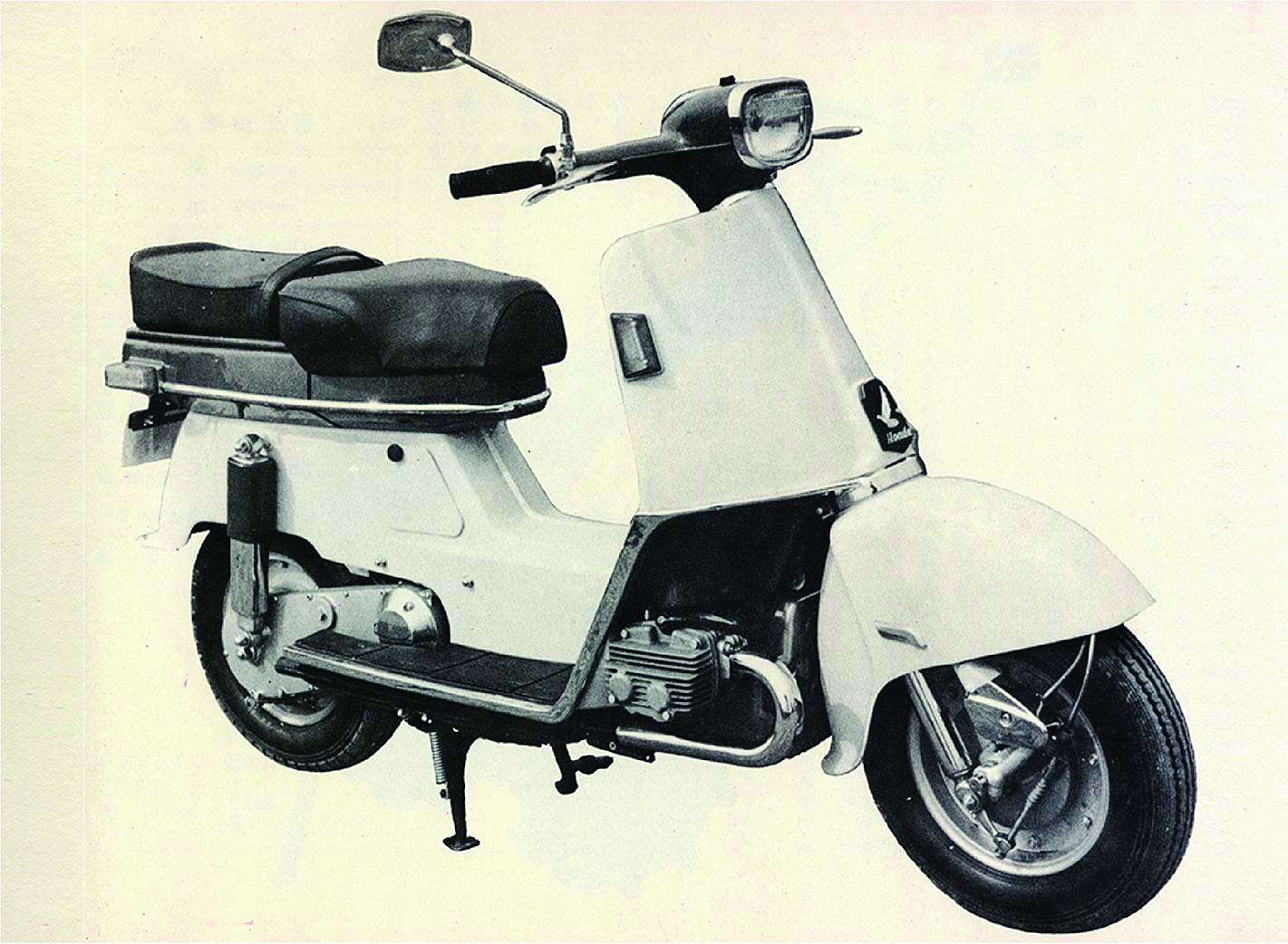
Honda actually produced its first automatic two-wheeler in 1961: the Juno M80 scooter, powered by an 11 horsepower, 124 cc horizontally opposed four-stroke twin mated to a Badalini automatic transmission. A Badalini transmission was a hydraulic-
mechanical transmission with infinitely variable ratios, developed in the mid-1950s Italy by Giovanni Badalini and patented in 1957. Honda improved Badalini’s design for use in the M80, and later in the 170-cc M85 scooter, but it sapped too much power, was prone to leak, and high patent fees eventually lead Honda to abandon it in 1964. The company later developed a torque-converter automatic for its cars and then adapted the technology to its mid-’70s automatic CB models.
Moto Guzzi actually produced the first modern automatic motorcycle, beating Honda by a year with the V1000 Convert. It used a two-speed transmission with a Sachs torque converter, though it also had a lever-operated multi-plate clutch. The clutch was used when starting the bike and when shifting between Low and Drive, but otherwise, a rider could launch and stop the bike without touching the clutch lever. The owner’s manual stipulated that Low was for “town or mountain riding” and that Drive was for “country or highway riding.” Guzzi produced the V1000 Convert from 1975 to 1982.
Other automatics throughout the years included the 1982 Suzuki GS450GA Suzukimatic (yes, Suzuki copied Honda by adding -matic to its name). It also had a two-speed torque-converter transmission, but it failed to sell any better than the Hondas and was produced for only two years. It was the last mainstream automatic motorcycle to hit the market until 2006, when Yamaha introduced the FJR1300AE, which featured Yamaha Chip Control Shift (YCC-S) that incorporated a manual five-speed gearbox with a computer-controlled clutch. This allowed fully automatic operation, or clutchless semi-automatic gear changes via a foot lever or by buttons on the left-hand switch assembly. Yamaha discontinued the automatic FJR1300AE in 2010, though the manual variation is still available today.
The Aprilia Mana 850 was introduced in Canada in 2009, powered by an 839-cc V-twin mated to a CVT. To make the ride more engaging it had a manual-shift mode, which locked the CVT in one of seven preset ratios until the rider initiated the next gear change via a foot shifter.
Many consider the 1910 Zenith Gradua, which used a CVT, to be the first automatic motorcycle in an era when motorcycles either had a direct drive or a lever-tensioned belt to disengage the engine, and either one or two speeds. However, the Zenith wasn’t really an automatic; the rider had to pull on a lever to change gear ratios.
Enter 2026, and there’s an abundant choice of automatic-shifting motorcycles. BMW’s latest R1300 models, Kawasaki’s Ninja 7 and Z7 hybrids, and Yamaha’s Tracer 9 Y-AMT all have computer-controlled clutches, much like the FJR1300AE of 2006. KTM is anticipating the release of at least one auto-clutch model this year. Honda’s automatics, on the other hand, utilize a DCT, which is more complex, heavier and more expensive to produce than an automated manual, but provides nearly seamless automatic gear changes.
While there may still be some stigma attached to automatics (“I can shift my own bike, thank you…”), the selection of clutch-free bikes is growing. And it looks like this time they’re here to stay.


Recounting the wisdom earned from the ups and downs of life on the road.
Before I understood what life on the road could offer, my first big ride was all about indulging in the pull of vast landscapes and absorbing the sacred connection between rider and machine. That still applies. But ride far enough — through a diversity of countries, climates, and chaos — and the road changes you. Not with one grand flourish, but slowly and almost imperceptibly. More than a journey, the road became a teacher, revealing that the real terrain I was crossing was internal — charted not on the Garmin but in the gradual surfacing of self-belief, blind spots, and the person I was becoming all along.
THE MILES BETWEEN THE MILESTONES
Somewhere along that long, winding route, it stopped being just my story as a new rider. My partner, Jason, and I have clocked more than 148,000 kilometres together, crossing continents and reshaping our lives around the rhythm of two wheels. What began as a bold, border-busting ride evolved into something extraordinary. Swapping wardrobes for weathered layers and a curated kit packed into two panniers and a roll bag, we gained something less tangible but far more lasting: a raw kind of presence.
Those early months through the Americas were an exhilarating blur. Braaping our way from the bottom of the planet to the top, we chased natural marvels and border crossings like lucky charms. Eventually, the novelty wore thin. What remained — the stillness between places, the unremarkable days on the blacktop, the coffee brewed on a beer-can stove at the edge of nowhere — became part of the experience. The rituals grounded us. The laughter over misadventures in the dirt bonded us. And the repetition instilled resilience.
With little Wi-Fi or routine back then, the open road became our mentor — sometimes stern, sometimes generous, but always clear. It demanded patience, offered humility, and often rewarded us with salt-of-the-earth souls or horizons so breathtaking they stopped conversation mid-sentence.
WEATHERING THE RELATIONSHIP RIDE
Sharing a life of moto-travel with someone — day in, day out — is its own adventure. Romance isn’t neatly packaged when you’re sharing a tent in the pouring rain after 12 hours in the saddle. I used to think the hardest parts would be mechanical — like a cracked subframe in Bolivia or a failed stator on Baja — but it’s the emotional ground that demands the most navigation. There’s no hiding on a cross-country jaunt. It’s just you, your partner, and the elements, on your steeds.
Arguments happened, naturally. A handlebar adventure offers no hushed place to stew. You have to bite your…

Longevity and handling, what more do you need?
You know a motojournalist likes something when he pays for it rather than trying to describe it as a “test” product. And if, for instance, said motoscribe bought the same tires no less than five times for his 2018 much-pampered Suzuki DL1000 XT, well then, that would be the ultimate proof of genuine admiration.
Now, truth be told, I pay for most of the accessories I test within these pages. That doesn’t alter the fact that I did buy five sets of Avon Trailriders in a row for my V-Strom. Blessed with decent longevity, excellent grip and — the main reason I loved them so — perfectly “linear” steering, never once, after having tested numerous other brands, have I opted for anything else.
Until Avon — recently acquired by Goodyear — decided the Trailrider was superfluous to its much-diminished lineup. Oh, they still, for some reason I can’t fathom, make the 50/50 Trekrider, but my 90/10 Trailriders are no more.
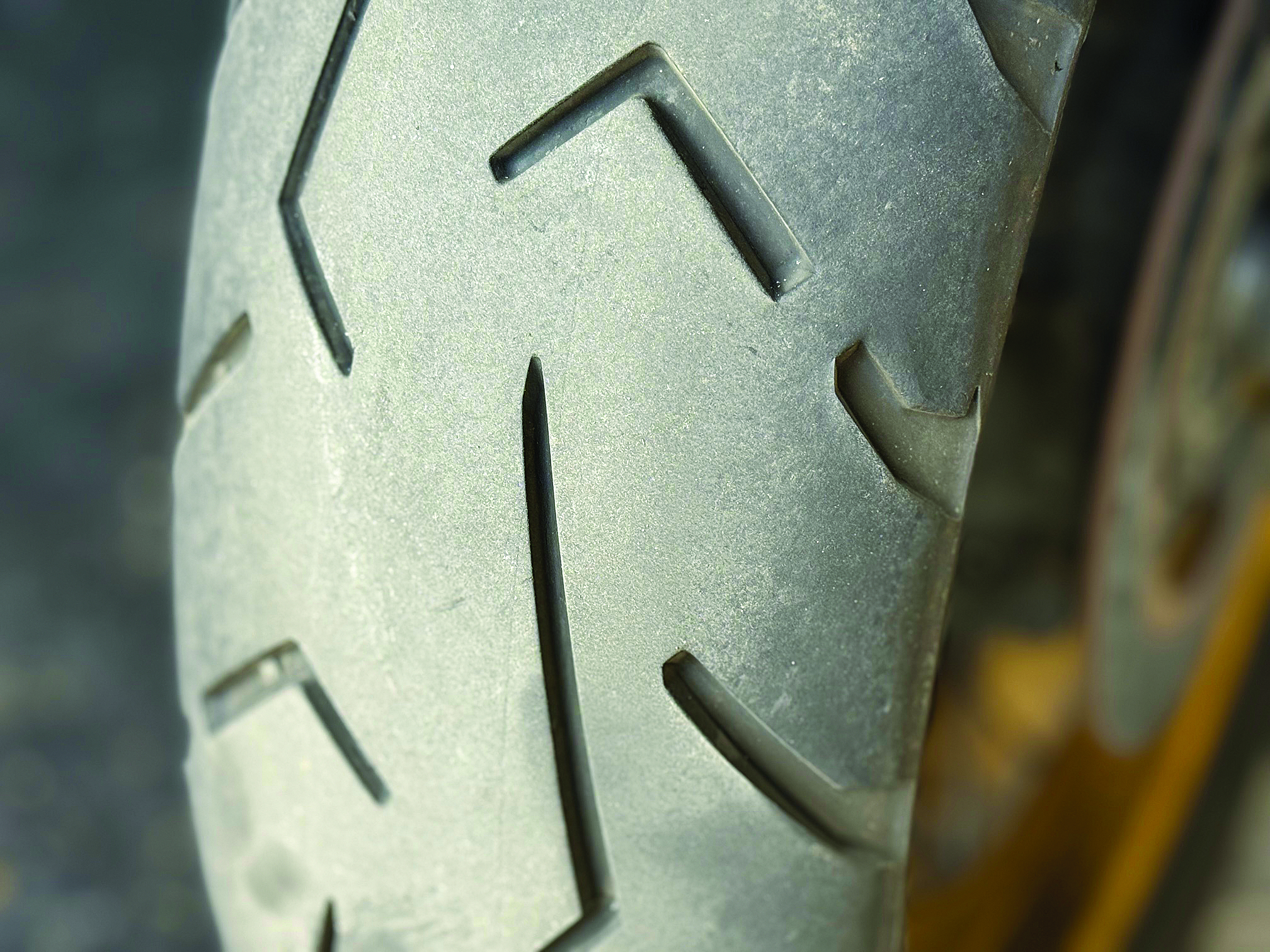
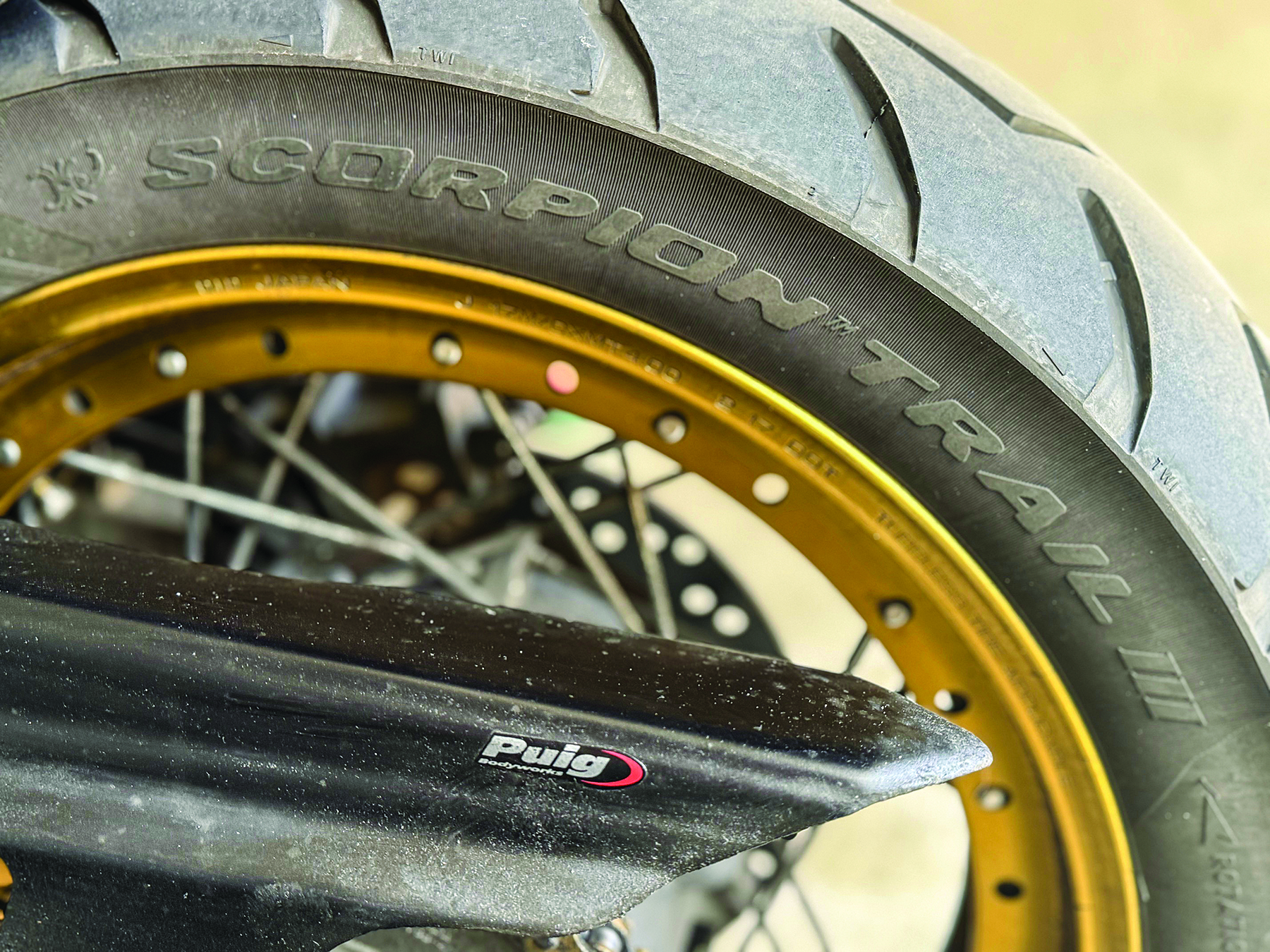
So, I’m looking for a replacement. The first candidate was Pirelli’s Scorpion Trail 3. They were chosen first because a) Pirelli has a great reputation for sporty tires and I do like to grind a footpeg; and b) because the reviews of the Scorpion 2s were almost universally positive.
After some 8,000 kilometres on the Trail 3s, I can see why. For one thing, the Pirellis may not steer quite as perfectly as the Avons I loved so, but they are pretty darned close. A little heavier on turn-in, my old Suzuki still dives to apexes with alacrity, surprising more than a few “real” sportbikes as I chase them or — okay, I’m bragging now — out-brake them into the Stelvio’s many tournantes. A+, then, on the whole precision-steering thing.
They are also surprisingly durable. I say surprisingly because, with a tread pattern so overly sportbike-like, I suspected they’d wear accordingly. The photos accompanying this article were taken at 8,000 kilometres and, as you can see with your own eyes, they’ve got lots of life left in them. I suspect that the rear might be capable of 14,000 or 15,000 klicks before needing replacement, a record for any tire on any of my V-Stroms (I’ve had three). The front, meanwhile, will probably suffer from terminal “cupping” before the tread runs out of depth.
The corollary of that durability, however, is that, despite Pirelli’s reputation and my previous experience with the company’s tires, they’re not quite as grippy as my much-missed Avons. Oh, for most riders, they will offer more than enough traction. Hell, for 98 per cent of riders, they’ll never put a wheel wrong.
But, on more than one occasion, either the front or the rear got a little looser than I find comfortable, usually when I was doing one of those passing-a-Panigale-in-a-hairpin manoeuvres. And, while I may be stupid enough to still pursue such silliness, I — now some 50 years into this motorcycling thing — am no longer brave enough to continue said silliness when the tires cry that they’ve had enough. And, just to clarify, unlike so many other reviews of tires that make comparisons on different roads and varying conditions, my experiences are the result of testing on the same roads, at the same speeds, and largely in the same conditions. In other words, the comparisons are valid and repeatable.
That said, the new Scorpions do offer decent traction in the wet. I didn’t try any lean-angle heroics on wet roads, but I did do some ABS-triggering stops and the Pirellis really dug in despite the dampness. And when it’s raining, I suspect that being able to stop in an emergency situation is a lot more important than grinding footpegs. Come to think of it, that probably should be true on dry roads as well.
Overall, the new Scorpions Trail 3s offer excellent durability, precise steering and prodigious wet-weather grip. Their sole compromise is grip that, on dry tarmac, is merely good. I do not think that that last point should discourage anyone from buying a set. Unless you really do spend your summers trying to grind once-pristine Gilles footpegs into dust, these Pirellis really do perform well and offer surprising, if not segment-leading, durability. They are available in virtually all adventure touring sizes, including 21-inch fronts that will fit the likes of Africa Twins, various KTMs and Yamaha’s Tenere 700. A 150/70R17 that fit my 2018 V-Strom 1000 XT costs $251.99 while the front 110/80R19 front sells for $212.99.
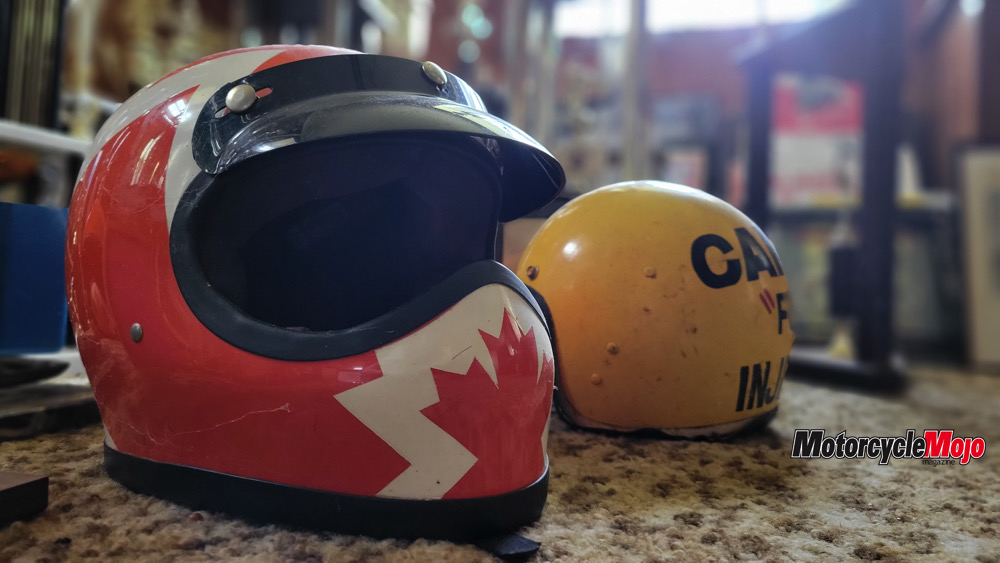
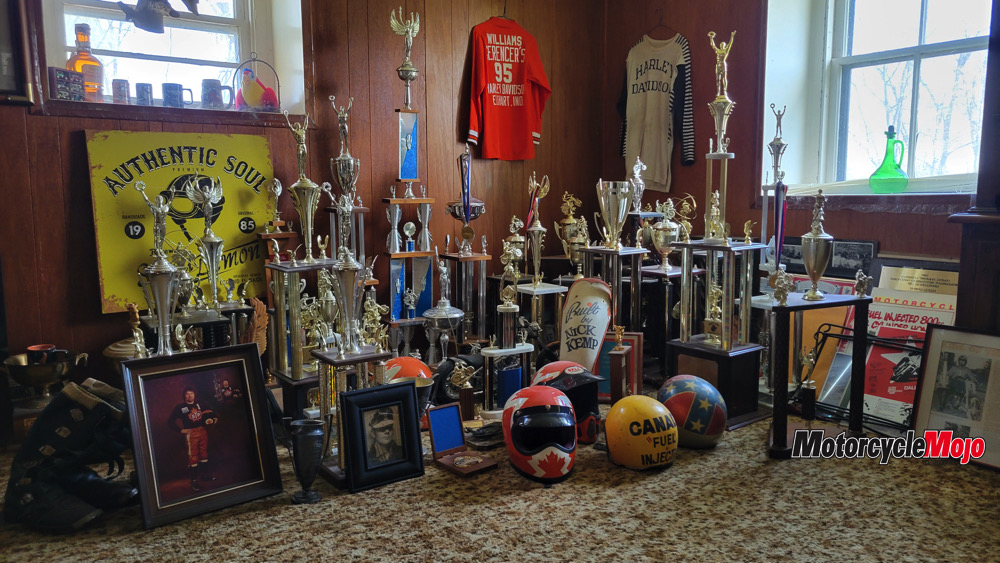

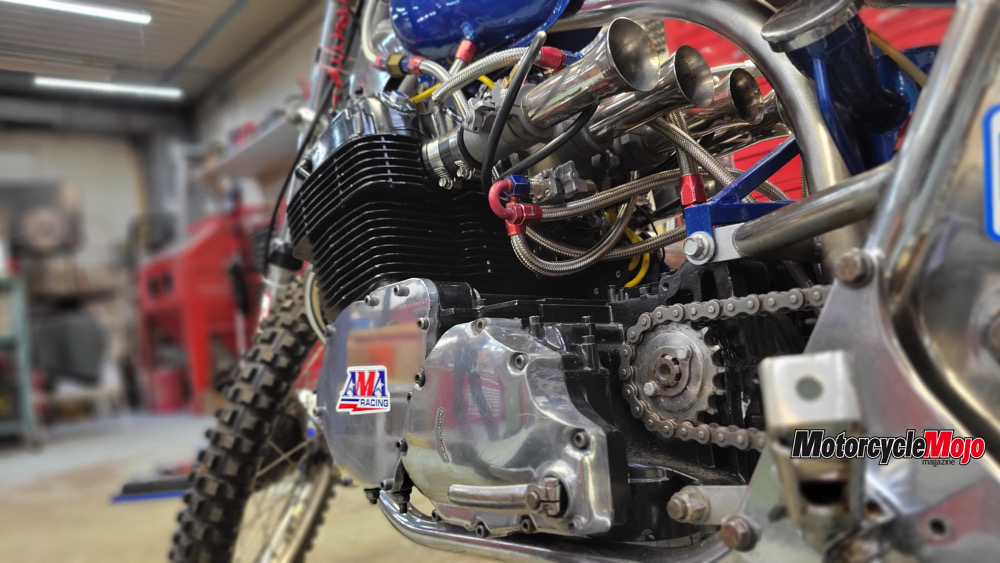
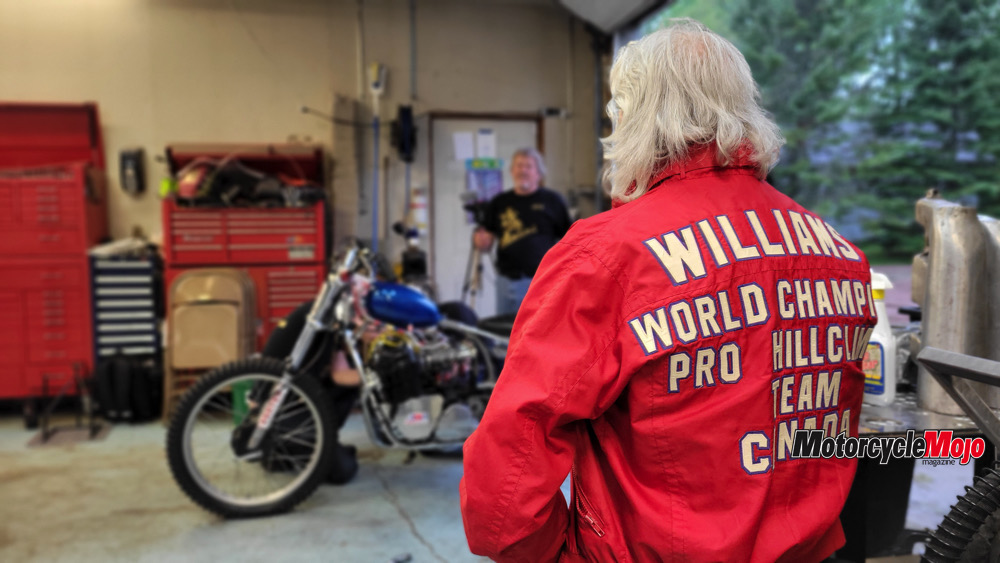


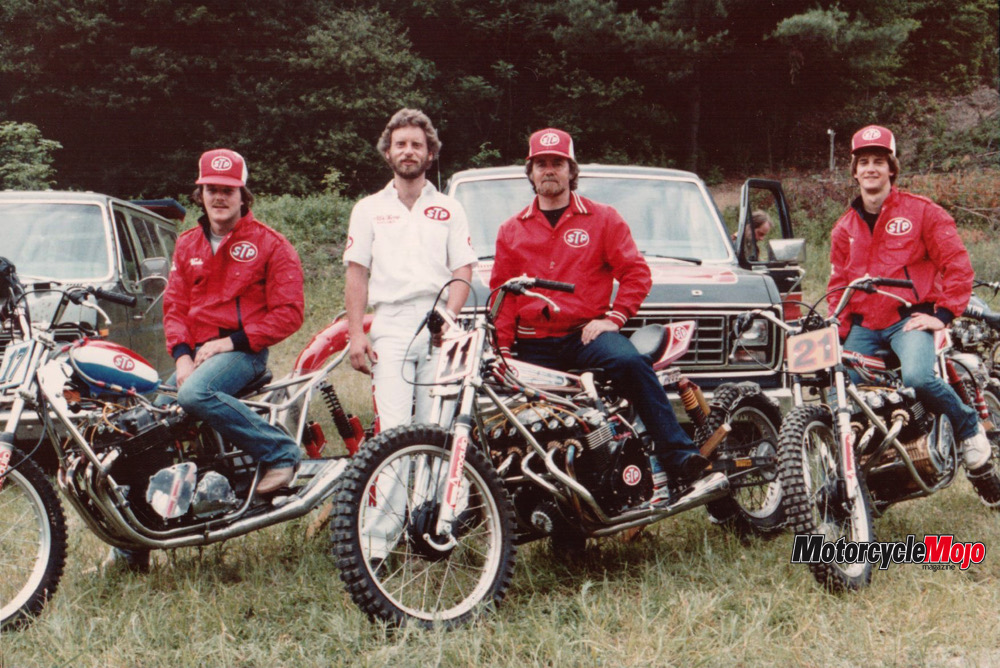
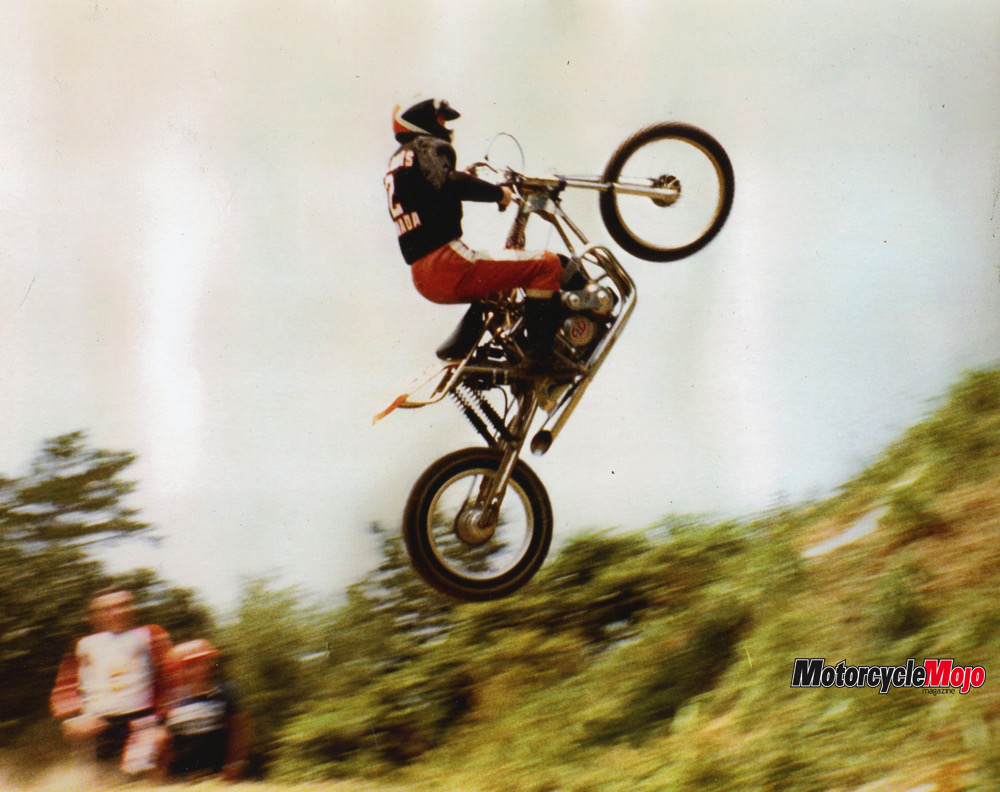
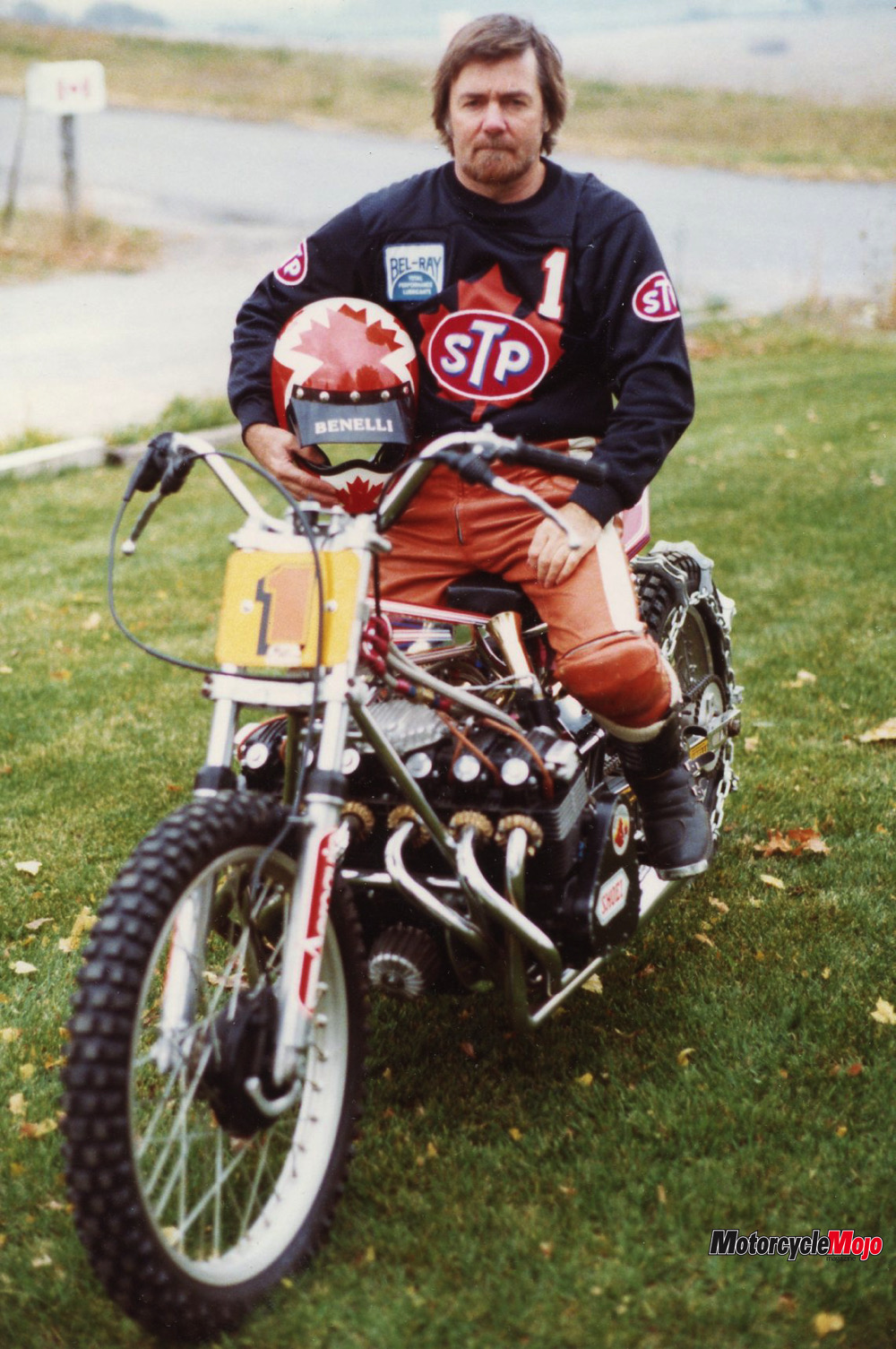
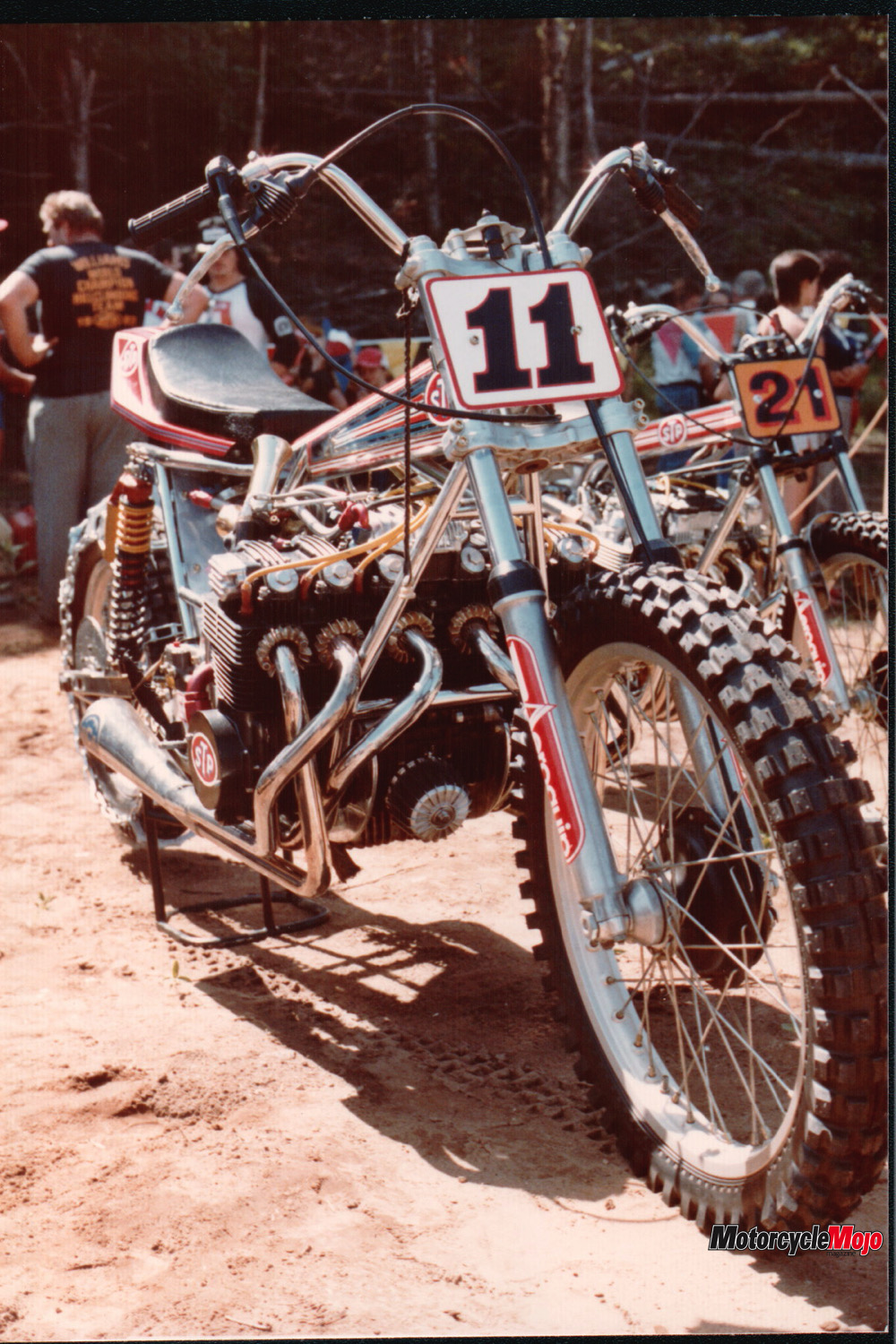
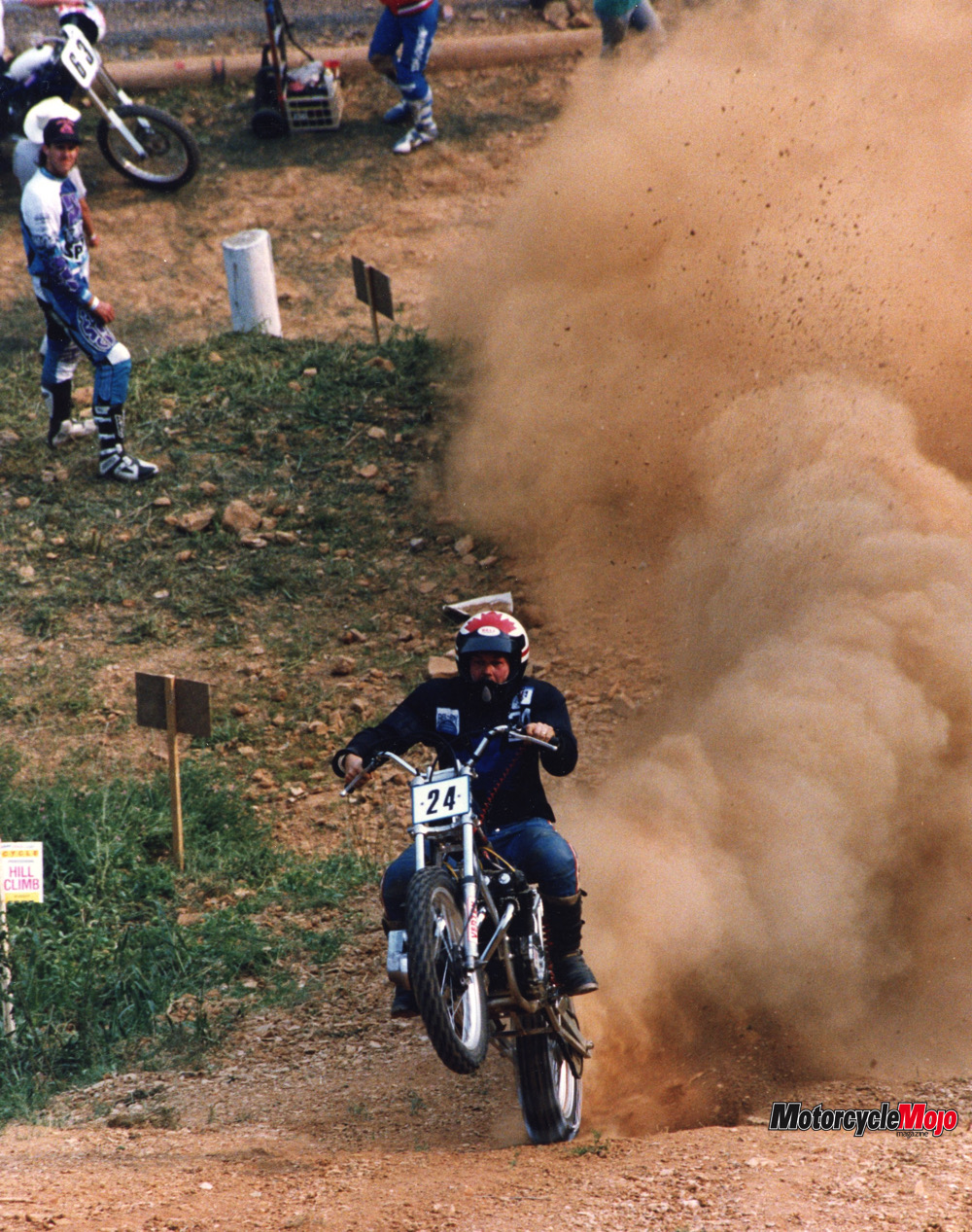
A film that documents the Williams family and how these champion hillclimbers changed the face of this most brutal sport.
Never would I think that a simple YouTube video would grow into an entirely new chapter for a once-retired race team. Here, director and producer Peter Goertz describes the making of the film Nitro – The Williams Dynasty.
As an amateur filmmaker behind the YouTube channel Pete’s Classic Cycle, I found myself looking for my next story. A friend, Jim Breslin, suggested I talked to John Williams, the world-famous hillclimber. Being unfamiliar with both John and the sport of hillclimbing, I was reluctant, but Jim persisted and made arrangements for an introduction. After an hour-long phone call, I knew there was something there. Not only is the story incredible but John himself is a true showman — a winning combination. It was also during this call that John mentioned, “You can’t talk to me without also talking to my two boys, Wade and Greg, along with mechanic Nick Kemp”, and with that very sentence my fate was sealed.
A STORIED RACE TEAM
For those of you unaware — like I was — John and the STP Williams Team are the most successful team in all Canadian motorsport history. With a combined total of nine world championships, 17 National Championships and 40 State Championships, the STP Williams Team were a force that, for more than 30 years, dominated the brutal sport of professional nitro hillclimbing.
Did I also forget to mention that all four members have been individually inducted into the Canadian Motorcycle Hall of Fame — another first. This doesn’t include John’s other induction into the Canadian Motorsport Hall of Fame either. The Williams Team not only conquered every summit but revolutionized the sport with their innovations in technology, safety, and professionalism ushering hillclimbing into the modern era.
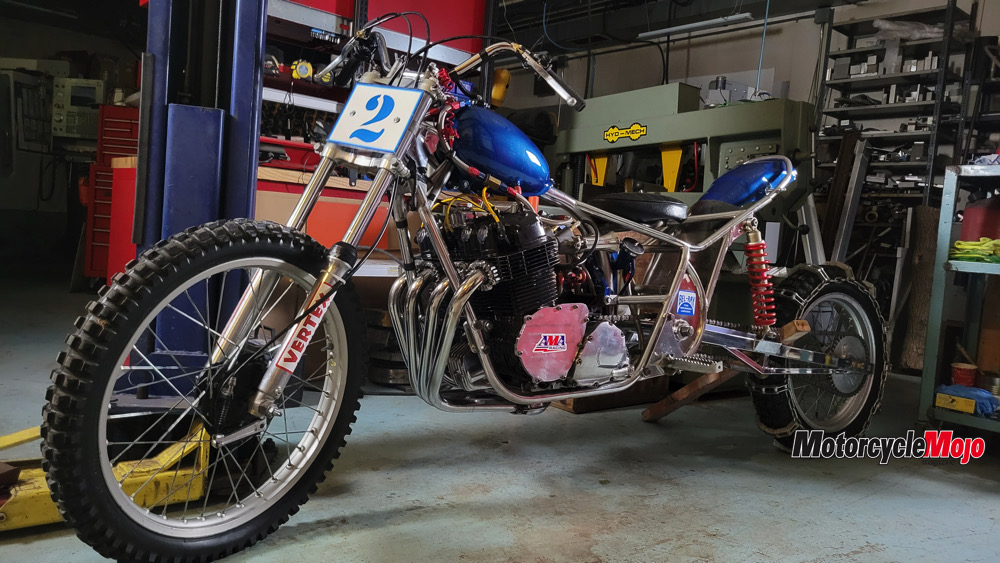
The plan of attack was to split the filming into two days. Day 1 would be at the Williams family home and Day 2 would be at Nick Kemp’s shop where we would also attempt to start one of the team’s world-famous 300 horsepower Nitro Hondas.
MEETING THE TEAM
Arriving at John’s house was very surreal. Nestled in the middle of a provincial park, his original country farm has been preserved in time from the expanding suburbs of Markham, Ont. His home is an homage to his decades-long career as a professional hillclimber. Each room is filled with photos and memorabilia showcasing his family’s many successes, not to mention the endless number of trophies.
Soon after my arrival, John’s two sons, Wade and Greg, along with team mechanic Nick Kemp arrived, each of them in their original Team STP Williams shirts. To say I was intimidated would be an understatement. Here is a world-champion team, trusting someone they have never met to tell their story — talk about a heavy sense of responsibility. I mustered up any remaining courage and got to work.
Once the camera started rolling, the stories that came from John and the team were fascinating. One after another, each better than the next. Seeing them start to relive these experiences through the stories was truly amazing, and only second to what happened next at Nick’s garage.
300 HORSEPOWER
THUNDERS TO LIFE
Hearing the stories was one thing, but watching them unfold before my eyes was another. This happened while they worked together to start Wade’s 800 cc Nitro Honda. Like a well-
rehearsed dance, each member fell back into their role with the dangerous start-up procedure. Suddenly, I was witnessing living history.
We may have been in Nick’s garage, but it might as well have been a world-championship race. I knew I was witnessing something that hasn’t been seen since the team retired some 30-plus years ago. This was a privilege I did not take lightly. After a few ignition timing adjustments, the 300 hp machine quite literally roared to life. The sound was so loud and intense I felt it with every fibre in my body. After a few hair-raising moments, the ignition was cut, followed by an emotional release of energy from everyone in the room with hugs, cheers and tears. We all knew how special this moment was.
FADING AWAY WASN’T AN OPTION
After all the filming was finished, the more I researched the team, the more I saw how much larger this story really was. Not only did they revolutionize hillclimbing but, as mentioned earlier, they are also the most successful team in all of Canadian motorsport history. Yet most people have never heard of them.
As a Canadian, I was very proud to learn about this, but it also saddened me at the same time. With their race careers predating the internet, this history was quickly fading away with time. I knew I had to do my very best to represent the team by giving them a platform to tell their story and secure their legacy through this film.
The process of putting the film together was quite tedious. The first order of business was to organize the 3.5 hours of interviews into one cohesive story. From there was the hardest part: deciding what clips to cut. For that, it really came down to only keeping the stories that had significance to either the genesis of their career, impact on the sport, or a specific challenge that was overcome.
Last and not least was sorting through hours of archived race footage and organizing every clip according to year, race and team member. I then tied it all together with a couple hundred hours of editing and, voila, Nitro – The Williams Dynasty was born. Little did I know that this was only the beginning.
ROCK STARS OF THE HILLCLIMB CROWD
Later that year, the U.S. Hillclimb Championships at the famed “Devil’s Staircase” in Oregonia, OH, took place. Brandon Kreeger from The Nitro and Mud Hillclimb Podcast pulled some strings and convinced the promoter to feature the film during the event. There was no better venue or audience to debut the film to than the entire hillclimb community at the biggest race of the year.
Walking into the historic race grounds with the Williams Team can only be compared to arriving at a concert with your favourite rock band. Right away, they were swarmed by old friends and race fans. Like my time in Nick’s garage, stepping back and watching the team in their natural habitat was amazing. The film was now coming to life before my eyes. John was on his A-game, sharing stories and laughter the entire day, and walking through the pits making sure to meet every single rider.
IT’S SHOW TIME
As the sun fell behind the Ohio hills, it was the moment that two years and countless hours of work all came down to. It was all I could do to hold my composure as I stood at the back of the crowd in suspense. This was the very first time that any of the team had seen the film, their story trusted to a stranger to be told on the big screen.
Those 90 minutes seemed like an eternity, listening for various cues from the audience to see if they were engaged. Would they laugh at John’s joke or gasp at Greg’s big crash? At last, the credits rolled, accompanied by a loud applause. I could finally breathe again, knowing that not only was the film well-received from the hillclimb community, but more importantly, I now had the stamp of approval and blessing from the Williams Team.
Returning to Canada, we had three initial premieres planned in Keswick, Stratford and Port Colborne, Ont. As word spread, three shows quickly turned into four which quickly turned into seven individual screenings over a period of five months. Each time, the entire Williams Team came out to support in full STP gear, taking the time to meet and talk to all of their fans.
As I heard stories from the audience at the various premieres, it really put into perspective how impactful the Williams Team was. Not only for the sport of hillclimbing but also as great ambassadors for Canada. A quote I heard more than once was “You knew that when the Canadians arrived, it was going to be a race.” This was something that the entire team recognized, and they did their very best to represent the values that we Canadians hold dearly on the world stage.
Another phrase that kept coming up was “reliving the past.” For me, that’s a saying that indicates you are finished, stuck in a mental purgatory trying to hang onto a distant memory. Although the Williams Team may not have summited a hill for three decades, this was not a way for them to relive the past. I believe it is the start of a new chapter, ushering in the next generation of fans.
I would like to thank The Williams Team for welcoming me into their homes and allowing me to be a small part in their continued story.
If you too would like to become a part of this story and help preserve this amazing Canadian history, Nitro – The Williams Dynasty is now available for free on YouTube for the world to see.
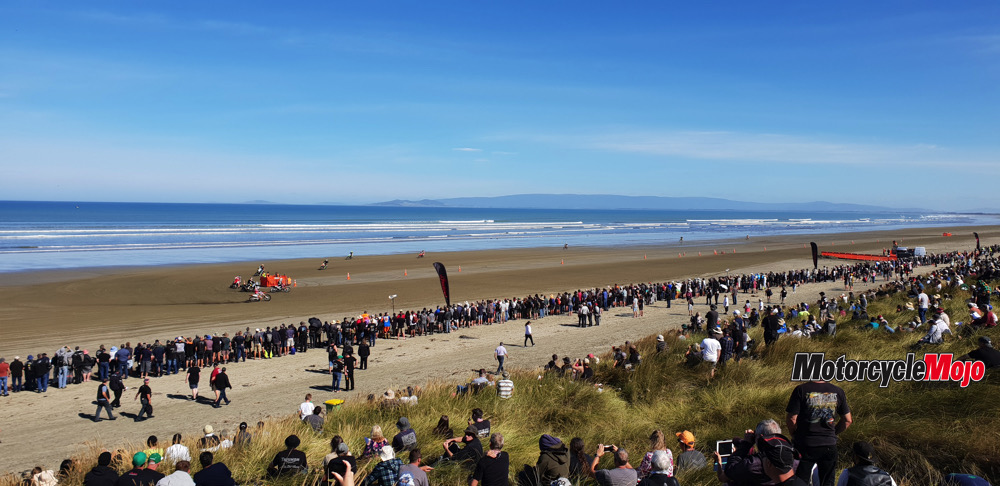
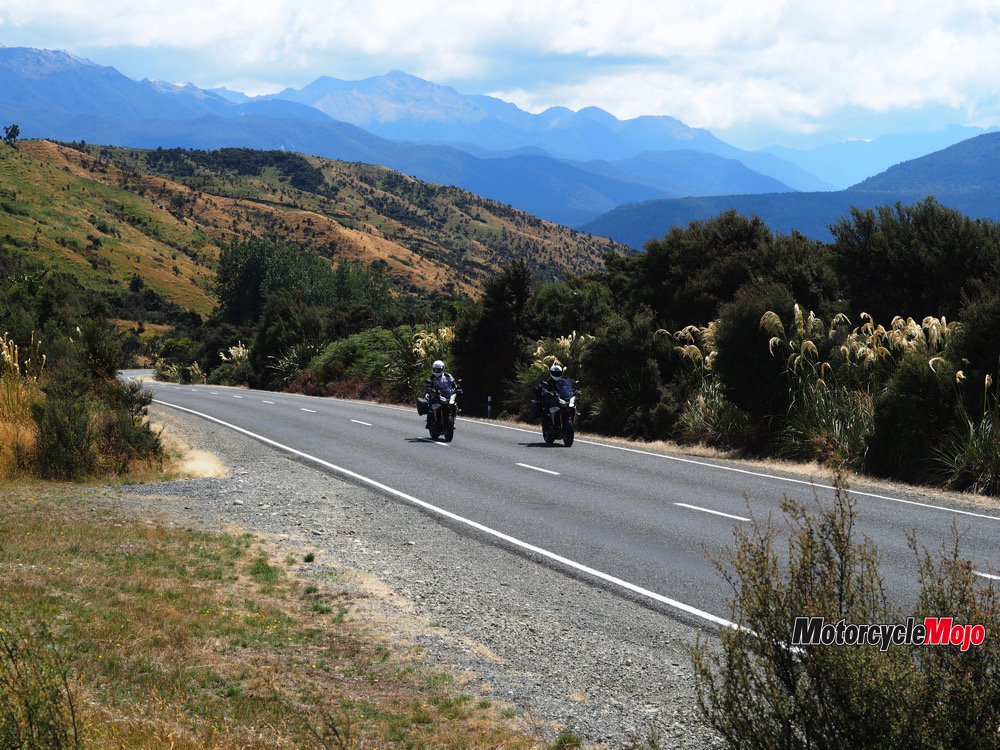
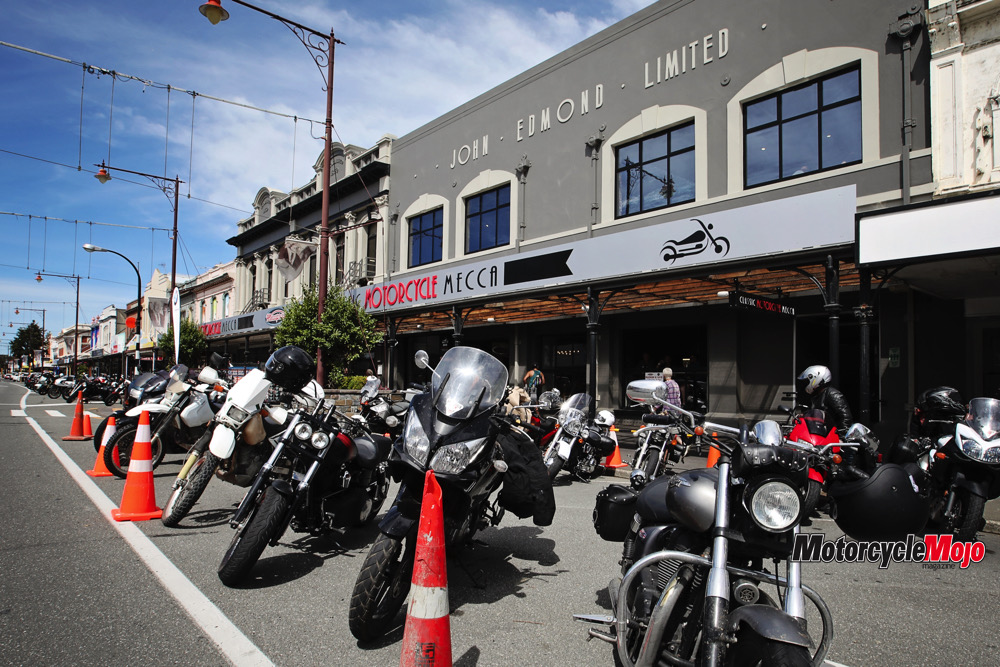



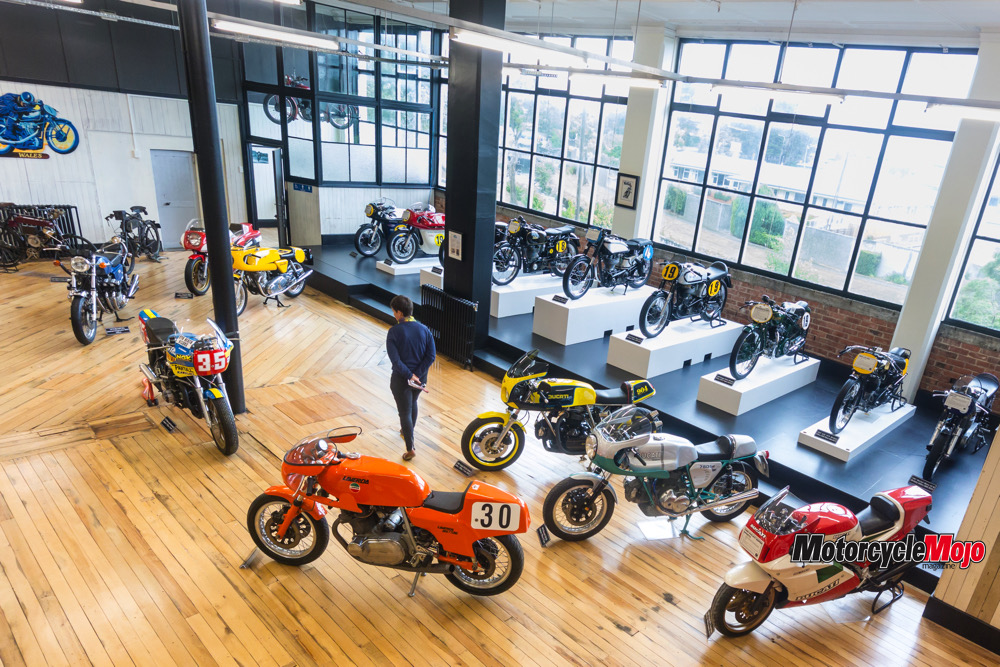
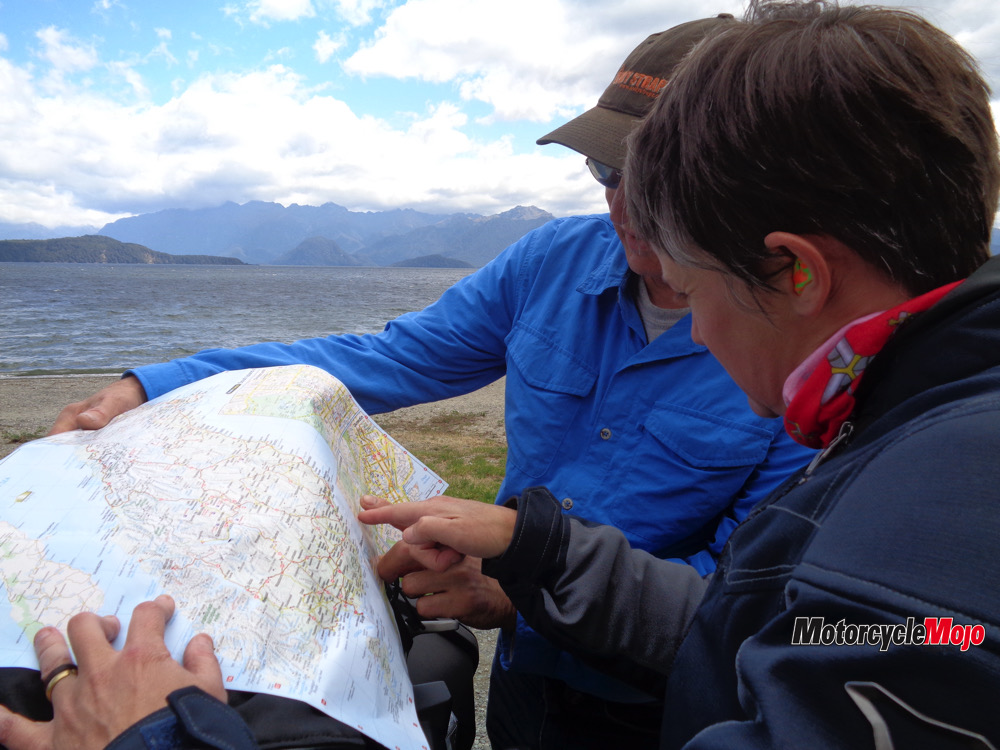
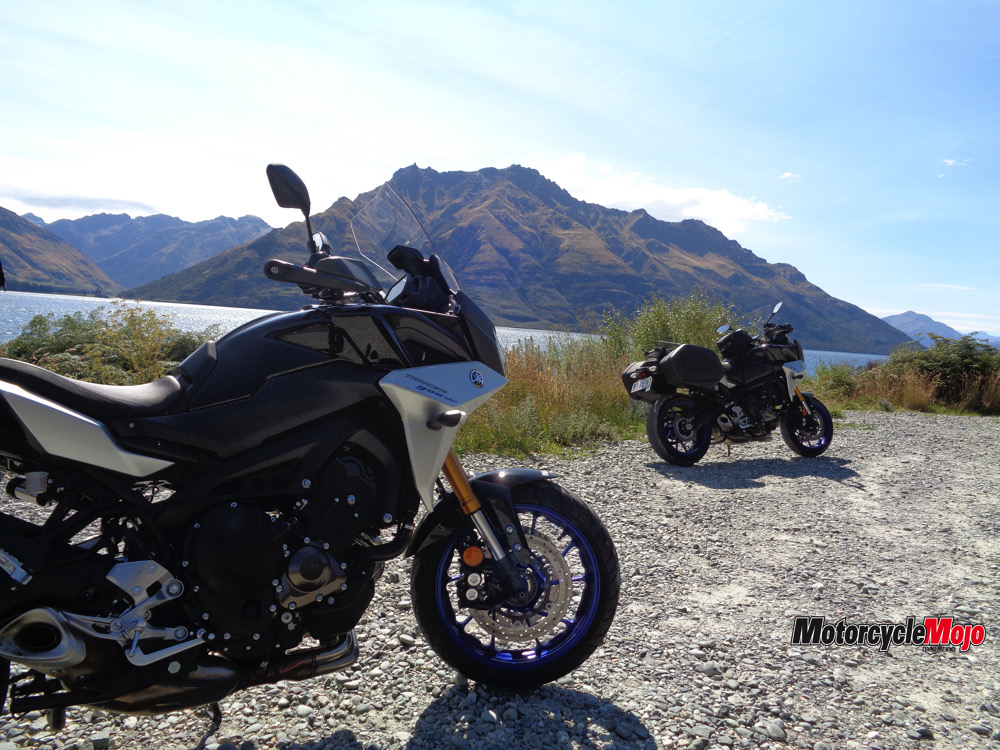
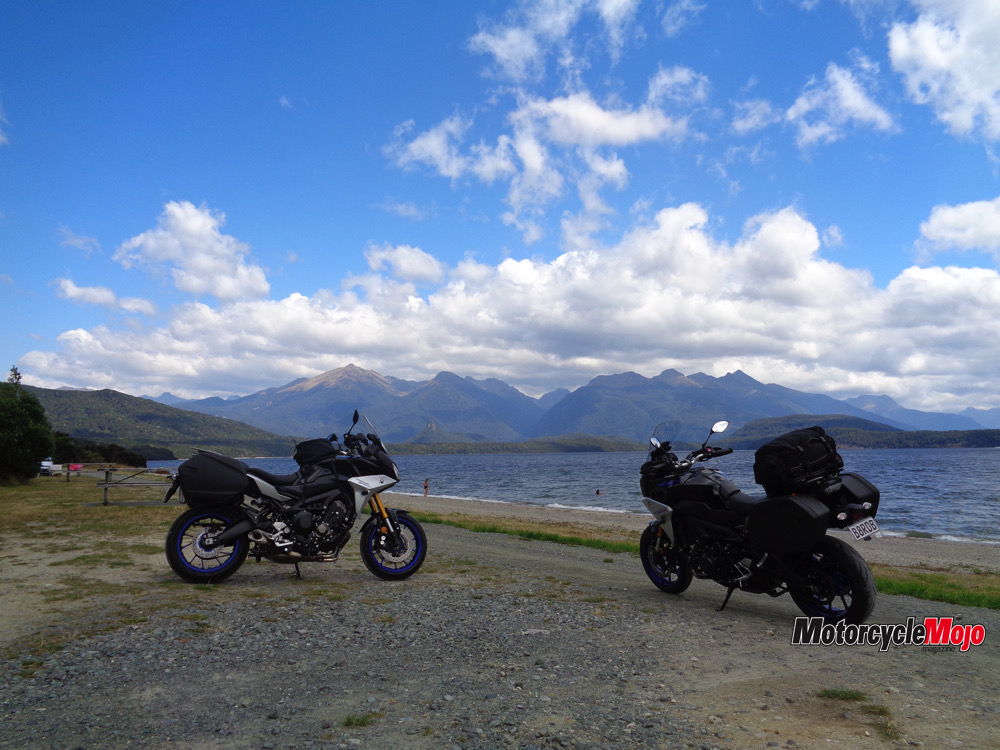
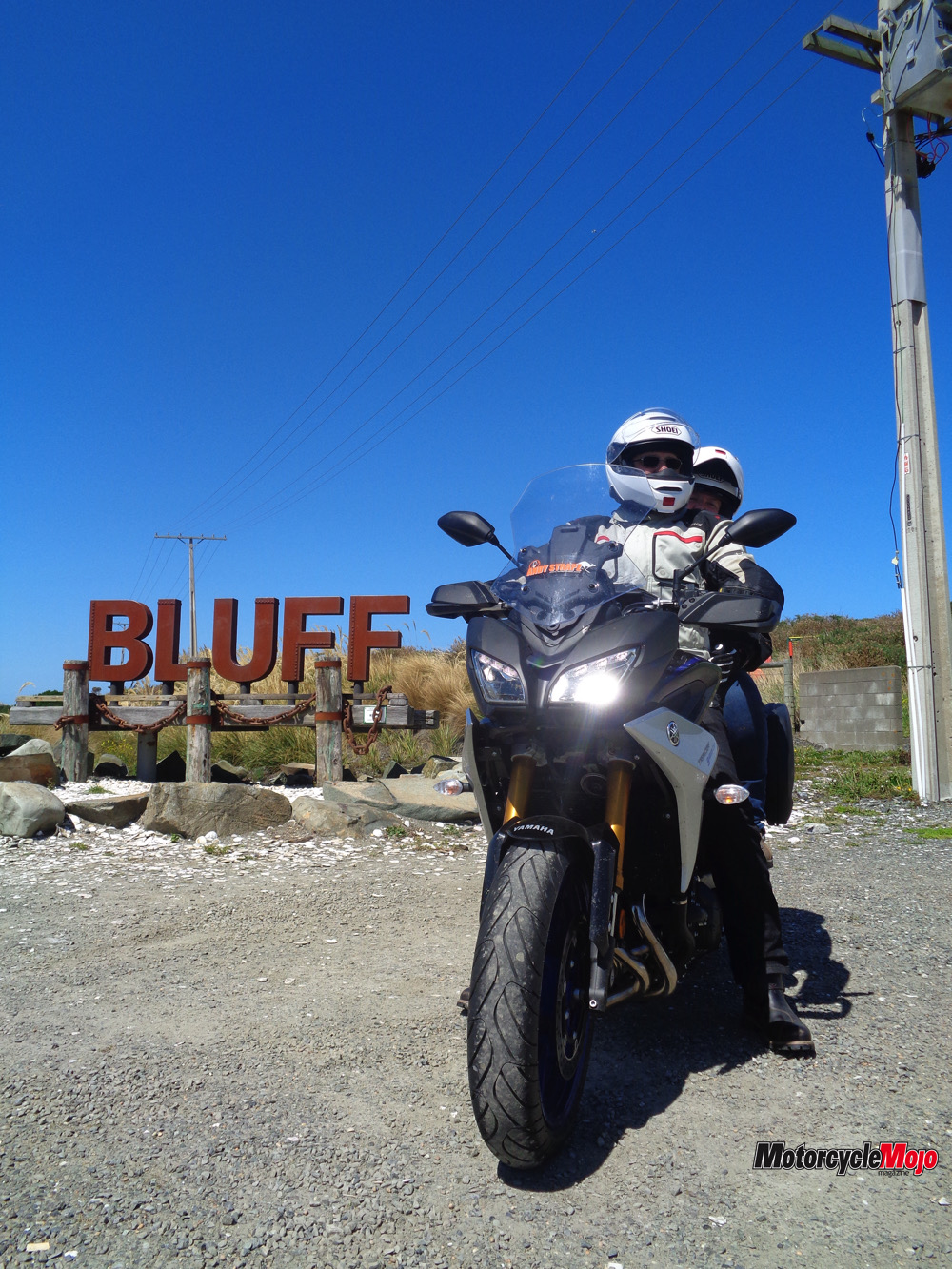
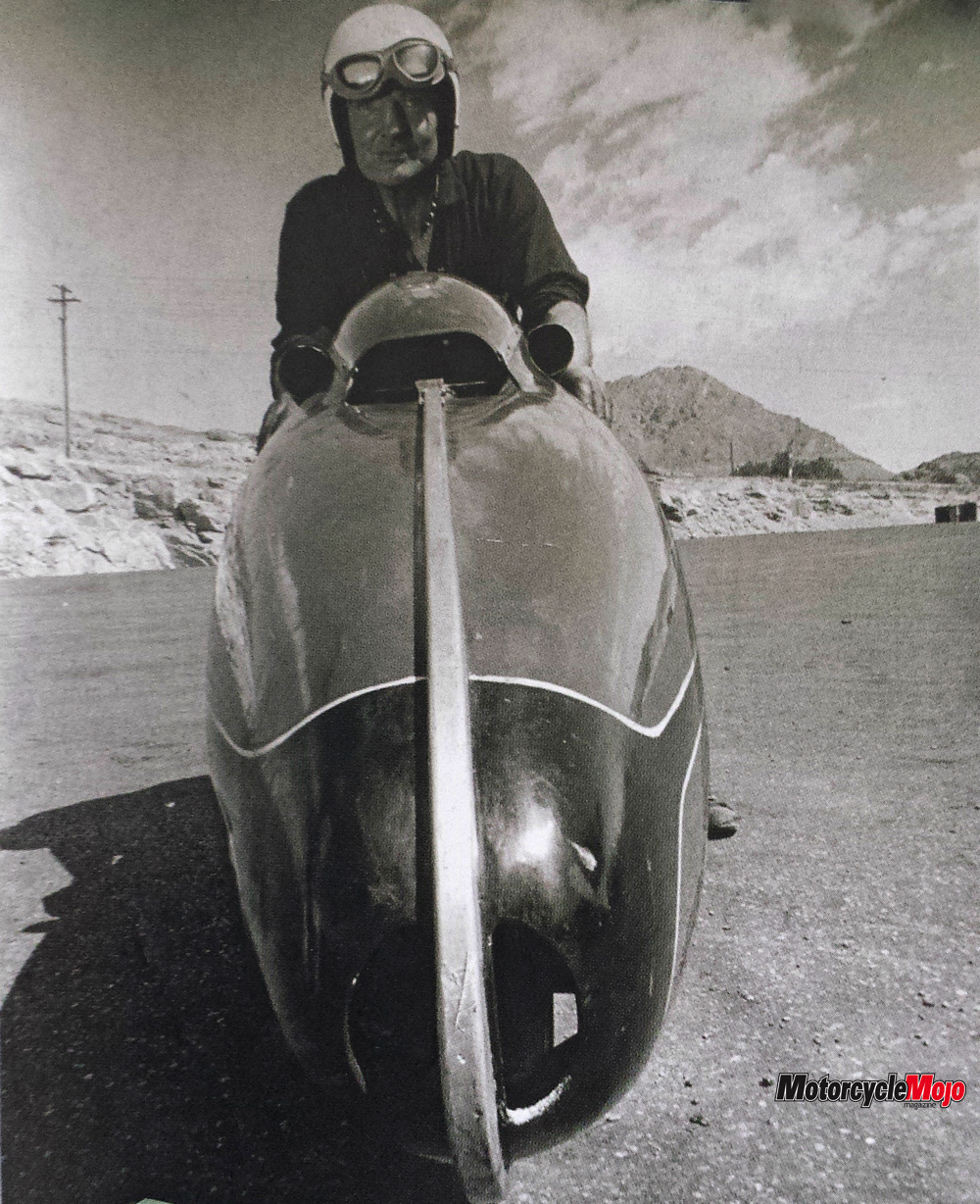
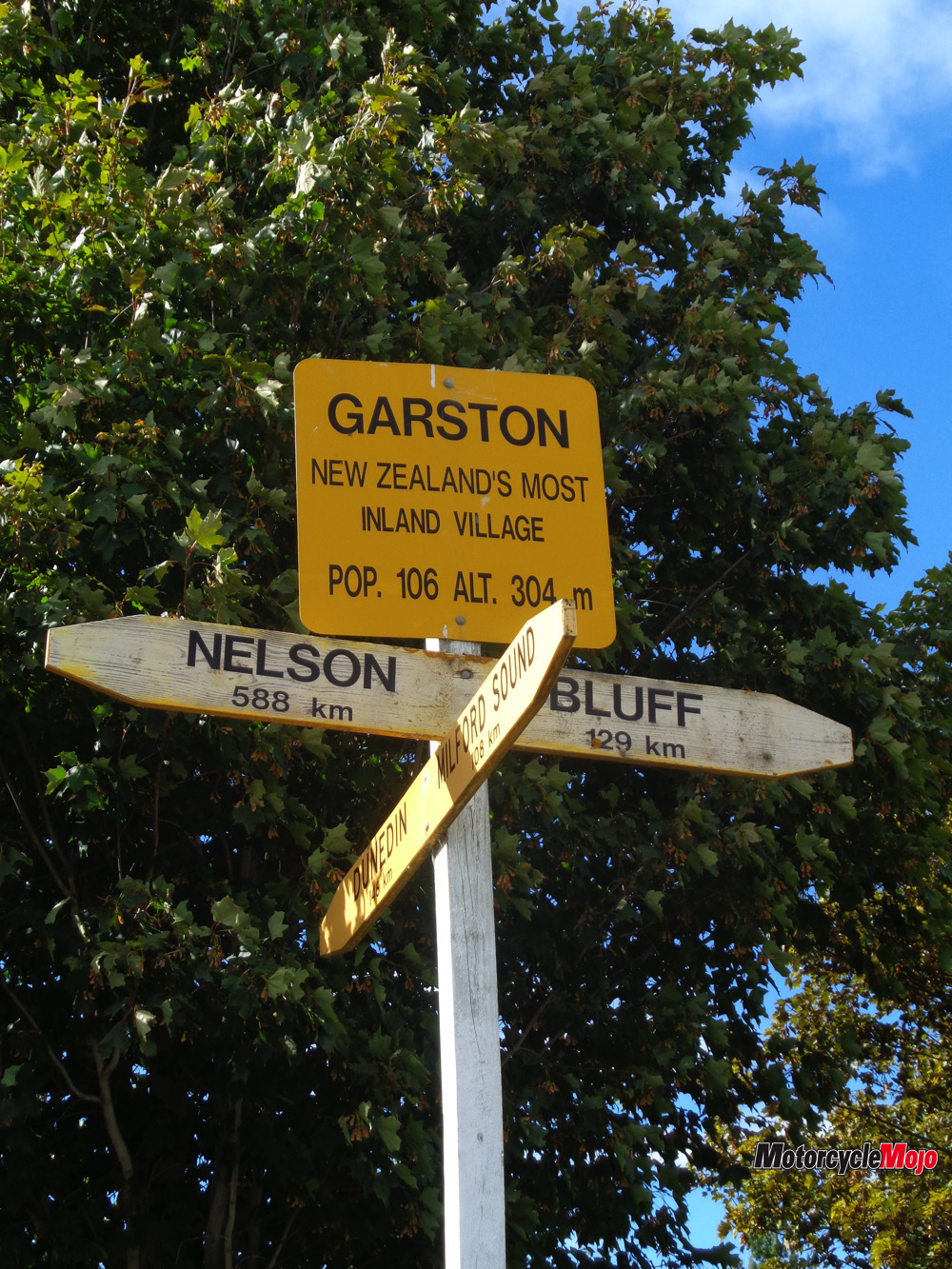
Remote, rugged and breathtakingly beautiful. New Zealand’s South Island on two wheels is a must-do for any intrepid motorcycle fan.
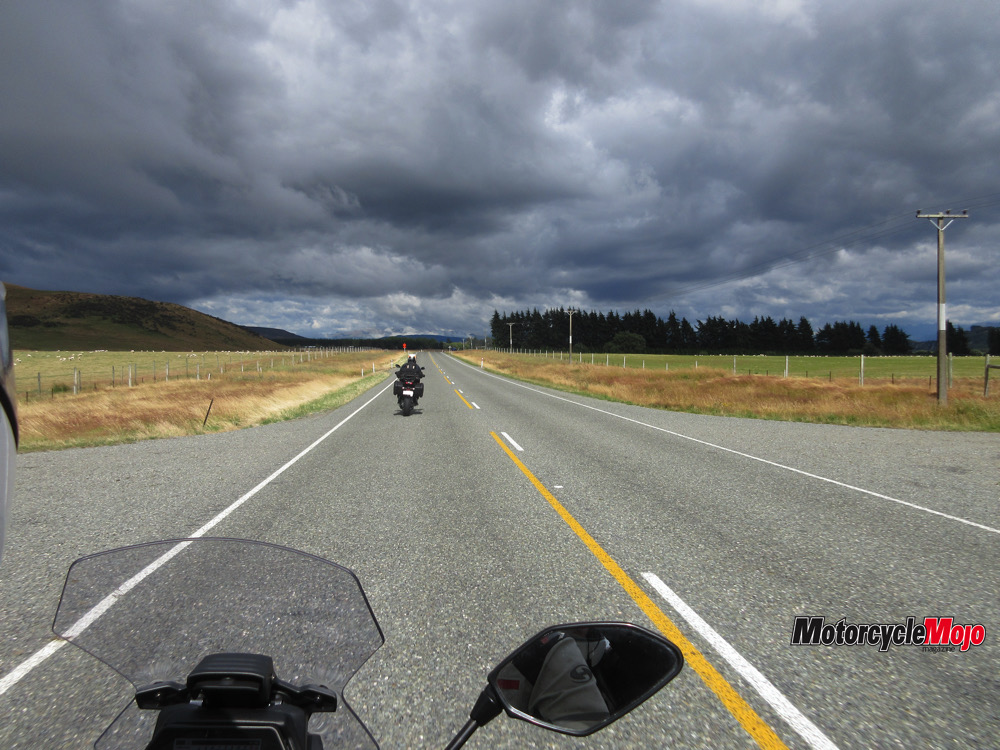
I’ve ridden in some wild winds before, but nothing like this. I’d just swung around the bottom western edge of New Zealand’s South Island and was met with a savage squall thrown at me by a ferocious Southern Ocean.
It was wind so fierce that slow and steady wasn’t even an option. Against my instincts, I eventually worked out that riding a smidgen over 100 km/h and getting tucked as low as I could get behind the windscreen was the best way to remain upright and with the most control amid such strong and gusty winds. I was grateful for the Southland region’s remoteness as wind blasts forced me onto the wrong side of the road.
New Zealand’s South Island is a bucket-list destination for motorcyclists worldwide, offering a mix of breathtaking landscapes, world-class riding and a deep sense of adventure. From alpine passes to remote coastal back roads, the South Island is a rider’s playground, where every twist and turn delivers postcard-perfect views.
For those yet to experience it, touring here is an eye-opener. Weather patterns are unpredictable, distances can be deceptive, and the remoteness in some areas demands your utmost respect. But for those who come prepared, it’s as close to motorcycling nirvana as you can get.
QUEENSTOWN TO THE WEST COAST
Most international visitors start their journey in Queenstown. Known as the adventure capital of the world, the town itself is swamped with tourists, but it’s not hard to escape them. Within minutes of leaving, the road south-east along Lake Wakatipu is a taste of what’s to come. The lake’s blue waters mirror the sky, while jagged peaks rise from the shoreline. Tourist campervans can slow things down occasionally, but there’s no need to rush — this really is scenery to savour.
A must-ride from here is the route over Haast Pass. The journey west snakes through valleys and climbs into thick rainforest before spilling out onto the West Coast, where the Tasman Sea crashes against the land. This road can be challenging, especially when wet, but it’s a gripping ride. Just be prepared for sudden changes in weather, and don’t push your luck — it’s too early in proceedings to make any silly errors.
THE SOUTHERN SCENIC ROUTE
Further south, the Southern Scenic Route offers one of the most satisfying stretches of riding in the country. Running between Queenstown and Dunedin via Invercargill, this 610 km route is a feast for the senses…
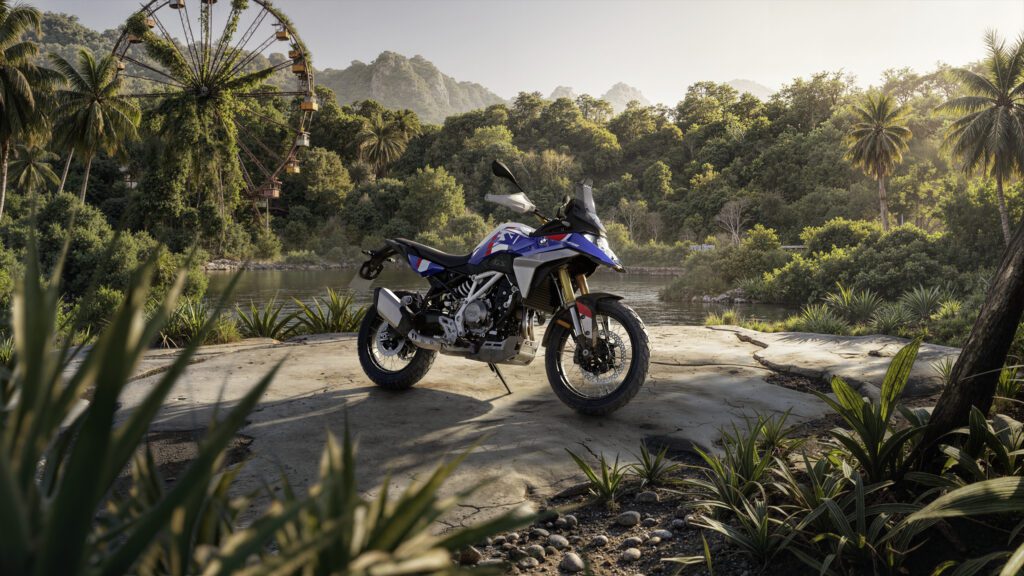
BMW Motorrad has added to the GS lineup with the release of the F 450 GS.
BMW claims this will be a versatile machine, combining usability, dynamic handling, touring comfort, and off-road capabilities. The F450 GS features a newly developed two-cylinder in-line fuel-injected engine, delivering a power output of 48 hp at 8,750 rpm and a maximum torque of 32 lb-ft at 6,750 rpm. The new engine is touted as one of the most compact and powerful builds in the segment. Additionally, it meets EU5+ requirements and consumes only 3.8 litres per 100 km. On the 14-litre tank it’s estimated that the rider will achieve a 350 km range and weighs in at 178 kg.
The F450 GS will include the BMW Easy Ride Clutch (ERC), this system eliminates for the rider to manually operate the clutch while riding, this option will only be included on the F450 GS Trophy variant. It’s important to note that although the ERC eliminates the need to use the clutch, the model is still equipped with a clutch to use if desired. Shift Assistant Pro is included on all except the base model and can be added to the base model.
Rain, Road, and Enduro riding modes are offered, as well as ABS Pro, DBC, DTC and MSR (engine drag control). Additional Enduro Pro mode can be added to all except the base model.
The F450 GS, offers a completely new chassis, built to be lightweight and robust with the engine as a supporting element of the frame. The model will also be equipped with a 43 mm KYB fork (Fully adjustable with sports suspension upgrade) and a fully adjustable KYB central spring strut. The standard seat height is 845 mm, but as always, a tall and low seat are offered additionally.
There will also be numerous options for BMW upgrades for the new model, including an Akrapovic muffler, BMW Motorrad cross-spoke wheel and more. There are four model options for the new F450 GS. Basic model is offered in Cosmic Black; the Exclusive model is also offered in Cosmic Black, but offers off-road footrests, handguards, plastic skidplate, Pro riding mode, Shift Assistant Pro and a clear windshield.
The F450 GS Sport is offered in Racing Red and features the same features as the Exclusive model but is upgraded with the KYB “Sports Suspension”. The top-tier model is the Trophy variant, offered in Racing Blue Metallic, and features the off-road footrests, white handguards, Riding Modes Pro, Shift Assistant Pro, “Sports Suspension”, a tinted rally windshield, aluminum engine guard, and the new version of the ERC.


This disc lock might be the best security for your motorcycle.
Little can put as big a hole in your day like exiting your favourite restaurant, pub or your girlfriend’s house only to find the spot that once held your two-wheeled pride and joy bereft of motorcycle. I had a Yamaha RD350 stolen many years ago and it still haunts me.
Hence why to this day, I always carry a disc lock, and why my garage has the mother of all security systems. Combining a steel beam that goes right through the door and a monster pad lock: If someone wants my bike, they’re going to have to saw a big hole through my two-layered door, a process I pray pisses off the neighbours so much they call the cops.
But that only works at home.
What to do when you’re out and about? The truly paranoid, of course, carry around a big chain everywhere so they can hitch their prized two-wheeler to some immovable object. Plenty of companies — Abus, Oxford and more —make some hefty chains made of hardened steel, the links often of odd shape (hexagonal seems popular). They are extremely robust, but they’re also the height of inconvenience; big, bulky and exceedingly unwieldy, they are difficult to carry around, take up way too much room in your luggage and are positively ungainly to bungie to your luggage rack. They do the job, but they are the opposite of convenient.
You could fit an alarm, but in my experience, their pitiful bleets don’t attract nearly the attention we think they do, rendering them nigh on useless. You could also fit some form of tracker, but that just tells you where your bike is after it’s been stolen. And, if anecdotal reports of police forces ignoring the information sent from tracking systems is any indication, knowing where your bike is doesn’t mean anyone is going to go get it.
Much easier and more effective, then, is to wield the ever-popular disc lock. They come in all manner of shapes and sizes, but their intent and basic operation is always the same. Using retractable pins, they all lock to the front disc brake itself and thus prevent the wheel from rotating. Oh, depending on where you lock it on the disc — say right at the bottom where it’s easily accessible for removal — the wheel can rotate as much as 120 degrees before it hits the front fork, fender or caliper, but, after that, it’s immobilized. And there are some seriously sturdy versions that are fairly impervious to destruction.
That said, they have a couple of issues. First off, the fact the wheel can still rotate a little has caused owners some tense — and sometimes costly — moments. Forget that you installed the lock on your disc, for instance, and, if you did try to ride away, a traditional disc lock would allow you to gain just enough momentum that some serious damage could occur when the lock hits the aforementioned fender or fork or caliper. You might even topple over, resulting in even more broken bits.
And they can be defeated. The locks themselves are often robust enough to resist attack from hammer and other tools of lock destruction, but enterprising thieves just take an angle grinder and slice through the part of the disc that has the lock through it. Then they can simply wheel the motorcycle away with, obviously, one destroyed-but-
easily-replaceable brake disc.
Enter the Roadlok. It uses the same general principle as a disc lock — i.e. a pin is placed through the brake disc preventing the wheel from turning — but it has few of its foibles. It’s also much more convenient to use and the part that gets inserted through the discs is much smaller, so it’s easier to carry. Here’s how it works:
A frame is bolted atop the right-side brake caliper that runs all the way down underneath the brake disc. At its end, there is both a lock and a cylinder through which you insert the immobilizing pin. Said immobilizing pin is spring-loaded, so that when it meets one of the cooling holes machined into pretty much every modern motorcycle brake disc, it pops right in, locking the motorcycle in place.
The advantages are manifold. For one thing, rather than having to carry around a heavy lock, the only movable piece is the immobilizing pin and the small piston it’s housed in; unlike a traditional disc lock, you could put it in your pocket and not even notice it. And lastly, since the spring-loaded pin injects itself into the first hole it sees — usually within 10-degrees of wheel rotation — there’s no chance of damaging precious parts.
It’s also better at theft protection. For one thing, since the pin is locked very near the brake calipers and fork, there’s no way to slice out the portion of the disc that the pin has engaged as you can with a traditional disc lock. For another, more ambitious types than I have tried attacking both the pin and the long mounting arm with everything from hammers to disc grinders and, while not totally indestructible, getting the better of the Roadlok appears to be extremely frustrating.
Even the obvious — unbolting the mounting bracket from the brake calipers — doesn’t gain you much: Since the pin is so snuggly ensconced in its hole in the disc, even with its mounting bolts removed, the mounting bracket is so tight to the calipers that it’s tough to lever away. And, even if you could, the pin is still locked in the disc, so you’ll still have to slice apart the brake disc. Indeed, the only way to get the bike rolling is to slice the mounting bracket, rotate the wheel so the immobilizing pin is in open territory and then slice out that portion of the brake disc with the pin. That’s going to take some time and, along with their lack of moral direction, motorcycle thieves are not known for their patience. Not only is the Roadlok lightweight, but it’s also one of the most effective motorcycle anti-theft devices going.
It’s also phenomenally easy to use. After parking the bike, simply unlock the plastic blanking device that prevents dirt from getting in the pin cylinder while you’re riding and then slip in the pin/piston combo. Since it’s unlikely that it’s right over the hole in the disc it’s going to pierce, you may have to move the bike a few inches before you hear the satisfying click that the pin is in position. And, when you’re unlocking the bike; if the bike moved at all the pin might be lodged into said hole in the disc so tightly that you might need to wiggle the wheel a few millimetres either way before it pops out. But other than that, it’s phenomenally easy to use.
It is a little trickier to mount, however. Since the hole in the brake disc must be in exactly the right spot for the pin to enter, the mounting bracket has to be exactingly placed. Roadlok provides two different lengths of mounting bolts (they’ll replace the OEM caliper-mounting bolts) and a whole slew of different size spacers to ensure you can place the pin precisely. The procedure is also made easier, since Roadlok provides listings of spacers and bolts that work on many popular motorcycles.
That said, I had replaced my brakes discs with some aftermarket bits, which means their cooling holes were in different place, meaning the recommended spacer/bolt combo would not work on my bike. Nonetheless, it took me less than 20 minutes and a little math to figure things out. Roadlok even includes a little card-sized template to help facilitate placement.
The Roadlok will fit pretty much any motorcycle with radial brake calipers. It also comes in a variety of colours — red, black and gold as well as orange for KTMs specifically — and you can buy everything from spare keys and pins to dust caps and complete bolt and spacer kits. It’s easy to use, not so difficult to install and indestructible enough that all but the most industrious of lowlifes will move on to easier prey. It’s not cheap at US$239.99 — plus US$19.99 for shipping — but I do sleep better when my precious V-Strom is at its most vulnerable.
Check it out at roadlok.com.
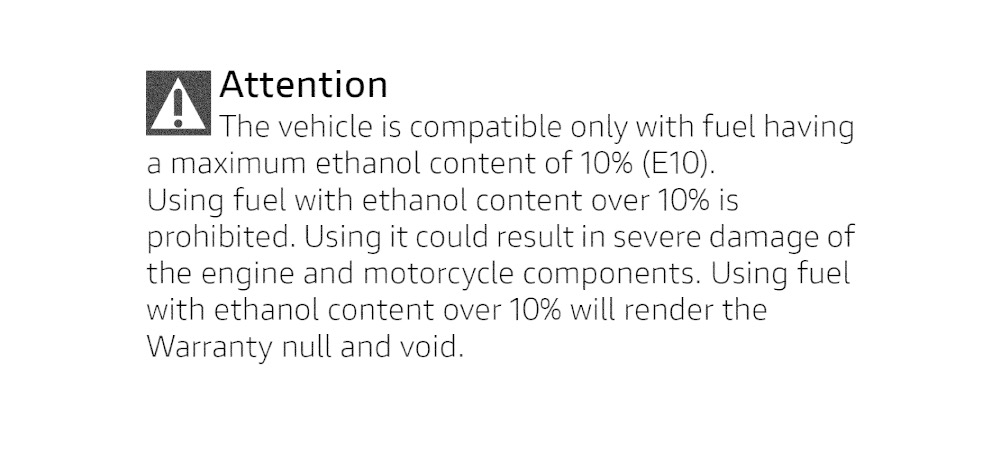

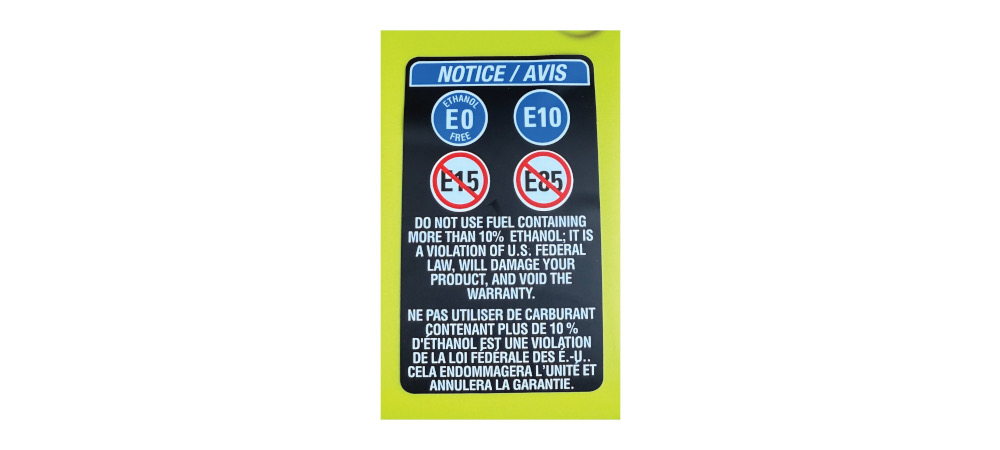
Well, it looks like we’ve been thrown a curveball in Quebec. As of last August 14, the province has approved 15 per cent ethanol (E15) gasoline as it works toward a mandatory minimum ethanol content of 15 per cent by 2030. Don’t think that you’re immune in other provinces, though; while federal law mandates at least 5 per cent ethanol content in gas across the country, several provinces already mandate E10 at the pumps, and will soon be rolling out E15 if they haven’t already done so.
From what I’ve seen, most gas stations in my area of Quebec are now selling E15, with gas pump sticker declaring, “May contain up to 15% ethanol.” I do suspect, however that E15 was actually introduced earlier in the summer. The reason I suspect this is because since I’ve taken my older bikes out of storage, I’ve been experiencing issues I hadn’t seen before. Primarily, my carbureted vehicles (as well as my lawn mower), have been harder to start, and they don’t idle smoothly until they reach operating temperature.
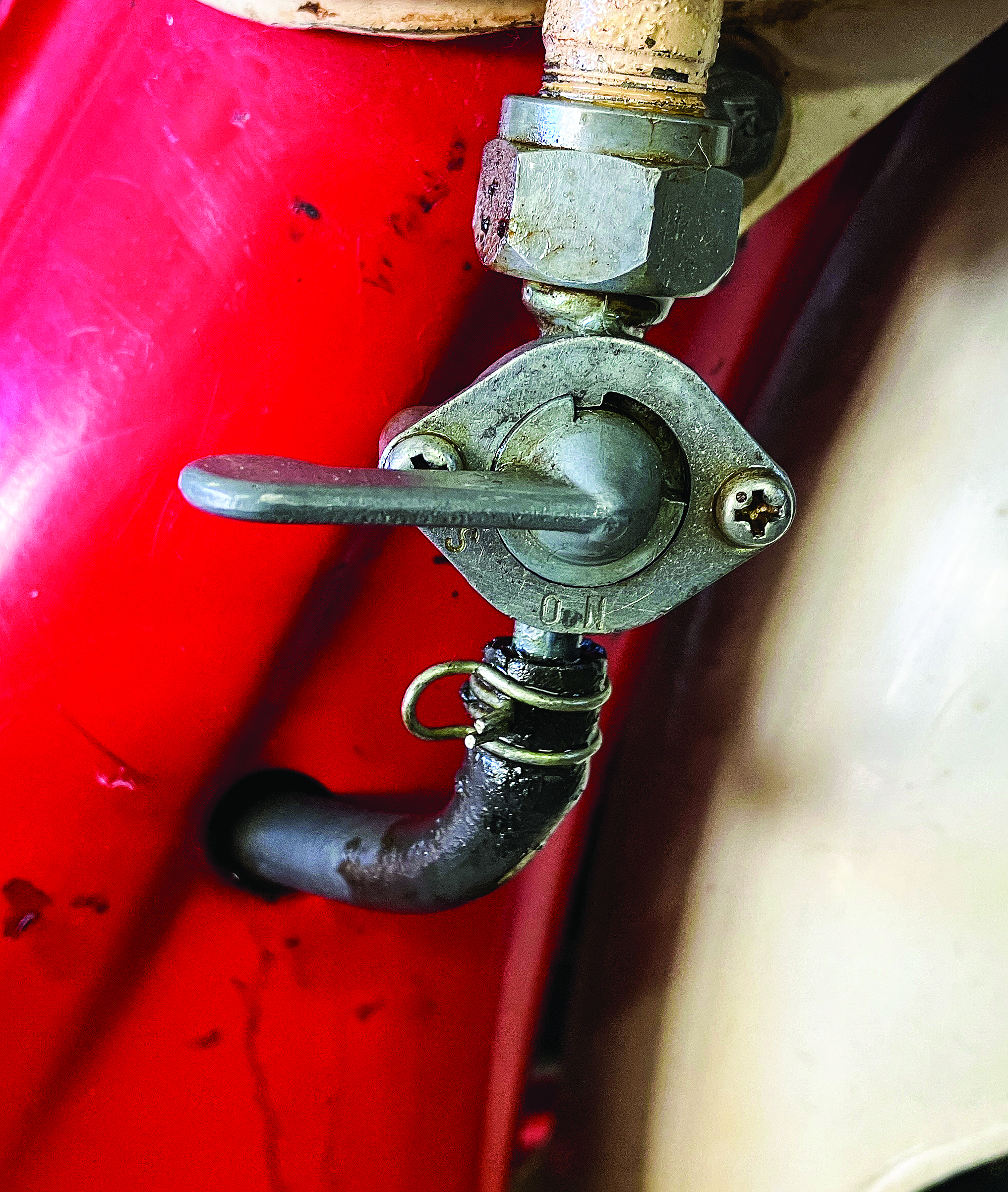
Even more telling are the issues my friend Carl has been experiencing on a number of his vintage Japanese bikes, all of which are carbureted. Many of his bikes refuse to start after sitting for less than a month, some after being parked for only two weeks. Many of the bikes that had no issues after recent service, have been experiencing carburetor leaks. Even more alarming is that a number of them now leak from the fuel petcock, something we would only see after years of storage. And while experience has shown me that leaky petcocks (and, in some instances, carburetors) usually stop leaking once rubber gaskets and O-rings swell up and reseal after gasoline begins to flow, they now continue to leak.
I had discussed the disadvantages of ethanol-blended fuel in the March 2025 issue, and had even demonstrated (unofficially) how it affects fuel consumption and performance. If you don’t have that issue handy, here’s a recap: My Honda CH80 scooter was easier to start and saw a 13 per cent increase in top speed, and the fuel consumption on my Mazda B4000 pickup improved by about one litre per 100 kilometres when filled with ethanol-free gas. And that was when comparing E-free gas to E10. E15 is worse, as it is even less energy-dense than E10.
Local news outlets reporting on Quebec’s change to E15 in August unanimously stated that it would be harmful to older vehicles, and would be especially bad for small engines, like those in snowblowers, lawnmowers, and a multitude of other machinery. I knew of the drawbacks of E15 even before the media reports, but what really surprised me was how quickly and how severely it affected older engines.
Corn-based ethanol was initially introduced as a gasoline additive to replace methyl tertiary butyl ether (MTBE) as an octane-booster, which itself was introduced to replace lead. It is essentially a less toxic octane booster, and it burns cleaner than gasoline, reducing slightly the overall emissions of gas. However, ethanol-blended fuel doesn’t burn as efficiently as non-ethanol gas, and fuel mileage suffers.
Aside from the reduced power and increased fuel consumption, there are a few bigger issues when adding ethanol to gasoline. It is hygroscopic, which means it absorbs moisture. Therefore, the higher the concentration of ethanol in gas, the more water that will be present in it after sitting for some time — and water equals corrosion.
This may be why the gas in Carl’s 1970 CB750 turned red after sitting for just a few months; it caused a layer of surface rust to form in the gas tank, which eventually worked its way into the fuel and into the carbs. The tank had been thoroughly cleaned last summer. Another issue is that it dries out and hardens rubber; fuel lines that were supple just months ago have turned as hard as plastic. Ethanol-blended gasoline also deteriorates quicker than non-ethanol gas. And while fuel stabilizer might help keep the gasoline from going stale a little longer, the ethanol in the gas will still wreak havoc on the fuel system.
For now, Carl has found a solution to the ethanol problem for his bikes. He bought, at considerable expense, a drum of Sunoco ethanol-free 95 octane race fuel. He won’t be using it as a regular replacement — at least not until we do further testing — but he will remove the bad gas and run Sunoco through his bikes when it’s time to put them away for the winter. We’ll only find out next spring if this solution works.I have noted that the premium fuel at a nearby Shell station is E10, so it’s what I now use in all of the non-injected engines in my garage. However, I’ll probably head to Carl’s place with an empty jerrycan just before winter arrives.
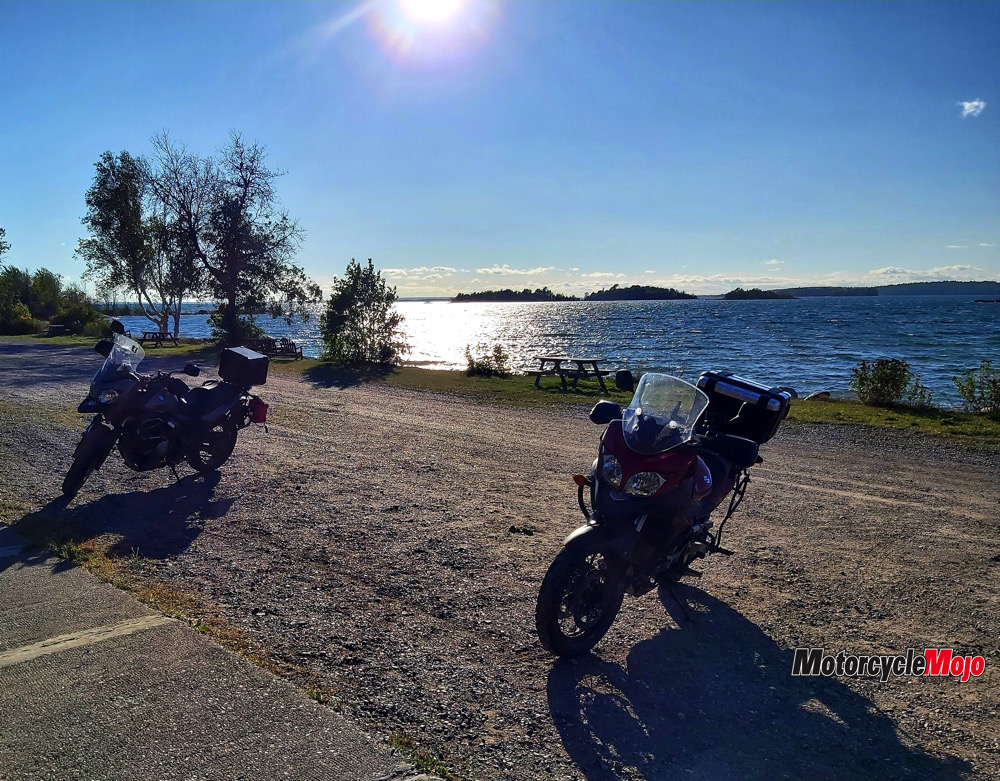

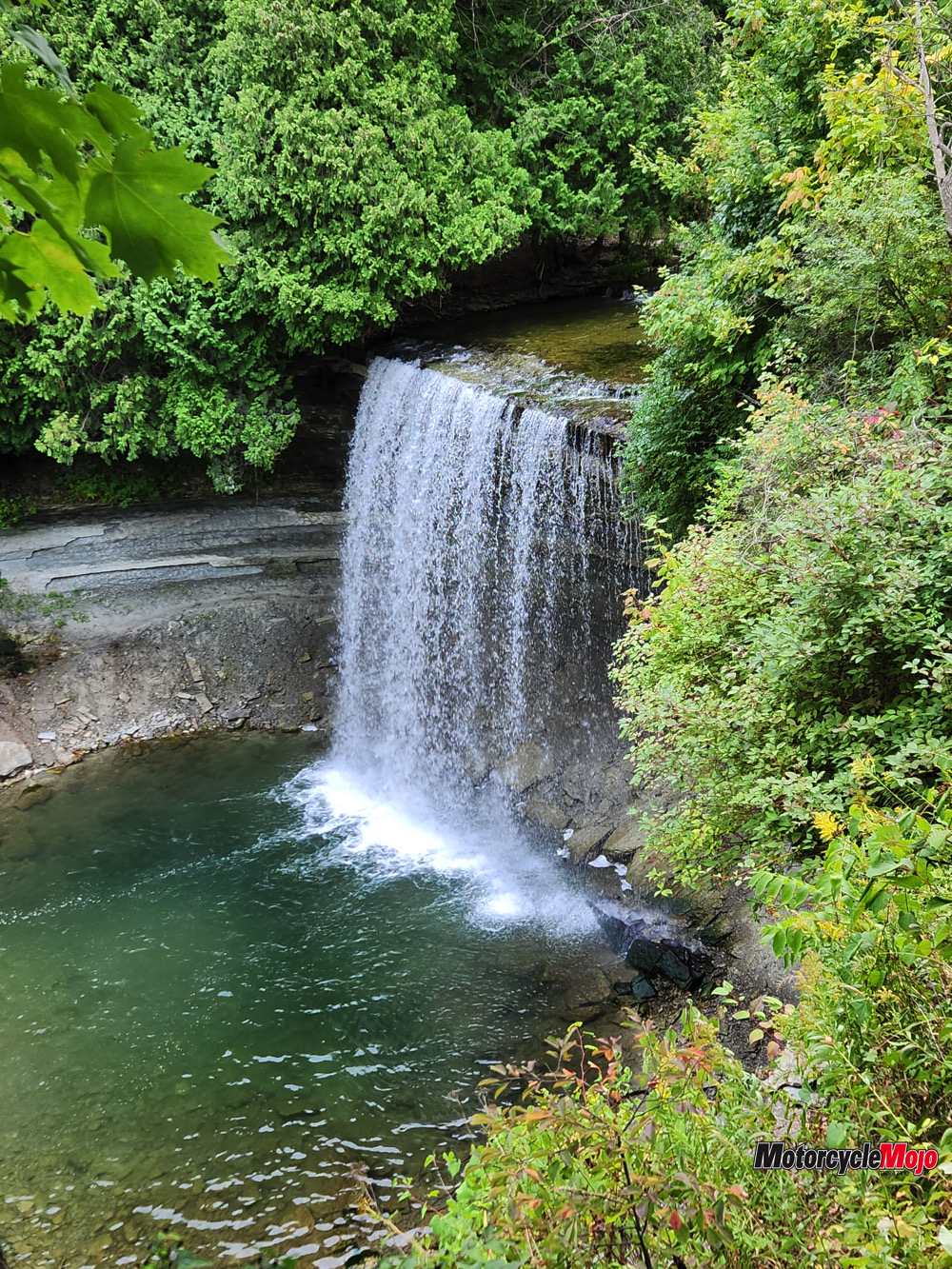
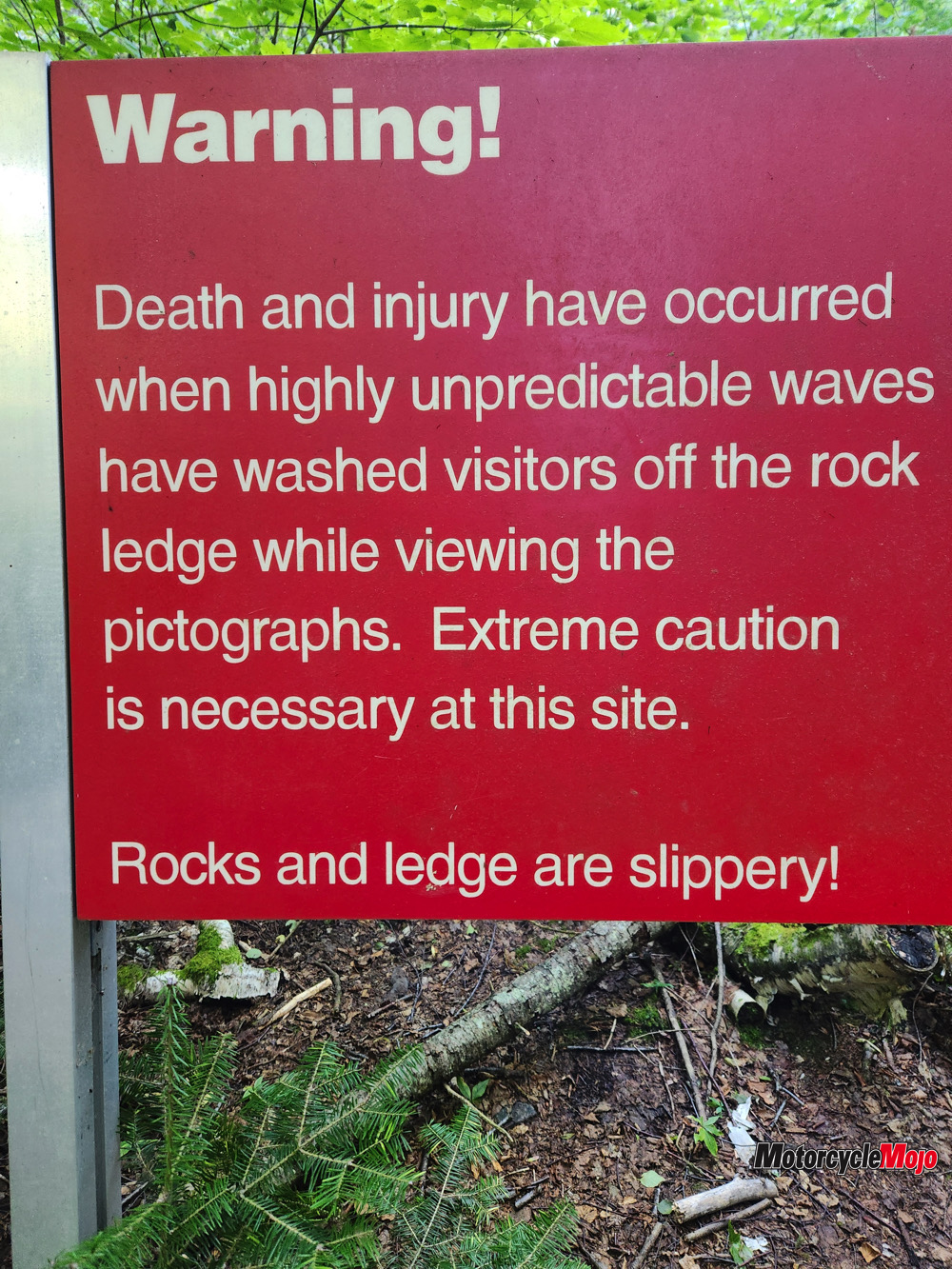
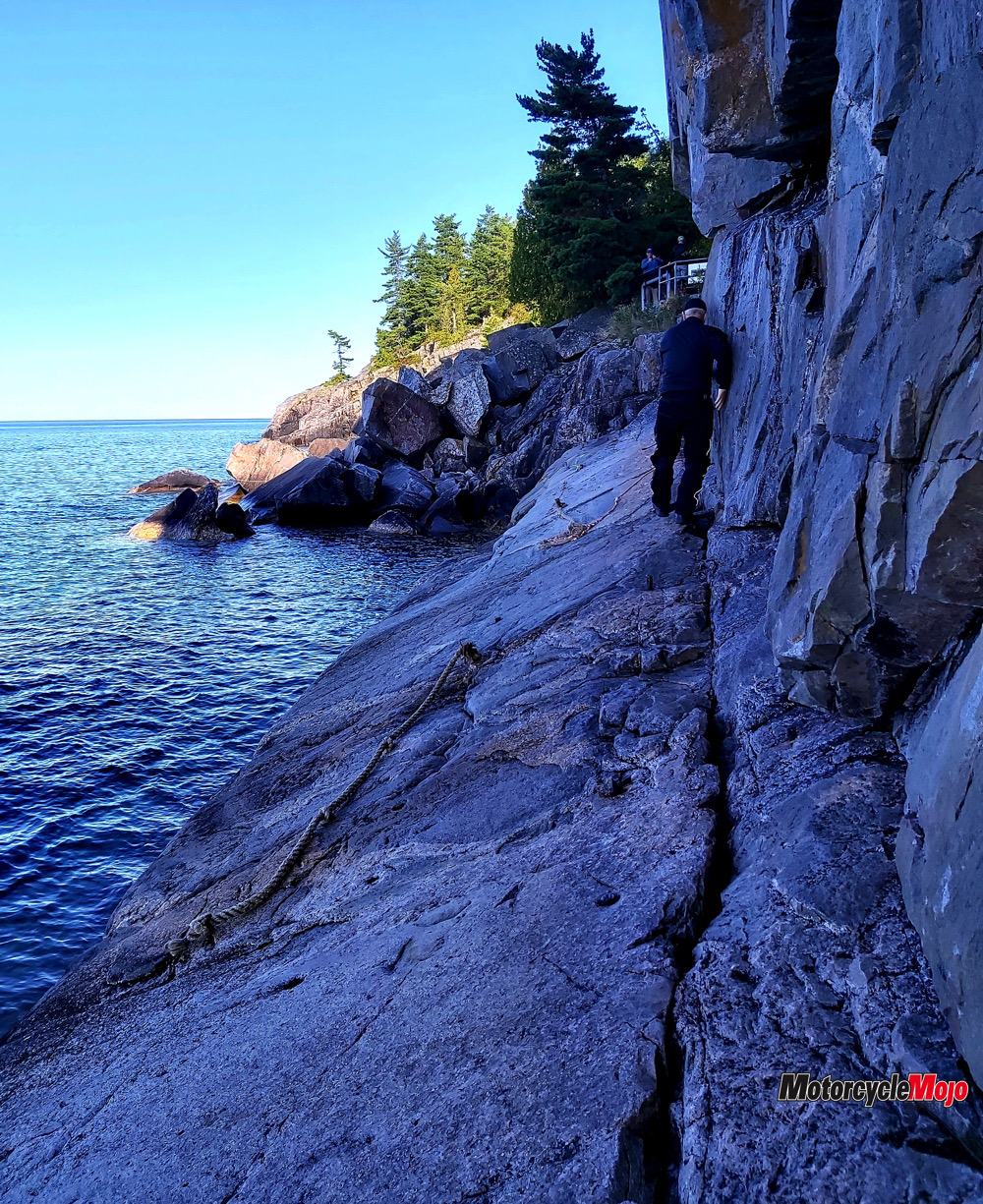


Taking in the sights and roads of Manitoulin Island and the eastern shore of Lake Superior.
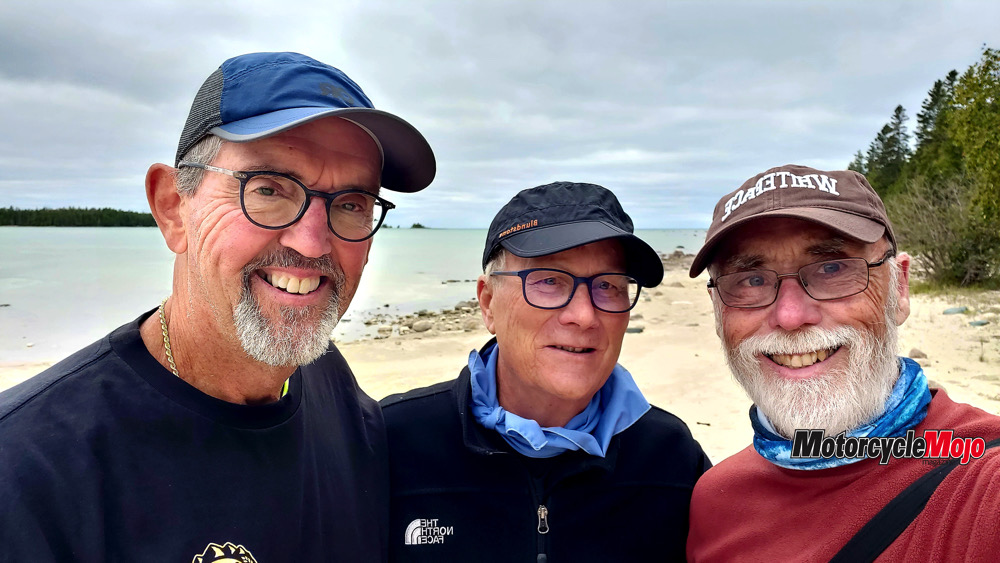
We are getting old and maybe a little decrepit, but like all motorcyclists, we want to keep experiencing riding adventures. Motorcycle touring gets in your blood. This year, John Anderson, Jim Oliver and I decided to keep the ride in Canada and answer the call of the north. We would head off on a ride after the heat of the summer had dissipated but hoped to catch an elusive autumn Indian summer.
The plan for me was to take a leisurely two days riding the backroads of Southern Ontario from my home north of Kingston to Owen Sound visiting family and friends before meeting up with John and Jim.
Before joining my riding buddies, I met Ian Davis (we were surgical residents at Queens University in the late 1970s) on his fishing boat in the marina out of Hope Bay on the Bruce Peninsula. The afternoon fishing expedition was not very successful (although an afternoon fishing on Georgian Bay can never be considered a bust). I had promised fresh fish when I met up with my riding friends later that day, but John had backup: steaks on the barbeque.
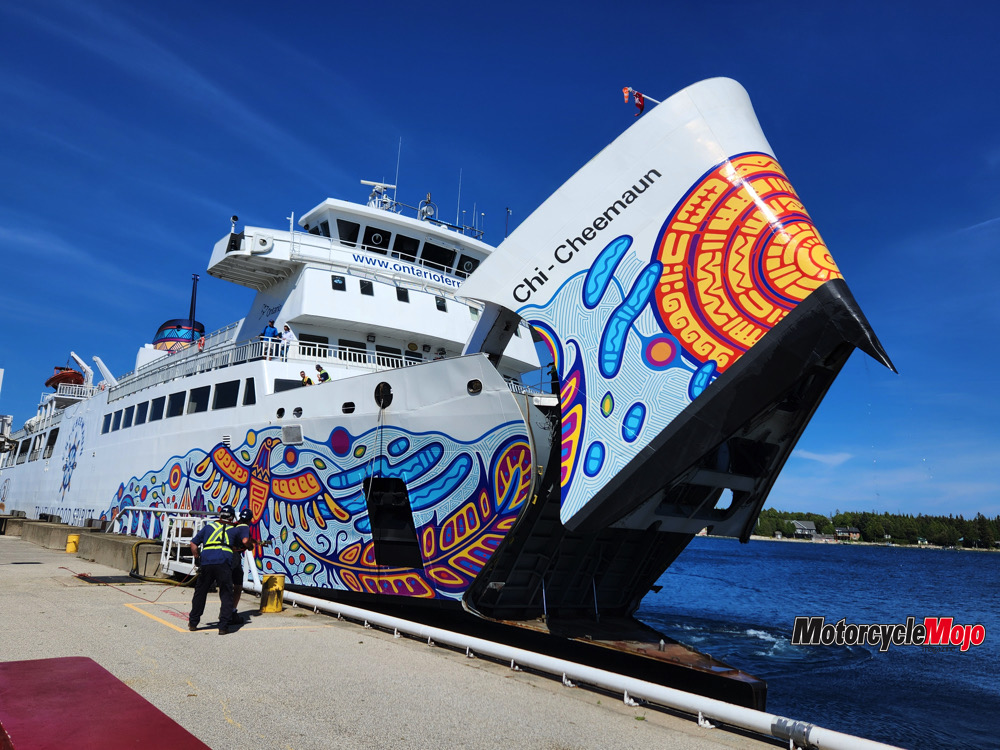
Saying goodbye to Owen Sound the first morning of our joint ride, we took the less-travelled roads hugging the rugged limestone east coast of Georgian Bay from Wiarton, and past the spectacular Lion’s Head to catch the MS Chi-Cheemaun ferry, our ride across Georgian Bay from Tobermory to Manitoulin Island. As many hundreds of motorcyclists over the years can attest, the ride on the Chi-Cheemaun is wonderful, particularly on a bike. The trip starts with conversing on the dock with like-minded riders and then continues to the experience of securing your bikes from tipping over deep in the hull, then enjoying quite good cafeteria fare and finally taking in the gorgeous sights as the boat glides across Georgian Bay…
It’s easy to forget the challenges facing a beginner rider: remembering every step while starting a motorcycle; struggling with smooth gear shifts; braking without stalling; and maintaining focus on ever-changing terrain. Whether facing heavy traffic on the road or climbing a steep hill off-road, beginners encounter overwhelming situations that seasoned riders take for granted. We often overlook how much effort it takes to learn the basics.
This summer, I attended a community weekend ride in Kamloops, B.C., organized through the GKMA dirtbike association. I was there to run a clinic for beginner riders. We worked on basic foundational skills such as clutch control, emergency braking, and riding positioning while standing and sitting. I was reminded of how much is going on for a beginner motorcyclist, when even something as simple as finding neutral can be a challenging situation, as can the understanding that your clutch is the most valuable mechanism on your motorcycle, and integral to every skill needed on your bike.
As I watched the riders progress throughout the morning with specific drills dedicated to the foundation of riding, I was reminded just how much time it takes to refine basic riding skills.
More recently, my father, Glenn, purchased a street-legal dirtbike to zero in on his off-road skills. I grew up dirtbiking with my dad and have many fond memories of riding with him. My perception growing up was that he was a phenomenal dirtbiker, and far better than me. I realized I still had that image in my head of him as I watched him struggle on a loose, rocky uphill.
He hasn’t ridden dirtbikes on tough trails for maybe 10 years, and although he is an extremely competent rider in all facets of motorcycling, his dirtbiking skills could use some refinement. Although my dad knows how to ride a bike, the trails and terrain of B.C. are completely new to him. The issue, it would seem, isn’t teaching skills; it’s that I’m just not quite sure how to teach my dad.
I remember when I was six, my dad tried to teach me to ride a Yamaha GT80 he had purchased for me; there were a lot of tears and tantrums (on my end, not his). He soon took me to Clinton Smout’s off-road school to learn from a professional. It worked great, and in a few years’ time, I had started working with Clinton, teaching other children to ride.
Clinton had built an “opposite bike” where all the controls on the motorcycle had been reversed. The purpose: to remind us how difficult it is for a first-time rider to use the controls and operate a motorcycle.
As you progress in any sport, your boundaries of comfort expand — let’s call it the “comfort bubble.” My dad’s comfort bubble in the dirt has diminished, and to safely grow that bubble, we had to approach riding with easier riding to instill confidence, while mixing in tidbits of instruction. It helped that Clinton was riding with us this particular time, as he was in B.C. for another event.
I hadn’t thought much of the trail until Clinton mentioned to me that it was pretty tough. “It was the easiest one in the area,” I said. It dawned on me just how hard this was to ride for someone new, or returning, to dirtbiking. In most areas in B.C., you have the option of gravel roads or ATV and dirtbike trails, but the issue is that there is a large skill gap between the two, making it difficult to progress and grow your comfort level without fear or risk of injury from riding over your head.
The day ended successfully, but I realized how difficult it is to learn something new, or get back into off-road riding after not riding dirt for many years. Dad levelled up in his riding that day with only a minor sore wrist, and I’m sure his comfort bubble grew — even though he didn’t realize it.
As you become more competent, the fears that once held you back fade away and are replaced with skills and instinct from experience. To a beginner, every corner, intersection, root, and rock on the trail can become an obstacle for them to tackle. But you adapt, and as you gain seat time, the fear that you first had for simple techniques and manoeuvres fades away and these skills become second nature.
Remind yourself of a beginner’s perspective. This can be hard to do if you’ve ridden for years. Be patient, and recommend that any beginners you know take a riding clinic if one is available in the area of specific instruction that they could use some help in. I will be continuing to retrain my dad at his dirtbiking skills, but next time I’ll choose some easier trails and work on riding drills to help expand his comfort bubble properly instead of throwing him into the challenging B.C. trails right away.