
Canadian Finalist in Harley-Davidson’s Battle of the Kings
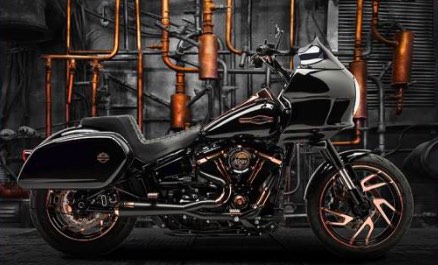
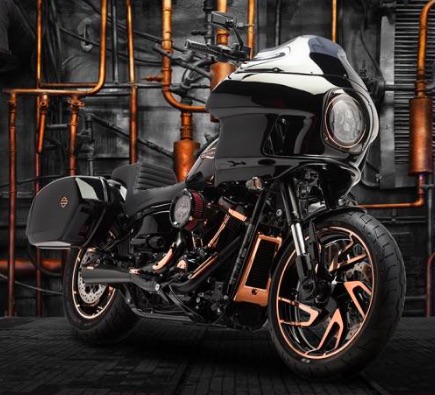
Harley-Davidson has announced it’s four finalists of the Battle of the Kings custom build competition, and one of them is a Sport Glide named “Moonshine” from Calgary.
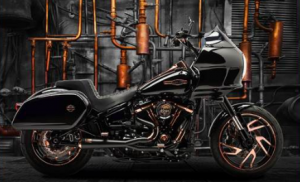
The Battle of the Kings showcases the very best in customization capability and the creativity of the Custom Kings who can be found at every Harley-Davidson dealership globally. In 2018 the Custom King crown was taken by debut-entrants Harley-Davidson Bangkok with their Street Bob-based build “The Prince.” 2019’s Battle of the Kings has brought fierce competition with 26 countries competing for the crown. Now, from 258 entries to four finalists from Canada, United Kingdom, Mexico and Germany.
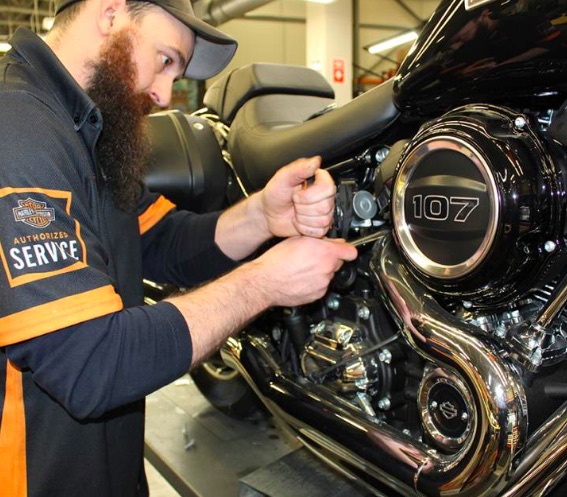
Canadian finalist Justin Willimont from Calgary Harley-Davidson headed the Sport Glide build from the dealership’s custom division, when asked where he pulled inspiration for Moonshine he replied. ” The inspiration for Moonshine came from the 1983-1992 FXRT Sport Glide. Its vintage club style touring is built for today’s riders and we wanted to bring it back. In order to make the bike “pop”, our design team felt it was best to use copper in place of chrome against the Harley-Davidson Vivid Black to be more visually appealing to our audience. The design was a group effort among our whole service team.
Any model in the Harley-Davidson range may be selected as a base for the build (excluding Trike and CVO models) meaning dealers have more choice than ever before in order to create a title challenger. To further inspire the competition dealers must choose from three style categories – Dirt, Chop and Race – for their build. The rules for the build are simple – 50% of the parts used must be genuine Harley-Davidson accessories and the customization budget is a maximum of 50% of the donor bike retail price.
Along with the Canadian Sport Glide there is a Street Bob from United Kingdom, a Softail Slim from Mexico and a FXDR114 from Germany. The winner will be announced this November, you can check out all of the bike build specs at the Battle of the Kings website.
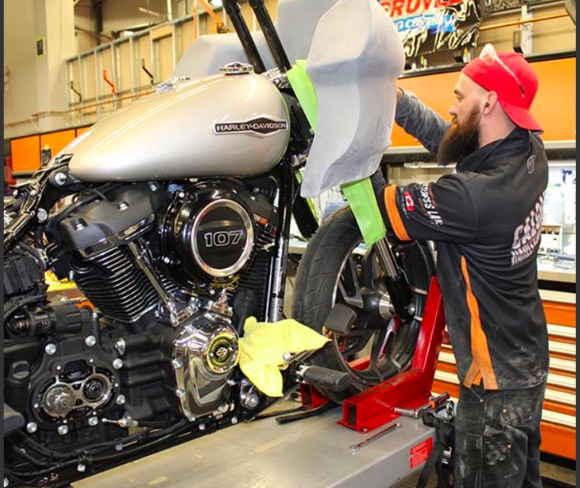
Using the proper oil in your motorcycle could save your clutch, as well as plenty of money in the near future.
Aside from testing and writing about motorcycles, I am also a certified riding instructor. With that job comes another responsibility: I maintain the 50-odd motorcycles of the training school for which I instruct. We have two sets of bikes: there is the fleet of road bikes, which includes newer Honda Rebels and CB500Fs; and there’s a fleet of closed-course bikes, which is comprised mostly of decades-old Honda CB450 Nighthawks.
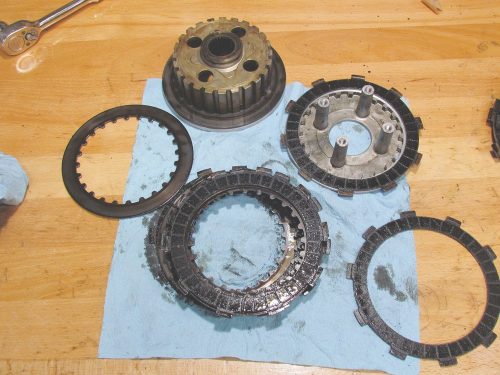 Even thought the aging Nighthawks tally lower annual mileage than the road bikes, they have suffered years of abuse at the hands of novice riders who, among other things, use the bikes to hone their clutch-hand dexterity. Those old Hondas have proven to be almost bulletproof over the years, but we’ve been experiencing a rash of clutch failures these past couple of years.
Believe it or not, until about two years ago, the Nighthawks, which date back as far as 1982, were still launching on their original clutches. Then the provincial testing curriculum changed and even more clutch-slipping, low-speed exercises were added. The Nighthawks protested by systematically frying their friction discs. I set about replacing the fried clutches and worn springs with aftermarket ones, as the OEM parts were obsolete. Things went back to normal. That is, until the new clutches began slipping – to the point that some of the bikes wouldn’t advance at all.
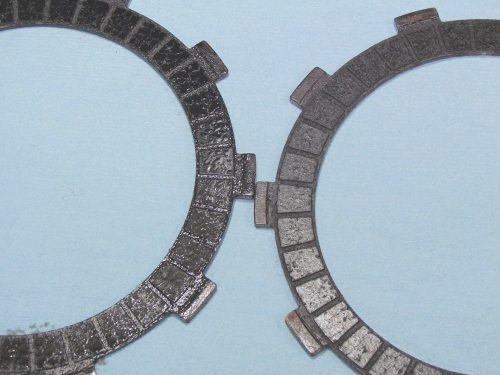 Recently, I took apart one of the slipping aftermarket clutches, which I’d replaced last year, and was surprised to find that while the steel and friction discs were darkened by the heat caused by the slipping, neither part seemed to show any wear. Measuring the thickness with a vernier caliper revealed that the steel and friction discs measured almost the same as they did when I’d replaced them. Something else was going on here.
Then I remembered seeing a few jugs of automotive engine oil in the school’s garage. I’d never really paid attention to them, but began inquiring among the other instructors who occasionally perform simple service tasks on the school’s bikes, including changing the oil. Indeed, my queries revealed that some of the bikes’ oil had been changed and, to reduce cost, the replacement oil came from those automotive oil jugs.
Now, I’ve heard many times that you should use only motorcycle-specific engine oil in a motorcycle. Among the reasons given is that motorcycle oil is better for the clutch – or, more appropriately, that automotive oil may harm a motorcycle’s clutch. This wasn’t the case 20 years ago, but environmental demands have changed engine oils since then. These days, automotive oil is formulated to, among other things, reduce fuel consumption. Oil manufacturers do this by adding friction modifiers in the oil. These friction-reducing additives are what can potentially cause a clutch to slip. Not that I didn’t believe the claims that automotive oil shouldn’t be used in motorcycles; but until now, I had never seen the results of doing so firsthand.
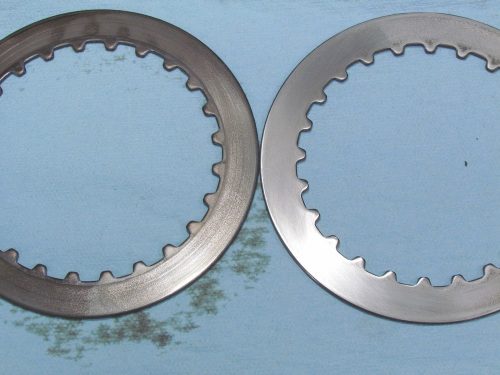 And so begins my experiment. But, truthfully, it’s also an attempt to keep costs down. Instead of replacing the slipping clutch discs, which are still well within spec, what I did instead is clean them. I wiped the friction discs clean with brake cleaner and let them dry thoroughly. I also sanded the steel discs with 400-grit sandpaper – for no reason other than to give the friction discs a new surface on which to seat. Once the friction discs had thoroughly dried out, I let them soak in mineral motorcycle oil. (At the school, we avoid synthetic oil for cost, but perform regular oil changes.) Then I filled the crankcases with motorcycle oil.
I’ve since repaired two motorcycles this way, and despite not being able to move before, especially at operating temperature, both bikes have endured a couple of weekends of low-speed abuse. Aside from a minor adjustment to reset the free play at the lever, they have been performing flawlessly.
Motorcycle-specific oil costs more than its automotive equivalent, but only in the short term. Use motorcycle oil in your bike, whether it is synthetic or mineral-based, especially if the engine oil also lubricates your bike’s gearbox and clutch.
There is one automotive engine oil that I do approve of and have been using in my bikes for many years, and it is actually formulated for diesel engines: Shell Rotella T6 synthetic oil. I use this oil because I admit I’m cheap and it costs less than dedicated motorcycle oil. But more important, this Shell-brand oil bears a Japanese Automotive Standards Organization (JASO) MA/MA2 certification. The MA certification means the oil is good for motorcycles that use the same oil for the transmission, clutch and engine; MA2 means the oil also is compatible with catalytic converter-equipped bikes. So, don’t cheap out – too much – on engine oil.
Technical articles are written purely as reference only and your motorcycle may require different procedures. You should be mechanically inclined to carry out your own maintenance and we recommend you contact your mechanic prior to performing any type of work on your bike.
Why add a communication device to your helmet when you can buy a helmet with communications already built-in?
These days, motorcycle communications devices are a dime a dozen and are available from quite a few manufacturers. However, Sena may be the most common name in the motorcycle communication business. Sena makes headset accessories for just about any helmet.
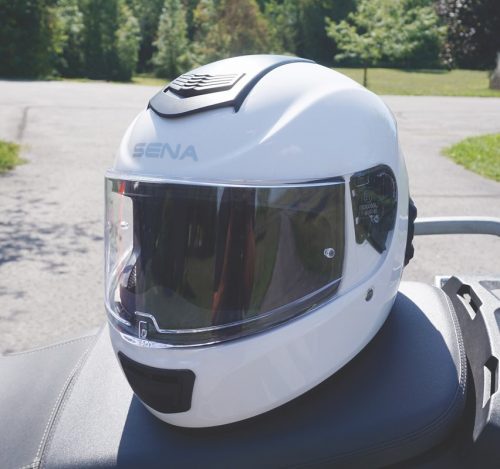 Recently, however, Sena launched its own line of helmets with integral headsets that are so discreet you wouldn’t even know there was a communication device installed – wiring, communication module, speakers and microphone except for the three buttons built into the left-hand side of the helmet’s shell.
Setting up the Sena Momentum helmet’s communication system is simple. The helmet comes with a “quick start” guidebook with easy-to-follow instructions. For more in-depth instruction or for reference during road trips, you can download a PDF of the entire manual to your smartphone.
If you use the Sena Smartphone App, it prompts you to download the most up-to-date firmware to your helmet. You can use the app to interface with your Momentum helmet and choose a multitude of interactive settings to personalize your helmet – and the same app works with dozens of other Sena headsets.
I know that all sounds very high-tech, but the setup and customization processes really are seamless and foolproof. Connecting the Momentum helmet’s headset to my smartphone was a breeze, as was using the helmet to connect to other Sena headsets. The Momentum helmet also uses Bluetooth 4.1 to connect to other Bluetooth-enabled devices, such as MP3 players and GPS units.
Ten FM stations can be programmed into the app or the headset can “roam” to find stations if you are in unfamiliar territory. If you find a station you like when roaming, just push a button to make the station a preset.
You access headset functions by pushing various combinations of the three buttons on the left-hand side of the helmet. Memorizing the various button combinations can be a bit frustrating, but repetition soon overcomes the annoyance.
The Momentum also works by voice command. Saying “Hello Sena” opens up your communication with the headset, then you can say a multitude of things, such as “stereo music” to play or pause music from your phone or MP3 player; “FM radio” to turn the built-in radio on or off; “intercom [1, 2, 3, etc.]” to communicate with other headsets; and “speed dial [1, 2, 3…]” phone numbers that you preset using the app.
The Momentum allows audio multitasking, meaning you can listen to music and have a conversation with an intercom user. The helmet can connect up to eight intercoms and even have group intercom conversations, and the intercoms don’t have to be Sena units – any Bluetooth intercom system should be able to connect to it.
Sena claims a 20-hour talk time and a working distance of up to 1.6 km in open terrain.
On the Road
Phone calls were easy to make, thanks to preprogramming numbers into the app. Accepting or rejecting calls was easy; listening and talking were clear, leading to problem-free conversations. The buttons on the side of the helmet were some of the easiest I’ve used because of their placement: they are at different heights, allowing for easy recognition by feel of which button(s) your finger(s) is/are on. My one complaint is that the buttons ascend toward the back of the helmet – I assume for internal fit or to follow the lines of the helmet – and while they are easy to find, I think the layout would be easier to use if they ascended forward from the bottom button, a more natural fit for your fingers to land on.
The Momentum helmet is very quiet on the road, provided you are riding in clean air – meaning: no turbulence from a small windshield or windscreen. I prefer the wind in my face, so I leave my face shield open quite often. That means I very much appreciated the Momentum helmet face shield’s significant detent in the fully open position, which keeps the face shield open at speed instead of it slamming shut.
Another nice feature: the helmet’s face shield accepts a Pinlock lens to prevent the face shield from fogging up in cooler temperatures. The face shield is easy to remove and to reinstall. Ventilation is standard: chin and top vents with an exhaust port at the back.
If you are in the market for a new helmet and a communication system, The Sena Momentum might be the helmet for you. Overall, it is a comfortable helmet with bells and whistles built in.
When I checked Sena Momentum prices online, I found $499.95 at gpbikes.com to $575.99 at fortnine.ca.
A layered system for all-weather riding.
I was excited when I received my set of Olympia Women’s Expedition II jacket and Expedition pants, as I had the perfect trip in mind to test them. Riding slightly more than 1,500 km south into Washington State for the Touratech-West rally was a good opportunity to see how the gear endured a variety of weather and riding conditions.
Olympia created its Expedition outfit to fit all budgets and offers female riders a well-rounded package for the price – removable armour, thermal lining (jacket only) and inner or outer rainwear. Although there are a lot of pieces to zip in and out of the gear, it does offer great all-weather versatility when used correctly.
Being an eternal optimist, I packed my rain layers away for the ride, but soon regretted my choice. Rain began falling only a few hours into my trip. I pulled over after a few minutes – my gear wet from the rain – and proceeded to put on the rain jacket and pants, both of which offer lots of room for ease of putting on and taking off.
The Expedition gear uses an AquaRes waterproof membrane, which doesn’t stop water from getting through the outfit’s many zippers. Olympia does state that the jacket requires a two-piece rain jacket and pant system to be truly waterproof, and both liners can be worn either inside or outside the gear. Outside is much more comfortable and easier to put on before it rains.
Pockets, Vents and Zippers. O My!
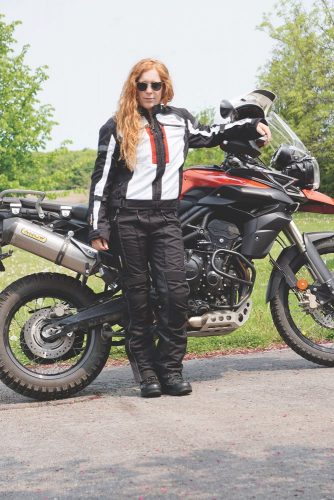 The Expedition outfit makes life a breeze! The jacket has two large zippered roll-down vents on the chest along with almost full-length zippered arm vents. On the back, there is one large zippered roll-down vent, which completes the cycle of airflow. On the pants, two large zippered roll-down thigh vents allow for great airflow on the legs. The zip-down panels are easy enough to open while riding, but you will need to stop to tuck them securely into the gear.
The Expedition gear offers a slim, flattering shape, although, like a lot of women’s gear, pocket space is diminished because of that. The jacket has side pockets along the hip and an inside pocket for a phone. The pants have a deeper pocket, but it runs along the vent zipper and may be prone to getting wet in rain. Putting anything in the pockets on both the hips and thighs can be difficult and, as such, felt awkward once sitting on my bike.
The Fit
The gear looks great and fits regular overall. I’m 165 cm and 57 kg, so I went with a medium jacket and size 4 pants. The jacket has a nice, broad shoulder fit and narrows through the waist and hips. Olympia added a neoprene-lined collar, along with adjustable arms and waist clasps to customize fit and comfort. However, I believe this jacket fell short in its hip adjustment and shortness of the torso. The hip adjustment consists of a Velcro cinch with elastic ribbing underneath. While this feature allows for some adjustment, the elasticized ribbing can ride up if you move and prevents the waist from returning to its rightful spot over the hips. The Expedition jacket and pants have a 20 cm-long zipper that joins the jacket and the pants to help prevent the jacket from riding up, but I still found that to be an issue.
The Expedition pants fit well and have elasticized ribbing on the side of the thighs and tops of the knees to improve flexibility in the pants. A full-length zipper from foot to waist makes the pants easy to put on while wearing boots.
The jacket and pants are well equipped to withstand abrasion. The jacket is made from 500-denier Cordura fabric with 1,000-denier Cordura fabric in protective areas. The pants are similar, with 500-denier Cordura and 2,000 denier Cordura in abrasion-prone areas. The jacket offers CE Level 2 armour in the elbows, shoulders and back, while the pants have CE-rated kneepads and EVA compression hip pads to keep you safe in case of impact.
After riding in the gear for my weekend trip, I believe Olympia is onto something good, but the gear still needs a few tweaks to make it better. The five-piece outfit is a great all-round package at an affordable price and you could save money by not having to buy additional mid- or outer layers. The Olympia Expedition II jacket retails for $599.99, while the Expedition pants are $465.99. Olympia gear is distributed through Motovan and can be purchased at most motorcycle dealers.
Indian Motorcycles has unveiled the new 2020 Challenger, boasting a striking combination of technology, American muscle and an all-new liquid-cooled engine.
We had heard rumblings in the corners the past weeks of something new coming from Indian Motorcycles, now it’s confirmed with the fixed fairing inverted front end bagger with the largest engine in it’s class. The 2020 Challenger will feature Indian’s first liquid-cooled large displacement engine (108 cubic-inch, 60-degree V-twin) that packs a best-in-class 122 horsepower and 128 ft-lbs. of torque. The new engine’s name pays homage to a vital piece of iconic Indian Motorcycle’s history; the Powerplus motorcycle produced from 1916 to 1924.
The Challenger also features a six-speed transmission with true overdrive, assist clutch to reduce clutch effort, and hydraulic valve lash adjusters and camshaft chain tensioners for a low maintenance, reliable powerplant. Riders can customize the bike’s throttle mapping by selecting one of three ride modes, including Rain, Standard and Sport – each ride mode has been engineered with its own distinct traction control setting to align with each mode’s specific throttle mapping. The bagger is also equipped with Indian Motorcycle’s intuitive Smart Lean Technology™, keeping riders confidently grounded by utilizing a Bosch IMU to add cornering control to the dynamic traction control and ABS, as well as Drag Torque Control.
“The Indian Challenger delivers a new level of performance for riders who understand that the seemingly small details make a huge difference,” said Reid Wilson, Vice President of Indian Motorcycle. “Our mindset was to leave no stone unturned and deliver a bagger that exceeds the standards in categories like power, handling, comfort, and technology.”
The Challenger is set to be priced starting at $26,999 CDN, with the Challenger Dark Horse being $33,999 and $34,499 for the Challenger Limited. As per usual Indian is offering a full line-up of accessories to fit the bike and style. The Challenger will be built at Indian Motorcycle’s production facility in Spirit Lake, Iowa, while the Powerplus engine will be assembled in Osceola, Wisconsin before final assembly in Iowa.
“While we are grounded in our iconic history, we are focused and driven to break new ground and establish a higher standard for riders; and the Challenger is a testament to that,” said Steve Menneto, President of Indian Motorcycle. “The amount of technology and level of detail packed into this bike is incredible, and it’s something we’re extremely proud of.”
Learn more about Indian Motorcycle and the 2020 Indian Challenger by clicking here
Husqvarna Motorcycles announced the launch the new EE 5 – an electric Minibike, five-kilowatt machine perfect for pure beginners and experienced riders alike.
The first-ever electric model from Husqvarna Motorcycles, the EE 5 offers youngsters an environmentally friendly way to learn, compete and have fun. Easily adaptable, the ride height can be simply adjusted to keep pace with an improving or growing rider. The quick-charging EE 5 combines the latest high-quality components with bodywork specifically designed to give young riders an ergonomically effortless, all-electric riding experience. Delivering two hours of riding enjoyment for beginners and 25 minutes for faster riders, the supplied charger takes just 70 minutes to fully charge the lithium-ion battery.

Shannonville Motorsport Park has been sold to John Bondar and Steve Gidman, the announcement came late afternoon on October the 11th.
Bondar operates the Canadian Touring Car Championship, while Gidman is a former ‘80s club racer at S.M.P, who operates a technology business. The track has been for sale since 2014 by long-time owner Jean Gauthier, and Bondar has been in negotiation to purchase the facility for much of that time.
The deal was announced on the 43rd anniversary of the first event held at the venue back on Thanksgiving, 1976. Since Shannonville Motorsport Park’s first full year of operation in 1977, the track has hosted 57 National Superbike races in the 39-year history of the Series, and more rounds of the Mopar CSBK tour than any other track.
Shannonville, located just south of major Highway 401 and east of Belleville, ON, started as a Go-Kart track owned by Toronto-area motorcycle racing insiders Tom Faulds, Don Williams, Harry McCluney and John Nelson. Raymond David later purchased the track in 1986, with David’s business associate and now previous owner Jean Gauthier taking control of S.M.P in 1992. Gauthier owned the track longer than anyone else, until the sale on the 11th to Gidman and Bondar.
It is expected that Shannonville will host a round in the Mopar CSBK Championship in 2020, for the 40th Anniversary of a series that was helped in it’s infancy by the long-serving and bike-friendly Shannonville track.
For more information on the Mopar CSBK Canadian Superbike Championship, visit www.csbk.
Harley-Davidson halts production on the LiveWire electric motorcycle due to issues with the charging system announced on October 14th.
The largely anticipated LiveWire production and shipment has now stopped after discovering problems through their final quality checks. The company told the Wall Street Journal that LiveWire motorcycles are still safe to ride, but is asking the few customers who have already received their bikes to only charge them at Harley-Davidson dealerships. The motorcycles had only started delivery to dealers on September 27.
The manufacturer released a brief statement on Monday. “As we lead in the electrification of motorcycles, we have delivered our first LiveWire motorcycles to authorized LiveWire dealers. We recently discovered a non-standard condition during a final quality check; stopped production and deliveries; and began additional testing and analysis, which is progressing well. We are in close contact with our LiveWire dealers and customers and have assured them they can continue to ride LiveWire motorcycles. As usual, we’re keeping high quality as our top priority.”
The company indicated that the motorcycles should only be charged at dealerships. This leads us to believe that the issue could be caused by the lower 110-voltage Level 1 charger; the charging system used with a standard wall outlet. With this being a hinderance in more remote areas with riders not near a dealership, we can’t help but wonder how the rumoured Long Way Up might be going for Ewan McGregor and Charley Boorman.
The manufacturer has not released a timeline of when production may start again.
The Toronto Motorcycle Film Festival announces the films that were awarded the People’s Choice and Jury awards at the 3rd annual TMFF, held October 3–6, 2019 at the historic Revue Cinema in Toronto’s vibrant Roncesvalles Village. The festival presents a mix of full feature and short films produced by large and independent filmmakers and includes red-carpet Q&A sessions with attending filmmakers, producers and cast, as well as juried awards.
International Female Ride Day founder and MOTORESS magazine founder Vicki Gray, writer and filmmaker Kate O’Conner Morris (21 Days Under the Sky), writer and actor, Sophia Vassiliadis, Gemini Award-nominee and Departures co-creator and host Scott Wilson, and Canada Moto Guide managing editor, Dustin Woods make up this year’s jury.
P E O P L E ‘ S C H O I C E A W A R D
WINNER: Wayne, Directed by Jeremy Sims
Wayne is the near improbable true story of Wayne Gardner. Wayne’s remarkable journey takes him from the working-class town of Wollongong, Australia and his first motorcycle, a $5 dirt bike, to the pinnacle of his sport where in 1987 Wayne becomes the first Australian to win the World Motorcycle Grand Prix, and with it, the hearts of all Australians. At its heart Wayne is also a love story, with girlfriend, Donna-Lee Kahlbetzer, never far from the action.
 J U R Y. A W A R D S
BEST FEATURE FILM
WINNER: Blenio, Utah, Directed by Alberto Bernad and Patrick Botticchio
The salt-lake bed in Bonneville, Utah awaits patiently the yearly pilgrimage of motorcyclists who come to try and set world land-speed records. In 2017, among the hundreds of racers present, there was also a young butcher from Olivone, a small Swiss town with a population of 800 people. Tiziano Vescovi, despite having no previous experience, has always dreamed of going to Bonneville and leaving his mark. With support from the Blenio Valley team, they prep a motorcycle and try to secure a land-speed record title.
BEST SHORT DOCUMENTARY
WINNER: Fast and Left, Directed by Evan H. Senn
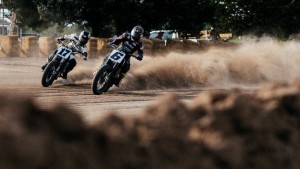
The arena is a dirt oval. The gladiators have a steel-shoe over their left boot that keeps them and their motorcycles balanced at high speeds. Every weekend, they travel great distances for the opportunity to pass the checkered flag first. This is flat track motorcycle racing. Flat track is one of the oldest forms of motorcycle racing and it has a rich history in the United States. Perhaps even more captivating than the bikes and the speeds however are the people that make up this exciting sport.

BEST SHORT NARRATIVE
WINNER: Endless | Mexico, Directed by Ryan Marcus
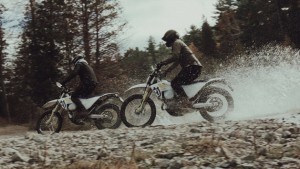
Endless | Mexico follows freestyle motocross rider Jimmy Hill in Guadalajara, Mexico during the Dia De Los Muertos festival. Inspired by the city’s landscape and more so the people, traditions, and culture that make Guadalajara such a unique destination to visit, Jimmy explores the city via dirt bike and all that the festival has to offer.
BEST CANADIAN FILM
WINNER: Crown Land, Directed by Viktor Radics and Kyle Topping
A short independent film about friendship, adventure and motorcycling.
For the full Film Guide, film synopses, credits, images, and more information visit torontomotofilmfest.com/film-

After 13 years, 3 locations, Atlanticade has announced it will be returning to Summerside, PE for 2020 and beyond.
The City of Summerside will now assume the responsibility for the annual festival starting with the 14th edition which will be held from August 6th to 9th. Founder and longtime chairman Dale Hicks will work directly with the Summerside committee over the next couple of years to ensure a smooth and seamless transition of the festival that attracts motorcycle enthusiasts from across North America.
“I want to thank the numerous volunteers, sponsors, and participants over the years who have contributed to the success of the festival” said Hicks. “However, after 13 years it was time to hand over the responsibility to another group who are committed to continuing the growth of the event”.
The association with Ribfest will continue in Summerside as several ribbers will share the festival site with Atlanticade vendors and registration headquarters. Summerside had previously hosted Altanticade three years between 2012 – 2014.
The High Seas Rally will continue on after a new partnership has now been formed. The Rally will set sail on it’s 20th cruise this November, and will continue on.
 The High Seas Rally started in 2003 and is the World’s Only Biker Rally on a Cruise Ship. The rally’s owners and organizers had been searching for the right group to assist them in growth and are happy to announce their relationship with the new partners. The Group brings many years of experience in producing multiple full-ship charter cruises per year.