
Tube-Type to Tubeless
With a bit of expertise and luck, you can convert your tube-type rims to tubeless.
Although I really like the look of spoked wheels, there are many reasons I prefer tubeless wheels. Unless spoked wheels are specifically designed to be tubeless, they normally require tubes to be inserted inside the tires. This is obviously because air escapes from the holes through which the spoke nipples pass.
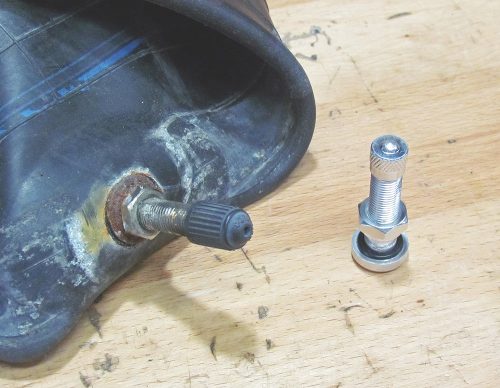 Tubeless spoked wheels, which you can find on several adventure touring bikes, are either designed with the spokes extending to outside the rim beads, as BMW has been doing for many years, or a special bonding compound is applied to centrally mounted spoke nipples to provide an adequate seal.
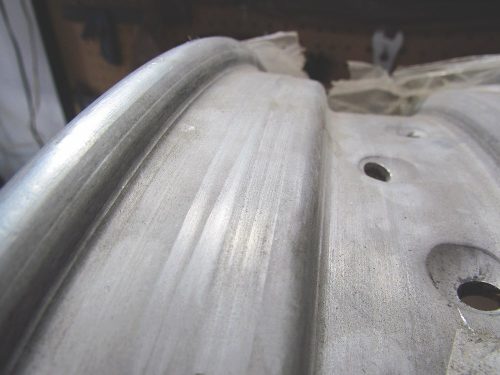
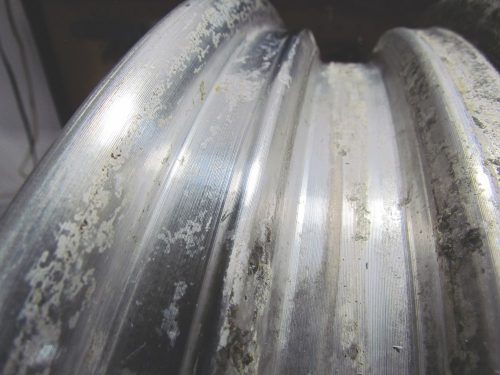
My 1980 Kawasaki KZ550 is completely original, including its cast aluminum wheels. While most cast wheels are designed to be tubeless, the ones on my bike are among the earlier examples of such a design, and they unfortunately are not compatible with tubeless tires. The main difference between my KZ550’s wheels and tubeless cast wheels is the way in which they are machined. The hole for the tubeless valve stem does not have a flat surface machined into it, onto which the valve stem’s rubber sealing washer or O-ring can seat to form an airtight seal. Also, the rim beads on my KZ do not have an inner lip machined into them which prevents the tire’s beads from slipping off toward the centre of the rim should the tire go flat while riding. If the beads slipped off in this manner, that would make the bike very unstable and increase the potential of a flat-induced crash, which isn’t good.
The advantages of tubeless tires are many. A tubeless tire runs cooler while riding due to the lack of heat-producing friction between the tire and the inner tube. This lack of friction reduces tire wear. Also, repairing a puncture on a tubeless tire is much easier. Unless the puncture is huge or there’s a hole in the sidewall, a tubeless tire can be easily repaired using tubeless tire repair plugs without removing the wheel or tire from the bike.
 Puncture a tube-type tire and you’ll have to remove at least one side of the tire from the rim to expose the tube, which you can then patch – temporarily – to continue you on your ride. Ideally, you should replace the inner tube outright for a more permanent fix. Of course, doing the latter will require that you remove the wheel from the bike, which isn’t ideal for a roadside fix.
Due to the obvious advantages of tubeless tires, I decided to convert my Kawasaki’s tube-type mag wheels to more practical tubeless wheels. Doing this required just a little bit of machining. The easiest way is to use a spot-facing drill bit, which you can find in specialty tool shops. A spot-facing drill bit has a smaller-diameter pilot that fits into the existing hole without cutting into it, and a larger-diameter cutting bit that cuts a flat surface to the outside of the hole. With the drill bit installed in a full-sized drillpress and the wheel square and secured, this is a relatively easy job to do, although the sealing surface won’t be perfect; you’ll also have to use epoxy to seal the joint between the tubeless tire’s valve stem and the wheel.
A more precise way to do this is to bring the wheel to a machine shop and get the valve stem’s hole cut on a milling machine. The cost for this will be minimal and the subsequent job will be much more reliable than attempting to do it on a drillpress. I’m cheap, so I used a spot-facing drill bit I had left over from another job, my drillpress, and some epoxy. I began with the front wheel, which I did three weeks prior to writing this, and it hasn’t lost a single pound of pressure in that time.
Do not even attempt to cut the valve-stem hole with a hand drill – or you’re going to have to scour classified ads for a replacement wheel after your attempted handheld machining process scraps your wheel.
About the only drawback of modifying a tube-type rim to tubeless is the rim bead design I mentioned earlier, which won’t lock the tire to the rim should I experience a puncture while riding. Note that while I have modified tube-type wheels to tubeless several times in the past without any problems, performing such a modification should be done with discretion – and at one’s own risk.
 Also note that you can use a tubeless tire on an unmodified tube-type rim as long you use an inner tube. You cannot use a tube-type tire on a tubeless rim without a tube, however, since the tire’s bead is not designed to provide a leakproof seal between the tire and the rim bead. All tires are identified as either tube-type or tubeless on the sidewall, so have a look before you install a tire.
Technical articles are written purely as reference only and your motorcycle may require different procedures. You should be mechanically inclined to carry out your own maintenance and we recommend you contact your mechanic prior to performing any type of work on your bike.
Quality gear for years of service and protection against the elements.
I had just received the Aerostich Darien jacket and AD-1 jean-cut pants and was excited to try them out while on a two-day motorcycle trip. I was expecting to ride through rain, sand and hot weather, so the ride would make for the perfect test of this riding gear.
The Darien jacket is made of tough, abrasion-resistant 500 denier Cordura with a GORE-TEX lining, while the AD-1 is fully seam-taped HT500 denier nylon with a three-layer GORE-TEX lining.
I started off in temperatures of about 10 C. With the jacket’s vents zipped closed, I was incredibly comfortable and found the gear breathed but didn’t allow the wind to affect my core temperature. The temperature slowly rose past 23 C and I began to feel the heat. Opening the pit-zips while riding was easy enough, and once I stopped, I opened the remaining vent on the back to allow airflow through the jacket.
As I slowly gained altitude, I found myself riding through flurries on snow-covered roads in -2 C, which warranted closing the jacket’s vents. Even without base layer changes, my core temperature remained warm. As I rode down from the summit, the snow turned into a heavy three-hour downpour – yet the gear held up and I remained completely dry.
The Look
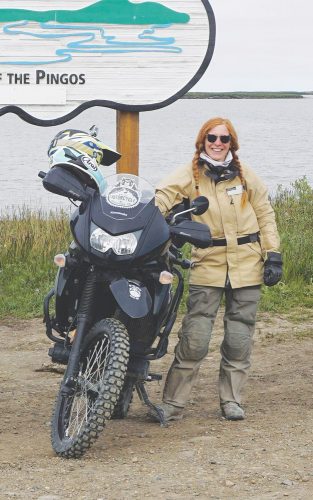 Some say that looking good is half the battle. If you’re a fashionista and that’s how you feel, then this may not be the gear for you. This stuff isn’t meant to drop jaws while you cruise down Main Street. Personally, I find the styling of the Darien jacket great. It’s utilitarian, it’s well made and it withstands harsh conditions.
I was really happy with the pocket placement and how the pockets are built into both the Darien jacket and the AD-1 pants. Having owned a couple sets of women’s gear, I find the biggest flaws in those tend to be pockets that are only large enough to fit a couple of coins and maybe a tube of lip balm – all of which I could never get at because I don’t have the hands of a five-year-old. I ditched my tank bag for a day to see how much I could fit into my new riding gear. I rode with my map, camera, phone, first-aid kit, multitool, wallet and a water bottle packed in my suit. I looked like the Michelin man, but I still rode comfortably because the pockets are attached to the outside of the core jacket – not on the inside, which takes up valuable space.
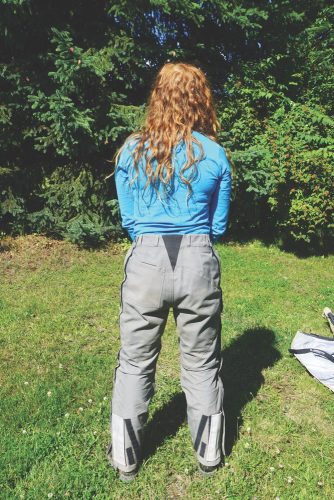
The Darien jacket offers two cinches on the arms and one on the waist to give a customized fit for the ride and layers I was wearing that day. The AD-1 pants have a stretchy cutout V in the back so the waist doesn’t bunch up when it’s tightened with the money belt that’s part of the package.
The Fit
I’ve struggled in the past to find a set of gear that fits me properly and offers the same comfort, protection and versatility that men’s gear offers. Yes, there is some great women’s gear out there and, with the ever-expanding female riding demographic, I anticipate we’ll continue to see more. Aerostich offers women-specific options, but, more important, offers gear that fits. Darien jackets are offered in closely spaced graded sizes in addition to short, regular and tall fits, for a total of 41 sizes. Optional fit alterations are available. Those features are why you won’t find Aerostich gear in retail shops. Go to aerostich.com, enter a list of your measurements in the “fit calculator” and Aerostich will recommend the size of garment that will fit you.
The Darien Jacket
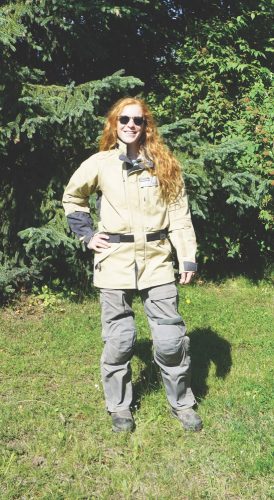 The Darien jacket retails for $785 and comes in a range of colours. The jacket is comfortable and easy to layer with undergarments. It has a relaxed fit with a ¾-length design, which means the Darien is longer than many other jackets. While riding, I did the famous “cutaway” hem roll to minimize the material in the front while sitting. However, having a longer jacket is valuable, especially while riding in mud … or falling. Overall, the fold-down collar, cinches and well thought-out pockets make this the best jacket overall that I’ve ever ridden in.
The AD-1 Pants
The AD-1 pants retail for $522 and come in black, grey or tan. The pants have articulated knees and a gusset crotch, which makes the pants incredibly comfortable to ride and move around in. The pants have a two-way zipper from foot to hip on the outside of each leg, which is great for accessing things in your pants pockets, taking the pants on or off while wearing boots or for easy access in case of a leg injury. (The worst thing when someone has a leg injury is cutting off the riding pant to assess the damage. Not only does this completely ruin the rider’s gear, but it also exposes them to sometimes harsh conditions.)
The downside to the AD-1 pants is the lack of vents, although I still found the material to be very breathable in hot conditions. I am sure Aerostich has its reasons for not including vents – most likely, that it could compromise the quality of the pants.
The only thing I would suggest to people who are thinking of purchasing Aerostich gear is to know the difference between the types of padding offered in the suits. The Darien jacket and AD-1 pants come with the option of TF3 or TF6 armour for the elbows, shoulders and knees. TF3 becomes more flexible in colder weather (from 12 C – 24 C; TF6 is stiffer in cold weather and softens up around 21 C. Getting the pants to mould to your body takes some time. Understand that this gear is like a wearing a new pair of Carhartts; they are stiff at first, but once worked in, you’ll never want to ride wearing anything else.
 If you’re looking for gear that that’ll keep you dry, fits perfectly and that you plan to wear for many kilometres and years to come, the Aerostich jacket and AD-1 pants should definitely be considered as you shop around. The company stands strongly behind its gear and have put years of experience into its garments, of which are made in Duluth, Minn. When you look and feel an Aerostich suit, understanding why so many people continue to wear theirs after many years of riding isn’t difficult. I now have ridden thousands of kilometres while wearing this gear and the Darien jacket and AD-1 pants now are my favourite set of riding gear – the organization, durability and fit are top-notch. I would highly recommend Aerostich to anyone looking for something to wear that will be comfortable for riding in any conditions and on any terrain.
About Aerostich
Aerostich, created in 1983, remains a grassroots company with deep values in local production, quality and customer service. If your Aerostich clothing doesn’t fit you perfectly, let the company know. You will pay just the shipping charges when returning the garment and the company will exchange a standard suit for another to ensure you ride away in the perfect gear for you. As well, the company offers easy repair options: all suits can be repaired at the Aerostich warehouse. The Roadcrafter suit, for example, is made of 120 pieces, so if you badly abrade a section, you can get just that piece replaced. This gear is also famous for its durability to withstand abrasions on hard surfaces.
Aerostich also has a “Ride More” guarantee with its one-piece suit: if you aren’t riding your motorcycle more with your new gear, you can send it back for a full refund within 30 days. Call 1-800-222-1994 or go to aerostich.com for more information.
#TheMotoSocial bringing people together for good times and a good cause.
By now many people have likely heard some mention of #TheMotoSocial, a social gathering of motorcyclists helping connect riders no matter what, where, how or even if you ride. These monthly events have been making their impact around the world. The gathering started in 2013 in Toronto by Viktor and Sam Radics, and quickly ignited inspiration around the world to continue the event in various locations; the goal is to bring people together with the common thread of motorcycles.
Most of these events happen monthly throughout a day or evening, but from August 23-25th, 2019 Prince Edward County (PEC) held the 2nd annual MotoSocial Camp. The MotoSocial Camp brought over 200 people together riding all sorts of machines. These events are proving what many of us know to be true; that the passion of motorcycling transcends generations, brands or riding styles. Whether you rode, drove or walked your dog there, the event welcomed everyone and raised over $54,000 for jack.org, young leaders who are revolutionizing mental health.
The monthly MotoSocial PEC is organized by Duarte, Sarah and Dustin – three riders determined to bring the quaint area together for the love of bikes. The MotoSocial Camp ran for its second year offering a movie night, local rides, slow races, not to mention a plethora of gourmet food and drinks from local businesses; Oh, and some damn good conversation. Nathan Nasland, a local in Prince Edward County commented, “The MotoSocial is fantastic. What I love about it, it’s all ages; old, young, it doesn’t matter. No brands or issues, everyone is just out here because they’re enthusiastic about motorcycling. We need a lot more of this in Canada.”
The MotoSocial Camp had an eclectic and heart-warming feel being held in a Second World War hanger on an air force training base that was once used as a training facility known as No.31. When looking at the large, slightly decrepit buildings one would have their doubts about it coming to life as the main stage for the gathering, but as each Edison bulb was screwed into place on the many strings strewn through the rafters, the hanger became a rustic beauty that shone throughout the night, filled with the people that gathered for a common purpose.
The MotoSocial is unique to most rallies or festivals. Most cater to a certain type of bike or rider; this one is all-inclusive, and it’s obvious when you roll in seeing the gigantic and beautiful “Love Everyone” sign hanging on the fence. There you’ll find everything from dual-sport bikes to vintage stock machines to new sportbikes, tricked-out Harley-Davidsons to scooters with sidecars.
#TheMotoSocial happens monthly in most major cities around Canada and they seem to be continuously popping up in more locations. If you’re interested in seeing what these unique events are all about, or just want to meet some new people, check out themotosocial.com for listings on the closest one near you.


In true KTM fashion, the company’s newest Sport Tourer emphasizes sport bike-like features. It could be considered the most radical long-distance bike on the market
While KTM is already Europe’s largest motorcycle manufacturer, it continues to ramp up its sales. One of its palpable hits that helps to drive that increase is the most expensive model in its entire range: the 1290 Super Duke GT, which first launched three years ago. KTM, an Austrian company, offers a unique take on sport touring – with emphasis on the “sport.” The sales figures indicate that this model completely addressed KTM president Stefan Pierer’s concerns before it appeared. “I don’t think a sport tourer in the classic way matches 100% with KTM’s brand identity,” he told me. “Our customers expect something sporty made the KTM way – not like other manufacturers do it.” Well, that certainly describes the GT, which since its 2015 launch has provided its owners with the dazzling performance and benchmark handling of the “take no prisoners” Super Duke R streetfighter (a.k.a. The Beast) combined with everyday practicality and user-friendly convenience. The combination is a successful marriage of opposites.
 Despite being the first ever KTM V-twin on-road model with touring pretensions, the GT has been such a hit that KTM has devoted some of its R&D budget to making the bike better still. So, at Intermot 2018, KTM unveiled the seriously improved 2019 version of the model and, just a short time later, the company asked me to come ride it for a day. My test-ride conducted in glorious sunshine and on superb riding roads running up and down the hills and valleys of KTM’s Upper Austria hinterland.
The 2019 Super Duke GT is even more fun to ride than before, as it is a sharper, stronger and more refined version of its predecessor in every way – a fact underlined by the outgoing 2018 model GT, which Luke Brackenbury, KTM’s PR manager and my riding companion, had brought along to compare with the new bike. Swapping back and forth between the two was an education: I never would have thought that the outgoing model would seem quite so dated, as it had set new sector standards during its 2015 release.
A New Visual Identity
 Part of the contrast between the two bikes is visual. Just looking at them both side by side as you walk toward them, it’s evident that the new model’s heavy style facelift by Kiska Design has given the 2019 GT more presence, as well as a greater sense of substance than before. The new, shapelier windscreen is also quite a bit more protective at speed than the older model’s and is safely adjustable with one hand while on the go and through nine positions over a range of 50 mm. Despite the extra protection the windscreen gives when raised to the max on fast stretches, it doesn’t drum at higher speeds. Cruising at 160 km/h with the V-twin engine running at 6,500 rpm was surprisingly relaxing for a neo-naked sports tourer offering excellent protection, very little residual wind blast and no excessive noise.
Purchase the issue to continue reading
Enjoy a weekend full of motorcycle-related films that range from custom builders to life-changing events, travel to racing, and everything in between
The Toronto Motorcycle Film Festival is back for its third year with a brand-new group of international films that aim to showcase universal stories told through the lens of motorcycling. The 2019 edition of the festival will be held Oct. 3 – 6 at the historic Revue Cinema in Toronto’s vibrant Roncesvalles Village. The festival features film premieres, meet-and-greets with filmmakers, jury and audience awards, Q&A panels and receptions.
More than 50 films in total were submitted to the festival from 15 countries; from that list, a select few will be screened this year, including a few world premieres. Some of the standouts include:
 Oil in the Blood, directed by Gareth Maxwell Roberts, is the first film to catalogue the builders, riders and artists who are driving the custom motorcycle scene forward, including many of today’s top builders, such as Ian Barry of Falcon, Max Hazan, Craig Rodsmith, Walt Siegl, Shinya Kimura, and Winston Yeh of Rough Crafts.
Wayne, produced by Fraser Brown, is the story of the life of Wayne Gardner — from a steel and mining town in Australia and his first $5 dirt bike to becoming the 1987 World Motorcycle Grand Prix champion. Whether you follow Moto GP or not, this movie will have you glued to the screen, laughing and cheering on Gardner.
Finally, The Distinguished Gentleman, directed by Jean Pierre Kathoeffer, is the story of Vincent Nicolai, one of the top five fundraisers worldwide for the annual Distinguished Gentleman’s Ride. Earlier this year, Nicolai’s garage caught on fire with him in it, causing burns on more than 40% of his body and almost ending his life. This film is about the power of community in the face of hardship.
The Distinguished Gentleman will have its world premiere at the festival in Toronto. The director, members of the production team and Nicolai will be riding up from New York City for the festival to talk about their film. Watching this film and attending the talk will be an amazing and emotional experience.
 Running in parallel with this year’s film screenings, the festival partnered with the Birch Contemporary art gallery to assemble an exhibit, dubbed Fast Forward, that features high-end custom and one-of-a-kind motorcycles and artwork from contemporary artists. Think BikeEXIF motorcycles in a gallery setting. This will be a motorcycle exhibit like none other seen before in Toronto.
The Toronto Motorcycle Film Festival and Fast Forward gallery exhibit will be running during Oct. 3 – 6 at both the Revue Cinema and Birch Contemporary.
For a complete listing of all the films that will be shown, including ticket information, visit torontomotofilmfest.com.
Many years after this writer raced on this hallowed track, he decides to watch the action from the other side of the fence
My buddy Alan Burns asked me in December 2017 about going to the 2018 Canadian Superbike Championships series racing (CSBK) event at Canadian Tire Motorsport Park (CTMP; formerly Mosport) with him. He was trying to entice me to race again, but instead of declining, I told him I’d happily hold the umbrella for him. I was getting pretty excited about riding up to CTMP on my VFR with all my camping gear. I’d be back at the track just like in the good ol’ days, except I wouldn’t be racing. My road-racing days were a lot of fun for me and I have a lot of good memories of racing at Mosport, so I was pretty excited to see the place again. In the end, Alan was too broke to race, but I decided to go anyway.
I also have a threadbare Mosport T-shirt from 2001 that my wife bans me from wearing in public and has been relegated to garage duty. That year was my first of eight consecutive years racing at Mosport.
 Mosport is a pretty big track with first-class facilities. When I began racing in 1999, I was going only to tracks such as Shannonville (east of Belleville, Ont.) and St-Eustache (near Montreal), where I could “club” race. There wasn’t any club racing at Mosport, but for one week a year, you could race with the Canadian Superbike series on a national level. Two years into my racing career, I went to Mosport and never looked back. It became an annual must-race event for me. It was where I learned that a fast, flowing track didn’t tire me out so quickly and also where I learned the importance of the draft. By tucking in behind a faster racer on the back straight, I could increase my speed 15 km/h to 25 km/h by drafting. Racing at Mosport was also the first time I began wringing the neck of my 1991 Honda CBR 600 F2. I never thought I’d want to go faster than 220 km/h, but at Mosport I couldn’t get enough of the speed. My rookie year at Mosport was my third year of racing that bike and I was growing very comfortable on it. On the back straight, I’d give it all it had and get drafted along at 240 km/h – and wanting more.
Entrance
I arrive at CTMP’s main entrance around 6:30 p.m. Plenty of time to grab my Advanced Weekend Super Ticket and an Advanced General Camping chit. I saved only $10 by buying these tickets ahead of time, but the purchase represented a commitment to go.
New asphalt greets me at the main entrance. There has been money spent on this facility since I was here last, and that is immediately apparent. In 2011, race car driver Ron Fellows and real estate mogul Carlo Fidani purchased Mosport and shortly after partnered with Canadian Tire. This financial partnership allowed for quite a few expensive improvements, such as resurfacing sections of the track and enlarging the main entry tunnel to allow vehicles as large as tractor-trailers into the infield. Other improvements include paved runoffs in Turn 2A and Turn 8, as well as pavement in the upper and lower paddocks.
I putt away from the main entrance on my VFR with my ticket tucked away to find a campsite where I’d be planting myself for the weekend. By suppertime on Friday, the perimeter of the track is lined, mostly with hard-bodied motorhomes and nine metre-trailers. Tent trailers are rare and tents are even more rare. I find one of the last spots available. It is sloped, but it is on the back straight – just as I had hoped for. I am able to pitch my tent and angle it so I will have a nice view of the motorcycles on track in the morning.
Saturday Morning Practice
 By 9 a.m. on Saturday, the practice sessions have begun, grouped by classes. The session lineup is a rotation of an Amateur class followed by a Pro class all day. The CSBK event at CTMP is a doubleheader weekend, so practices are held in the mornings and final races on both Saturday and Sunday afternoons.
Saturday is a beautiful 28 C sunny summer day, and I know I’m overdoing my sun exposure. The Pro 600 race is a barnburner, with Mitch Card, Tomas Casas, Sebastien Tremblay and Jacob Shaw-O’Leary fighting a four-way battle for the lead. It is nail-biting action right until halfway through the last lap, when O’Leary and Card crash three seconds apart leaving Casas to take the win. It is awesome racing!
After the Pro 600 race, I visit the paddock area, which is fully accessible to all spectators at a CSBK event. From a distance, I see a familiar face relaxing in Mitch Card’s pit area as a crew of three mechanics repaired Card’s bike. I used to race with Bill Card, Mitch’s dad, in the Amateur 600 class and I remember a lot of fun weekends at the track with him. Bill was very good: he almost won the National Amateur championship in 2003 and went on to an impressive Pro career. In 2004, Bill was promoted to the Pro ranks and raced for years in Pro 600 and Pro Superbike, as well as a few seasons in the Thunder class.
I ask Bill if he missed the racing. “No. I don’t think I could be as competitive as I would want to be,” he says. “The fastest I ever went here was a 1:24.7 [lap time] and I was in the lead pack battling Crevier. This morning, my son went out and did a 1:24.1.” Then, Bill laments the fact that he didn’t begin racing until he was 33 years old – Mitch began when half that age. Bill is still lean, and I suspect he would be very competitive today. The bikes and tires are so much better today than they were 15 years ago.
Battling with Steve Crevier? Now, I had to admit that was a better story than my brush with motorcycle fame. I decide not to tell Bill I once held open the St-Eustache washroom door for two-time CSBK champ Michael Taylor.
All-Day Action
 The Pro Superbike race also is a barnburner, with Jordan Szoke, Kenny Riedmann and Ben Young battling it “out in a tight pack. I am convinced Szoke was just biding his time, sitting in the catbird seat and ready to pounce on Riedmann and Young to take the win. But it doesn’t happen that way, as Young scores the victory.
After the Amateur Superbikes race, it is time for some off-track demo rides. I had signed up for two Honda rides – on a CBR500R and a CRF250 Rally. I have been interested in the 500 as a sensible upgrade for my wife from her CBR250R. My ride is silky smooth and the ergonomics feel as small as the 250, but my wife will be the real judge.
The 20-minute demo rides are free and well organized, and they offer excellent opportunities to ride the latest bikes from Honda, BMW and Harley-Davidson. The roads around CTMP are quite nice and there are some flowing curves that hug the small hills and take you through picturesque towns.
I am very impressed with how full-sized the CRF250 Rally feels and it is really begging to be ridden off-road, but this is an asphalt-only ride.
Movie Night
Saturday evening, I have time for a track walk before the Toronto Motorcycle Film Festival’s award-winning movies are shown at an outdoor movie theatre set up in the infield at Turn 1. My track walk floods me with memories of travelling over this tarmac 10 years ago at speed.
CTMP is a beautifully flowing 13 metre-wide, 10-corner, four km-long road course with steep elevation changes that allow more energy for gentle turns and exhilarating corner speed with your knee planted on the ground. Racing here is a real rush. I still describe the joy of racing through Turn 2 as turning left with your knee on the ground at about 160 km/h as you descend by about six stories from the top of Turn 2 and you do it again in Turn 4, going left and dropping by about four stories before rising sharply into Turn 5.
I’ve crashed at more than five tracks during 11 years of racing, but never at Mosport.
As I’m walking along the back straight in the fading sunlight, a grandfather and his granddaughter go whizzing by me on a skateboard at about 30 km/h. She is squealing with delight. They make it safely to the hairpin and she’s giddy with excitement of doing it again with Grandpa.
After reaching my camping area, I end my track walk and retreat to the palatial accommodations of my old tent. It’s been a great day, but I’ll have to take in less sunshine tomorrow. I’m satisfied, but wiped.
Demo Rides Between Races
I get up Sunday morning and immediately walk to the lower paddock to sign up for more coveted morning rides on the BMW and Harley demo fleets. I like the BMW GS bikes quite a bit. They symbolize vacations for me; I just want to load up the bags and head out cross-country for a week or two months on one of these bikes. The 800GS rides like a dream, but I am begging for some off-road riding. Admittedly, the BMW lacks for nothing on the road, however.
Right after that, I have the pleasure of riding a Harley full-dress touring bike. In my 30 years of being a motorcycle enthusiast, I’ve never had the opportunity to ride a Harley or a Ducati. The Harley’s paint has a gorgeous sheen and this bike’s seat feels like a pillow. The ride is a smooth one. I certainly could be comfortable on this torquey baby for a month on the road.
Sunday is a day to watch the races from different areas of the track. I watch another amazing Pro 600 race from Turn 2. I love watching the start of a race. The racing pack taking off from the start and dipping into the turns like a ferocious pack of wolves running through the woods sends a tingle right down my spine. I remember the excitement of racing – and I want to be in that pack.
CTMP is the last CSBK race of the year. Tomas Casas wins, with Mitch Card and Sebastien Tremblay in hot pursuit. They put on a great show in the race and afterward put on an equally good smoke show at Turn 2.
After the Pro 600 race, I cross over to the outside of the track to watch the Amateur 600 race at Turn 1.
I compliment a spectator who is there with his BMW 1200GS. In one of those “small world” stories, he ends up being Billy Shields, formerly an amateur racer at Shannonville in the mid-2000s. Billy and I were familiar names at that track.
Big Bike Excitement
I begin packing up my tent right before the big Pro Superbike race begins. There’s more packing to do, but I take a break to soak in the Superbikes rocketing past at almost 300 km/h on the warm-up laps. Two minutes later, we can hear a muted roar through the trees. The race has begun and the pack is coming within hearing range. The noise intensifies into a crescendo that I can feel in every bone in my body as the entire pack roars up the back straight toward us in a searingly hot flash of excitement. This is only their first lap of 20, with a helicopter chasing the leaders around the track on each lap à la MotoGP.
The race is excellent, with Jordan Szoke chasing Ben Young and Kenny Riedmann for the entire race. Riedmann takes the win, with Samuel Trepanier working his way past Szoke. Szoke, a multi-time champion, ends up finishing fourth. The top five riders are an amazingly close 0.6 seconds together. I expected Szoke to pounce and take the win on the closing laps, but he ends up having mechanical issues and is happy just to stay within range of the leaders. His placing is enough to wrap up his 13th CSBK championship with his accumulated season’s points. Good consolation prize for not winning this time.
I finish packing my bike and slowly ride out of the park right after the racing ends. It has been a fantastic weekend at the CTMP Superbike Nationals. Lots to see, demo bikes to ride, free movies at night, great atmosphere with a riding stunt show between races. The racing itself has been second to none.
On the ride home, a freight train parallels the highway and the setting sun has hit it just right with a golden orange glow painting the entire train. It’s then that I’m struck with the realization that I completely forgot to buy a CTMP T-shirt. ”
out in a tight pack. I am convinced Szoke was just biding his time, sitting in the catbird seat and ready to pounce on Riedmann and Young to take the win. But it doesn’t happen that way, as Young scores the victory.
After the Amateur Superbikes race, it is time for some off-track demo rides. I had signed up for two Honda rides – on a CBR500R and a CRF250 Rally. I have been interested in the 500 as a sensible upgrade for my wife from her CBR250R. My ride is silky smooth and the ergonomics feel as small as the 250, but my wife will be the real judge.
The 20-minute demo rides are free and well organized, and they offer excellent opportunities to ride the latest bikes from Honda, BMW and Harley-Davidson. The roads around CTMP are quite nice and there are some flowing curves that hug the small hills and take you through picturesque towns.
I am very impressed with how full-sized the CRF250 Rally feels and it is really begging to be ridden off-road, but this is an asphalt-only ride.
Movie Night
Saturday evening, I have time for a track walk before the Toronto Motorcycle Film Festival’s award-winning movies are shown at an outdoor movie theatre set up in the infield at Turn 1. My track walk floods me with memories of travelling over this tarmac 10 years ago at speed.
CTMP is a beautifully flowing 13 metre-wide, 10-corner, four km-long road course with steep elevation changes that allow more energy for gentle turns and exhilarating corner speed with your knee planted on the ground. Racing here is a real rush. I still describe the joy of racing through Turn 2 as turning left with your knee on the ground at about 160 km/h as you descend by about six stories from the top of Turn 2 and you do it again in Turn 4, going left and dropping by about four stories before rising sharply into Turn 5.
I’ve crashed at more than five tracks during 11 years of racing, but never at Mosport.
As I’m walking along the back straight in the fading sunlight, a grandfather and his granddaughter go whizzing by me on a skateboard at about 30 km/h. She is squealing with delight. They make it safely to the hairpin and she’s giddy with excitement of doing it again with Grandpa.
After reaching my camping area, I end my track walk and retreat to the palatial accommodations of my old tent. It’s been a great day, but I’ll have to take in less sunshine tomorrow. I’m satisfied, but wiped.
Demo Rides Between Races
I get up Sunday morning and immediately walk to the lower paddock to sign up for more coveted morning rides on the BMW and Harley demo fleets. I like the BMW GS bikes quite a bit. They symbolize vacations for me; I just want to load up the bags and head out cross-country for a week or two months on one of these bikes. The 800GS rides like a dream, but I am begging for some off-road riding. Admittedly, the BMW lacks for nothing on the road, however.
Right after that, I have the pleasure of riding a Harley full-dress touring bike. In my 30 years of being a motorcycle enthusiast, I’ve never had the opportunity to ride a Harley or a Ducati. The Harley’s paint has a gorgeous sheen and this bike’s seat feels like a pillow. The ride is a smooth one. I certainly could be comfortable on this torquey baby for a month on the road.
Sunday is a day to watch the races from different areas of the track. I watch another amazing Pro 600 race from Turn 2. I love watching the start of a race. The racing pack taking off from the start and dipping into the turns like a ferocious pack of wolves running through the woods sends a tingle right down my spine. I remember the excitement of racing – and I want to be in that pack.
CTMP is the last CSBK race of the year. Tomas Casas wins, with Mitch Card and Sebastien Tremblay in hot pursuit. They put on a great show in the race and afterward put on an equally good smoke show at Turn 2.
After the Pro 600 race, I cross over to the outside of the track to watch the Amateur 600 race at Turn 1.
I compliment a spectator who is there with his BMW 1200GS. In one of those “small world” stories, he ends up being Billy Shields, formerly an amateur racer at Shannonville in the mid-2000s. Billy and I were familiar names at that track.
Big Bike Excitement
I begin packing up my tent right before the big Pro Superbike race begins. There’s more packing to do, but I take a break to soak in the Superbikes rocketing past at almost 300 km/h on the warm-up laps. Two minutes later, we can hear a muted roar through the trees. The race has begun and the pack is coming within hearing range. The noise intensifies into a crescendo that I can feel in every bone in my body as the entire pack roars up the back straight toward us in a searingly hot flash of excitement. This is only their first lap of 20, with a helicopter chasing the leaders around the track on each lap à la MotoGP.
The race is excellent, with Jordan Szoke chasing Ben Young and Kenny Riedmann for the entire race. Riedmann takes the win, with Samuel Trepanier working his way past Szoke. Szoke, a multi-time champion, ends up finishing fourth. The top five riders are an amazingly close 0.6 seconds together. I expected Szoke to pounce and take the win on the closing laps, but he ends up having mechanical issues and is happy just to stay within range of the leaders. His placing is enough to wrap up his 13th CSBK championship with his accumulated season’s points. Good consolation prize for not winning this time.
I finish packing my bike and slowly ride out of the park right after the racing ends. It has been a fantastic weekend at the CTMP Superbike Nationals. Lots to see, demo bikes to ride, free movies at night, great atmosphere with a riding stunt show between races. The racing itself has been second to none.
On the ride home, a freight train parallels the highway and the setting sun has hit it just right with a golden orange glow painting the entire train. It’s then that I’m struck with the realization that I completely forgot to buy a CTMP T-shirt.
After being neglected and covered in dust, this little Italian Scrambler gets a new lease on life
Almost 25 years ago while on holiday in the town of Sidney, B.C., Steve Tayler was walking down a street when he noticed an old motorcycle at rest behind a dusty, unwashed window in a small commercial building.
Tayler opened the door and stepped inside what appeared to be a custom paint shop. He spoke to the proprietor about the bike, which turned out to be a 250 cc 1966 Ducati Scrambler that definitely looked the worse for wear. While Tayler wasn’t specifically looking for an old Ducati, the motorcycle was for sale.
“I was aware of what a Ducati single is, thanks to having been a reader of vintage motorcycle magazines,” Tayler explains. “While this one was together, it wasn’t running and it was in really rough condition.
“In fact,” he adds, “I’d say it was a wreck.”
Bought on a Whim
 But that didn’t stop Tayler – who lives on a rural property west of Calgary – from buying the Ducati. He bought it on the spot, shipped the bike home and promptly dismantled it. That’s when the research began – and keep in mind these were the days before the Internet. Phone calls and letters led Tayler to a supplier in Seattle, from which he managed to purchase an original parts book.
“I was very impressed by the high-quality diagrams that really allowed me to zero in on what was missing on this Ducati,” Tayler says. “The headlight was wrong [and] it was missing the taillight and the air cleaner and so many other small parts and pieces.”
Tayler is no stranger to motorcycles and restoration projects. That’s thanks to his dad, Ted, who was trained as a mechanic in England before the family immigrated to Canada. Tayler was seven when they arrived in Calgary in the late 1950s, and Ted got a job as a mechanic at Bert & Jack’s Garage, then a well-known service and repair shop that focused on British automobiles.
Mechanical Background
That Tayler’s first motorcycle was of British manufacture should come as no surprise. He and his dad put an early-1950s BSA Bantam back together, and the small 125 cc two-stroke, single-
cylinder bike was Tayler’s first real ride. A brand-new Honda 90 followed, but Tayler’s attention soon turned to British sports cars – specifically, a 1972 MGB GT.
He’s restored this MGB twice and still owns it and several other British cars that he’s reconditioned from the ground up.
In the early 1990s, when the opportunity to buy a 1968 Triumph Bonneville presented itself, Tayler bought that bike. Then he purchased and restored a 1969 Norton Commando. It was only a short time after completing the Norton restoration that Tayler discovered the languishing Ducati.
The Way the Factory Designed It
 In 1966, the 250 cc four-stroke, single-cylinder Ducati line consisted of the Monza road touring bike, the off-road Scrambler and the Mach 1 competition models. These singles feature a bevel gear-driven overhead camshaft, and compression ratios varied across the 250 cc range: 8:1 in the Monza, 9.2:1 in the Scrambler and 10:1 in the Mach 1. All three models featured a similar single downtube steel chassis, but the competition-oriented Mach 1 offered the cleanest lines, complete with its clip-on bars and racing-style saddle.
As purchased, Tayler says, the only really nice part of his Ducati Scrambler project was an existing orange, metal-flake paint job on the gas tank that obviously wasn’t stock. While he’s something of a purist when it comes to putting something back together as close as possible to the way it left the factory, Tayler isn’t averse to changing a paint colour – but the orange didn’t work for him. He also likes to polish most aluminum pieces until they gleam.
With the Ducati apart, Tayler discovered the frame was bent slightly. So, he delivered the chassis to Greg Miguez at Greg’s Cycle Ltd. to have the tubes straightened. That motorcycle shop is one of Calgary’s longest-lived independents. Miguez began in 1970 by selling CZ, Jawa and Moto Guzzi motorcycles while servicing other brands. Now, he focuses on the off-road market, but continues to offer his repair and welding services to the local motorcycle community.
Definitive Parts Source
 During Tayler’s search for parts, he found Henry Hogben of Ducati Singles Restorations in LaSallette, Ont., who is an expert on Ducati singles.
“I sent a very long list of parts I’d need to Henry,” Tayler says. “Henry was like a walking encyclopedia about the Ducati. He gave me a lot of info and sold me a lot of parts.”
Hogben was something of a legend among Ducati owners, having built and tuned several single-cylinder machines that have won races, including a 250 single that won an American Historic Racing Motorcycle Association championship in the hands of Jay Richardson. Hogben, something of a man of mystery,
lost his right arm earlier in life, but that didn’t stop him from becoming a wizard with a wrench. He also continued to ride and set up a Ducati 450 with its clutch and front brake levers on the left handlebar together with a thumb throttle from a snowmobile. (Hogben died late in September in 2010.)
When Tayler took the wheels of his Ducati apart, he discovered the rear hub was abused to the limit. A replacement came from Hogben, and Tayler set about polishing the front and rear hubs, replaced the bearings and ordered new spokes. The original Ducati rims were tweaked back into shape and rechromed before being laced to the freshly serviced hubs. Dunlop Gold Seal tires were levered onto the rims to complete the rolling stock. Brake shoes were renewed at the same time.
Slap on the Paint – But With a Brush?
Once the frame was straightened, Tayler bead-blasted it and the swingarm before painting the tubes with black paint using a brush – which is how the finish was applied at the Ducati factory. Tayler rebuilt the rear shocks with new seals and the forks were restored with new seals, polished lowers and painted shrouds.
Tayler took the engine’s cylinder and head to Mike Briggs at Performance Cycle & Auto in Calgary. Briggs bored out the cylinder to fit an oversized piston sourced from Hogben, installed new valve guides and cut the seats for replacement valves. Then, with the crank journals polished and new bearings and seals installed, the engine components were delivered to Tayler’s friend, Mike Quantz. It was Quantz who put the engine back together.
A new Veglia speedometer came from the now-defunct Domi Racer/Accessory Mart shop that was based in Cincinnati, Ohio. At the time, Accessory Mart was a treasure trove filled with parts for British and European motorcycles. The company was liquidated in 2013.
Paint and Decals
To replicate the factory paint job on the gas tank, Tayler borrowed an original tank from another local Ducati enthusiast. Decals were sourced from Hogben, and the tins were delivered to Guy St. Pierre at Cyclemania Artworks in Okotoks, Alta. While St. Pierre has retired and closed his shop, he still accepts paint jobs on occasion.
The seat on the Ducati had already been restored when Tayler bought the bike. However, just about every nut and bolt was replaced with proper stock Ducati parts – most of them sourced from Hogben, who also supplied a correct headlight and taillight, hand controls and many of the rubber pieces.
“The exhaust baffle I added to the tailpipe and the mirror are about the only things on the Ducati that don’t truly belong on it,” Tayler says.
Not a Highway Bike
When the restoration was finished, the Ducati fired up and ran fine. Tayler rode it to the end of his driveway and ventured out on the two-lane asphalt highway that runs by his house. He travelled only a kilometre or two before he realized the machine, as it was set up, was not going to be a good highway motorcycle. Hoping to make the Ducati somewhat friendlier on the road, Tayler bought different-sized sprockets to alter the gearing from Hogben. Tayler tried again, but was disappointed with the outcome once more, believing he’d hold up traffic anytime he rode the Ducati on the highway.
“That 250 cc motor is beautiful and it runs flawlessly, but it’s just not fast enough for around here,” he says. “It was really meant to be used off-road or on a city street.”
For now, the Ducati’s fluids have been drained and the bike remains a showpiece only. If Tayler does want to hit the road, he has larger machines that will keep up with traffic, including a Honda CBX – and that’s a motorcycle definitely meant for the highway.
An adage that’s proven itself time and time again during my moto-touring adventures.
It took me a moment to realize that the rat-a-tat-tat sounds on my helmet were from sleet. My visor, usually one to stay dry and clear, was fogged up and wet inside and out. My visibility was blurred, and I, even with earplugs, couldn’t miss the thunder – which sounded very angry – that let me know that the weather had gone from bad to worse. Then, a white light almost immediately illuminated the outer edges of my visor. Lightning. Behind me. And close. Drat!
I was riding west out of Canso, N.S., and had climbed up to a windswept plain where the trees were stunted and many had few or no leaves at all. The highway seemed like the highest point. Wait a minute. I was on the highway. I was the highest point. I needed to get off of this road. And fast!
Five minutes back, I had passed what I thought was a general store. It was the only manmade structure I’d seen for a while. I did a quick U-turn – it was easy: there was no one else out in that weather – and went back to find it. I pulled in and saw a sign that said Motor Vehicle Licensing or some such thing. I didn’t really register that the building wasn’t a general store, as I know that many rural general stores often do just about everything. The building looked like it was closed, so I peeped through the window. It wasn’t a general store; three motorcycles sat on the floor. But the building didn’t look like any motorcycle dealer I’d ever seen either. I didn’t know what it was. I checked the door, and a note said to go to the shop in a separate building behind.
New Friendships Made
 I peeped into the window of that building and immediately jumped backward, startled by a leaping German shepherd, its frantic barking and junkyard persona not making me feel particularly welcome. The dog’s name was called, and it retreated. I opened the door and entered with trepidation. There, I met Holger. He was repairing a motorcycle. I told him that I needed to get out of the lightning storm and dry my visor. The dog ambled over and said hello in a more friendly way. Although he was a German shepherd, he was a pussycat. He liked the attention I gave him and we became fast friends.
Holger is a pre-eminent motorcycle mechanic who is well known in Germany, as I found out later from his friend. Back home, Holger had been responsible for setting up the Yamaha Racing Team’s motorcycles. He was well respected and had owned his own motorcycle dealership in Germany before he came to Canada.
And so begins my story about the unforeseen – some may think unfortunate – events that made my trip to Nova Scotia so interesting and gave rise to the adage I would soon come to associate with moto-touring.
Adversity Breeds the Best Stories
 When you are motorcycle touring, you wouldn’t normally consider rain, sleet and thunder and lightning to be welcome additions to your trip. Great roads and clear days are what you probably expect. Now, I’m not so sure. At the end of the day on a canoe trip, you don’t sit around the campfire talking about the flat lake you paddled across. You talk about getting lost on the mosquito-laden, bushwhacking portage that took you twice as long as it should have and made you paddle well into the evening. Adversity is what gives you stories to tell – so, too, with motorcycle touring. Adventures are boring when everything goes according to plan.
My best stories almost always arise from how an obstacle was overcome or are about the event that wouldn’t have happened had a setback not occurred. The ensuing event is invariably better than what had been planned: the place more scenic; the people more interesting (or generous, or colourful, or helpful); the experience more profound. Hiccups in my journeys almost always lead to the best memories. Sure, stuff happens. But I’m beginning to realize that when one door closes, another always opens. That is an adage that proves true, time and time again.
Unexpected Accommodations
Holger, being a motorcycle mechanic and enthusiast, was delighted to help out a fellow motorcyclist. The weather wasn’t letting up, so I decided that I needed to hunker down until the weather abated. Holger just happened to have a buddy, Thomas, also from Germany, who had a rustic cabin on Hayden Lake – not five minutes down the road. Holger was generous with his time. He negotiated a “biker” rate for me over the phone with Thomas and, since Thomas was away from the property, took me there, got me the key from under the secret rock and made sure I was comfortable. Before leaving, he asked me where I planned to go next and made a point of telling me about some great motorcycle roads in the area and the best roads to use on my way to Halifax and Lunenburg. Thanks, Holger!
When Thomas got back, he promptly brought over a six-pack of Heineken, which he figured I needed after riding in that mess. The cabin was great. Warm, dry, picturesque – just about perfect. I liked the cabin so much that I stayed there for two nights, doing some hiking out by Little Dover and enjoying the lake and a perfectly grilled steak cooked on the barbecue that sheltered under the covered porch. I also took my favourite photo from my trip, a picture of a blue canoe on the dock amidst the fog.
I never would have found this mini-paradise had I not run into bad weather, or if I hadn’t just ridden past Holger’s shop, or if it was a general store and not a bike rider-friendly motorcycle repair shop, or if Holger didn’t have a buddy who just happened to have a cabin that was available at an affordable, biker rate. Like I said, when one door closes, another opens. That was proving to be a theme for the trip.
A Lucky Sign
On my way to Cape Breton to ride the Cabot Trail, I pulled into Antigonish for some fuel for both my bike and me. When I came back out on the highway, the bike felt a little funny. Often this can be caused by an odd road surface and as soon as the pavement changes, the problem goes away. But I paid close attention. It wasn’t getting better; it was getting worse. I pulled over at a level road crossing about five metres into the cross street. I got off my bike and immediately found that the rear tire was flat.
I flagged over a pickup truck to ask the driver where I was so I could call CAA. He pointed at a sign. It was a billboard for a Yamaha dealer. I said, “Yeah, okay, but first I have to get there – and for that I need CAA.” I didn’t understand what he was going on about because the sign was surrounded by trees and bush; there weren’t any buildings in view. He said, “No, that is the dealer. That is the entrance to their driveway.” Turns out that the dealer was 300 metres up the driveway and couldn’t be seen from where I was. I called the number on the sign, and a young guy from the dealership brought out a truck and trailer and we took my fully laden bike into the shop.
They didn’t have the tire I wanted, but they did have a tire that would fit, so I was on my way in slightly more an hour. I reached Baddeck on Cape Breton Island, my planned destination, in plenty of time. Am I lucky or what? I mean, if you’re going to get a flat tire on a major highway, in this case Hwy. 104 just outside of Antigonish, getting one about 75 metres from the driveway to a motorcycle dealership on Pomquet River Road is the way to do it. What are the chances? I was beginning to think they were quite high. One door closed. Another opened.
Beers and a Book
 On another occasion, I pulled over in Kentville, N.S., to see how far I was from Parrsboro. The GPS reading said 98 km. I called to tell my cousin that I was on my way and would be there in about an hour and a half. I wanted to go straight there because, of course, the forecast was for rain. I entered the destination into my GPS, which worked out the route: the display indicated I was going to have a 344-km ride. Ah ha! The 98 km was as the crow flies, straight across the Minas Basin. I called again to say I’d be there the following day and set out for Blomidon Provincial Park instead.
At the sign-in office, I met a young lady who was the park employee who would sign me in. Also there was a park volunteer – a lady closer to my age – who helped out. Turns out she was a motorcycle rider and enthusiast. After all of the laughs and stories, I took about half an hour to get out of the office, where, prominently displayed, was a sign that said that alcohol was banned from the park. Well, I hadn’t picked up any, so that wasn’t going to be an issue.
About 10 minutes after I arrived at my campsite and while I was setting up my tent, the volunteer showed up with my firewood, a brown paper bag and a book. She surreptitiously handed me the bag – there was cold beer inside – and said to be discreet. The book she gave me was a one cm-thick tourist guide called Motorcycle Tour Guide: Nova Scotia & Atlantic Canada, which is written by Harold and Wendy Nesbitt. It is a veritable treasure trove of motorcycle routes, sites, accommodations, etc., and became a valuable part of my tour planning. So, I couldn’t make it to my cousin’s place. So what. Instead, I sat around my campfire with my brown paper bag, reading my new book and enjoying being in the outdoors – until morning, at which time I broke camp in the rain. Overall, a great experience that would have been missed had things gone according to plan.
Fort Ingall
You might call my trip to Nova Scotia this year my Rain Ride of 2019. I don’t mind the rain – even riding in the rain – but when I have been riding and setting up camp in the rain, day after day, I eventually reach my rain tolerance threshold and am more apt to search for an affordable Airbnb or hostel than get drenched yet again. Which turned out to be a good thing because it led to a great experience on the way home. For my trip home, I didn’t want to have to worry about rain, so I went online in search of an affordable Airbnb and found one in Témiscouata-sur-le-Lac, Que. The Airbnb was an 1800s English fort called Fort Ingall. I slept in a bunk bed in dorm-style sleeping quarters in the bunkhouse behind the fort’s wooden fence, in which were holes every two metres through which soldiers would fire their muskets. If I had wanted a more realistic experience, I could have chosen straw bedding. Nah. I chose a mattress.
After about 6 p.m., the entire staff left, leaving the fort in the hands of the three of us staying that night. We built a fire (free firewood) and told stories around it until we retired to our bunks. That experience was pretty cool, and never would have happened if my trip wasn’t so full of rain.
Most of my trip was uneventful. I rode the Cabot Trail (albeit nervously, on unfamiliar, mismatched tires), saw the tides on the Bay of Fundy and spent a few days in Lunenburg camping in the town’s campground. I saw some lighthouses and rode on some great roads, including a route just outside of Parrsboro that the locals call the Mini Cabot Trail and which leads down to Advocate. In spite of the rain, the flat tire and the changes in plans, I had a great time. And through it all, I’ve become better at motorcycle touring. I’ve learned to embrace the obstacles and setbacks because, as was proven time and time again…
When one door closes, another opens.
One of British Columbia’s greatest day rides
Depending on which way you decide to travel the Duffey Loop, it is one of the most loved and known rides on British Columbia’s Lower Mainland and almost all riders have travelled on it or are planning to ride it some day. My usual count is three times a season; often, my first of the year is just to see how early in the year I can make a full loop.
My preferred direction to ride it in is clockwise; others like doing it counter-clockwise. I’ve done it both ways, but for this article, we’ll go clockwise to make it easy to follow.
Leaving Vancouver, you have the choice of taking either the Lions Gate Bridge from downtown or, if coming in from East Van or Burnaby, the usual choice is the Ironworkers Memorial Bridge. Both these routes take you to the Upper Levels Highway and the Trans Canada Hwy. 1 out to Horseshoe Bay. Here, the highway becomes Highway 99, a.k.a. the Sea to Sky Highway.
A Nice Scenic Road
 The province spent a stadiumful of money to improve this highway for the 2010 Winter Olympics and that’s evident as soon as you leave Horseshoe Bay; the road is a two-lane divided highway with long sweeping curves and spectacular views. But pay attention: the road is demanding.
There are ample passing lanes as you wind along the coastline, so no need to get frustrated if you get stuck behind slower vehicles. Just slow down and take in the scenery. The first bedroom community you will pass through is Lions Bay. The speed limit here is 60 km/h and a favourite place for cops to set up. It’s very twisty through here, and they can hide around any number of corners.
Leaving Lions Bay, you come to Porteau Cove, a nice public park with a boat launch and campground (which is almost always full) and some good straight stretches ahead at Furry Creek, known for its beautiful golf club, part of which can be seen from the road.
The next small place you ride through is Britannia Beach, an old mining town that still offers mine tours and has an interesting museum. It’s worth a stop if you’ve never been there or have a hankering to go underground.
More Speed Traps
 Britannia Beach is also a place where the speed limit drops to 60 km/h and the RCMP like to set up at the bottom of the long, downhill sweeping curve coming into town from the south. I’ve seen flatbed tow trucks parked at this very spot with three or four sport bikes loaded on the back. Keep in mind that if you get caught riding at 40 km/h over the posted limit, the police can take your bike. So, slow down!
On that note, on weekends in the summer, there may be 100 to 300 motorcycles on this road, so keep your eyes on your mirrors – the sport bike guys come up really fast and often ride in groups. They can and will surprise you if you’re daydreaming.
The next town you come to is Squamish, a larger suburb of Vancouver with shopping. The Starbucks at the mall off Cleveland Avenue is a stop frequented by bike riders. Affectionately known as Squambucks, it always has at least 30 bikes parked here, with riders in the process of coming or going during the weekend in summer months.
Continuing north on Hwy 99 from Squamish, you will pass by the turnoff to Brackendale, known for having the largest concentration of bald eagles in North America from November to February.
Keep Moving On
From here, the road gains in elevation as it winds through mountain terrain. You will be able to keep a good speed right into Whistler, where things slow down again. Not much to see here in summer unless you’re into tourist traps and expensive shopping. Don’t get me wrong: it’s a nice sterile town and you can take a gondola ride or go downhill mountain biking and there’s great skiing in the winter. But this is a motorcycle-related article.
There is a Chevron gas station in Whistler that offers 94-octane gas for those needing it. Chevron is the only gas station in B.C. to offer 94 octane that is ethanol-free, and you will pay a premium for it. I paid as high as $1.78 per litre in 2018.
Once you leave Whistler, you’ll notice that the road isn’t as wide or as well cared for as it was behind you. Still, it’s a fine ride into Pemberton, which is the usual gas stop for most riders as there are both a Petro Canada and a Husky station in town. Worth mentioning: Pemberton has a real shortage of restaurants, so if your planning to find a nice place to eat, there’s only two or three places to choose from, plus a McDonalds and, of course, fine gas-station dining.
Leaving Pemberton, you pass Mount Currie as you ride through the Lil’wat First Nations reserve. Please respect the posted speed limits here: it’s 30 km/h, but only for a short distance. Soon you’ll make a right turn to follow Hwy. 99, a.k.a. Lillooet Lake Road, which turns into Duffey Lake Road.
Lose the Traffic
 As you pass the Cottonwood Recreation Site, you’re getting close to Joffre Lakes Provincial Park, which is coming up on the right. There are three lakes and a glacier in this park. It’s a very popular spot, so if you’re behind some cars at this point, it’s a safe bet a few will turn off here.
The first large lake you pass on your left is Duffey Lake. From here, the road is very winding with lots of switchbacks. Watch for gravel in the corners from people pulling trailers who don’t watch their off-track, so their trailer wheels hit the shoulders and drag gravel onto the road. Many good riders have gone down on this stretch of road due to gravel.
You’ll notice that there are as many crossings of Cayoosh Creek as there are switchbacks on your way up toward Cayoosh Summit, where the mountain views continue.
Coming into Lillooet is a winding and narrow road along the side of the mountain with steep drop-offs and very rugged terrain. Hopefully, you filled up in Pemberton because getting stuck out here is not something you want to do.
Lillooet is a must stop for fuel, with most people filling up at Lightfoot Gas, another Chevron that offers 94 octane gas. Coming into Lillooet, you’ll notice that the temps rise and the landscape becomes very arid – almost desertlike in places – compared with what you’ve been riding through to this point.
A Change of Route?
Here you have a choice to make: you can do the original Duffey Loop by continuing on through Fountain Valley, Marble Canyon and on toward Cache Creek or you can turn south on Hwy. 12 and do the shorter version of the loop to Lytton. The difference is 581 km, as the full Duffey Loop is a 691-km ride.
For the sake of our ride, we’ll stick to the original loop and continue on to Fountain Valley, a small First Nations community that straddles a short bit of road through the Fountain Slide, a hillside that never stops moving. The road is a short dirt section that always has a flag person stationed there because of construction. After that stretch, you’re back on pavement heading toward Pavilion, Marble Canyon and the historic Hat Creek Ranch, where Hwy. 99 ends and meets Hwy. 97. A right turn takes you onto the Cariboo Highway and into Cache Creek.
Cache Creek is another gas stop, with a Chevron offering 94 octane.
South of Cache Creek, you find yourself back on the Hwy. 1 and heading toward the Fraser Canyon, which takes you all the way back to Hope. You’ll ride across Spences Bridge, which spans theThompson River, and follow along the side of the canyon all the way into Lytton. Remember Lytton? This is where the riders who took the shorter loop return to Hwy. 1.
Lytton is also where the Thompson River meets the Fraser River. If you stop at the bridge in Lytton, you can see where the clear waters of the Thompson run into the very muddy Fraser River – an interesting sight, for sure.
Travelling south in the canyon, you pass by Kanaka Bar, North Bend, Boston Bar, the climb over Jackass Mountain to Hell’s Gate, cross over the Fraser River and toward Alexandra Provincial Park. You will pass through a number of tunnels that take you through to Spuzzum, Saddle Rock, Yale and Hope, the last of which is a must stop for gas with two Chevron gas stations to choose from.
Wrapping up the Ride
Two good places to eat in Hope are Home Restaurant or Rolly’s Restaurant.
Rolly’s is right behind the Chevron on Water Avenue, which is the road you just rode in on. Home Restaurant is about a three-minute ride on Old Hope Princeton Way on the road out of town heading east. Both restaurants are equally good and can be busy, but the wait is worth it and you can chat with other riders that are sure to be there about the awesome bit of road you’ve just ridden.
From Hope back to Vancouver, you have two options: Hwy. 1 (a.k.a. the “slab”) or take the scenic Hwy. 7 through Agassiz, Harrison Mills, Lake Errock and Deroche (where you can buy fireworks year-round), then on through Dewdney, Hatzic and into Mission. This stretch of road is a nice two-lane ride through farmland and mountain views.
At Mission, you have the option of taking Hwy. 11 down to Abbotsford and join up with Hwy. 1 to save time or pick your way through Maple Ridge, as many riders do.
No matter how you ride the Duffey Loop, it will leave a lasting impression on you. Without a doubt, the loop is one of B.C.’s great rides.
With a proven race history, the revised 2019 R3 should be a great bike on the track or the street
Not that long ago, if you were just getting into motorcycling and were looking for the affordability and easy operation of a small-displacement motorcycle, you had to settle for diminutive cruisers such as the Honda Rebel 250 or the Yamaha V-Star 250. Those were tiny bikes, and if you were looking for a sportier option of more adult-sized proportions, there really wasn’t much out there. Fortunately, there is a renewed interest in small-
displacement bikes these days (notice we’re not calling them small bikes), and now a much wider selection of normal-sized sport bikes displacing less than 400 cc is available.
 Honda has the CBR300R; Kawasaki, the Ninja 400; KTM, the RC390; Yamaha, the R3; and Suzuki – at least, for 2018 – had the GSX250R (which isn’t in the 2019 lineup). Even BMW jumped into the mix with its G310 series singles, as did Husqvarna with its Svartpilen and Vitpilen 401. These are all normal-sized motorcycles that offer respectable performance, even when measured by an experienced rider’s standards. Aside from easy, confidence-inspiring handling, bikes undercutting the 400 cc threshold are also insurance-friendly in most provinces. There’s even a bona fide national racing series, the Amateur Lightweight Sport Bike series that showcases most of these bikes. Jake LeClair won the inaugural championship last year aboard a Yamaha R3.
Yamaha mildly refreshed the R3 for 2019, then sent out invitations to ride it on the roads in Ontario’s Bay of Quinte area and on the track at Shannonville Motorsport Park. We also got a chance to ride a race-prepped 2019 R3, which will be competing in this year’s Amateur Lightweight Sport Bike championship. (See Prepped To Win Races.)
Changes – Some Small, Some Big
 The list of changes for 2019 is rather small, but a couple of those changes are significant. The most obvious changes were made to the bike’s styling. The fairing is styled more like Yamaha’s bigger R models, and includes an air intake between the headlights. Unlike the bigger R models’ air intakes, which force air into the airbox, the R3’s air intake “ducts” cooling air to the radiator. The headlights flanking the air intake are LEDs, and they are much brighter and draw less current than the 55-watt halogen bulbs they replace. The restyled bodywork is more aerodynamic and is said to have increased top speed by 8 km/h from whatever it was, as Yamaha hasn’t divulged the previous number. Ergonomically, the clip-ons have been lowered by 22 mm.
Replacing the previous model’s large, round analog tachometer and smaller LCD screen is a large, rectangular LCD screen. The new screen offers all of the same information as its predecessor instrument panel, so the change is mostly aesthetic. The new dash is functional and easy to read when you are tucked in and the throttle is pinned, although I prefer the previous setup with its large, round tachometer.
The biggest change beneath the bodywork is the use of a 37 mm inverted fork, a change from the 41 mm conventional fork on the previous model. While the diameter of the R3’s fork tubes is smaller than those on its predecessor, inverted forks are inherently stiffer by design. The R3 comes equipped with Dunlop Sportmax GPR-300 tires, although Yamaha installed Dunlop Sportmax Q3 race-compound tires on one of the stock bikes for our test rides.
Unchanged is the 321 cc parallel twin engine, as well as its fuel-injection mapping. Yamaha Canada doesn’t publish horsepower figures; but in Europe, Yamaha claims engine output to be 41 horsepower. Rob Egan, who operates the CSBK dyno, says a stock R3 makes about 40 hp at the rear wheel, and a race-prepped one makes about 43. A Ninja 400 on the same dyno makes about 45 hp, while a Honda CBR300R makes about 32.
While ABS and non-ABS versions were available until last year, only an ABS-equipped R3 is available for 2019. The changes have driven up the price by $400 to $6,299 compared with last year’s ABS bike. Last year, the price of the non-ABS R3 started at $5,399.
On The Road
We began the day with a cold ride through the picturesque countryside of Bay of Quinte. On the road, there’s nothing really outstanding to report about the R3. It is a pleasant street bike to ride, and the lowered handlebars don’t really encroach on ride comfort, although the former taller bars were certainly better for long-distance trips. There’s enough legroom that even a six-foot-tall rider like me doesn’t feel cramped.
The engine isn’t a powerhouse at lower revs, although the bike will chug along smoothly in top gear at speeds as low as 60 km/h. Still, you’ll have to drop several gears if you expect any kind of acceleration from that speed. If you let the engine spin past 9,000 rpm, though, the R3 triggers an instant grin. At that rpm, the engine becomes a little screamer and the bike becomes deceptively quick. You can feel a slight jump in the power band when the tachometer needle sweeps past that 9,000 rpm threshold, urging you to use the shifter vigorously to keep the revs up there.
The six-speed gearbox works smoothly with a light touch, which isn’t entirely unexpected on a lightweight bike. The only item that I felt could have used improvement is the front brake, which has a soft initial bite and requires a moderate amount of effort when stopping.
On The Track
At the track, the R3’s rigid chassis stands out. The bike is stable, yet steers quickly. I’d ridden the previous model on a racetrack and I remember it could have used a firmer fork. The new setup is indeed firmer and more rigid, providing better front-end feedback. And while the front brake lacks feel, with a hard enough squeeze, it slows the bike hard and without fading. The only deterring factor to riding at an all-out pace on the R3 is the stock Dunlop tires. While they provide a surprising amount of grip, they squirm and skip about over bumps at near-maximum lean.
A session on a stock R3 equipped with Dunlop Q3 race rubber permitted a quicker pace, easily enabling peg-scraping lean angles. These tires return the confidence-inspiring feedback and surefooted stability lacking in the OEM tires. And the chassis easily handles the extra grip without any ill effects on handling. Sometimes installing high-grip tires onto a bike with a less than stellar chassis actually amplifies the chassis’ weaknesses. Not so on the R3, which handles better in every respect compared with the R3 with OEM tires. I do have a preference for those Dunlop Q3s because when the R3 is equipped in that manner, it is a very good sporting street bike that you could ride to the track, then ride on the track after only paying your entry fees and pulling the mirrors.
Proving Itself On The Track
While the Yamaha R3 might not have the most remarkable spec sheet in the sub-400 cc category, especially when compared with the larger-displacement and more powerful offerings from Kawasaki and KTM, the R3 nonetheless proves its performance potential on the racetrack. Not only did the R3 win a championship last year, but at the time of writing, halfway through the racing season, a Yamaha R3 had won every round of the CSBK Amateur Lightweight Sport Bike championship. So, not only does the R3 now resemble its bigger Yamaha R siblings, it backs up those looks with impressive performance.
Peter Fonda, star of Easy Rider passed away on August 16, 2019 at the age of 79 .
He has starred in iconic motorcycle films such as The Wild Angels and most famous, Easy Rider.
Although the image of a savage unruly biker wasn’t shared by all motorcyclists, the films have become a pillar in the foundation for motorcycle culture gaining more and more recognition through the years. We find it eerily comforting that this is also the year of the 50th Anniversary of the release of Easy Rider, the film that Fonda is best-known for. The film earned him an Oscar Nomination for his acting and co-writing in the film. In 1997, the actor received another nomination for best actor in Ulee’s Gold.More recently he also stared in motorcycle-related movies such as the Wild Hogs and Ghostrider. Fonda was often known to push boundaries in many counterculture films in the ’60s and ’70s and will be remembered by many for his acting.
“We want to be free to ride our machines without being hassled by the man” Peter Fonda, The Wild Angels 1966.
In May, BMW showed off a unique concept bike at the Concorso D’Eleganza Villa d’Este, on the shores of the Italy’s Lake Como. The show, which features mostly historic vehicles, has been held since 2011.

The Concept R18 is a long, low-slung custom bike with styling that harks back to the BMW R5 of 1936. All of the historic stylings are there: the twin downtube cradle frame, the exposed drive shaft, the rigid-look rear frame, the solo saddle. The spoked wheels measure 18 and 21 inches. The air-cooled boxer continues the historic theme, breathing through a pair of Solex carburetors. However, the 1,800 cc engine is an entirely new design, although it won’t likely reach production in it’s current form, given that emissions standards put to rest the carburetor a long time ago.
“For me, motorcycles like the BMW Motorrad Concept R18 are a response to a growing need among the motorcycling community,” says Edgar Heinrich, head of BMW Motorrad Design. “Instead of technology, the focus here is on simplification, authenticity and transparency. I observe an almost romantic yearning for real mechanical engineering.”