
Female Rider Takes a win at Redbull Romaniacs 2019
Germany’s Anna Schmölzl takes first in the IRON Class at Redbull Romaniacs
Redbull Romaniacs celebrated their “Sweet 16” July 30 to August 3 this year. Each year the challenge gets tougher and riders prepare for what is arguably one of the most gruelling challenges they will ever face. Year after year, professional and amateur riders take a run at Romaniacs. In the past men have always dominated the podium – until this year. The name Anna Schmölzl will be going down in the history books as the first women to take first in any class at Redbull Romaniacs
The IRON class held 110 determined competitors this year. Schmölzl from Germany took first and beat out second place by an impressive 21.30 minutes. What’s even more impressive is that Schmölzl is currently preparing for her knee surgery which is just a few weeks away. We’re constantly seeing more women step up in motorcycling and encouraging the next generation of female riders to push boundaries. Not only is it inspiring to see women riding in races like this but also beating out the men with such grace as any women would have.
Merci infiniment, my friend, mentor and business partner.
I met Denis Lavoie in 1984. That was the year I began working at Harley-Davidson Montreal, for which he was head mechanic. Born on the north side of Quebec City, Denis’ passion for motorcycles began when he was young, and was focused on working on them, flat track racing and Harleys. Two of his three brothers, Martin and Paul, shared Denis’ affinity for two wheels. For years, those two brothers raced flat track in Canada and the U.S., often on Harley XR750s. Paul, like Denis, has been working on bikes for years; Paul currently operates LRX Performance, a machine shop near Calgary where he does engine work for top-level motocross racers. Bikes run in the Lavoie family.
After Denis spent a couple of years working as a motorcycle mechanic in western Canada while in his mid-20s, he moved to Montreal, where he took a job at the Harley dealer. I began working there as an apprentice mechanic fresh out of trade school. I learned some things at school, but Denis taught me how do dig deep into an engine; how to rebuild top ends completely; how to rebuild a bottom end; how to align a crankshaft. All the major work. Denis was ready to lend a hand to anyone, for any reason, and he was always very grateful to anyone who did the same for him – no matter how little the task. He’d give you a hearty two-handed handshake and show his gratitude with a sincere “Merci infiniment!”
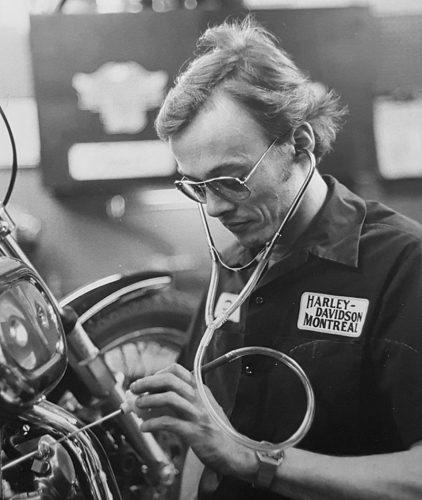 He also taught me how to be meticulous about anything I did. He once chewed me out for doing a sloppy wiring job, which I’d attempted to justify by telling him that it didn’t matter since it was under the seat and out of sight. “You have to do a clean job,” he scolded me, “even if it don’t show!” To this day, I take great care with all mechanical work I perform, especially so when working on wiring.
When Denis decided to leave H-D Montreal in midsummer 1992, he took his tools and belongings back to Quebec City, packed up his Harley FXRT – which he’d bought new in 1985 – and upon taking it out of its shipping crate, gave it a complete overhaul – and headed to Alaska.
In September of that year, I received a phone call while working at the dealer where we’d met; on the other end was Denis, who’d just returned from Alaska. “I’m going to open a shop. I found a place in Longueuil [on Montreal’s South Shore] and I’d like you to be my partner.”
It took me all of 15 seconds to give up a secure, well-paying job and enter the unstable world of self-employment and shop ownership. But that’s how confident I felt around Denis and how much I trusted him. We opened Cosden Specialties in March of 1993. You can probably guess the origins of the company name.
Aside from the standard shop tools and benches, our shop was equipped with a lathe, valve resurfacing machine and valve-seat cutting tools, TIG welder, crankshaft jigs, an arbor press, a honing machine, and countless specialty tools. Denis showed me how to use them all, and properly. We worked primarily on Harleys, built custom bikes and had even signed a contract to service the Harleys of the provincial police force.
Although Denis never road raced and went down a drag strip but a few times to test bikes, the advice he gave me by simply watching me compete improved my riding enough to win races. He had an intellect that bordered on genius, and there weren’t many subjects you could discuss with him in which he wasn’t well versed. And he had an uncanny sense of observation. “I don’t wear glasses because I can’t see,” he’d tell me, “I wear them to see better.”
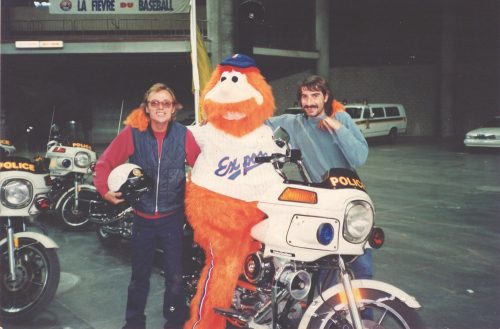 We eventually parted ways as business partners, but remained friends. He continued to operate Cosden Specialties, where he could always be found sitting on a stool by his workbench, cigarette burning in an ashtray and a steaming cup of coffee by his side. Denis’ only vices were coffee and cigarettes, both of which he consumed in abundance. I’d see him when I could, which fate dictated would be but a few times a year. He was always delighted to see me, and we’d spend hours catching up. He told me of his terminal lung cancer last October. Doctors said he probably wouldn’t see Christmas.
For whatever reasons, the skinny French Canadian motorcycle mechanic from Quebec City took a liking to the Montreal-born apprentice of Greek origin, and a friendship began that lasted until Denis took his last breath on May 30. The sign from our shop now hangs in my garage, an homage to a long-time friend.
For everything you taught me, Denis, merci infiniment.
Technical articles are written purely as reference only and your motorcycle may require different procedures. You should be mechanically inclined to carry out your own maintenance and we recommend you contact your mechanic prior to performing any type of work on your bike.
The all-new Rocket 3 R and Rocket 3 GT has the world’s largest production motorcycle engine at 2,500cc, the new Rocket 3 delivers 11% more power than the previous generation. Along with the highest torque of any motorcycle with 163 LB-FT @ 4,000 rpm.
- Two new class-defining Rocket 3 models
- Rocket 3 R – The ultimate muscle roadster, with instantaneous world-leading torque, incredible control, comfort and capability
- Rocket 3 GT – Incredible performance and presence, with supreme comfort,
laid-back cruiser riding attitude and effortless touring capability
- Pure muscular presence and magnificent style
- Signature design features, including twin LED headlights, sculpted three-header exhaust run, hidden folding pillion footrests and 20-spoke cast aluminum wheels with imposing 240 mm rear tire
- Distinctive new hydroformed exhaust headers, delivering a deep growling triple sound
- Phenomenal handling and commanding ride
- More than 88 pounds (13%) lighter than its predecessor
- The highest specification of equipment, including top-spec Brembo Stylema®
monobloc brake calipers and adjustable Showa suspension - Ride-enhancing technology, including second generation TFT instruments with
illuminated switch cubes, Optimized Cornering ABS & Traction Control, four riding modes (Road, Rain, Sport and Rider-configurable), all-LED lighting, Hill-Hold control, cruise control, keyless ignition and heated grips
- 50+ dedicated new Rocket 3 accessories
- New comprehensive luggage range and all-new accessories for enhanced comfort, practicality, style and security
- New ‘Highway’ inspiration kit, showcasing the extensive range of touring capability
This is the world’s biggest production motorcycle engine featuring several mass-optimized performance enhancements including a new crankcase assembly, new lubrication system comprising dry sump and integral oil tank, and new balancer shafts – together giving a 40-pound engine weight savings over the previous generation.
The Rocket 3 engine also has the highest torque figure of any production motorcycle, with 163 LB-FT – an astounding 71% more than its closest competition. With an incredibly flat and rich torque curve, reaching a peak at 4,000 rpm.
The distinctive hydroformed three-header exhaust run is an iconic design detail on both the Rocket 3 R and Rocket 3 GT. This has been meticulously engineered for the perfect exhaust routing, flowing from the header into the combined cat box and onto the beautiful triple-exit silencer.
For exceptional levels of rider comfort and a commanding level of control over the Rocket 3’s powerful performance, a new torque-assist’ hydraulic clutch provides the rider with a light clutch action by reducing lever effort. The Rocket 3’s all-new high-performance six-speed helical-cut gearbox is precision-engineered to be smoother, stronger and lighter than a standard gearbox.
The Rocket 3 line-up features an all-new high-specification mass-optimized aluminum frame with an innovative design that contributes to the new Rocket 3’s overall weight saving and provides an incredible torque-to-weight ratio, over 25% higher than the closest competition. The motorcycle features a fully adjustable Showa monoshock rear suspension unit with piggyback reservoir. Paired with a 1.9-inch (47mm) adjustable Showa front forks to deliver superior handling and exceptional comfort and touring capability.
Contributing to the Rocket 3’s clean, uncluttered styling is the beautifully engineered single-sided swing arm, with offset monoshock. The stylish internally wired handlebars further reinforce the bike’s muscular feel and commanding riding position. The new Rocket 3 is laced with details like a sculpted fuel tank, and brushed stainless and aluminum accents that perfectly complement their colour scheme options:
- Rocket 3 R
- Korosi Red
- Phantom Black
- Rocket 3 GT
- Two-tone Silver Ice & Storm Grey with Korosi Red pinstripe decal
- Phantom Black
The Rocket 3 R and Rocket 3 GT will be available January 2020 and pricing is expected to be announced in November this year.
Click here for more information
Yamaha Motor Canada announced the release of the redesigned 2020 YZF-R1 and YZF-R1M. Featuring a refined engine, augmented electronic control features, enhanced suspension performance, advanced bodywork, and a more aerodynamic performance with the next-generation R-series design.
Refined CP4 Engine
You’ll find the next generation of Yamaha’s unique 998 cc inline four-cylinder crossplane crankshaft engine in these 2020 models. An all-new Accelerator Position Sensor with Grip (APSG) has been added in the redesign, the ride-by-wire system with Yamaha’s Chip Controlled Throttle (YCC-T) eliminates throttle cables and reduces weight while providing smoother throttle operation. Returning features such as titanium fracture-split connecting rods and offset cylinders contribute to a responsive and potent character, while the cylinder head, fuel injectors, finger-follower rocker arms, and camshaft profiles are new for 2020.
Enhanced Electronics Package
The most technologically advanced electronics package in Yamaha’s supersport lineup complements the evolutionary engine of the new 2020 R1 and R1M. Yamaha’s proprietary six-axis Inertial Measurement Unit (IMU) continues to be the key feature of the package, processing real-time vehicle attitude and wheel speed data for the new Brake Control (BC) technology, giving riders the option to choose between two intervention modes. Riders can select a “BC1” setting for enhanced upright, straight-line braking, or a “BC2” setting for enhanced braking into corners, where intervention timing grows faster the deeper the lean angle becomes.
A new Engine Brake Management system also allows the rider to select between three levels of engine braking force to suit their individual preference or riding situation on the road or track. Both the BC and EBM settings are adjustable through onboard Yamaha Ride Control and Yamaha’s Y-TRAC smartphone (Android only) and tablet app (Android and iOS).
Enhanced Suspension Performance
Premium Öhlins Electronic Racing Suspension has been a staple of the R1M’s chassis performance, and a new NPX pressurized front fork with a gas cylinder built into the front fork axle bracket, along with revised rear shock settings to complement the performance of the front fork, are features of the new 2020 model. The base-model R1 also receives suspension performance enhancements courtesy of a new KYB front fork with a new internal shim stack design, and a KYB rear shock with revised internal settings.
Advanced Bodywork with Next Generation R-Series Design
Redesigned bodywork contributes to higher-quality performance and a more comfortable rider fit. The new design creates a 5.3 percent increase in aerodynamic efficiency while reducing wind noise and pressure on the rider when in a tucked position, while improved comfort comes from smoother side sections where the rider’s legs contact the bike. The 2020 R1M also receives a new carbon fibre tail cowl to accompany the existing carbon fibre fairing, front fender and passenger seat cowl.


The new 2020 YZF-R1 will be available in Team Yamaha Blue and Metallic Black for an MSRP of $21,999 and will begin arriving at Yamaha dealers in September. The 2020 YZF-R1M will be available in a Carbon Fibre colour scheme for an MSRP of $27,999. Quantities in Canada will be limited; contact your local dealer to place your order.
You can find more information here
When your ride has been accumulating dust and dirt, it’s time to Muc-Off
Muc-Off’s mantra is “clean, protect and lube.” The company designs and produces everything you need to do those three important steps for your motorcycle. Muc-Off has been developing cutting-edge cleaning and maintenance products for motorcycles and bicycles since 1994. And since the company is based in the U.K., the developers have a long history of trying to keep their toys clean, what with all the rain and wet roads in that part of the world.
 Muc-Off products include concentrated soap, premixed spray soaps and waterless spray soaps that clean and polish when you don’t have a hose handy. Microfibre cloths, microcell sponges and chain cleaners round out the cleaning liquids. Muc-Off also offers a wide array of cleaning brushes for washing painted bodywork to spoked wheels and a brush specifically designed for cleaning the drive chain. The company even offers specialized brushes for getting into the tightest spots; a couple are particularly useful for getting between the cooling fins on an air-cooled engine.
The protectant part of the equation includes an all-around spray that is sprayed on after washing and leaves a non-sticky protective layer that inhibits corrosion and dirt adhesion between washes. There is also a finish detail spray specifically for matte finishes.
For bikes with final drive chains, Muc-Off offers two chain lubes: one for all types of weather (remember, it was developed in rain-soaked England) that is designed, obviously, for wet conditions, but also for longer distances, and is claimed to withstand the rigours of off-road riding; and a dry chain lube for short to mid-range distances. Handy having the choice if you just run around town frequently or spend many hours at a time on the road. Both products are safe for all types of chains.
In addition to these products, Muc-Off has developed a multitude of other products, including an anti-fog treatment spray, visor and lens cleaner, and a product called Foam Fresh for keeping the inside of helmets, jackets and boots smelling fresh.
Last winter crept up on me and I didn’t get the time to wash my Triumph Tiger 800XC properly before the snow flew. It really didn’t bother me, as that style of bike doesn’t look bad when it’s dirty. But this spring, when I got the Tiger out, I felt sorry for it and washed it on the first decent day. I broke out the Muc-Off products and spent some time trying out the various cleaners and brushes.
 Simply spray on the biodegradable motorcycle cleaner on a wet bike and let it sit for a few minutes, agitate the heaviest grime with the appropriate brush and rinse off. I was surprised by how little work was required to get last fall’s grime off, even after it sat all winter. Almost all of the dried-on bugs lifted easily, although I had to work slightly harder to remove some of the more stubborn ones.
Between the Muc-Off soap and the biodegradable chain cleaner spray, the grease on the rear wheel and chain guard that had been splattered with last year’s chain lube cleaned up nicely. The stiff chain-cleaning brush is designed to clean three sides of the chain at one time and has longer stiff bristles on the other end of the handle for getting into hard-to-reach areas.
The only thing left to do was to lube the chain when it dried – all-weather chain lube, in my case – and spray the protectant spray over the whole bike (except the brake parts, of course).
The bottom line: all of the products I used did exactly as they claimed. I cleaned a very dirty bike to a gleaming shine with minimal effort. Then I immediately went out on some muddy forest trails because, well, the Tiger looks just as good dirty.
Muc-Off (muc-off.com) also makes many more products than are listed in this review and are distributed in Canada through Kimpex. Products range in price, and prepackaged multi-product kits are also available. Go to your favourite motorcycle shop, dealership or kimpex.com to pick some up.
Sometimes lack of planning and unexpected misadventures make for the most memorable stories.
“I didn’t think I’d get stuck in snow this time,” I pondered as I sat at my public park campsite in between the ball diamonds and a splash zone in Wolf Point, Montana. I also didn’t think I’d get into a bar fight, become stranded in the wilderness or sleep on someone’s front lawn, for that matter. But sometimes that’s just how things go. Often our all-time favourite trips consist of things that didn’t go exactly to plan. We tend to dwell on the ultimate goals, allowing them to steep in our minds and take away the moments in front of us – like putting a fogged lens on a camera that inhibits you from taking in the full picture.
One of my fondest memories is from a 2015 trip I did from British Columbia to Ontario. My planning for this didn’t include accommodations or a diligently mapped route. I was more focused on packing a set of clean base layers with a slight concept of my route and, of course, a can of beans in case I became lost and hungry.
I rode south through the ever-expanding landscape of the Kootenays from Revelstoke, British Columbia, enjoying every curve to the U.S. border. I crossed into Washington state and continued my ride into Idaho. As the sun sank, I approached the lighted urban nightscape of Coeur d’Alene. My stomach was telling me I couldn’t avoid heading into town, where I spotted a bar with the roadside lined with motorcycles.
The First Unexpected Challenge
 Good food and good conversation were had as I sat on a sidewalk patio and chatted with other riders. Out of the corner of my eye, I saw a group of girls who looked like they had taken advantage of happy hour and now had their sights set on the lineup of bikes. One girl jumped on a custom Suzuki GSX-R1000 parked beside my bike and posed while her friends snapped photos.
My enraged stare must have burned holes in the back of her head and she turned around to exchange words. She stumbled toward me tripping on the raised curb. I proceeded to remark about her troubles walking as she brushed herself off and within seconds she had my hair in one of her hands as the other was throwing a misaimed punch to my forehead. My survival instinct kicked in and my fist was simultaneously returning her punches.
As if a grenade had dropped, everyone jumped back and started cheering and yelling! Fists met faces! The bouncer barrelled through the crowd and threw an excessively hairy arm between us and broke up the fight. He gave me a high-five after everything settled down.
Riding solo allows you to portray a side of yourself that doesn’t often shine through. For me, on that night, it was badass biker woman – a force to be reckoned with.
Alternative Routes
 The next day I awoke with a new sense of myself as I left Coeur d’Alene with the Idaho sun beating down. I pulled into a gas station to have a look at my trusty paper map to look for fainter lines to follow to continue my journey east. Being fed up with cottagers and other impassible traffic, I decided this would be a good day to take the road less travelled.
I was heading home to see my parents and help them to move, so there was a definite deadline. My parents were packed, ready and waiting for me. My options were to continue on the tourist-ridden road or take a small spur off the main road. I found a faint line on the map that weaved through the forest in the right direction for about 65 kilometres.
I followed a side road following the path of the running water beside me, gravel in the corners, no lines on the road . . . and no cars! As I rode farther away from civilization, I came to a fork in the road. Eeny, meeny, miny, moe was my first tactic to settle on a route. If it didn’t take me where I was planning to go, I knew it would at least take me somewhere, and sometimes that’s enough.
I embarked on my journey down the forgotten road. Within moments I was in awe of an immense tunnel blasted through a rocky ridge. The tunnel was originally built for loggers to pass through instead of building a road over the ridge. The single-lane road curved alongside a kinked river and mountainside, and the wilderness was humbling and breathtaking. The “road” turned into a gravel trail that wound up into the mountains. I strategically made my way along the rough road, finding enjoyment in the slow riding while taking in the vistas of the untouched wilderness that surrounded me.
As I made my way through the trail to about the last 10 km, I noticed the elevation climbing higher and patches of snow were getting larger. I suspected that the ride was about to get unexpectedly interesting.
The End of the Trail – Almost
The patch of snow was nine metres long and about a metre deep with a deep rut already cut into it. I knew this would be a troublesome task, but my bike was up for the challenge and I wasn’t about to give up easily.
I was close to a main road but figured there was one of two ways this could go. I could make it through the snow on my fully loaded street bike with balding street tires with great success, arriving in town and proving my father wrong about my pace. (He said I was travelling slower than Terry Fox.) Or I could get stuck and spend the rest of my day riding back on the road I had just taken only to end up at the gas station I was at hours before.
As I rode through the snow, my bike was fishtailing as it struggled to find traction. I had almost made it through when I was stopped dead in my tracks. My rear wheel couldn’t make it over a massive clump of iced-up snow. I tried pushing the bike back and forth to try to gain momentum, but it was a no-go. I was stuck!
I lost my footing and dropped my bike.
“Damn you, Idaho!” I yelled along with a few expletives, waving my fist to the sky as my pride deteriorated to dust and blew away in the warm Idaho wind.
No cell service and alone with my bike stuck in snow – this was not a situation I was proud to have put myself in. Discouraged, I unloaded my bike and picked it up, then pushed it back through the rut, sliding and slipping in the snow. After almost an hour of gruelling work, both wheels were back on dirt. I sat for a moment to think about this humbling experience, with its lesson to be prepared. Then I loaded my gear back on and reluctantly began the five-hour trek back to the gas station.
Plan B
 As the sun sank below the horizon, my “low fuel” light illuminated; it would be tight. I had to move quickly to ensure the gas station would still be open. I finally arrived at the same pumps where I had been several hours before. I breathed a sigh of relief as I filled up my tank, which had nothing left in it but fumes. I decided to make it as far south as I could to prepare for the Lolo Pass crossing into Montana in the morning.
Julietta was a quaint rustic town that lined the highway. Like a beacon shooting up in the night sky, an “open” sign was the only thing illuminating the town. I was in need of a quick bite before I settled down for the night. As I walked through the doorway of the almost empty pub, I immediately felt short of breath from the second-hand smoke that filled the room. With my eyes burning, I pulled up a stool at the bar; the two chihuahuas that were running on top of the bar, the town’s mayor, his girlfriend and the bartender all stopped and stared. They all sat at the bar with their extra-long cigarettes, extra-light beer and looks of bewilderment. For a split second, I thought about leaving, but if my day weren’t already interesting enough, this would surely make for a good ending.
I grabbed the small stand-up menu from the bar – Tater Tots or a turkey sandwich. The options were minimal, but there wasn’t a thing I didn’t like on the menu, so I ordered everything. Within minutes, a half-dozen locals began filtering into the pub: they may have been the rest of the entire population of the town. Bobby, a local, and I hit it off and, as the night went on, we talked about many things. I learned she has had a very hard life over the past three years, having battled cancer and lost several loved ones during that time.
I asked Bobby where I could set up camp and, after taking a longer than normal sip of her beer, she proposed I camp in her yard for the night. I left Julietta the next morning with a heavy heart, grateful for my encounter with Bobby and the other friendly town folk.
An Unforgettable Ride
I made my way down through Orifino and into Kooskia as the sun rose high, and I stopped for gas just before heading to the Lolo Pass. I was excited about this part of my journey as it would be the last bit of vertical land I would see before the mountains flattened into prairies and farmland. As if a child drew a line through a maze, the Lolo Pass is perfectly scribbled through the scenic mountains of the Bitterroot Range of the northern Rockies.
Over the past 48 hours, I had experienced being stuck in snow, involved in a bar fight, vast wilderness, kind people and kooky small towns. Most of all, I gained empowerment and confidence. My pace was slow, but it’s not always about the destination. What makes a trip unforgettable can be an experience that happens in a matter of minutes or through a span of a couple days.
Although I had been on the road for only three days, they held a year’s worth of experience and education. Those events would have made a perfect ending to an eventful trip, but the reality was my trip had just begun. I unknowingly set my fate for a long, hard and very worthwhile ride that involved ticks, unnerving camping spots, near misses with giant birds and silver-tongued answers to get out of speeding tickets.
But that’s for another time.
Soon to be 100 years old, Mr. Betts isn’t going to let a little thing like age stop him from riding his Gold Wing.
On the family property near the hamlet of Wentworth in Cumberland County, Nova Scotia, “Bun” Betts and his older cousin tinkered with an old Indian V-twin motorcycle. They’d checked and cleaned the plugs, adjusted the timing, added fresh gasoline, set the spark advance and hoped for the best. Betts pushed the bike down the lane with his cousin at the controls, and the Indian barked to life.
“I was 12 or 13 years old then,” Betts says. “And that’s my earliest memory of a motorcycle. I never did ride it myself – I was always either pushing it to get it started or sitting on the back of it as we roared down the road.”
Born on August 15, 1919, Betts’ full name is Charles Wyman Betts. When he was just a toddler, he says, he got pneumonia and almost died.
“The doctor, he’d given up on me,” Betts says. “But it was the nurse who tried something that broke the pneumonia. After that she called me her little bunny – or Bun for short – and the nickname stuck. My mother called me Wyman, but nobody around here knew my real name. I was Bun to everyone.”
A Long Line of Hard Workers
 Betts comes from a family of hard-working people. He says his grandfather, Baynard, was a stowaway aboard a schooner.
“He was nine years old when he got on the boat somewhere overseas and hid among a bunch of molasses barrels,” Betts relates the story he was told. “They found him there and, of course, they couldn’t turn the boat around. When they landed in Halifax, he found his way around and, at some point in time, got an education because he went on to own and run a general store with his wife in the Wentworth Valley area and raised a family of six children, including my father, Arthur.”
Betts continues: “I had to start working myself when I was nine years old. My father was in the logging business, and we had a mill called A.T. Betts and Sons. I clearly remember that it was Arbor Day, and we were off school. I went to the mill that afternoon, and that was the day my father lost his hand in a workplace accident.”
While the two events weren’t connected, after that tragic incident, Betts began helping out at the mill. When he was through school, Betts says, his whole life became dedicated to the job. He’d work the saw, cutting the logs and milling the wood into dimensional lumber that was then sold to a wholesaler. When the pond at the mill would freeze over, Betts would go to work at the local ski hill, moving snow or tuning skis. He sold the mill when he was 70, but continued working there for several more years.
His First Two-Wheeled Transport
While he recalls his cousin’s Indian, it wasn’t until Betts was in his late 20s that he invested in a ride to call his own. It wasn’t a motorcycle, however. What Betts bought to travel the half-mile from the family home to the mill and back was a new 125 cc Vespa scooter with a pressed steel, step-through chassis and 10-inch wheels.
“I think that lasted about one summer,” Betts says of the diminutive form of powered two-wheeled transport. “The scooter didn’t work out as well as I thought it might have.”
Years later, Betts returned to motorcycles. But first, he had to get flying out of his system. When Betts was in his early 50s, he bought a Cessna 172. He learned to fly and would pilot the Cessna over Wentworth Valley and other parts of Nova Scotia, simply admiring the verdant landscape laced with rivers and dotted with ponds.
First Motorcycle
 Then, he got a small Honda motorcycle. He can’t recall the exact model, but he kept it for only a couple of years before moving up in the early 1980s to a Honda GL650 Silver Wing Interstate. (That midsize touring bike was introduced in 1983 and was based on the GL500 Silver Wing, introduced in 1981, which in turn was based on the manufacturer’s earlier CX500 model; each of those bikes had a 80-degree, liquid-cooled transverse mounted V-twin engine, five-speed transmission and shaft final drive. In 1983, Honda dropped the GL650, the manufacturer’s remaining midsize touring motorcycle from its lineup.) Betts kept his Silver Wing for two or three years before moving up to a 1200 Gold Wing.
Evenings or weekends, when Betts wasn’t flying his Cessna or crafting impressive grandfather clocks made of oak and other hardwoods, he was riding – but only when the weather was warm and never when it was raining. “I’m not a wet-weather rider; I only like the summer sun,” he says with a laugh. “And I never ventured very far, because I couldn’t stay away from the mill for very long. And then winter would arrive, and you don’t ride in the snow.”
Gave Up Flying, But Not Riding
When Betts reached the age of 80, he sold his airplane, but, as he approaches his 100th birthday, he continues to ride. His current motorcycle is a 2003 Honda Gold Wing that he bought used with only 1,000 kilometres on the odometer. Betts rides in a well-used leather jacket adorned with a Defenders Motorcycle Club crest, an open-face helmet, good gloves and some heavy sneakers. He prefers to get aboard his Gold Wing from the high side, or from the right rather than the left. While the bike is heavy, he says, he has no problem getting it off its side stand and, with its 1,800 cc powerplant, Betts is impressed by the power.
“I’ll get the bike out on the driveway and when I get to the bottom, I’ll decide whether to turn left or right, then I go wherever the road takes me – and they’re all good roads around here,” he explains. Obviously, he likes to ride because his ’Wing’s odometer currently shows almost 69,000 kilometres. “I like the two-lane roads where I can go 70 to 80 km/h,” he says. “That’s where I’m comfortable, and you can just get out and watch the countryside roll by.”
However, on a Tuesday evening, one of his favourite places to head out to is Bike Night at Masstown Market in Masstown. He enjoys visiting with others and talking about motorcycles, and always buys a 50/50 ticket. The proceeds from tickets fund a summertime picnic – and he appreciates attending that too.
Of his age, Betts says, “One hundred is just a number. I feel fine, but I do get tired a bit more easily than I once did.”
He waxes philosophical when he talks about his approach to life: “I’ve never been one to make plans. Tomorrow’s another day, and I’ll always take it if it comes…”
While the looks are a little over the top, the handling and performance are spot-on.
Svartpilen doesn’t exactly roll of the tongue. It’s an unusual name, and I wondered if it actually meant something. It does, in Swedish. In English it translates to “black arrow.” So now you know.
While I wasn’t initially fond of the 2019 Husqvarna Svartpilen 701’s styling when I first saw it in pictures, it actually looks really cool in three dimensions. I immediately appreciated its bold design once I saw it in the metal at its international press launch, held in Lisbon, Portugal. As a bonus, the bike backs its unique styling with excellent performance.
A Svart-Dressed Duke
 KTM acquired Husqvarna Motorcycles in 2013, and that collaboration has resulted in several street-oriented KTM-based Huskies, including the Svartpilen. That’s why beneath the Svartpilen’s bold bodywork – in which you’ll see hints of naked bike, dirt tracker and Mad Max – you’ll find a tweaked KTM 690 Duke. And that’s a very good thing.
KTM’s 693 cc liquid-cooled single is the most powerful production single ever made — by anyone. It claims 74 horsepower and 53 ft-lb of torque. That’s about the same horsepower as Suzuki’s SV650 V-twin, with about 8 ft-lb more torque on the Svartpilen. The engine has two counterbalancers; one counters crankshaft vibration, and another one in the cylinder head does the same for the valve train. The engine transfers power through a slick-shifting six-speed gearbox.
While the frame and swingarm are the same as on the KTM 690 Duke, other chassis components are not. Unlike the Duke’s WP suspension, which is adjustable only for rear preload, the Svartpilen is equipped with higher-spec WP components. Its 43 mm inverted fork and single rear shock are adjustable for compression and rebound damping, and the rear shock is also adjustable for spring preload. The Svartpilen also has 15 mm more suspension travel than the Duke, at 150 mm front and rear.
A More Relaxed Ride
Other chassis changes include a more upright riding position than on both the Duke and the Svart’s sibling, the Vitpilen 701. (Vitpilen translates to “white arrow.” So now you know.) An 18-inch front wheel on the Svartpilen takes the place of the 17-incher on both those other two bikes. While the Vitpilen’s chassis geometry is identical to the Duke, the Svartpilen’s is a bit more relaxed due to its larger front wheel. The Svartpilen also has a more relaxed riding position than either of those bikes, with a higher handlebar and lower foot pegs.
The Svartpilen is rather svelte, tipping the scales at 158.5 kg dry, or about 164 kg full of fuel. Traction control is standard on the Svartpilen, whereas it was part of an optional track package on the Duke. The Svartpilen also has an electric quick shifter, although it only works when shifting up. ABS is also standard, and like the traction control, it can be turned off.
Cranking It Up
 Among the most exciting press launches I’ve attended in the past were those where the hired route guide rides like he’s trying to evade capture. That was the case on this ride, which took us west out of Lisbon and toward Cascais, then north into the mountains. I followed the lead rider, a local fellow, out of our hotel’s parking lot and, after a brief wait at a nearby traffic light, he took off between cars as if he were riding in a rally. Lane splitting and filtering is the norm in Europe, but this was extreme. This was promising to be a fun ride, prompting a grin that hurt my cheeks.
The rolling slalom between cars really emphasised the Svartpilen’s nimble handling, slender framework and torquey engine. The gearbox shifted with a feathery touch, although I refrained from using the quick shifter and mostly used the clutch in town because the latter provided smoother gear changes. Using the quick shifter increased the effort at the shifter, and in town the shifter was being called into service frequently.
Once we got on the highway, the speeds increased and the Svartpilen easily maintained 130 km/h, or about 10 km/h above the posted speed limit, without straining. (Actually, highway traffic in Portugal moves along even faster than that.) While the engine is mostly smooth at highway speeds, some buzzing does transfer through the seat and the mirrors blur at higher speeds with the engine spinning above 6,000 rpm.
The ride only got better when we hit the winding mountain roads north of Cascais. The wide handlebar provides lots of leverage for manoeuvring around tighter bends, without inducing a weave through faster sweepers. Rolling on the gas between turns is a blast on this bike, as it lunges forward regardless of the selected gear. Because of the engine’s broad power band, shifting is mostly optional.
Canada-Friendly Suspension
 The suspension really impressed me. Usually naked-bike suspension is tuned almost supersport-stiff, which returns exceptional handling but a toll on rider comfort. The Svartpilen has what I’d consider a Canada-approved suspension. We took a turn onto a tight, narrow and twisty road with bumpy, patched and broken pavement. Our near-escapee lead rider never slowed, so I just followed, surprised to discover that the Svartpilen railed along, soaking up bumps without upsetting the chassis while returning confidence-inspiring handling. A sport bike would have probably folded in two under these conditions.
The only suspension adjustment I made after our first rest stop was to increase the rear rebound damping, which initially was too soft for my weight and caused the bike to wallow a bit at higher speeds. A flat-blade screwdriver is needed to make the adjustment, which nobody had on hand, so I improvised by using the ignition key, which worked remarkably well.
About my only gripe with the bike is with the instrument cluster. While the gauge itself is a large round item, the display area is much smaller. It also sits at an awkward angle that makes it hard to see, and the rubberized trip-meter buttons to the left of the gauge are hard to use, as they need a lot of pressure to depress.
Uh, There is One More Thing
There’s one more thing that puts me off about the Svartpilen 701. It’s not the handling, which is exceptional. It’s not the engine’s output, which is smooth enough in delivery to make a novice feel at ease, yet more than powerful enough to satisfy an expert rider. And it’s not the styling, which I find to be fresh, unique and quite functional.
It’s the price. The 2019 Husqvarna Svartpilen 701 retails for $13,399. That’s a whopping $1,900 more than the 2019 KTM 790 Duke, which features a 799 cc, 103-horsepower liquid-cooled parallel twin. While KTM has pulled the 690 Duke from its 2019 lineup, that bike sold for $9,999 last year. So, yes, the price makes Svartpilen 701 a hard sell. But if you like its bold styling enough to splurge, you won’t be the least bit disappointed with its performance…
Now you can ride the same Ducati superbike as factory WSBK riders Chaz Davies and Alvaro Bautista
For the first time ever in the past 31 years since the World Superbike Championship (WSBK) began in 1988, there were no twin-cylinder motorcycles of any kind on the grid when the WSBK series kicked off on the Phillip Island Circuit in Australia last February. It was a watershed moment for Ducati, as there wasn’t a Desmo V-twin Ducati on the track. In addition, all the bikes on the grid now have one-litre engines for the first time since 2008, when the Fédération Internationale de Motocyclisme (FIM) lifted the capacity ceiling for twins to 1,200 cc versus 1,000 cc fours.
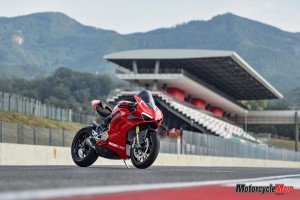 Ducati finally has ended its line of Desmo V-twin racers. Their history stretches back to 1972, when Paul Smart won the Imola 200, the Italian manufacturer’s debut race with a 750-cc Desmo V-twin. Fourteen World Superbike titles later – the last of them won as long ago as 2011 by Carlos Checa with a 1098R – Ducati has now finally produced a four-cylinder model for Superbike racing, closely based on its Desmosedici V4 MotoGP contender, originally introduced back in 2002, with the latest version (on which Andrea Dovizioso has been runner-up in the past two MotoGP World Championships to the Márquez/Honda duo).
That Desmosedici technology was already brought to the mass production marketplace one year ago with the Panigale V4 S. However, that bike’s 1,103 cc motor made it ineligible for Superbike racing. But at the 2018 EICMA Milan show, Ducati unveiled its first-ever four-cylinder street-legal superbike – the 998 cc Panigale V4 R. WSBK homologation rules place a price cap in the country of origin for homologated models, which must be fully street legal as well as have a minimum of 125 bikes built before the first race, 250 by the end of the first year and 500 by the end of Year 2.
Production of the V4 R began in January, prior to the Phillip Island race. The V4 R is Ducati’s most powerful customer road bike yet, delivering 221 hp on a bike 172 kg dry weighing for a power/weight ratio of 1.28. Add on the racing kit, which includes an Akrapovič race exhaust, and power rises to 234 hp and dry weight is reduced to 165.5 kg.
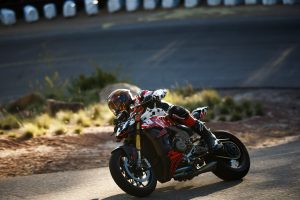 But Ducati doesn’t regard the V4 R as a limited edition special like the 500-off Superleggera, which sold out immediately in 2017 despite its $85,000 price tag and half the number of cylinders. “We anticipate building at least 1,000 examples of the V4 R in 2019,” says Paolo Quattrino, Ducati’s product manager,. “While, of course, it’s a very expensive model, we believe that the high level of technology and the outstanding performance will attract many customers – not only committed ducatisti, but we hope to conquest customers from other brands. So this will not be a limited edition model.” The price in Canada is set at $47,995.
Purchase the issue to continue reading
Traction is so overrated.
A motorcycle is not meant to slide. It’s unnatural. You have to make it happen. And whether it happens by mistake or by skill, it’s one of the single most exhilarating sensations a human body can experience. You are on the edge of traction – crashing, but not crashing. This is flat track racing.
 I grew up racing motorcycles in Eastern Canada in the late ’70s and ’80s during a period when the American Grand National Championship flat-track racing was in its glory days. Roberts, Springsteen, Shobert and my favourite racer of all time, Ricky Graham, were legends in their prime. Although I’ve spent more than 40 years racing motocross, road racing, supermoto, ice racing, desert rally and off-road, the addictive sliding sensation of American flat track is what appeals to me most.
So in early March, I buy a little van, throw my old Honda dirt tracker and a bunch of stuff in the back and drive the 3,000 km from snow-covered Moncton, N.B., to be a part of the 78th Daytona Bike Week.
On March 14, the Daytona TT kicks off the American Flat Track (AFT) Championship series. The track has been moved to centre stage within the Daytona International Speedway in the same location that the Supercross track was a week before. Leading up to the TT, Florida becomes a hotbed for training, support racing, promotions and everything flat track. New race teams are gearing up to tackle the summer-long race series all over the U.S.A.
Resurgence of the Sport
 Flat-track racing is enjoying a rebirth. AFT has reconfigured the classes to Pro Twins and Singles, added better and more venues and attracted an audience with online technology. You can watch every race live and for free on fanschoice.tv. With that renewed interest, sponsorship continues to grow. More motorcycle brands are involved than ever before. The fields are deep and racing is always bar-to-bar and thrilling. With all that, the series hasn’t lost its grassroots feel of Saturday night at the county fair.
After three days of driving down the eastern seaboard, I am rolling through the picturesque rural landscape of central Florida. The endless fruit production and pasturelands hide the fact this is a significant dirt-bike neighbourhood. First, I roll past the gates to Bakers’ Factory, where KTM’s professional Supercross racers train. Close by, there is El Chupacabra Ranch, the private training facility of pro racer Blake Baggett. I follow my instructions and let myself in at the private gate a little farther down the road.
This is home to Johnny Lewis and Moto Anatomy. You quickly see this isn’t farmland. Race rigs and trailers, dirt ovals of various sizes, motocross tracks and motorcycles of all breeds litter the compound. Racers from all over are here for one purpose: to get faster on a race bike under the tutelage of Lewis. Jeffrey Carver Jr., an AFT Pro Twins Championship hopeful, is pounding laps on a motocross bike. MotoAmerica road racing champion Alex Dumas, from Quebec City, is integrating dirt-track training into his program as he prepares for the Twins Cup Championship series. Pro Supersport road-racing champion Cory Alexander, from New York, is spending his days on motocross and dirt-track trainer bikes and putting the final touches on his new Kawasaki 450 AFT Singles bike for the Daytona TT. And me? Well, I’m just happy to be here, visiting the Lewis family again and going around in circles on my Honda.
In Training
 I was led to Lewis a few years ago as I was preparing to race the Pikes Peak International Hill Climb. I spent four days in a one-on-one dirt-track training program designed to improve my skills on a 200-hp mountain road racer. Lewis uncovered 40 years of bad body position habits on the first day back then that I’m still working on. And I never knew you could accomplish so much with a rear brake.
A transplant from a hotbed of dirt-track racing in Pennsylvania, Lewis moved his family to Florida in 2014 with the vision of offering professional racer training. Turning 30 years old this year, he is still a threat anywhere he laces on a steel shoe, as his recent podium at the Texas Half-Mile demonstrated. But his heart is more focused on sharing his riding and racer prep knowledge and helping to develop the sport.
We head to Orlando for the day for a special project. Motorcycle racing legend Jeff Ward, at 57 years old, has decided to race all of the TT-style races on this year’s AFT series, beginning with the Daytona TT – an idea spawned during an impromptu outing at a Moto Anatomy school in Southern California last year. We arrive early at Standard Motorcycle Co., about the hippest little shop on the planet, to ready Ward’s Daytona TT bike. Boxes and boxes of flat-track specialty parts are installed on a Moto Anatomy trainer bike until it is AFT Singles-legal and ready.
Track Time
The next day, we land at Cross Roads Speedway in Jasper, Fla., for a day of testing at one of the state’s most favoured short tracks. Lewis organized the day and invited a list of racers preparing for the Daytona TT. I am happy to be invited to get some seat time and mix with AFT stars Jeffrey Carver Jr., Brandon Robinson, Brandon Price and Jeff Ward. Besides a rained out event last year in Quebec, my last-dirt track race was in California in 1999. I have to admit I was giggling in my helmet as I chased Hall of Famer Ward around the clay oval.
“You’re never going to turn that bike if you don’t get that leg out,” mutters Lewis as he walks past me in the pits. He doesn’t miss anything. He’s always in motion, maintaining the track and observing the riders, his cellphone either at his ear or pinging endlessly with incoming texts and emails. Get a tire to this guy; that guy needs a bike; these people need a place to stay; a new sponsor inquiry; new course signups; interviews; talk-show host offers; come teach in our country; etc.; etc. Being well connected in the sport of flat track comes at a price, but I’ve never heard him say no. With the season opener in his hood, he is in demand.
After the Daytona TT, Moto Anatomy hits the road for training schools that are selling out all across the U.S.A. and Canada. Last year, Lewis was invited to give a school in the U.K. for members of a start-up flat-track series there. He’s returning there this year and adding the Netherlands and Greece to his trip. He consults with a start-up series in Brazil. Saudi Arabia has called!
Flat Track Made Famous
Flat-track racing is as American as apple pie, but was mostly misunderstood by the rest of the world until dirt-tracker Kenny Roberts showed up in Europe and won the World Grand Prix road-racing championship in 1978. Americans Eddie Lawson, Wayne Rainey, Kevin Schwantz, Kenny Roberts Jr. and Nicky Hayden all cut their teeth on dirt tracks and went on to win the world title. Today, most of the world’s elite motorcycle racers integrate dirt track into their training program. I think it’s a matter of finding and getting used to riding a motorcycle on its last breath of traction. As Lewis puts it, “You are basically almost crashing all of the time.”
Before the Daytona TT feature race, there are three days of racing in the AMA All Star National Flat Track series going on at the Volusia Speedway Park in central Florida. Two days are on the fast half-mile banked clay oval and one day on the short track. The grids are full, with more than 300 entries travelling from far and wide to enjoy Bike Week and the sunny south.
My stock-engine Honda doesn’t have the horsepower for the big track, claiming a fourth and a fifth in the main, but is well suited for the short track, on which I manage to win my heat race and the main event. I am happy enough just keeping myself off the ground for three days, as I just had the plates and screws removed from my shoulder from my last getoff, cartwheeling my rally bike off the side of a mountain in the 2017 Fundy Adventure Rally.
Race Day
The next morning, I flash my media pass at the gate and proceed to drive under Turn 1 of the famed Daytona International Speedway, through the tunnel and into the pit area. It’s race day – the 2019 Daytona TT. I meander through the race garage pits like a true fan-boy, glad-handing and snapping pictures and selfies with any of the AFT stars who will tolerate it. The mood definitely is elevated and everyone has Race Face on.
The Moto Anatomy garage houses its two entries in the AFT Singles class: the No. 336 of Ward and the 122 of Dalton Gauthier. Gauthier, a 20-year-old from Pennsylvania, won this event in 2017. Both KTM school trainer bikes are well prepped, but have stock engines giving the bikes a pretty big disadvantage on the long, asphalt front straight of the new track format.
Qualifying to race the main event is no easy matter, with almost 70 entries and the final grid allows only 16 bikes. Ward is fast, running just outside the top 10 in qualifying lap times. Ward, usually a gifted hole-shot guy, unfortunately gets bumped, crowded and buried off the start of his heat. And with that, his day is done. There is no recovery from a bad start in flat track, with the top 20 bikes running within the same lap time’s second. Gauthier recovers from a poor qualifying time, puts himself in the main event and pulls off a second place after leading for a while. Very impressive for a thrown-together deal on a stocker, thanks to Lewis. Look for this kid in Victory Lane all season.
The Pro Twins main has some drama. With JD Beach and the No. 1 plate holder, Jerad Mees, crashing out early, No. 44 Brandon Bauman takes his Indian program to a new level and a victory.
Just because I don’t want my gypsy tour to end yet, I stop in at Senoia Raceway, just south of Atlanta, on the way home. They call this place the Baddest Bullring in the South, a fast, high-banked, black groove, clay flat track. Saturday night racing under the lights with full stands just can’t be beat. A front-row start and a second place in the main is just a bonus.
Three days later, with my van’s odometer having tracked a 7,900-km round trip, I roll to a stop in my driveway, which is lined with snowbanks more than a metre high. And thinking to myself: “That’s how you do Daytona Bike Week.”
There is a lot to explore in the magical state of New Mexico
“WARNING: Highway 70 may be closed at any time for up to three hours during a Missile Test.” That road sign is the first indication that I am approaching White Sands National Monument, which is surrounded on three sides by White Sands Missile Range, the largest military installation in the United States. White Sands, which encompasses 8,300 sq. km. in southern New Mexico and is most infamous as the test site for the first atomic bomb, is a key location in the U.S. military’s defence plan.
After collecting my National Parks Passport stamp at the visitor’s centre, I follow the 12-km driving loop into the largest gypsum dune field in the world. It is almost noon and the whiteness is blinding. At the four-kilometre mark, the paved road reverts to sand and I stand up on the pegs of my 650 V-Strom. Dazzling sand drifts so much and so regularly that plows must be used to clear a path, leaving pristine roadside banks. Were the temperature not 35 C, I could believe I am riding right into a Canadian winter, especially when I happen upon a large group of children riding saucers down the dunes. Unlike other sands, the pure white gypsum crystals do not become hot in the sun, and I hike over several towering dunes just to experience something of their size.
UFOs and Aliens
 Northeast of Alamagordo, the landscape rises by almost 1,000 metres and the temperature drops by more than 10 degrees. At Ruidoso, I suddenly find myself surrounded by tall ponderosa pines, an abrupt change from where I had been only an hour before. I am heading to Roswell, out of my way by three hours because, after all, this is a riding holiday – and besides, who wouldn’t go that far to see aliens? A central feature of downtown Roswell is the UFO Museum, which stands by the claims of rancher William Brazel, who in June 1947, found strange fragments of metal that could be pieced together into a “saucer.” The U.S. weather service maintains the material came from a weather balloon, but tales of sightings and conspiracy theories have only increased over time.
Before the sun sets, I return to Ruidoso and “wild camp” along Ski Run Road in Lincoln National Forest. I revel in the silence, a soulful cricket my only companion, and in the ponderosa pines wafting their delicious vanilla-like aroma.
Most of the next day is spent traversing flat rangeland. Arrow-straight back roads, which in Texas would have a 75 mph limit, are limited to an unreasonable 55. As there seldom is another vehicle in sight, I decide to obey the law – of Texas. I soon discover that locals feel the same when a pickup truck hauling a horse trailer pulls up and passes me.
Maggie’s Diner
From Moriarty to Tijeras, I follow a section of Route 66, then turn north on Highway 14 – a truly Scenic Byway. Knowing that scenes from the movie Wild Hogs were filmed at Maggie’s Diner in Madrid, I look forward to eating there myself, just to say I have. I ride into town, past all sorts of quirky shops and art galleries, and there it is! I take a selfie out front and go inside to find the bar and booths covered in T-shirts, stickers, patches and jewelry, some of it celebrating the diner as it had appeared in the movie. But not a beer or an enchilada in sight. Disillusioned, I head across the street to the Jezebel Café & Soda Fountain. It is good. But it isn’t Maggie’s. And the server is no Marisa Tomei.
The ride into Santa Fe with its 400-year history and adobe architecture brings back the magic. New Mexico is known as the Land of Enchantment, and Santa Fe contributes more than its share of that aura. Unique Pueblo pottery, kachina dolls and Kokopellis adorn art studios and shop windows alike. I park just off the plaza to enjoy the ambiance and tour the oldest house in the U.S.A. (ca. 1649) and the oldest church (ca. 1610). The mix of Native and Spanish cultures really does stir a sense of the numinous. The road into the mountains is wonderfully twisty, but this is no place to race. Corners show remnants of winter sanding, and on eight occasions I come upon mule deer standing beside – or on – the road. I set up camp at 3,048 metres above sea level in Santa Fe National Forest.
Morning is so still and quiet that I can hear the air whispering under the wings of a raven overhead. I push back the cover of my bivy and see my breath – it is below 0 C – so I lie there for a while, warm in my down sleeping bag and encircled by aspens that point skyward. Their bark is white and their new leaves are the unequalled green of spring.
Atomic Development
 Fifty-five minutes later, I ascend into Los Alamos, a misfit town in this southwestern land. Once little more than a ranch school for boys, during the Second World War, Los Alamos became the secret government town where the sole purpose was to develop the atomic bomb. I pass the old gatehouse where all visitors to town had been required to show ID, and I tour the museum that tells the town’s story. Today, Los Alamos National Laboratories has grown and diversified, and the town’s residents rank among the most highly educated and with the highest earnings in the nation – quite a contrast to the rest of the state.
En route to the Jemez Mountains (pronounced HAY-mez), traffic is filtered through a checkpoint because the road leads through a maze of secured government buildings. Highway 4 leads to Valle Caldera National Preserve, a 36,000-hectare basin that is the remnant of a volcanic explosion that was 500 times more powerful than that of Mount St. Helens. I wind through aromatic piñon forests and past hot springs before descending into the Jemez Valley, which lies between sharp cliffs of white and red. In Jemez Springs, I explore the ruins of a pueblo and church dating back to the 1620s. Like other remote mountain communities, this village seems to draw an interesting mix of artists, sculptors and free spirits.
Farther south, I detour up Forest Service Road 376. The single-lane route winding up a red canyon wall is all that remains of a logging railway built in the 1920s. About 8 km in, I reach the Gilman Tunnels, which were blasted out of the granite cliffs. Beyond the second tunnel, I lean over the low guardrail to hear the Rio Guadalupe spilling over the rocks far below. Looking farther up the road, where it turns into rutted gravel, I see why it is listed on dangerousroads.com for its blind curves, hairpin switchbacks and avalanches that can occur at anytime. As a solo rider, I think it best not to attempt it.
Mountain Sunset
From the small village of Cuba, I turn east through tiny hamlets such as Gallina and Coyote while riding across a constantly changing landscape, from rolling range to rugged canyons and back again. Passing Abiquiu, I come out at Hwy 68 north of Española, then follow the Rio Grande north through a steep canyon. The towering cliffs seem to lean over the narrow highway and massive rubble lines the roadside. Steel girders and cable wire fencing stand guard over the traffic (me!) below. I arrive in Taos in time to watch a magnificent sunset over the mountains. And as dusk falls, I make my way down a one-lane gravel road north of town, overlooking Arroyo Hondo. An arroyo is a dry riverbed that can fill with water during a rain, and this night it is babbling – a pleasant ambiance for a night’s rest under a starry sky.
Gliding across a vast plain the next morning, I am startled when the earth abruptly drops away beneath me. I have come upon the Rio Grande Gorge, a 200-metre chasm traversed by one of the highest two-lane bridges in the country. It is breath-taking. On Taos’s main square, I wander through the shops with all their silver and turquoise jewelry, Nambe pottery and Native American art. And I enjoy New Mexican fajitas with mole poblano, a sauce made with three kinds of chilis, 35 spices and a hint of chocolate.
Highway 518 twists beautifully up and through Carson National Forest before weaving down into Las Vegas, which is starkly different from its Nevadan cousin. Arriving at Santa Rosa in the high desert, I am astonished by Blue Hole, a “lake” 24 metres in diameter and deeper than it is round, and which is one of the most popular scuba diving destinations in the U.S.A.. I watch children plunging into the 16-degree water next to a small group of scuba students.
Fallen on Hard Times
 From Santa Rosa to Tucumcari, any wrinkles in the Earth’s crust are smoothed out and soon the landscape is ranchland stretching away in all directions. Tucumcari was once an iconic stop on Route 66 and, like so many others, the town was struck a blow when the interstate passed it by. Try as the Tucumcari town fathers might to sell the town as “historic,” many businesses are boarded up and hotels offer rooms for $29 per night.
At San Jon, the next forgotten settlement, I find a place to camp in a municipal park. A motorhome is the only sign of life, and I meet Pierre and his wife, a retired couple who, it turns out, are from Montreal. We discuss the weather as we watch a lightning storm on the far, flat horizon.
“I think it’s moving north of us,” I say hopefully, holding a wet finger up in the breeze.
“The forecast says we should get rain around 10 p.m.,” says Pierre, “but the wind direction seems like you’re right.”
To be safe, I set up camp on high ground, and make sure the bivy is zipped and buttoned shut. I had treated it with weatherproofing before leaving home, but I have yet to test it – a perk of travelling in the sunny southwest. I lie there watchfully, the silent light show creeping ever closer. At 10 p.m., right on schedule, the heavens open. First with rain. Then sleet. Then hail. Remember when you could buy a bag of marbles in assorted sizes? Well, the contents of all the bags fall from the sky on this night. In the bivy, I feel like an unarmed man playing paintball with God. This stung. Keeping covered, I unroll my riding jacket and pants, which I am using as a pillow, and lay them out on top of me inside the bivy. I am taking ATGATT in a whole new direction.
Morning comes bright and sunny, the weatherproofing has passed the test and, as a bonus, the bike is the cleanest it has been in weeks. As I pack up after breakfast, I smile at my good fortune, at the adventure and exploration, and with my sleeve rub the only remaining speck off the windshield.
New Mexico has indeed proven to be a Land of Enchantment, a jewel of unparalleled charm.
There’s nothing like an advanced riding course to brush away the cobwebs and retrain your deteriorated muscle memory.
No matter what you’ve done in your life, you had to begin somewhere – and riding a motorcycle is no different. You may be a new rider or, if you’re like me, you’ve been riding for several decades. I received my motorcycle licence before motorcycle training was a thing, or at least before I ever heard of it in the small city I grew up in during my formative motorcycle-learning days.
Times have changed. Now there are hundreds of training centres around the country and most riders these days have taken some kind of basic motorcycle rider training. But there is still a lot to learn – that’s why it’s called “basic.”
To get the most out of your motorcycle riding experience, you may want to consider upgrading your skills. There is a saying that goes something like: “You don’t have 20 years’ experience; you have one year’s experience repeated 20 times.” Those 20 years could mean you’ve been riding on straight highways for that time – and that’s not gaining experience; that’s repetition and not pushing your skills to the next level.
Bad Habits
 You should never stop learning, even if you have decades of riding under your belt. Everybody develops bad habits, and one way to rid yourself of those bad habits is to take an advanced training course periodically and be critiqued by a professional instructor and, therefore by design, upgrade your abilities.
One of the hardest things to master on a motorcycle is proper technique. Smoothness is important in every single action you perform on a motorcycle; this is especially true for braking, accelerating and cornering. But technique goes deeper than that because each of those actions can change the steering geometry of your bike if not done correctly, thus upsetting your bike’s natural handling characteristics that were designed into it. An advanced course shines the light onto just how much there is to learn after basic training.
I Needed Upgrading
Other than a marathon ride from Ontario to British Columbia and back last fall, I didn’t ride much in 2018 due to shoulder surgery that prohibited getting on a bike. After the downtime that winter brings, and then for almost a whole summer, I felt rusty – plain and simple. I felt nervous during my first rides before heading across the country and desperately felt I needed to upgrade my training or, at the very least, take a refresher course.
I’ve taken a variety of courses over the years, and I believe there is always something to be gleaned from proper instruction. Despite my rusty reflexes, I knew the muscle memory would return with proper training, so I decided on an advanced training course to clear the cobwebs from my head and build on my many years of experience. Total Control Advanced Riding Clinic is one such course: it takes you to the next level in your quest to be a more competent and safer street rider.
Sharp Rider
 I took the course from Sharp Rider Motorcycle Training in Toronto. Donna Skinner, her husband, Randy McKnight, and Paul Rogers own Sharp Rider, a licensed Total Control training centre. Skinner and Rogers also own gtamotorcycle.com, a well-known motorcycle forum based in Ontario but with membership across the country. Skinner, a little discouraged from seeing so many posts on the “Fallen Riders/In Memory of’ section of the gtamotorcycle forum, realized there was a need for such a course because there wasn’t any advanced street rider training that bridged the gap between basic rider training and racetrack training. That was the impetus to start Sharp Rider in November 2011 and pursue licensing to use the Total Control curriculum in spring 2012.
The Total Control Advanced Riding Clinic is the brainchild of Lee Parks. Parks is no stranger to the world of motorcycles: he is a national race champion, instructor, motorcycle writer and editor, photographer – and the list goes on. Suffice to say he knows a thing or two about motorcycles and how they react to rider inputs, and how to train riders to implement those inputs properly.
The course operates with an instructor/student ratio of six students to one instructor so that proper attention is paid to each student. The class I enrolled in was the first of the season and was full with 12 students. Students bring their own bikes, so there was a wide variety of motorcycles styles, ranging from touring to sport-touring, adventure-touring to sport bikes – all street bikes are welcome.
While Sharp Rider is the only licensed Total Control school in Canada, Skinner says, it is totally mobile and can teach its intermediate and advanced courses anywhere provided there’s a parking lot. However, two of the students in my class, Greg and Isabel Tees, rode all the way from Nova Scotia for Level 1 on the Friday and stayed for Level 2 training on Sunday.
Important Skills to Learn
 Total Control’s training mandate follows the principle of crawl before you walk and walk before you run. That starts in the classroom and then, after each segment, moves to the range where you put the classroom theory to work.
The stepping stones to becoming a better rider that are learned in the one-day Total Control Level 1 course are through a series of modules that include:
- Traction management and what factors lead to increased or decreased traction. Parks mentions that dirt-riding experience is valuable here, as it lets you practise having little or no traction, but without the more severe potential consequences of learning about it on the street.
- Concentration, so you can assume the right frame of mind and what you can do to avoid fear.
- Throttle control and the importance of a smooth right hand.
- Trail braking and what it does. Many riders have heard of this, but few know how to implement it and even fewer understand how important trail braking is to their bike’s suspension.
- Body positioning, through a series of 10 interconnecting steps to proper cornering.
- Vision. I know this sounds like a no-brainer, but there are certain things you must look for to stay safe and become a better rider, whether you find yourself in sweeping high-speed corners or in hairpin turns.
- Choosing the proper line for specific types of corners.
- Suspension setup. This is bit of a black art, and the instructors go though how to set up your bike’s suspension. Not all bikes have adjustable suspension, but there are options available that are explained to you.
The Course
Out on the range, the instructors show you the most common ways that riders do something wrong, then repeat the exercise to show you the correct way. They then go through each step with you before you try it – and you’ll be critiqued and given suggestions of how to improve. All of this is done on your own bike, so you are already familiar with it.
Students are promised that taking the course will improve their riding, will provide better understanding of the bike and how their actions on the bike will affect its handling, and explain how to recognize problems on the road and how to deal with them.
For my course, the first of 2019, Parks himself was to be the instructor but, due to bad weather, flight cancellations and redirected flights, he wasn’t able to arrive on-site until midmorning. No problem. Skinner, with seven years of training under her belt, is an accomplished Total Control instructor, handily took the reins until Parks arrived. Parks is an animated and entertaining speaker and is as dynamic as the Total Control course is – always moving forward to the next step in our education of properly controlling our motorcycles.
The instructors enable students to learn the skills outlined in the course curriculum easily by relating the segments to real-life scenarios. Keep in mind this isn’t a high-speed track course. This is a street-based course that takes place in a parking lot at slower speeds because riding slow is harder than riding fast. Riding proficiently at slow speeds opens the door to more competent and entertaining high-speed fun.
Cornering Technique
Taking corners is done by every single person who rides a motorcycle, but, let’s face it, taking a perfect corner consistently is not the easiest thing to do. However, when you get it right, it’s one of the most rewarding things you can do on a motorcycle. The 10-step cornering exercises get you “hanging off” the bike in racer fashion and had me wondering when I would apply all of the techniques that were taught, especially when much of Canada has relatively straight roads. Then I realized that while I may not always be involved in tight corners, the cornering techniques absolutely taught me the science behind how a bike turns and how I can apply that science to any corner. The bottom line: proper cornering skills afford you the maximum available traction, and the most fun.
Suspension tuning is somewhat of a black art for most riders. The day at the centre closes with a lesson on how to determine if your suspension is properly set up and how to adjust your suspension so it’s optimized for road travel. The instructors also discuss available options if your shocks or forks are non-adjustable. For those who can’t make it to a class, there is another way to learn the Total Control curriculum minus the instructor critiquing. Parks wrote a book titled Total Control and co-authored a book called Race Tech’s Motorcycle Suspension Bible. This advanced riding course is based on Total Control, although Park’s knowledge of suspension systems also plays an important part in his training courses.
No matter what you are doing, I believe there is always more to learn. So why not learn how to make your favourite mode of transport safer and more fun?