
Motorcycle Meditation
Sometimes the best medicine is to just get away and think about life.
Stop me if you’ve heard this one: A guy walks into a doctor’s office, and the doctor says to him, “I’m sorry, you have cancer.” This is the third time I’ve heard a doctor say this to me in 10 years. So, I have to go to my happy place, which means Vancouver Island and a tent.
But I had traded away the mighty V-Strom – after four years of loyal service and some abuse – a bike that would have been perfect for exploring dirt roads and wild camping. Would the new bike (named “Bones,” after my dearly departed mother) be able to cut the mustard on the trip I so badly needed?
Remember Ewan and Charley? They were the ones who convinced the world in Long Way Round that with a true adventure bike (and a large backup crew, and sponsorship, and money), you could have true adventures. So adventure bikes sold like crazy. And many of them never went off pavement. But what about before adventure bikes? Ever hear of Ted Simon and Jupiter’s Travels? In 1973, Simon loaded up his 500 cc Triumph and spent the next four years travelling around the world and having nothing but adventures!
The Perfect Off-Road Machine
 And back in the early 1950s, my then 16-year-old mother (wait, she wasn’t my mother yet!) dated a 20-year-old Frenchman named Leo (scandalous!) who only had a 1947 Harley for transportation. They had all kinds of adventures, most of which she told me while I held my hands over my ears and made “la la la, I can’t hear you” sounds. She was a bit of a maverick, and always wanted me to buy a Harley. So with the advent of the new Softails, last year I honoured her wish and bought a new Heritage Softail Classic 114. The perfect off-road machine. If worst came to worst, I could use the gigantic removable windscreen to signal aircraft for help.
So I loaded it, and loaded it, and finally had enough stuff packed on her to survive a week of non-provincial-park camping. But due to a ferry snafu, my first night of camping on the island was spent in a Nanaimo hotel.
The next morning, it was time to get to some actual camping, but I had noticed the day before that the front end of the bike was wandering a bit and didn’t feel as solid as usual. Being the Knucklehead, I had forgotten one of the cardinal rules of packing up a bike: increase rear suspension preload to compensate for the extra weight! So, with three full turns on the rear shock, we were all solid handling and never bottoming out, even in the worst conditions. We pointed our noses south to look for Highway 18, which would take us west across the island, skimming the bottom of Cowichan Lake. There was supposed to be some good rustic camping in that area.
No Exit
However, I had set the navigation on my GPS to “Adventurous Routing,” which gets you off the main roads and looks for twisties and more interesting routes. It did a great job, because once through the town of Cowichan, I had no idea where I was.
The GPS was telling me to take a narrow tree-lined road marked with “No exit” signs. At first I hesitated, but then figured, what the hell? and decided to see where we would end up. It turns out that GPS is pretty smart. I think the locals were putting up those signs so visitors would stay off their best roads, because this “No exit” led me to another “No exit” that was equally beautiful, which led me to Pacific Marine Drive. This was one of the nicest rides I have ever taken. Virtually no shoulders on this road, just trees and vegetation, or sheer rock face right up to the edge of the pavement. You could be fooled into thinking you’re in northern Ontario, but then a mountain comes into view. Twists and turns galore, some so sharp they’re marked as low as 20 km/h, but the farther you venture, they just stop marking them, so it’s slow in and fast out, keeping a bit wide for maximum visibility through the blind turns, noting that tandem-trailer logging trucks could be coming the other way.
Logging trucks pulling tandems were a virtual constant on this trip. Riding behind one such rig piled so high with trees that they formed a pyramid at the top, extending higher than the side stakes on the trailer, I was being pelted with bits of bark and small branches. At my first opportunity, I pinned the throttle to get past this behemoth, and the Stage One 114 woke up, sounding like Steve McQueen’s Mustang in Bullitt.
The serpentine road threw everything it could at the new chassis and suspension of the Heritage. This bike can be leaned right over, and even a sizeable bump right before a left-hand hairpin didn’t upset the fully loaded bike enough to cause concern.
All this led me to an old wooden sign for Fairy Lake Campground, and after a long, hot ride, I decided to check it out. A rustic campground of about 30 spots, it looked to be the only sign of civilization on the lake. “Civilization” is used rather loosely here, as there is no drinking water, showers, etc. that you might find in other campgrounds. Just a few post-war pit toilets and a lot of trees. But I got a private spot, right on the shore, with my own little beach. Perfection.
Gator and the Otter
 After setting up camp, I decided to explore on foot. I ultimately concluded that I prefer to use my entrenching tool rather than expose myself to the potential health risks hinted at by the incredible odours emanating from the toilets. However, on a more positive note, I did meet Gator.
Gator and Lori have a little compound set up for the season and are paid to act as the campground “hosts.” Though this is not a provincial campground, the province still wants someone around to keep an eye on things, especially as there is no cellular service, so they employ someone like Gator to live there in a trailer, which he got free from a recycling depot. An engaging fellow from New Brunswick, Gator is in his element and has taken a rather eclectic approach to decorating his compound. He and Lori are only there for the summer season, though.
“This whole camp is underwater in the winter. I’ve seen it,” he said. That helped explain the condition of the trail into and around the camp that is a combination of gravel and dirt, and sunken sections too large to be referred to as mere potholes. Fortunately, the loaded Harley tractored through it all without problem.
That evening, an otter and I (Fairy Lake is actually fed by saltwater) enjoyed supper together: me dining on freeze-dried hiker food and he (or she) dining on whatever was below the surface of the water, no more than four metres from where I sat. He (let’s say) dove down amid a boil of bubbles and resurfaced to noisily chew on his supper, watching me the whole time. We chatted amiably. He politely refused a dram of something to take the chill off, and we watched the clouds and silently enjoyed the approach of darkness. Then he was gone, and I was left alone with my thoughts and the beautiful evening sounds of the birds.
Into the Night
 I stayed by the water’s edge until after the bats came out. To my left, a tree-covered mountain shrouded in low-hanging cloud; to my right, a more distant tree-covered mountain, but patches of blue sky letting a few rays of dying sunlight through, and in front, scattered clouds over flatland. A 180-degree view of calm, dark, beautiful lake under a mostly cloudy sky. I stayed until I could see no more.
The next morning I awoke at 3:15, not sleeping well these days. I tried reading. I tried writing. I tried adding more air to my sleeping pad. But nothing worked, so at 5:30 I gave up and decided to strike camp, heed the advice of Gator and move to Lizard Lake, which he had claimed is both larger and nicer.
But first I went for a quick, cold swim in the dawn light. Even with little sleep, that swim woke me up and prepared me for another day.
And then it started to rain – a slow, dreary drizzle that gradually intensified just enough to be annoying. After securing my soggy belongings with a couple of ROK Straps (wonderful things), I headed first to Port Renfrew, less than a half-hour away, in search of breakfast. Bedrizzled, damp and uncomfortable, I tucked into cold eggs Benny and weak coffee. But the server was a gem, the music good (old jazz) and a seat beside the woodstove. Just what one needed to be fortified for a ride in the rain.
Gator was right: Lizard Lake was indeed a nicer lake than Fairy, with perhaps 20 spots. I couldn’t get a campsite on the water, but no matter. That evening I took my small camp chair to the shore for my ritual of sitting, eyes and ears wide open, for as long as the light allowed. A lot can be noticed when sitting quietly by a shoreline with no electronics to distract. Tiny silver fish leaped straight up out of the water as though propelled by springs. Nearby, a large fish rolled on the surface. Nothing intruded into my bubble of tranquility.
The Adventure Winds Down
After a few days, however, it was time to get back to reality. Once again the big Harley was loaded down and made the bumpy, gravelly trip to pavement and pointed homeward. I was following a slow-moving minivan from Alberta, but I was in no hurry, and passing would have been dangerous. Around a bend, a large deer exploded from the underbrush on the left as though shot from a cannon, and was going so fast that it slammed into the rear fender of the van. Stunned, its legs splayed like Bambi on an ice-covered pond, it barely found its feet as I was hard on the brakes with little room to avoid it. Oh, how I wish Harley-Davidson had put a second brake rather than a salad bowl on the front wheel of the Heritage. But we managed to avoid each other, and Bambi went off into the brush on the right side of the road.
John Steinbeck once wrote: “One goes, not so much to see but to tell afterward.” Not this time. There was much to see that I have not told of, but what matters is that I saw it, I breathed it into my lungs, felt it against my skin and, hopefully, locked it into my memory. Because if I ever forget what I saw, heard and felt as the evenings slowly gave way, that will be a great loss.
Of all the places I’ve travelled in Canada, Vancouver Island is the one I love the most. And I now realize that the Vancouver Island wilderness holds magic and healing for me.
It could be the ideal Triumph if the Thruxton’s riding position is too aggressive and the Street Twin is too mild-mannered
Triumph’s modern classics — all of the Bonneville-based bikes — are appealing for many reasons. They feature parallel-twin engines, a layout for which Triumph became renowned after introducing it in the late 1930s. Bonnevilles also feature classic Brit-bike styling that pays homage to the company’s earlier twins, bikes that were renowned for their light weight and high performance. After an almost 20-year hiatus, John Bloor brought back the Bonneville name in 2001, after purchasing the ailing company and rebooting it with an entirely new line of motorcycles.
 These newer Bonnevilles were completely redesigned in 2016, when they got liquid cooling, ride-by-wire throttle control, ABS, traction control, and improved chassis with better handling; plus, they were significantly lighter than the air-cooled Bonnevilles they replaced. The then newly introduced Street Twin featured more contemporary styling than the more classic silhouettes of the T100 and T120. But, while you could get the T-bikes with two different engines – the base 900 cc twin, and the larger, more powerful 1,200 cc mill – you couldn’t get a Street Twin with more power.
You could opt for the sporty Thruxton if you wanted more power in a sporty package, but its stiff suspension and aggressive, almost supersport-like riding position nixes it as a daily rider. With its more accommodating riding position, all the Street Twin needed to be the ideal retro bike for more experienced riders was more power. It does get 10 hp more for 2019, but that’s not enough to satisfy those with a gluttonous appetite for speed.
Well, Triumph has hit the sweet spot between the Street Twin and Thruxton, with the all-new 2019 Speed Twin, which we rode along the roads winding through the mountains of Mallorca, just off the coast of Spain.
Added Performance
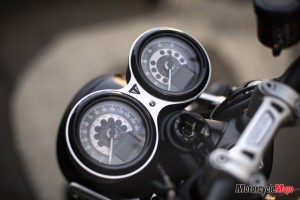 The recipe for more power is simple: The Speed Twin replaces the Street Twin’s 900 cc, five-speed twin with the 1,200 cc, six-speed unit from the bigger Bonnies. But Triumph didn’t just settle for the 79 hp engine of the T120 for the Speed Twin; it instead opted for the 96 hp engine of the Thruxton. Tuning is the same as it is on the Thruxton, and the 270-degree twin puts out a maximum of 83 ft-lb of torque at just 4,950 rpm.
There are, however, some minor changes that distinguish the Speed Twin’s engine from the Thruxton’s, including a magnesium valve cover, lighter engine side covers and a lighter clutch assembly, all changes that drop its weight by 2.5 kg. Like the Thruxton, the Speed Twin gets switchable traction control, and three ride modes – Rain, Road and Sport – each one with progressively more aggressive throttle mapping and TC settings. Maintenance intervals are set at a generous 16,000 km.
The chassis, too, is unique to the Speed Twin. It was developed from the Thruxton R, with a few important changes. Chassis geometry is very similar: the Speed Twin matching the Thruxton R’s 22.8-degree rake and boasting a touch more trail at 93.5 mm (92 mm for the Thruxton). But the Speed Twin has 15 mm more wheelbase, at 1,530 mm, achieved by lengthening the drive chain and pulling the wheel back in the swingarm. This puts a bit more weight over the front wheel, and brings weight bias to an even 50:50. As with all Bonnevilles, the frame is made of steel; however, its removable downtubes are made of aluminum, whereas on the Thruxton they are also made of steel. Unlike the non-R Thruxton, which has floating twin-piston front calipers and solid discs, the Speed Twin has higher-spec Brembo four-piston calipers and floating discs.
When combined with other weight-saving measures, like lighter wheels and a lighter battery, the Speed Twin claims a dry weight of 196 kg, which is 10 kg lighter than the Thruxton, 7 kg lighter than the Thruxton R, and even 2 kg lighter than the smaller-displacement Street Twin. That makes it the lightest, highest-performance parallel-twin currently available from Triumph, which is surprising when considering it undercuts the Thruxton by $700, listing at $13,300.
First Impressions
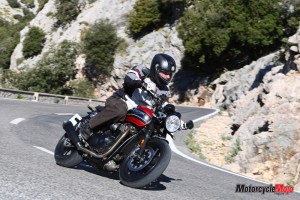 Temperatures in Mallorca were in the mid single digits Celsius when we thumbed the starters at 8:30 in the morning. The Speed Twin returned a rich, throaty exhaust note in the cool, crisp air. Fortunately, our hosts had installed heated grips on the test bikes, a highly recommended addition in Canada, even if they are $330 options. If you find that costly, consider that the bike is prewired to accept them, and the heat level is displayed in the instrument panel. They also have a very clean switch setup, with the switch incorporated neatly into the left grip.
The bike feels surprisingly light when lifting it off the side stand, and seat height is modest at 807 mm, allowing an easy, flat-footed reach to the ground for my 32-inch inseam. This is a tad lower than the Thruxton’s, despite the seat boasting about an inch more foam. A tall, wide, tapered aluminum handlebar places you upright, and the foot pegs are 38 mm farther forward and 4 mm lower than on the Thruxton, providing a more accommodating foothold.
Clutch pull is light, as is nudging the bike into gear. Successive gear changes are light, with short, solid throws. We began the day on open roads, where the Speed Twin chugged along smoothly at 100 km/h, the engine spinning just 3,400 rpm in top gear. Good passing power is available in sixth gear from that speed, but if limited space prompts you to zip by a car quickly, dropping two gears allows you to complete the manoeuvre in a matter of seconds. Torque delivery is broad, and the engine pulls forcefully and without letting up until it hits redline at 7,000 rpm. The broad spread of torque allows you to almost forget the gearbox on winding roads, and the engine accelerates readily from 2,000 rpm whether you’re in second, third or fourth gear.
Almost all recent Triumphs exhibit stellar throttle control, and the Speed Twin is no different. While throttle response at lower speeds in lower gears requires a more delicate right wrist in Sport mode, it remains fluid enough to make the other two ride modes almost redundant. The softer throttle response of Road mode did make handling stop-and-go traffic a bit easier, and I’m sure Rain mode will give riders peace of mind in wet weather, though the bike handled cold, wet pavement just fine in Sport mode, which was my default mode for the day. This is more a testament to the engine’s linear power delivery, though, which makes the bike remarkably easy to ride, and probably so even for novice riders.
Made for Twisties
The roads surrounding Mallorca are remarkably twisty, with a variety of bends ranging from high-speed sweepers to first-gear switchbacks. The leverage offered by the taller, wider handlebar provides lighter steering than on the clip-on-clad Thruxton, while maintaining unwavering stability at speed. The Speed Twin’s weight reduction has a bigger effect on handling than just the lack of kilos would suggest. Triumph made efforts to reduce inertia – through the lighter clutch, brake discs and wheels – and this makes the Speed Twin especially flickable through esses.
The suspension is essentially from the Thruxton, but tweaked for the Speed Twin: there’s a bit less rear preload and fork oil volume is increased slightly, which allows less air volume for more progressive action through the fork’s travel. Having ridden only the supersport-stiff Thruxton R, I can say that the Speed Twin is certainly not that; its suspension is much more compliant and everyday usable, and not just tuned for riding back roads at a sporty pace. While the suspension is on the firm side, and some adjustability other than the provided rear preload would be welcome, it is nonetheless tuned to handle a broad range of riding conditions, providing excellent control for attacking twisties at speed, while remaining moderately compliant for everything else.
The cold weather did cause concern along the route, particularly in the morning when the roads were damp. In fact, one 5 km stretch of road remained shaded and wet throughout the day, and actually had moss growing on the pavement, its green hue sapping confidence instantly. However, Triumph’s choice of sporty Pirelli Diablo Rosso III radials as OEM tires is commendable, given they displayed remarkably good grip and returned confidence-inspiring feedback. Combined with the traction control, the tires never once slipped on the wet pavement, and that was in Sport mode, which turns down the traction control. Some riders in the group did say they felt the tires lose grip at some point, though that was early in the day, when temperatures were at their lowest.
The seat is firm, yet flat and wide, and it handled a 200 km ride with my backside feeling no worse at the end of the ride than it did at the start. Finally the brakes, which are supported by standard ABS, are two-finger light at the front, with excellent feedback and supersport strong braking power.
The Right Bonneville for You?
Triumph essentially invented the retro bike when it launched the New Bonneville at the beginning of the 21st century, with other manufacturers following suit since then, and creating an entire category with a number of competent, attractive machines to choose from. If you’re in the market for a high-performance retro bike, like maybe a BMW R nineT Pure or Kawasaki Z900RS, the 2019 Triumph Speed Twin certainly deserves a look. Even if you’re looking at Triumph’s own Thruxton because you like its café racer styling, you should still consider the Speed Twin. Just throw on a set of clip-ons and you’ll get the café racer look on a bike that is lighter, and costs less, even with the handlebar change.
You might be sold on the 2019 Speed Twin’s styling alone, with its classic silhouette, and styling touches like brushed-aluminum fenders, forged-aluminum headlight brackets, an unpainted aluminum swingarm, a complete absence of chrome and an overall tidy appearance. But add to that its accommodating riding position and its better-than-Thruxton performance spec sheet, and that should seal the deal.
| KTM has announced the twelve riders who will be competing in a unique event within the 2019 Merzouga Rally – The KTM Ultimate Race.
Following special qualification events held within the six KTM ADVENTURE RALLIES across the world in 2018 and 2019, participants had to prove excellent machine control, navigational skill and competent mechanical ability across multiple days. Each rider gets to compete in an exclusive class at the Dakar series race in Morocco with a fully supported ride that includes flights, accommodation, meals, entry fees, as well as a full race service. KTM is now proud to announce the hardest and most fearless 12 riders of the KTM ADVENTURE community from around the world who have qualified for this epic final battle, which takes place from March 31 to April 5.
The Ultimate Race is a special class at the Merzouga Rally, very similar to the main event and partly ridden on the same routes. Like the pros, the participants will face a marathon stage where no outside assistance is allowed. Each competitor will have access to a specially prepared KTM 790 ADVENTURE R which will be equipped with a host of KTM PowerParts, such as the Akrapovič Slip-on Line silencer, the Ergo seat and protection parts, along with a roadbook to help navigate through the desert. The Ultimate Race participants will be treated like KTM Factory riders, supported on site with a truck and a team of mechanics to help out with parts and tools or with fixing the bike after a tough race day. The winner of the Ultimate Race can keep their KTM 790 ADVENTURE R race bike along with receiving an all-expenses paid package for two people to see the 2020 Dakar Rally. Wondering how hard to is to qualify for the Ultimate Race? Check out our article on the most recent rally and how our Canadian Qualifiers won, click here for more.
|
Indian Motorcycle and Jack Daniel’s have partnered again to create 177 limited-edition motorcycles celebrating their shared commitment to quality, originality and craftsmanship in the design of their products.
This year’s bike, the Jack Daniel’s Limited Edition Indian Springfield Dark Horse, draws its inspiration from Jack Daniel’s Single Barrel Select Tennessee Whiskey, Jack Daniel’s most premium whiskey offering. This bike was developed as a tribute to all the craftsmen who value working with their hands and are committed to developing products of the finest quality. This year’s Jack Daniel’s limited-edition motorcycle maintains the sleek, stripped-down styling of the Indian Springfield Dark Horse along with a number ultra-premium design features that truly make it a one-of-a-kind motorcycle.



Pricing for this ultra-premium motorcycle starts at $44,499 in Canada. Each bike also comes with a two-year unlimited mileage factory warranty and free membership in the Indian Motorcycle Riders Group™ for one year. Each bike will be built to order as a model year 2020 with delivery starting in September 2019.
Interested customers can enter the promotion from now until March 17 for a chance to purchase one of the 177 bikes at https://www.indianmotorcycle.com/en-ca/jack-daniels-2019-springfield-dark-horse/.
Following the close of submissions, winners will be randomly selected and called upon by their preferred Indian Motorcycle dealer to inform them they are one of the lucky few who will be able to purchase one of these finely crafted motorcycles.
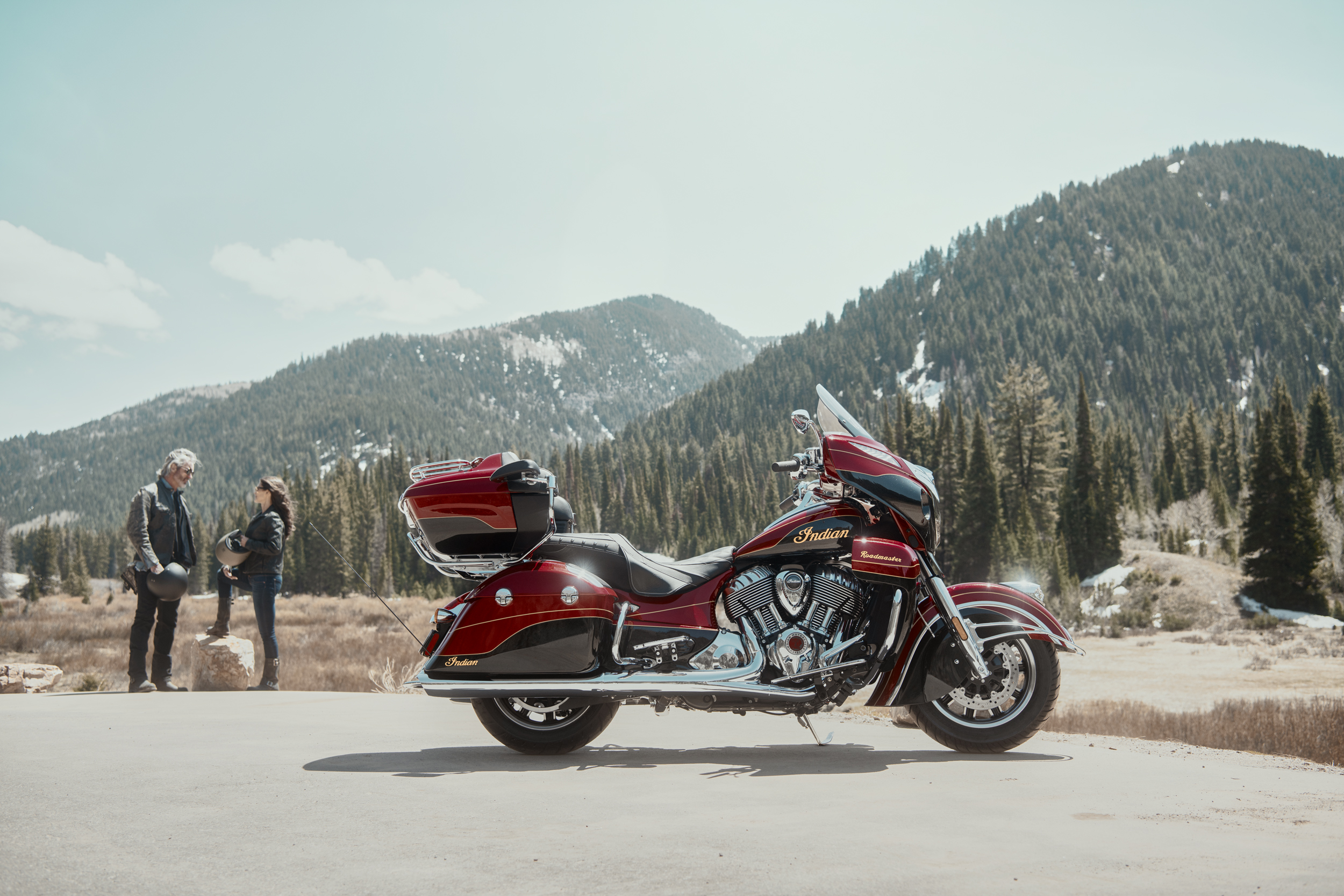
Indian Motorcycle introduces incredibly rare 2019 Roadmaster Elite Motorcycle.
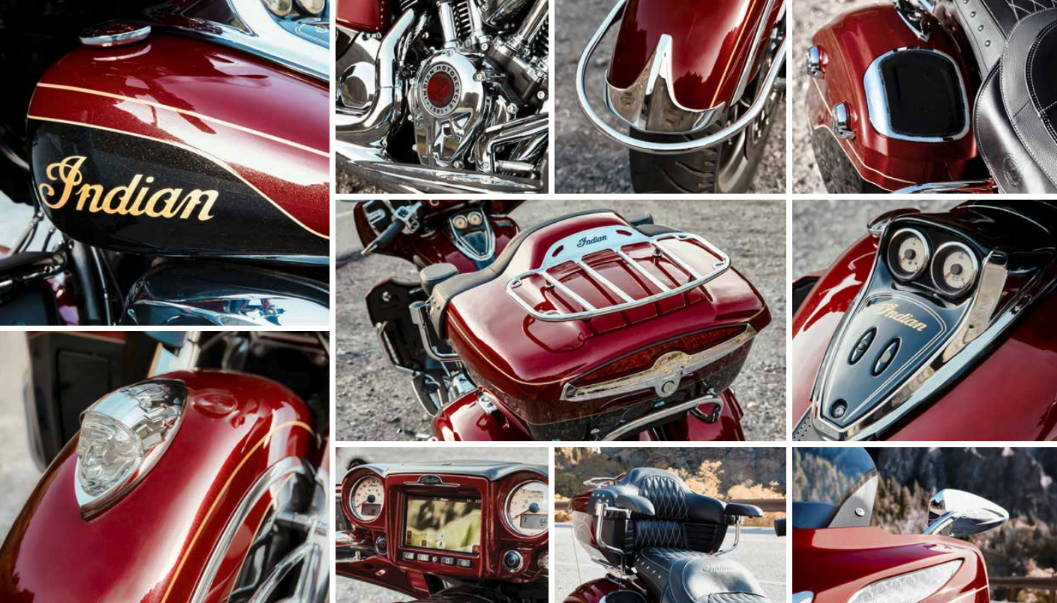
With only 200 being produced the 2019 Roadmaster will have a hand painted custom-design, and gold leaf badging. Every Roadmaster Elite is an artistic masterpiece that features Wildfire Red Candy over Black Crystal paint with real 24-karat gold leaf badging. Each bike undergoes a meticulous paint process that takes nearly 30 hours to complete and is finished by hand.
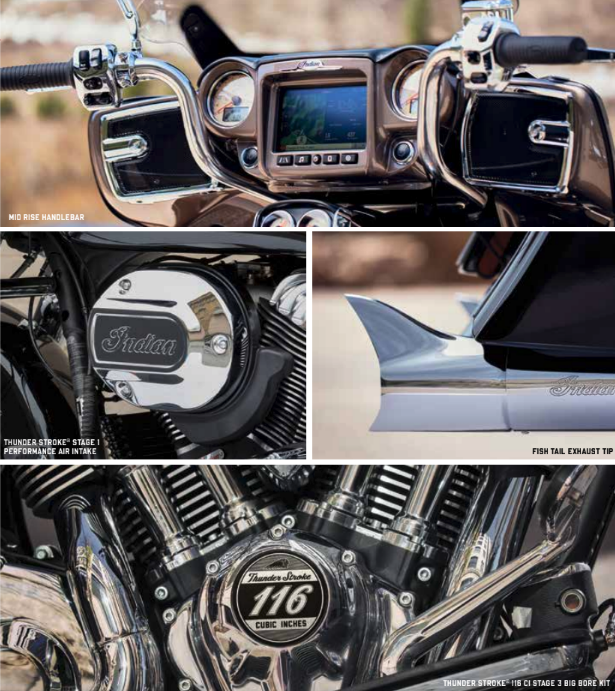
The Roadmaster Elite will be fully loaded with every upgrade and luxury able to be thought up including an upgraded 600-watt Powerband Audio Plus system that auto-adjusts based on speed, wind, and noise to deliver crystal-clear audio. On the motorcycle you’ll also find a seven-inch wide, glove-compatible touchscreen that features turn-by-turn navigation, customizable rider information screens, Bluetooth compatibility, and pairs with the Indian Motorcycle Ride Command mobile app for remote accessibility to key vehicle information. Not to mention a long list of additional upgrade like full LED lighting, a genuine leather two-up touring seat individually heated for rider and passenger, ABS, heated handgrips, keyless ignition, a push button power windshield, weatherproof, remote-locking saddlebags, a spacious trunk that fits two full face helmets, and over 37 gallons of storage space.
“The Roadmaster Elite offers the most refined, premium touring experience for riders that demand the best of the best,” said Reid Wilson, Senior Director for Indian Motorcycle. “We’ve truly left no stone unturned, packing this bike with style and comfort features that take the touring experience to a new level.”
The powerful Thunder Stroke 111 engine produces 119 ft-lbs of torque for exceptional power at low RPM. On the motorcycle you’ll also find selectable ride modes, rear cylinder deactivation and other performance upgrades.
Selectable Ride Modes
Three selectable ride modes, including Tour, Standard and Sport. This allows the rider to adjust the bike’s throttle response to fit their riding preferences. The throttle map for each Ride Mode was designed with a specific application in mind, resulting in one motorcycle with three distinct personalities.
Rear Cylinder Deactivation
When the Thunder Stroke 111 reaches operating temperature and the ambient temperature exceeds 59⁰ F, the rear cylinder will automatically deactivate when the bike is at a standstill, resulting in less engine heat for improved rider comfort in slow-moving or stopped traffic. The rear cylinder instantly reactivates when throttle is applied for a seamless transition to full power. The bike also features redesigned lowers that provide optimal airflow for improved comfort.
Among the performance upgrades available for the 2019 Roadmaster Elite are a new Stage 1 Exhaust, a Thunder Stroke Stage 1 Performance Air Intake, Thunder Stroke Stage 2 Performance Cams, and the 116ci Stage 3 Big Bore Kit for riders looking for the ultimate in performance.
With only 200 available, pricing for the ultra-premium Roadmaster Elite starts $44,499 in Canada. Available at Indian Motorcycle dealers today.
Learn more about Indian Motorcycle and the 2019 Roadmaster Elite by visiting IndianMotorcycle.com
When looking for a used bike, a bit of research early on can alleviate future headaches and expenses.
As winter begins to wind down, the time is ideal to look for a new bike with which to begin a new riding season. Maybe you can’t afford a brand-new machine, or maybe you want to look into an older bike that eluded you when you were younger; either way, you’ll be prompted to scour classified ads for a “previously owned,” “experienced” or, my favourite, “re-marketed” motorcycle. (Yes, marketing experts have been concocting terms to replace the term “used,” since it is believed to connote negative responses in focus groups.)
 As Clinton Smout pointed out in his column on page 14, buyer and seller may not see eye to eye when it comes time to negotiate how much money should change hands for the acquisition of a new-to-you dream bike. This is why it’s wise to be prepared when going to look over a potential purchase, and to be fair in your assessment of the actual issues the bike might have.
I prefer to look at a bike that hasn’t been detailed, buffed, polished or otherwise wiped clean of evidence of neglect. That doesn’t mean I prefer the bike to be covered by thousands of kilometres of filth, though even that would be revealing as to how the owner treated the machine. Some dirt will enable you to see signs of oil leaks – where the dirt is dark or wet, especially near a gasket, you’re assured oil is seeping out of the engine somewhere nearby. But don’t mistake the wet, oily goop near the front chain sprocket or along the swingarm for an oil leak – that actually tells you that the owner lubricated the drive chain regularly.
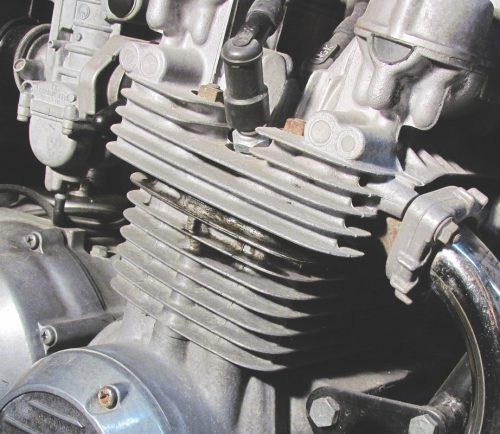
A recent acquisition I made, a 1980 Kawasaki KZ550, needs a new head gasket: the darkened cooling fins between the cylinder and head were clear evidence of the job ahead. Had the previous owner meticulously cleaned the bike, using a toothbrush to wipe off the oily residue from between the fins, I would only have discovered the leak after my first few rides.
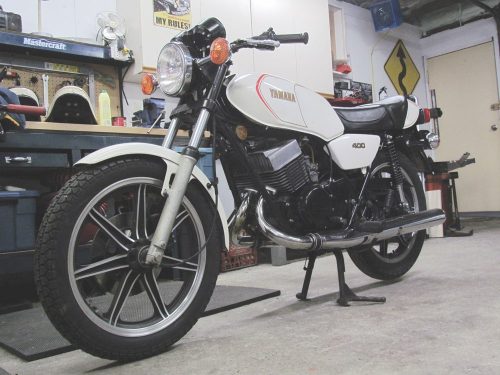
 Some issues may be visible whether the bike is clean or not. A 1980 Yamaha RD400 that belongs to a friend of mine is in need of new intake manifolds. Upon initial inspection they look shiny and new, but up close, cracks can be seen in the rubber. Whether those cracks cause an air leak or not is irrelevant to you, the buyer. When something looks as if it needs attention, always assume the worst-case scenario, and use it to bargain. Even if the seller tells you the cracks pose no problems and the bike runs fine, you will be responsible for their replacement when they do give up, which will probably happen sooner rather than later. And finding these parts is difficult since Yamaha no longer makes them, and they are scarce even in the aftermarket.
The same bike had a swingarm that was swinging side to side, if only slightly. A seller might suggest to “just tighten up the swingarm bolt,” but you should assume the swingarm bearings need replacing, as it is you who will be shouldering the cost of replacing them after you buy the bike. That said, there’s no need to invent faults where there are none, but unless proven otherwise, it’s fair to assume the worst-case scenario when a fault is found – dealers do it all the time when taking trade-ins.
Another thing to consider is the rarity of replacement parts, as is the case with the RD400 manifolds. Regular replacement parts like brake pads, drive chains, batteries, sprockets and spark plugs are rarely a problem and are easily sourced through the aftermarket. And even if bearings and seals are no longer available through the original motorcycle manufacturer, they can be found through bearing suppliers, though this might require that you have the part in hand when placing your order at the counter.
For the most part, tires are not an issue, but in some cases, like on both of the bikes I’ve mentioned above, the original sizes are no longer available. The KZ550 had a 3.25-19 front and 3.75-18 rear, while the RD400 had a 3.25-18 and 3.50-18 front and rear. While all sizes but the 3.75-18 can be found individually, a matching set made by the same manufacturer is more elusive. Equivalent metric sizing can be found to replace the original sizes, but in most cases the tires will be slightly larger. While this isn’t really a tool to use when negotiating the purchase price of a bike, it’s something to consider for long-term ownership.
Once you spot a machine you’re interested in, do some online research, look for common parts, find out about common issues, and be prepared. And don’t forget to be fair.
Technical articles are written purely as reference only and your motorcycle may require different procedures. You should be mechanically inclined to carry out your own maintenance and we recommend you contact your mechanic prior to performing any type of work on your bike.
Tales from the archives.
While Harley-Davidson isn’t everyone’s first choice when it comes to a motorcycle brand, there’s no denying that the iconic company has a rich and unique history when it comes to being a motorcycle manufacturer. I’m sure there have been more books written about Harley-Davidson than any other motorcycle company, but not all of them are written in conjunction with the Harley-Davidson Museum, where there are more secrets buried about the Motor Company than anywhere else.
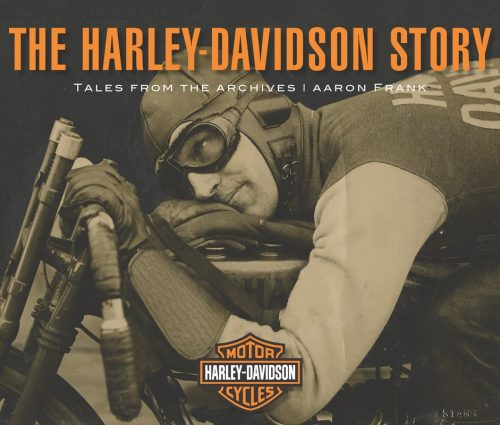 The Harley-Davidson Story is written by Milwaukee-based motorcycle journalist Aaron Frank (former Motorcyclist magazine contributor), who had unprecedented access to curatorial staff at the Harley-Davidson Museum, and starts with an introduction by Jim Fricke, the museum’s curatorial director.
This 224-page coffee-table book covers topics that stem from the original shed in the backyard of the Davidson home where William Harley and the Davidson brothers worked at designing and building an engine to power bicycles. The book naturally moves on to Serial #1, the Motor Company’s first V-twin of 1909, and continues to highlight engine and model milestones, racers, world travellers, clubs and many more characters.
The Harley-Davidson Story touches on Project Serengeti (code name for the 2018 Softail and Milwaukee-eight engine) and Project Livewire, but just as a museum-based book should, it covers much of the company’s early history of such obscure creations as the “hip leisure machine,” as H-D described the Topper scooter; the company’s entry into Grand Prix racing with a two-stroke 250 that shattered Yamaha’s four-year winning streak; the more than 5,000 rocket engines that H-D manufactured for U.S. Navy drones; as well as Project Nova, which never really got past the prototype stage, although some of you might recognize design similarities to the early-’80s FXRT. And how about the Penster, a reverse trike developed in 1998 – almost a decade before the BRP Spyder? The big difference being the Penster leaned into corners. Did you know H-D debuted a reverse trike called the Forecar in 1914?
This and so much more is included in the book’s 45 chapters that feature 250 colour photos. It’s a book for not only for motorcycle fans, but also for fans of the grit and determination of early business development and turn-of-the-century industry.
Published by Quarto (Motorbooks) with an MSRP of $52, the book is available at quartoknows.com or the regular outlets like Amazon and Chapters. But shop around, as prices seem to fluctuate considerably. I found it on amazon.ca for $35.90.
ISBN – 13:9780760360712
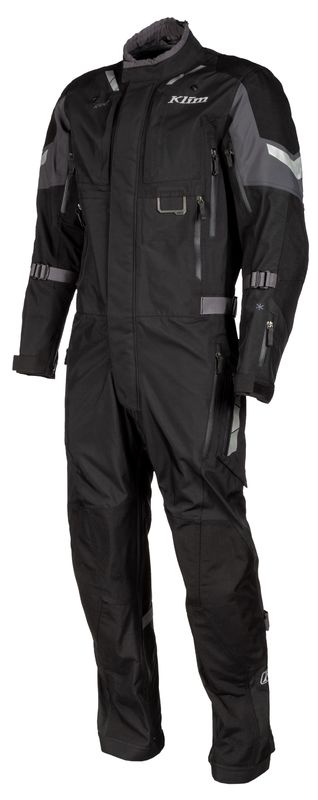
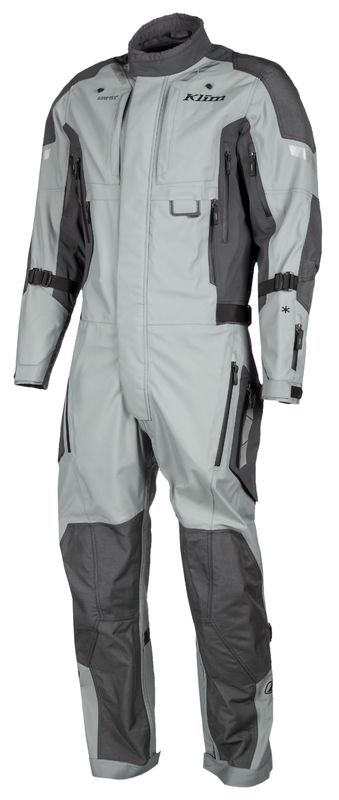
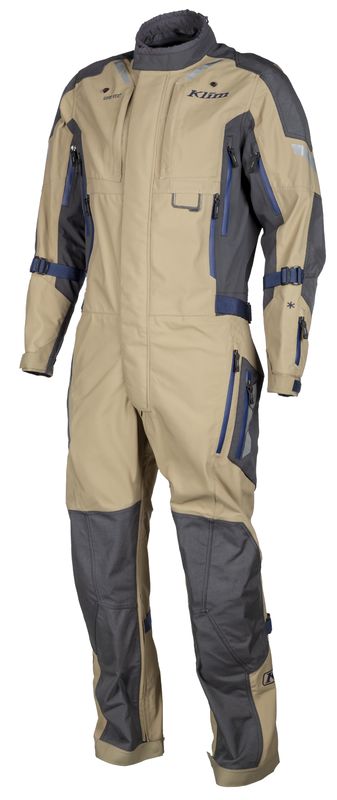
With commutes and grand motorcycle journeys in mind, KLIM is proud to announce the Hardanger one-piece suit.
KLIM has created this suit with the vision of offering an adapting suit to all-type of riders whether it’s long-distance days or in-town commuting rides. Fitting a one-piece suit can be more challenging than a comparable jacket and pant, but ample adjustment straps ensure the Hardanger is comfortable in both sitting and standing positions. Further, the D3O molecular armour in all key impact areas is adjustable, letting you tailor the suit to fit.
The Hardanger is engineered for ease of use and comprehensive comfort, and the convenience that comes as a byproduct is a calculated result. For those of us who are daily commuters or on grand motorcycle journeys, we now have a piece that lets us simply step in, and set out.
Key Features include:
- Three Layer Performance Gore-tex shell
- Top down zip-in, zip-out function
- 750D Cordura on knees, shoulder, elbows and boot panels
- Waterproof port for heated clothing wires
- D3O LP1 ventilated armour
Sizes
SM-3X Short
SM-3X Reg
SM-3X Tall
Colours
Black, Grey, Tan
Canadian MSRP $1,699.95- $1,764.95
(depending on size)
For more information, visit www.KLIM.com
Battle of the Kings get larger than life with the addition of Canadian and US dealerships competing for the title.
 After an epic international showdown in 2018 Battle of the Kings, Harley-Davidson’s annual dealer custom build-off competition is set to be bigger than ever before in 2019. This year sees even more countries, including Canada and the United States of America joining the battle to be crowned the best in the world.
The competition showcases the very best in customization capability and the creativity of the Custom Kings who can be found at every Harley-Davidson dealership globally. In 2018 the Custom King crown was taken by debut-entrants Harley-Davidson Bangkok with their Street Bob-based build “The Prince.”
With over 350 entries already, defending the title will be the toughest yet as competition heats up on a global scale. Any model in the Harley-Davidson range may be selected as a base for the build (excluding Trike and CVO models) meaning dealers have more choice than ever before in order to create a title challenger. To further inspire the competition dealers must choose from three style categories – Dirt, Chop and Race – for their build. The rules for the build are simple – 50% of the parts used must be genuine Harley-Davidson accessories and the customization budget is a maximum of 50% of the donor bike retail price.
The Battle of the Kings competition takes place in national and regional phases throughout the year with the ultimate winner and 2019 Battle of the Kings Custom King to be decided and crowned in November 2019. Voting for the Canadian phase of Battle of the Kings opens online February 14th. All competing Harley-Davidson dealers will be showcasing their custom built-off until March 15th for everyone to admire and vote for their favourite custom motorcycle.
For information on the Battle of the Kings contest and to vote for your favourite Canadian custom click here
 Harley-Davidson funded a study that revealed what all motorcyclists already know: riding motorcycles reduces stress and has beneficial effects on mental health.
The study was conducted by three researchers at the UCLA Semel Institute for Neuroscience and Human Behavior, led by neuroscientist and public speaker Dr. Don Vaughn. The research for the study included monitoring the biological and physiological responses of more than 50 experienced riders, using portable EEG devices. Parameters measured included heart rate, electrical brain activity, and levels of adrenaline, noradrenaline and cortisol.
Riders subjected to the study had their brain activity and hormone levels measured before, during and after riding a bike, driving a car and resting. The results revealed that riding a bike decreased hormonal biomarkers of stress, increased heart rates and adrenaline levels, enhanced sensory focus more than while driving a car, and increased alertness. The changes in heart rate and adrenaline were similar to those experienced during light exercise.
“The differences in participants’ neurological and physiological responses between riding and other measured activities were quite pronounced,” Vaughn said in a press release. “This could be significant for mitigating everyday stresses.”
So there you have it. If you’re feeling the stress of everyday life bearing down on you, hop on your motorcycle and go for a ride – doctor’s orders.
On September 26-28, at Red Mountain Resort in Rossland, B.C., the Canadian Adventure Rally is coming back for its third year in Western Canada. Adventure enthusiasts will enjoy some of the most epic riding just north of the U.S. border. Nestled in the heart of the Columbian mountains, the Canadian rally will offer unique unspoiled backcountry riding conditions.
The North American rallies include spectacular riding opportunities, demo rides on KTM’s latest adventure lineup, the opportunity to speak with KTM’s factory technicians, enjoy an awards dinner and take a first-look at the brand new KTM 790 Adventure. Open to all brands, KTM’s adventure rallies are a place for like-minded enthusiasts to come together and share their passion for adventure riding in some of the most breathtaking scenery in the world.
New two-day navigation rally is open to all motorcycle brands over 600 cc. The two-day KTM navigation rally will be tailored to suit all rider abilities and interests – from long distance adventure touring, to technical off-road adventure. Teams of two to four riders will take on the challenge of navigating across the Canadian western mountains while following a supplied GPS route. Red Mountain Resort showcases diverse and exciting routes for all types of riders. Participants will also benefit from the presence of pros like as Chris Birch, access to KTM staff, dedicated adventure vendors and the ability to demo KTM’s latest adventure lineup, including the new KTM 790 Adventure R.
KTM is pleased to welcome back the Ultimate Race Qualifier for the second-straight year at both rallies. More details will follow regarding the Ultimate Race Qualifier, but interested participants can sign up now to secure a spot as space is limited for this event.
For more information or to register for the KTM adventure Rally Canada in Rossland, BC, to visit the official page,
You can also find Emily’s take on last year’s event. Click Here
Some builders find the exciting part of a restoration is the hunt for parts.
There’s no mistaking a Triumph Bonneville. Launched in 1959, the Bonneville was named to commemorate a 214.47 mph world land speed record set by Johnny Allen in a Triumph-powered streamliner at the Bonneville Salt Flats.
The looks, the sound and the power are all unique to the revered Bonneville model that, with the exception of a few years, has been in production for almost six decades.
Calgary’s Bob Klassen isn’t immune to the charms of the earlier models, and for close to three decades owned a unit-construction 1970 Triumph Bonneville.
During that time, he’s also built, and had a hand in building, close to a dozen pre-unit Triumph motorcycles.
A Brief History Lesson
 None of these projects began as complete machines. Instead, a frame came from one location, an engine – or engine pieces – from other sources, and all of the ancillary components from myriad sellers.
That’s exactly how this 1962 Triumph Bonneville T120R came together. Before we get to the build story, we need to learn a little more about Klassen and his penchant for pre-unit Triumphs, even though his first Bonneville was a unit-construction machine.
For those wondering, a “pre-unit” Triumph simply means the engine and gearbox are separate components. From 1937, the first year of Triumph designer Edward Turner’s Speed Twin, the parallel twin-cylinder engine and transmission lived in completely separate alloy castings. In 1957, the 350 cc Triumph 3TA gained a unit-construction engine, where the cast alloy cases contained a cavity that housed all the gears and shafts of the transmission, behind the crankshaft. The 500 cc 5TA featured unit construction when it was launched in 1959, but the 650 cc models didn’t get that treatment until 1963.
For Klassen, a retired mechanical engineer, the beauty of a Triumph lies in the pre-unit machines, and, as mentioned, he’s built a few, including a Triton, a desert sled and several bobbers.
Triumph’s Duplex Frame
 It was in 2011 that Klassen constructed a bobber based on a 1962 duplex Triumph front frame loop, David Bird hardtail and Bonneville engine cases. During this process, he learned two things: first, he loved the look of the three-year-only duplex frame (Triumph debuted the duplex frame in 1960 and dropped it in 1962) with its twin front downtubes; and second, “Even with a rigid frame conversion on the duplex frame, I felt it handled way better than any other Triumph – unit or pre-unit – I’d ever built.”
A seed had been planted, and Klassen began thinking that building a close-to-stock 1962 Bonneville, with the duplex frame, would be something he’d like to do. The project didn’t really gain any momentum until he was visiting John Oland of Motoparts in Edmonton.
“I was wandering around and went out into John’s boneyard, where there was a row of frames,” Klassen explains. “I spotted a duplex front frame loop, and it had surface rust on it. I spent a few more minutes examining it and
discovered it didn’t have a VIN stamped on it. Also, the side-stand and centre-stand lugs had no evidence of use – I think it was a factory replacement frame that had never been used.”
The Search Begins
 Klassen bought the front frame section and began, as he says, a very slow process of acquiring, restoring and building up the parts to make his ideal Bonneville.
On eBay, he sourced a number of specific parts to piece together the duplex front forks. These have different internal damping components from earlier pre-unit forks, and the triple trees also differ.
While working on the forks, Klassen was on the search for a set of duplex frame T120 Bonneville engine cases. He found a set on the Canadian Vintage Motorcycle Group’s buy-and-sell web pages and purchased them out of Ontario.
“There’d been some alloy repair work done to the drive side case, where it had cracked about two or three inches below the base of the cylinder,” Klassen says. “The repair had been done years before, and I re-profiled the outside
of the case while Derek (Pauletto of Trillion Industries in Calgary) welded up the internal cracks.”
With a set of usable T120 cases, Klassen located a used crankshaft that he cleaned up, then checked the balance factor and had the journals ground to accept new shell bearings for the connecting rods. He sourced a set of standard bore cylinders from a friend, and bought new Hepolite pistons and rings from Motoparts.
Luckily, the Bonneville alloy twin-carburetor cylinder head was a piece Klassen had in his own collection of parts. It was rebuilt with new guides and valves, and the seats were freshly cut. A set of Amal 376 monobloc carburetors were vapour-blasted to remove the exterior surface oxidation, and attention was paid to the internals during careful reassembly.
The pre-unit gearbox was also on Klassen’s shelf. It was disassembled, cleaned and checked for any issues. Nothing major was amiss, so it was carefully reassembled and sealed up for use in the Bonneville.
The Search for Rear Suspension
Meanwhile, after searching for months for a duplex rear sub-frame, Klassen turned to his plan B. He knew from having built his duplex frame bobber that a unit Triumph hardtail bolted right onto the duplex front frame loop. If a unit hardtail would fit a duplex frame, then why not a unit swingarm sub-frame?
Klassen began looking for a unit swingarm rear sub-frame and found one locally in a friend’s garage. At some point, the rear seat hoop had been cut off, so the first thing Klassen did was bend up a new tube and make frame plugs so it could be welded into position. Several mounting tabs were cut away, and he proceeded to hand fabricate new studs and tabs to hold the parts unique to the duplex frame, including the rear brake pedal, oil tank and battery/toolbox. With the brackets cut and shaped, Klassen had them all welded in place by Cory Brewster of Brewster West Industries in Turner Valley before all frame components were powdercoated semi-gloss black at Rite-Way Powder Coating in Calgary.
A set of new Hagon shocks went between the sub-frame and swingarm, and Klassen turned his attention to wheels. For these he wanted to use flanged alloy rims. At a Red Deer vintage motorcycle swap meet he found a WM2 19-inch for the front, and at the Millarville swap meet, he unearthed a WM3 18-inch, both in a 40-spoke pattern. The front hub is a later-style eight-inch Triumph item, while the rear is a stock Triumph spool-style. Klassen ordered stainless steel spoke sets from Walridge Motors, and with the hubs powdercoated semi-gloss black by Rite-Way, he laced and trued the wheels himself and installed Dunlop Gold Seal tires front and rear.
Only when the Bonneville was mostly complete did Klassen start searching for a gas tank.
A Rare Fuel Tank
“It’s hard to find an original duplex gas tank,” Klassen says. “You can get a reproduction tank out of India, but I preferred original metal. When I built the duplex bobber, I bought a few pieces off a fellow in Ontario, so I called him and asked if he might have a duplex tank.” Although he struck out, the fellow directed him to Ken Brown, whom Klassen describes as “a Triumph restoration guru in B.C. Ken had a stock Bonneville gas tank for the duplex frame that he was willing to part with, and it came with the badges and the parcel rack.”
When it arrived, Klassen was pleased with its condition. As sold, it had been cleaned and left in a coat of primer. Scott Wilson of Calgary (regular readers might recall his Shinobi Honda CB450 build story – April 2018) was entrusted with the two-tone paint job on the tank and the gloss black on the oil tank and toolbox.
Fenders were sourced from eBay sellers: the rear a chrome guard that needed some modification to allow the grab handle to fit; the front is also chrome from an unknown application. Klassen made up the front fender stays using lengths of 3/8-inch steel tube with cast end pieces harvested from a set of unit Triumph stays.
During mock-up, Klassen fit a set of one-inch-diameter low bars, but didn’t think they suited the look of the Bonneville. He opted instead for a set of Norman Hyde M-bars, and the rider’s view is complemented with a set of Smiths chronometric instruments, including speedometer and tachometer.
All fasteners were cleaned, glass-beaded and sent to Victoria Plating for cadmium coating during final assembly. One of the last pieces Klassen sourced was the grey-topped saddle from Walridge Motors. And, after seeing a photograph of a leather Triumph tank-top bag in Lindsay Brooke’s book Triumph Motorcycles in America, Klassen cut and hand-stitched his own version.
It’s a Runner
With final details in place, the machine fired first kick thanks to a strong spark from the Lucas magneto that Klassen had cleaned and serviced himself. There was, however, a jetting issue that had to be overcome before the Bonneville became a reliable runner – it’s now covered just over 800 km this past summer.
“The handling of a duplex frame bike is so much different than any unit or earlier swingarm frame pre-unit Triumph that I’ve ridden; it has a much better feel,” Klassen says. He liked it so much, in fact, that he “decided to sell my 1970 Bonneville – it’s found a good home. The duplex Bonneville was a three-and-a-half-year build because finding so many of the parts took time, but the result was worth it.”