
Crash Landing
The Long Road Home
Liz Jansen recently released her third book, a memoir entitled Crash Landing. It’s a story of personal healing and self-discovery via the memories she has of and the stories she’s been told about both sets of grandparents and the hardships they endured as they came to Canada in the early 1920s as Russian refugees fleeing the Russian Civil War.
Approaching her 60th birthday, Jansen set forth in the quest to discover her roots in 2014, while on an extended motorcycle trip she called the Ancestor Trail to discover the prairie lands that her grandparents settled on.
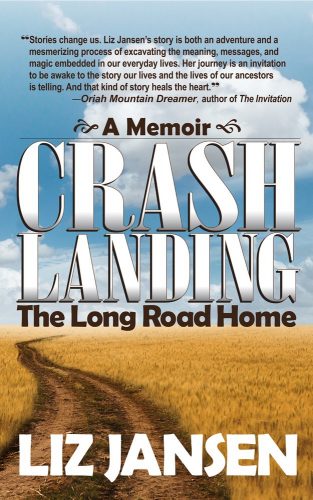 Unfortunately, a bad motorcycle crash ended the trip unexpectedly. After a couple of years of recovery, she got back in the saddle of her new Triumph Tiger to resume the search that took her from her southern Ontario home to Alberta, Saskatchewan and Manitoba.
Her story is entertaining and well written, and is interspersed with the travels and difficulties that her German Mennonite ancestors endured while seeking a new life on the Canadian Prairies and simply trying to survive in a strange and foreign land.
The book is a roller coaster of emotions and thoughts as Jansen describes her upbringing, and as any spiritual road trip into a person’s past could be, with a great deal of motorcycle travel thrown in for good measure.
If you’ve ever wondered about your lineage or how your past has shaped who you are as the person you are today, you’ll want to read Liz Jansen’s latest book.
Get it at lizjansen.com, Amazon and Indigo for $19.95 for the 264-page paperback or $7.90 for all formats of ebook. ISBN 978-1987853087
On December 18 Mopar CSBK announced the Canadian National Motorcycle Road Racing championship tour dates for the upcoming 2019 season.
The series will open slightly earlier than in previous seasons, with the first round set for the Victoria Day long weekend in May.
The 2019 Mopar CSBK National Schedule
Round One Shannonville Motorsport Park, ON. – Pro Track May 17 – 19
Round Two Grand Bend Motorplex, Lake Huron, ON. – Technical June 7 – 9
Round Three Autodrome St-Eustache, Montreal, QC. June 21-23
Round Four Atlantic Motorsport Park, Halifax, N.S. July 18-21
Round Five Canadian Tire Motorsport Park, ON. August 9-11
A special 2019 round for the new-in-2018 Amateur Lightweight Sport Bike category, in conjunction with the VRRA’s Vintage Classic at Calabogie Motorsports Park, ON, has already been announced for June 28-30. The traditional Pro Cycle-backed east coast trip in July will again feature double headers for both Pro categories, Mopar Pro Superbike and Liqui Moly Pro Sport Bike, with support from the Society of the Atlantic Racing League. The 2019 Series finale at Canadian Tire Motorsport Park, or “old Mosport,” will continue as an all-class double header, including Magneti Marelli Amateur Superbike and Parts Canada Amateur Sport Bike too.
In nine of the past 14 years, the winner of the Shannonville Pro Superbike feature round has gone on to earn the overall National Championship and number one plate. Seven of those times, the rider doing that double was Jordan Szoke of Lynden, ON, the 13 time overall Canadian National Superbike Champ.
In 2019, Szoke will be 40 years old, and rejoin Kawasaki to compete on a Mopar Express Lane-backed ZX-10RR Ninja superbike. For the previous seven years, Szoke has raced for BMW with the successful S1000RR, winning the Championship six of those times.
Prior to CSBK’s 2019 start, the RACE organization will offer several warm-up events at Shannonville Motorsport Park, including a Test weekend April 20-21 and the first “Super Series” Regional May 10-12, the weekend prior to the opening National round. Official spec Dunlop tire supplier Pro6 will host a Test Day on the Thursday prior to the start of 2019 National action at Shannonville.
Over the course of the 2019 summer Canadian road race season, series organizers’ Professional Motorsport Productions of Toronto will begin preparations for a busy off season of 2019-2020. The tour will begin celebrations surrounding the 40th anniversary (red ruby) for the Championship in 2020.
It’s as much about building friendships as it is about tough competition.
Nestled in the interior of British Columbia rests the Okanagan Valley, and as September came to a close, you could find a gathering of a special kind of people. The kind that bleeds adventure, the kind willing to sacrifice their bikes and bodies in search of an adrenalin rush and a great challenge. This gathering was the second annual KTM Adventure Rally Canada 2018, held September 26–30, with riders from Canada and the United States taking part in the events throughout the week. Riders started to arrive as early as Monday to take part in the skills clinics put on by extreme enduro champion Chris Birch and to try out some of the new Austrian machinery at the KTM demo rides before the rally routes started on Thursday. I had packed my things on my street bike in Revelstoke, B.C., and headed two hours southwest to SilverStar Mountain Resort for the rally.
The KTM Adventure Rally happens in six different countries – Italy, Australia, New Zealand, South Africa, United States and Canada – and is created to bring riders with all makes of adventure bikes over 600 cc together for a weekend of challenging riding and meeting other like-minded folks.
There were initially three routes for riders to attempt while at the KTM Adventure Rally: R1 – the hardest of the off-road adventure routes, encompassing three days and 1,000 km; R2 – a two-day, 900 km, medium-difficulty adventure-touring route of trails and gravel; and the S route – a two-day, 1,200 km mostly paved route. However, it is an adventure rally, and before it even got started, it was determined the S course be cancelled due to the lack of entries. For the super-competitive riders, there’s also the Ultimate Race, which takes place each morning before the R1 route (see “The Ultimate Goal,” p. 54.)
Teams of two to four riders would navigate through the routes using GPS. Riders participating in the R1 course would ride Thursday, Friday and Saturday, while those opting for the R2 would start on the Friday. If riders rode the R1 course on Thursday and decided it was too difficult, they could then drop into the R2.
Ready, Set, Rally!
 As the sun struggled to break through the heavy mist, riders filtered into the starting area early Thursday morning. Everyone waited patiently to take off from the start line to see what the day would hold for us. However, there were a few surprises throughout the route. Steep, loose, rocky trails put riders and their machines to the test, forcing some to turn around and ride the more manageable R2 route for the next two days. I had opted for an easier route the first day and rode with another female competitor. I was fortunate to be riding one of KTM’s 690 Enduro Rs, but nervous enough on this new-to-me bike to not play too rough with it the first day.
As the day came to a close and the sun sank behind the mountains, riders spoke of the day’s ride – it was tough. That was not to be debated.
Almost half the riders originally in the R1 course dropped into the R2. Many teams scrambled to create new teams based on the intense level of riding that was promised for the next two days. I had decided I’d like to see what the fuss was about on the R1 route, so I started searching for a partner to attempt it with. I met Calvin, who had split ways with his riding partner because they had different competitive goals, and as we chatted, we decided we would make a good team for the next day.
A Tough Day’s Ride
 The mist hung above the valley as riders waited in the frigid air to attempt the R1 and R2 courses on Friday. Calvin and I took off down the weaving roads that lead us into the valley. We made our way into an expansive trail system that had been carefully planned out to offer plenty of technical riding and lead to breathtaking viewpoints. It was a tough enough task riding through overgrown brush and single track strewn with logs and rocks, but doing so while trying to navigate with your GPS made it near impossible. As we made our way through the thick web of trails and cow paths, we had gotten into what would be the crux of this day’s course – a kilometre-long hill climb of loose, rutted single track winding up through the forest.
Things that are worthwhile often don’t come easy, and this was no exception. As I attempted to make it up the steepest and roughest section, my front wheel washed out, and just like that I was down. I pulled my bike off the trail as more riders came up the hill behind me. The carnage had begun. Within a minute there were nine of us scattered on the hillside. One by one we pulled and pushed every bike – from the lighter 690 to the heavyweight bikes like the 1290 – up the hill. It was no longer about getting ahead, it was about getting everybody out. I understood now why there were so few people continuing on this course after the first day. Showing the true colours of the participants, it’s not about getting to the end in good time, but rather having a good time and building camaraderie with everyone as they attempt to just get to the end.
Mechanical Gremlins
 Once everyone was up the loose, rutted slope and mildly rested, we continued up the extensive hill. Then disaster struck! Calvin’s clutch blew; we were stuck on the last section of the hill and his bike was missing an important part of its driveline. After some discussion, we decided that it’d be best if he coasted back down the merciless slope. The one we had struggled so hard to achieve – the hardest part of the day – only to turn around and not finish.
We weren’t alone. Defeated by the hill was another group that also had a mechanical issue. Calvin and I rode down with John and Jason, towing the disabled bikes with the working bikes through the flat sections of dirt road. We made it to the road, where we then waited to get a tow back to SilverStar. As we sat watching other riders finish the course, we reminded ourselves that the best memories are of things that don’t go to plan.
A New Team
With Calvin out, I was once again without a partner for the last day of the rally. Fortunately, Tom, Dave and Mike, who had helped me up the hill the day before, were willing to let me tag along with them. We took off into the bitter wind of the morning. Quickly off the tarmac, we got into a loose and wet single track. This was shaping up to be the hardest day, forewarned with tales of muddy, rutted trails with deep creek crossings. However, dry weather and low water levels made for favourable conditions and a more manageable ride through lush, moss-covered forests, ascending to dry desert overlooking Okanagan Lake on the summit where lunch was well deserved. It was a moment of reflection for riders who sat on the lookout, admiring the terrain that we had been lucky enough to ride the past few days.
We descended the mountain on a fast single track with banked berms and rolling terrain. After two days of attempting to finish the course, I finally made it through a full day.
Friendships and Camaraderie
Everyone gathered for what would be the last dinner of the rally. You could look into the crowd and see not only riders in a contained space together, but friendships and lifelong bonds that were created through only three days of riding. With 130 riders in attendance throughout the rally, it’s hard to believe how much work had gone into such a successful weekend.
We ended the night with a ceremony that included awards for the most team spirit, best sweeps and the toughest riders, and, of course, the overall winners for the R1 (Wendell Maki and Cory Hanson ) and R2 (Colin Gage and Lennard Joe) routes and for the Ultimate Race. The top two Ultimate Race riders of the weekend, Vasile Scurtu in first and Radek Burkat in second, will represent Canada in the Ultimate Race at the KTM Merzouga Rally in Morocco in April 2019.
By the end of the rally, there were more than a few riders with broken bikes and fresh cuts and bruises, reminding us of the incredible experience. The next morning, I strapped the last piece of luggage onto my bike as I prepared for my journey home, and rolled out onto the snow-blanketed road. Just like that winter had hit, and it was truly the best way to end the season.
As I rode, my fingers and toes became numb and I thought that this was a small price to pay for such an unforgettable weekend. Everyone should experience a gathering such as this, not just for the riding, but also for the amazing connections that can take place over such a short span of time.
Hard to spell, wonderful to get to.
A chance placement beside the Northwest Territories tourism department at the 2010 Edmonton motorcycle show allowed me and Merven Gruben, the mayor of Tuktoyaktuk, to chat about motorcycle riding in the NWT. There had been riders taking the gravel Dempster Highway into Inuvik, but taking a motorcycle the last hundred or so kilometres into his hamlet of Tuktoyaktuk could only be done by boat up the Mackenzie River in the summer, or ice road in the winter. He did mention there were rumours of the government wanting to put in an all-weather road from Inuvik to Tuk, but as with all government projects in the North, nobody believes them until they are fully completed.
At the motorcycle show in January 2018, we were again positioned a few booths away from the NWT tourism booth and its strong, inviting message was clear: The Inuvik–Tuktoyaktuk road is open!
A Plan in the Works
Being a world motorcycle traveller, the thought of riding to Tuk relit my curiosity. The need to see it in person had never gone away, and if the road was open, then I wanted to see it for myself. Furthermore, if the ride proved interesting, I would consider adding it to the list of places our motorcycle tour company could bring riders, and that meant a quick trip to Inuvik to investigate the roads, hotels, restaurants and emergency services.
I flew to Inuvik in early March, into a world still white and cold from a lingering winter. I had grown up in Edmonton, so a winter scene with short hours of daylight was not unusual, but I was shocked by how long it took to fly north of Edmonton to get there. A two-hour flight to Yellowknife, and another two-hour flight north to Inuvik. It was the first time that the scale of Canada’s North needed to be relevant to me.
Over my $25 bowl of spaghetti I met with Chief Lawrence Neyando of the Inuvik Band, who also happens to be an avid KLR rider. He felt the general outlook on the road was that it was going to become the place to come and ride for the adventure-minded. He reminded me that although Prudhoe Bay is technically farther north than Tuktoyaktuk by 100 km, Prudhoe Bay is a working oil and gas area, and that means visiting the Arctic Ocean involves leaving your motorcycle behind and signing up for a bus tour to take you to the water. Tuktoyaktuk will happily hold the claim to be the only place in North America where you can ride your motorcycle into the Arctic Ocean.
On the Road
 By late spring, a plan was in place to check out the full driving route in person. John Wellburn (our South American and Mongolian guide) and I would explore the Vancouver to Tuktoyaktuk route with two BMW F800GS Adventures, mimicking the guided tour’s general itinerary.
A week before our scheduled departure, we purchased a chase van to assist with our South America tours. The van had a new radio system installed to help the driver stay in radio contact with the motorcycle guides, and I was keen to use this ride as a test run for the van and communication system. I called up Piet Human to see if he was available to take my place on the bike. Piet is one of our South African guides who had just returned from five weeks on tour in Mongolia. With a “yee-haw!” he flew to B.C. to ride the second F800GS while I followed behind in the van.
Looking at the maps over our morning coffee, it was easy for our small group to see that this trip consisted of three distinct legs: (1) 3,000 mostly paved kilometres from Vancouver to Dawson City, Yukon; (2) 770 km of gravel on the magnificent Dempster Highway running from Dawson City to Inuvik; and (3) 150 km of gravel on the new Inuvik–Tuktoyaktuk Highway.
Our run to Dawson City was completed with mostly good weather and gorgeous mountain scenery that northern British Columbia is renowned for. Our one regret was that our side trip from Dease Lake to Telegraph Creek was cancelled due to rain, and the subsequent learning that the tiny community of Telegraph Creek was badly damaged in the 2018 forest fires.
Adventure Foiled
We arrived in high spirits into Dawson City, ready to launch into Canada’s Far North when I received a text from Chief Neyando in Inuvik. A friend of his was stuck on the highway because of a mudslide. It seemed that heavy rains had caused erosion and water damage to hillsides and the Dempster Highway was closed. Our adventure from Dawson City to Tuk stopped even before it started.
The Dempster Highway took its general direction from an existing dog-sledding route, while the initial source of funding had been driven by oil and gas exploration in the 1950s. It would take until 1978 to be finished completely, crossing two major mountain ranges and two rivers (including the mighty Mackenzie) to link Dawson City and Inuvik. It would be a bitter pill to swallow if our travels were thwarted by a road closure and we were not able to see any of it.
It was, however, oddly comforting to realize that Mother Nature ultimately held the cards for the successful transiting of the highway, and none of the willing travellers’ fancy bikes, 4x4s, buses or camper trucks could trump her. This fact, in addition to the remoteness, stunning scenery, sheer length and lack of resources on the Dempster cements its status as one of Canada’s greatest wilderness highways.
Green Light Means Go!
Back in Dawson City, we were advised to keep an eye on 511yukon.ca, the Yukon government’s highways and public works website, to obtain the latest on the road closure. We excessively and compulsively kept refreshing the website all night, but it was not until breakfast the following morning that we received the green light: one lane had been opened!
With full fuel tanks we headed north. On the Dempster, fuel is only available at Eagle Plains (400 km), Fort McPherson (590 km) and Tsiigehtchic (650 km). Casual map reading suggested splitting the Dempster run into two legs, travelling to the halfway point in Eagle Plains and the next day carrying on to Inuvik. And perhaps this is the secret of the northern roads: casual, flippant or normal route planning does not fit well with the reality of serious northern weather. With a good-weather window on us for the next few days, we decided to push through to Inuvik in a day, which would still allow us a reasonable forecast for getting up to Tuk the following morning.
Initial concerns about the condition of the Dempster faded as we were treated to beautiful skies and a smooth and packed running surface, so we could concentrate on the grand and striking scenery that flew past on either side. In less than an hour we reached the Tombstone Territorial Park, leading us through a transition from the familiar vast pine forests intertwined with lakes and rivers to the rugged and spiky Tombstone Mountains standing guard over a green tundra. Stopping for pictures led to wonder on the scale of the park and a game where we tried to reasonably estimate the distance from a mountain range on the one side of the road to the mountain range on the other side – an impossible task.
Following the Water
As we cleared the park, we left a southern watershed whose water would end up in the Yukon River and then west to the Bering Sea. From then on we followed watercourses that feed the Mackenzie River, and like that river, we wound our way steadily north to the Beaufort Sea and the Arctic Ocean.
At nearly the halfway point, Eagle Plains is a fuel station, a workshop, a lodge and a welcome respite from the realities of northern weather. Despite a sign at the start of the Dempster warning travellers of no emergency medical services, the lodge has its own ambulance, which had been busy in the week prior to our arrival, mostly due to some bikers crashing on the muddy road.
Over dinner in Eagle Plains, we decided that although there is only one Dempster Highway, she has two personalities, and which one shows up depends entirely on how much rain has fallen in the previous few days. A dry Dempster is a fast track of playful curves and tempting straightaways. A wet Dempster is a mess. As with other adventurous destinations, it was apparent that the best thing you can include on your packing list for getting here is a handful of spare days to let the road dry out if needed. Evidence of rain and muddy vehicle travel were obvious in the wandering sets of criss-crossing ruts spanning the width of the road. If the road had some time to dry, tire tracks would start to firm up and create a single set of light-coloured tracks, leaving dark areas on either side to be cautiously avoided.
Crossing the Arctic Circle
 From Eagle Plains, it is 35 km to the customary photo stop in front of the Arctic Circle sign. Apart from the sign itself, there was nothing else out of the ordinary – and Piet was disappointed to see no dotted line across the landscape as he had envisioned since childhood.
An hour north of the Arctic Circle we hit the border of the NWT. The foreboding mountains from the morning were giving way to muted, undulating lands, and the openness of the Mackenzie Delta was easier to understand. The wide waters of the Peel and Mackenzie Rivers were crossed with free ferries, but in winter these rivers are crossed with an ice bridge on the frozen water. This also means that twice a year – during the river’s freeze-up and thaw – the northern section of the Dempster Highway is cut off from the rest of Canada.
Our gamble with the weather paid off, and our weather window held perfectly throughout the day. With the Mackenzie ferry behind us, it was a blast of straight roads, comfortable speeds and smooth riding until the handful of paved roads of Inuvik welcomed us.
24 Hours of Daylight
With the bikes parked and the sun solidly in the sky, we wandered around for a place to eat, tricked by the daylight, which made it seem earlier than it was. Most of the restaurants had closed at 10 p.m., and at 11 we convinced staff at a burger joint to squeak out three more burgers before they too closed for the night.
What remained for us was the last 150 km stretch of recently completed all-weather road from Inuvik to Tuktoyaktuk.
Like the Dempster, the Inuvik–Tuktoyaktuk Highway owes its arrival at least in part to oil and gas exploration in the 1960s. Almost 50 years of policymaking and paperwork would be needed before the 2014 approvals were in place to start meaningful construction. A 2016 moratorium on drilling in the Arctic changed the primary beneficiaries of the road away from the oil and gas industry toward the local communities and tourism. By the end of 2017, the road was opened.
The Last Push
 We left Inuvik early with a mixed weather forecast for the day. Meandering its way through the delta, traffic must cross eight bridges to reach Tuk. Apart from frequent encounters with large construction trucks travelling both ways on the highway (the last 15 km of surface was still being covered with gravel) and navigating the thick bed of marbles with heavy winds pounding us from the side, we didn’t face much trouble on the new road.
At one roadside break, we made polite conversation with Owen Allen, a friendly passerby who stopped out of interest to talk to us. Owen is a local from Inuvik and holds two jobs: one as a contractor to carry mail between Inuvik and Tuk, and the other as a travel consultant in Inuvik. On his daily mail run the previous week, he counted six abandoned motorcycles alongside the last 15 km stretch – it was simply too muddy to get the stuck bikes out, even with the help of the local RCMP.
As in Inuvik, the infrastructure of Tuktoyaktuk is designed primarily to cope with winter. Buildings are placed on blocks to avoid melting the permafrost. To dig proper footings into the earth would disturb the permafrost and potentially melting it, putting the above structure at risk of shifting. “Utilidors” are above-ground insulated boxes that run like spiderwebs through the town, connecting all the buildings with water and sanitary lines, and eliminating the need to bury them underground. Houses have enclosed porches to keep cold weather out, and most residential front doors are up at least one set of stairs. Beside the houses are white, steel reservoirs for heating oil, perched high off the ground. Typical winter-life equipment like snowploughs and snowmobiles are parked randomly, waiting for the snow to return. It’s clear that the summer in this town is only a brief pause between winters.
Developing New Markets
Tuk is responding as quickly as it can to its new-found status on the bucket list. A new campground has opened, along with two restaurants, including one serving muktuk (whale). Popular with visitors has been the “I made it to Tuk” sticker campaign that Cemil Alyanak, a retired Canadian military officer, donated to the Hamlet of Tuktoyaktuk. Last year, $8,000 was raised from the sticker sales, which will go back into funding sustainable development in the area. Artisans working in traditional Inuvialuit art (especially carvings and clothing) are enjoying brisk business.
Piet, John and I held a quick meeting under the Arctic Ocean sign to seal the fate of this trip. We all agreed that having a trip that was not entirely easy, with imposing geography and some challenging roads through sparsely populated areas, fit well with the other tours we ran in Mongolia, Africa and South America. And adding a Canadian tour destination would be the fitting tribute to our company’s 10th anniversary in 2019. With handshakes all around, Piet and John celebrated with a dip in the Arctic Ocean before turning our convoy around and heading south.
Back at home, I got in touch with Merven Gruben to catch up. I congratulated him on recently being re-elected mayor, and he reminded me that his grandfather Eddie and father Bobby ran dog sleds on the ice road to ferry goods between Inuvik and Tuk in the 1950s. As their transportation business grew, they bought Bombardiers, then trucks, and eventually grew large enough to be one of the main contractors to help complete the Inuvik–Tuktoyaktuk Highway.
I told him that our reconnaissance run had been very informative, and we were eager to start sharing this unique part of Canada with the world, although the road conditions could cause some logistical stress. I asked the mayor about the stuck motorcycles in the road close to Tuk and whether that was going to be an ongoing worry. He replied, “The road was not yet finished and surfaced, now it is and we will have no more problems at any time of the year going forward. The highway is more beautiful than ever.”
An exceptional finished product for a first-time build
In a moment of weakness, Dale Marchand hit the “bid” button on an eBay auction for a pallet of parts, including a 1957 Harley-Davidson Panhead engine, transmission and springer fork, together with a 1974 Paughco frame, some hubs and rims and a handful of other odds and ends.
“I was at my cousin’s stag party and it was three or 4 o’clock in the morning when my friend Mark Schultz sent me a link to the eBay auction,” says Marchand. “It looked like a bike that had been built up in the 1970s and then torn apart quite a few years later, but I ended up buying it out of Virginia and had a pallet of parts shipped to me.”
There’s a First Time for Everything
 No stranger to motorcycles, Marchand says he’s put his share of kilometres on bikes, both in the dirt on a number of different off-road machines and on the street aboard a 1979 Honda Gold Wing and a 2009 Harley-Davidson Street Glide. Before buying the Panhead project, however, he’d never built a custom – and it changed his life’s direction – just not in the way one might anticipate (we’ll get to that in a bit).
Growing up in Fort McMurray, Alta., Marchand worked first in a tire shop and then in a heavy-transport company. At the latter job, he did a lot of fabricating and repaired a wide variety of equipment. As he says, in that industry, if you’re not trucking, then you’re fixing something. It’s also where he became a proficient welder using both TIG and torch equipment.
As mentioned, it was Marchand’s friend Mark Schultz who pointed out the eBay listing. Schultz is, according to Marchand, a biker and a builder. Because Marchand has done some welding for Schultz, he was spurred on by the builder to create his own custom motorcycle.
Taking Stock
“Once I had the pallet of parts, Mark was more than generous with his time to help me go through the items, piece by piece, so I’d have a better idea of what all I had,” Marchand says.
Included were old Harley-Davidson star hubs and some rims, but there were no brakes, linkages, fender, gas tank, headlight, handlebars, foot controls or distributor. There was an oil tank, but it was in rough shape. To start, Marchand wanted to make sure he had good bones for the basis of his build. He bead-blasted the rigid Paughco frame and inspected it for integrity. It was given a clean bill of health, and Marchand deemed it suitable for use.
“It’s not as glamorous as finding a real 1957 Harley-Davidson frame,” he says, “but it’s stamped as a 1974 Paughco and the frame does have some character. And, the head tube and the bearings looked good, and so did the rear axle plates.”
Good-Condition Driveline
 He then turned his attention to the bored-oversized 88 ci engine. Marchand says that although it was in really good condition, but he took it apart to check critical tolerances. All measured up to his satisfaction, so the case halves were cleaned, and new bearings went in to support the crank. The cylinders were given a light hone and fresh rings installed on the pistons. Marchand was pleased to note the cylinder heads were good-quality, Made-in-America replica Panhead units from STD Performance.
Marchand gave the heads to George Welch of Welch Motorcycles in Edmonton. Welch treated the heads to new seats, valves and springs. All new gaskets went between the sealing faces of the cylinders and heads, and the chrome pushrod tubes and “pan” covers went back on.
The transmission is kick-start-only and was disassembled, cleaned and checked, then put back together with fresh seals. After the engine and transmission were rebuilt, both were placed in the frame to check for alignment. Thankfully, the engine output sprocket and the clutch chainwheel lined up and ran true.
He next mocked up the Harley-Davidson springer fork, making new bushings and installing fresh springs and shock to help keep the ride under control. For rolling stock, Marchand built up a set of wheels using the chrome 16-inch rims that came with the project and original Harley-Davidson hubs. To keep the motorcycle more “mechanical” in nature, he opted for drum brakes instead of modern disc brakes.
Finding a Theme
 From that point, Marchand says he spent a great deal of time considering the look that he was after. A flowing overall line was a very important aspect of the build, and as he chose the parts that he’d use, a theme emerged: ribs.
For example, the gas tank is an aftermarket Sportster item with a wide central rib. Marchand added a simple sight gauge to the lower back of the tank, so he could tell when he was getting low on fuel, and also installed a flush-mount gas cap. To carry that rib theme to the tail of the motorcycle, he found a six-inch-wide fender from Lowbrow Customs with a rib down its centre.
The fender didn’t hug the profile of the Pirelli tire quite the way Marchand envisioned, so he worked it over to get it tighter to the rubber and made fender stays using 3/8-inch steel rod. For the attachment points, he utilized ready-made parts from BungKing.com and TIG-welded the components together.
Ancillary Parts
For lights, Marchand found an aftermarket headlight that would be period correct for a 1957 Harley-Davidson. The taillight is a vintage microphone-style lamp from Seven Sins Choppers, while the signal lights are from Panic Cycles.
“I wanted signal lights for safety,” Marchand says. “I’m not an aggressive rider, and the lights make me more visible; plus, the taillight and the signal lights all help carry forward the ‘ribbed’ theme.”
For an exhaust system, Marchand bought aftermarket pipes that feature the flex-style shields over the headers from Drag Specialties. The tailpipe culminates in a small reverse-cone-style megaphone that was ordered online from a café racer webstore – Marchand can’t recall which one, however.
Two of the last pieces to be assembled in a mock-up state were the saddle from Rich Phillips Cycles and the handlebars. The bars were a kit of tubes from Bare Knuckle Choppers that Marchand adjusted to his liking, trimmed, and then welded together.
“When I was shopping for parts, my quest was to really try and find pieces that other builders might tend to look past,” he explains.
Vintage Colour Scheme
With the Panhead essentially “put together,” it was time for Marchand to think about a paint colour. He knew he didn’t want all black or something like cherry red. Instead, he drew inspiration from the 1950s when he paused to take a good look at the colour on the kitchen cabinets in his mid-century cabin. Finished in a pastel green, the colour captured his imagination. A friend laid down a custom-blended green, cream and black paint scheme on the fender, horseshoe oil tank and gas tank, which is topped off with Harley-Davidson badges meant for a 1961 motorcycle.
All other black parts, including the frame, fork and headlight bucket were powdercoated.
“It would be nice to say I customized every single component,” Marchand says, “but I was happy to pull together pieces from a number of different small shops and support the industry in that way.”
A Different Kind of Two Wheels
His Panhead was finished in late-summer 2012, and he had every intention of building another custom motorcycle, but Marchand wanted to create his own custom frame from scratch. When he searched for someone to teach him how, he discovered Paul Brodie’s bicycle-oriented Frame Building School 101 at the University of the Fraser Valley in British Columbia. This is when Marchand’s life changed direction, as he is now producing one-off, handcrafted, titanium-frame bicycles working under the name Rollingdale Cycles – look for him by that name on Instagram to view some of his creations.
Another custom motorcycle has yet to emerge from his workshop, but it’s great to witness the results of a moment-of-weakness purchase – one well-executed 1957 Panhead, and the creation of a successful home-based bicycle-building business.
Sometimes it just isn’t in the cards to finish a ride, but that doesn’t mean you can’t get back on the road a few years later.
Like many, when I vacation by motorcycle, I look forward to spending time with good friends, having the opportunity to make new friends, and enjoying the scenery and the experiences that will ensure lasting memories.
Mojo memorialized our last trip to the Gaspé Peninsula with a published article of our exploits (“Cruz’n the Gaspé,” Jan/Feb 2016). On that ride, three of us rode counterclockwise, stopping at Matane to cut across the peninsula to New Brunswick. This time with my long-time friend Bob, who was also on the first Gaspé ride, we would be covering the section of the Gaspé we didn’t get to see.
Bob’s hometown is Wolfville, on the eastern edge of Nova Scotia’s Annapolis Valley. I reside an hour away in Dartmouth; we started in Stewiacke on Highway 102. It was a chilly 8 C morning on Mastodon Ridge and unseasonably cool for June 26, but given it was pouring rain the day before, we’d take cool over wet.
I was riding the newer-model (at the time) motorcycle I had on our last trip, a 2010 Vulcan 900 Classic LT, which still serves me well. This time Bob had the newest ride – a 2016 Triumph Thunderbird LT. The 1,700 cc beast of a machine is built for comfort and touring. Once we refuelled, we were off and heading to Amherst via the 102, then connecting to the Trans-Canada Hwy 104 at Truro.
We bypassed the Cobequid Pass toll section of Hwy 104 for our preferred Route 4 around Folly Mountain. While Route 4 is slightly longer, you don’t feel as if you’re losing time riding along this smooth and well-maintained road. Hitting Amherst, we zipped straight to the New Brunswick border and onto Hwy 2.
Through New Brunswick
 Connecting us to Hwy 10 at Coles Island was Hwy 112, which is less travelled than the traditional route of the TCH. This highway was the first of the second series highways we’d come to find that the N.B. Department of Transportation would rather patch up than resurface. The asphalt consisted of 50 shades of grey; each shade depicted the year it was patched, we figured.
We eventually made our way to Blackville on Hwy 8. Seeing a deer standing roadside contemplating its next move cautioned us for the need to be extra vigilant, especially first thing in the day and as evening approached. Blackville is a sparsely populated community, but well equipped to support the numerous salmon anglers that frequent the area in season. With the spring salmon run over, we seemed to be the only guests at the motel.
The sun had been up for hours by the time we hit the road at 7 a.m. Quickly reaching Renous, we cut west across the province on Hwy 108, a road we dubbed the “nightmare road,” as we headed to Plaster Rock. This road was one grade above impassable in our opinion. Its primary use is by 18-wheelers hauling lumber across the province, and it’s better left to them. As Bob said to me when we arrived in Plaster Rock, “That’s two hours and 12 bucks in gas we’ll never get back.”
The Not-So-Grand Falls
 We continued north to Grand Falls and the road had improved dramatically. The pace was pleasing and offered lots of spots to pause for scenic photos as we followed the Saint John River north.
The falls in Grand Falls were not so “grand,” as the torrent of water that usually passes through the gorge was being diverted to the generating station. Grand Falls claims six million litres of water – nine-tenths the volume of Niagara Falls – flows over the falls every second in the spring. Now only a trickle remained for sightseers. We could, however, see evidence of the power of the water by the silky-smooth rocks below the dam. Even dry, these falls were still impressive, though.
We cruised along the secondary road 144 to Edmundston, making our way to Rivière-du-Loup and then northeast to Matane, where we settled for our second night, staying only minutes from the Matane ferry dock. The sunset over the St. Lawrence was breathtaking, and Hwy 132, which had taken us here, was pristine.
Reservations are suggested for the Matane-Godbout ferry, but as the reservation systems were down when we called, they told us to just show up early. The benefit of an early arrival was the opportunity to chat with a fellow rider. He was on a three-wheeled Can-Am Spyder. Our new friend spoke French and no English, and we spoke only a little French, but we managed to learn about each other’s travel plans with hand gestures and broken vocabulary.
Tie-Downs. What Tie-Downs?
 I was surprised that the ship’s crew didn’t have tie-downs available for our bikes. This worried us, as we feared coming back to our bikes lying on their sides or leaning up against our new friend’s Spyder. We put chocks under the wheels and hoped for the best. The crossing of the St. Lawrence to Godbout was as smooth as we had hoped it would be.
Highways 132 on the south side and 138 on the north are truly a pleasure to ride; bends and curves invite you to gently lean into them. Bob and I agreed that riding these roads gave us the experience we long for as riders.
We visited Baie-Comeau, birthplace of former prime minister Brian Mulroney, and took in a sampling of the Quebec hospitality and culture. It was here that we engaged in some wonderful conversation with owner of the Galerie d’art, Elsa Boisjoly, and we checked out her shop full of amazing antiques and magnificent artwork. After exploring the offerings and a highly engaging conversation, Bob and I bought a couple of souvenirs. One purchase I made was an old K-tel record album (Daffy Dances with Chubby Checker) for my eldest daughter. I should have considered how I was going to get it home before buying it. I managed to secure it wrapped in cardboard and placed between my makeshift toolbox trunk and the backrest. Main Street, Baie-Comeau, whet our appetites to experience more of Quebec.
After crossing the Saguenay River on a picturesque, 15-minute free ferry crossing, we reached La Malbaie, where the 2018 G7 was held. What an impressive hotel and casino this is. No wonder it was chosen as the sight to gather the world’s G7 leaders. We couldn’t help but inquire of some of the staff if they encountered Mr. Trump during the summit, but they didn’t have much to say about that.
We rolled into our night’s destination of Baie-Saint-Paul – a wonderful community of friendly people with numerous microbreweries, restaurants and shops to visit. After a succulent plate of ribs and locally brewed beer, it was the specialty gelato from a neighbouring shop that put the final special touch on the meal.
The Alberta Connection
Another early rise, it was off to Quebec City and the only rain on our trip – a 30-minute thundershower that had us scrambling to put on our rain gear. We crept up on a Harley with Alberta plates. We rode as a trio for quite a while and coincidently all pulled into a Tim Hortons for a needed break. Scott Hall was the rider’s name, and we learned he was making his way to Bob’s hometown of Wolfville to meet his wife the next afternoon. We committed to getting together when we retuned home.
The sun was back out in full force as we crossed the St. Lawrence to Lévis and made our way east out of Quebec, backtracking our way down the 144 to St. Leonard, which was our destination for night four. The following morning we made a point to cross the Saint John River at Hartland, N.B., through the world’s longest wooden covered bridge.
Continuing our way southeast to Sussex, then stopping at Penobsquis on the 114 for our final night. The owners of the Pinecone Motel were two of the most genuine and sincerest hosts we had ever encountered. Sarah, our hostess, prepared the most scrumptious breakfast, which was included in our room price.
We motored along the 114 through Fundy National Park, which was a true joy to ride. We stopped at the Alma General Store to take in the sight of fishing boats resting on the ocean bed during low tide. It’s a picture you see in many New Brunswick tourist brochures and calendars.
As the road signs beckoned us, we elected to take the curvy, picturesque route along the coast on the 915, which looped back to 114 at Riverside-Albert. As we headed into Hopewell Rocks, a young moose ventured onto the road. Favourably, our bikes were loud enough to entice it off the road and back into the forest with no harm done. Low tide is surely the time to go to Hopewell Rocks and walk on the ocean floor. This marvel of nature is a must-stop if you are ever on the New Brunswick side of the Bay of Fundy.
During the trip we kept in touch with Scott, and true to our commitment, upon our return home, Bob invited us all to his house in Wolfville for an amazing barbecue dinner, and we enjoyed the company of our new Albertan friends.
It was a great end to a memorable motorcycle vacation.
Yamaha upgrades its midsize triple into a well-equipped and comfortable sport-touring machine.
There was a time when most bikes coming out of the Yamaha factory had inline four-cylinder engines or V-twins. Most of those bikes were either sport and supersport bikes or cruisers. Supersport machines, at least in the middleweight class, fell out of favour after being taken out by the double-blow of the economic crash of 2008 and hikes in insurance. As for cruisers, well, just look at Yamaha’s 2019 lineup: about the only bikes there that fit in the traditional cruiser mould are the Bolt and the decades-old V-Star 250.
It’s understandable that those categories suffered losses in sales, since they were both very focused; one produced bikes centred on racetrack performance; the other on bikes primarily built to look at – both sacrificed comfort and practicality to feed their respective niches.
 Fortunately, Yamaha has turned things around, and in the last few years, the company has released a slew of new, more practical and more comfortable bikes designed to take on a broader range of riding styles and riders. You’ll find the MT series of naked bikes, from the very practical and affordable MT-07 twin to the MT-10, which features near-R1-like performance. In the middle is the MT-09, and it features a jewel of an engine – a sweet-sounding, liquid-cooled inline-triple that displaces 847 cc and produces copious amounts of torque over a broad spread of rpm. It’s this engine and chassis that underpins the all-new Tracer 900 GT.
Euro-Inspired Sport-Tourer
The Tracer 900 GT is based on the Tracer 900, which originally arrived in Canada as the FJ-09 in 2015, changing names in 2018 to align with its European nomenclature. The GT also gets some inspiration from its European counterpart, taking the taut, nimble chassis and versatile engine of the Tracer 900 and adding some amenities that make it more practical for everyday use, while also improving its long-distance capability. These include upgraded suspension components, different instrumentation, saddlebags and a couple of other tour-friendly items I’ll touch upon shortly.
 But first, the Tracer 900 begins with a very sporting chassis, utilizing a rigid, die-cast aluminum, twin-spar frame with near-identical rake and trail numbers to the R1, at 24 degrees and 100 mm
(24 degrees/102 mm for the R1), but with a 95 mm-longer wheelbase at 1,500 mm, for a more planted overall ride. Where the GT chassis differs from the Tracer 900 is in the suspension components; the GT adds compression damping adjustability to the Tracer’s rebound damping and preload-adjustable inverted 41 mm fork, and while the shock retains the same rebound damping and preload adjustability, the latter is altered conveniently via a remote knob located just aft of the left-hand passenger foot peg mounting bracket. The added components have increased the wet weight from the Tracer 900’s 214 kg to 227 for the GT.
Like any proper sport-tourer, the GT rolls on 17-inch wheels, onto which are mounted supersport-sized 120/70 and 180/55 Dunlop Sportmax radials. Brakes are also almost supersport spec, with a pair of radial-mount four-piston calipers squeezing 298 mm discs up front, and a single-piston caliper mated to a 245 mm disc in the rear.
Comfortable Ergonomics
 The riding position is upright, with a relaxed reach to the wide handlebar and enough legroom for a six-foot-tall rider when the seat is adjusted to its higher setting, which puts it 865 mm from the ground; the lower position drops it 15 mm, and it’s easily adjustable in less than a minute by lifting the seat and relocating a bracket beneath. The handlebar can also be moved forward 10 mm by removing it and rotating the risers.
The GT replaces the Tracer 900’s LCD screen with a colour TFT screen. While the screen is large, the display itself is about as big as the display on an older iPhone 4, which is to say it’s pretty small, especially since it offers a multitude of information, some of it probably a bit too small for riders in the upper range of Yamaha’s 35-to-55-year-old target market. While it adds a high-tech flair to the GT, it’s not preferable to the larger, twin LCD displays on the Tracer 900, at least not for me.
Screen menus, which control too many functions to list here, are accessible via buttons on the left-hand switch assembly and a thumbwheel on the right switch assembly. Unfortunately, adjustment for the three levels of the standard heated grips is also accessible only through the screen, which is rather inconvenient, since it diverts your attention to the screen while riding. Accenting the heated grips are hand guards that serve more to divert the windblast from your hands than to protect them from bouncing off trees, as on an off-road bike.
The adjustable windscreen is relatively narrow but tall, and provides good wind protection, especially when raised to its highest position. It’s easily adjustable over its 38 mm range while riding using one hand on a central clamp-like handle.
That Sweet-Sounding Triple
The exhaust produces an appealing drone that’s just loud enough to keep most owners from splurging on an aftermarket exhaust system, which should appease your neighbours during those early-morning start-ups. While Yamaha Canada avoids publishing horsepower numbers, European specs place peak engine output at 113 hp at 10,000 rpm; peak torque is rated at 64.3 ft-lb at 8,500 rpm. Torque delivery is quite broad – the GT accelerating quite forcefully from as low as 2,000 rpm and seemingly never running out of steam until it hits the rev limiter at 11,500 rpm. This lets you select a gear and leave it there, allowing the engine to power you between corners unhindered by gear changes on a twisty road, though if you do choose to sift through the six-speed gearbox, Yamaha has made the upshift easier by including an electric quick shifter on the GT. Although the quick shifter is a nice addition and makes upshifts effortless at a quick pace, it’s an item I would not miss if it were not part of the GT package.
On the road, there’s little fault to find in the way the Tracer GT handles. Steering is light and neutral with confidence-inspiring stability at speed. The foot peg feelers will only touch ground when pushing hard through high-speed sweepers, and the suspension proved best for me in its softer settings, providing adequate control for a modest sporting pace while remaining compliant enough to soak up all but the biggest bumps without harshness. It’s good to have the available adjustability, since a quicker pace would have merited a slightly firmer setup. Access to the suspension adjusters is easy, and the convenience of the remote rear preload adjuster cannot be overstated.
Yamaha has included its D-mode selectable ride modes, which offers three levels of throttle response. My preferred mode was the standard option, which provided a nice balance between the overly aggressive throttle of A mode and the softer B mode, offering an engaging enough response to better exploit the engine’s torquey character. Also standard is ABS and two levels of traction control. To help reduce fatigue while covering long distances, the GT also has cruise control.
The final touch that makes the GT lean more toward the sport-touring spectrum than the Tracer 900 is the addition of colour-matched hard saddlebags. The saddlebags are small, though, containing 22 litres of cargo each. Yamaha does offer 36-litre accessory saddlebags, but the smaller ones come from the European GT model, which are narrow and more conducive to lane filtering in town, which is the norm in Europe. The standard, smaller cases are called City Cases, and these can be found in Yamaha’s accessory catalogue at a hefty $1,670.
Priced to Compete
This partially justifies the Tracer 900 GT’s price increase over its stripped-down stable mate. The GT retails for $14,599, a $2,600 premium above the Tracer 900. If you can do without some of the GT’s luxuries, you can equip a Tracer 900 with Yamaha’s larger 36-litre Shad cases and hardware, and heated grips for an additional $1,465, for a total of $13,464, though you wouldn’t have the quick shifter, upgraded suspension, cruise control or the TFT screen. I don’t think the difference in price is that big, making the GT a pretty good bargain and an excellent choice if you’re looking for a bike that offers a great balance between bigger, considerably more expensive, open-class sport-tourers, like the Yamaha FJR1300, and smaller, urban runabouts, like the MT-07. It would be even better if it had those bigger bags, though.
A monthly motorcycle social event that’s spreading to all the coolest cities.
On a warm August night in Vancouver, I back my bike against the curb by an ice cream shop and shut down the engine. I managed to squeeze into a space, along with more than 100 other bikes lining both sides of the street. I’m greeted by Warren Fenton, one of the Vancouver hosts. He tries to greet everyone, makes introductions to be sure everyone meets someone new, takes photos and posts them to Instagram. “This isn’t shop-ride oriented, so we don’t have any ride worries. It’s strictly for people to meet new people, make new friends and talk,” Fenton explains.
Riders arrive on everything from scooters and vintage rides to current street bikes and mini-bikes and even a sidecar outfit with a dog in it. I meet Dave with his 1966 Tiger 500 that looks virtually new. We talk about his experience buying it from an old guy on Vancouver Island who was a machinist. “The drum brakes are pretty good,” Dave says. “I just leave lots of room.” We talk for a bit more before moving on to meet other riders. This is #TheMotoSocial.
If you live in Toronto, Ottawa, Montreal, Vancouver, Edmonton, New York, Chicago, San Francisco, Hamburg, Budapest, Cape Town or Aukland, you could be attending a MotoSocial, hang with cool bike lovers, drink coffee or eat ice cream and ogle bikes. But primarily, the idea is to just connect as friends. And even if you don’t live in one of these cities, the way this thing is spreading, it could be in your town by the time you read this. You could even be a host.
Humble Beginnings
 It started quite simply. Back in 2013, Viktor Radics of Toronto and his bride, Samantha had an idea. “Wouldn’t it be nice to have an event during which riders of all stripes and brands could just hang, talk and get to know each other?”
Their goal was to help people connect with one another and to help everyone feel more at home and connected in their city – to make Toronto feel more intimate and to solidify the community of riders. Using motorcycles as the glue, the idea was to bring people together in person with these three basic principles: Everyone is welcome, everyone is invited and everyone is included.
And Viktor and Sam have worked And Viktor and Sam have worked hard at it, finding hosts in all the above-named cities, spreading the good vibes and sense of community. People are connecting with them through social media and wanting to get involved. This isn’t some local bike night. It’s becoming a global phenomenon. “We exist to build community and to build camaraderie,” Viktor says. “We’re more about the people. The bikes are just the common thread.”
Meeting People Face to Face
In this age of the social media-obsessed, Viktor and Sam are trying to get people to meet other actual people. And it’s working. I meet Kelvin with his ’05 “Bruxton,” which is his cross between a Bonneville and Thruxton. There’s schoolteacher Maureen with her 113 cc Cowl Edition Yamaha Raider. Then Paula with her ’96 Honda Magna. Sporting her classic Marlon Brando-style riding jacket, Paula’s a newer rider and is embracing the biking community, and loving riding with her dad, who’s been on two wheels for 50 years. “There are varying degrees of douchebaggery in the riding community, but this is a good group,” she says. That seems a fair assessment.
TheMotoSocial has a beautiful and bountiful website filled with stories, photos, a blog, videos and details for every city. I encourage you to visit it, and get involved. And as Fenton says, “Just be friendly.”
On December 13, it was announced that Jordan Szoke, the winningest racer in National Canadian Superbike history signed a two-year deal supporting his Mopar Express Lane backed Superbike team.

Szoke will be defending his Mopar Canadian Superbike National title with the redesigned 2019 Ninja ZX-10R next season backed by Blackfoot Motosports.
“I am really excited about this new venture,” grins Szoke. “I started out my super bike career on a Kawasaki, so it just seems fitting to finish it on Team Green.”
Szoke started his “real Superbike” debut on a 1993 model Kawasaki Ninja ZX-7RR in 1997 at Atlantic Motorsports Park. In turn bringing home his very first National Superbike Championship to Kawasaki in 1998. Szoke and Kawasaki had one of the most successful runs in Canadian History with a 4-year winning streak, sweeping both the Superbike and Pro 600 titles from 2006-2009.
“Kawasaki and I are a good fit,” says Szoke. “It is an exciting step for our National Series to have Kawasaki involved in our Superbike program and also a positive step forward for the rest of our competitors and fans to enjoy another brand gunning for the top spot. There is life after sitting in the rider’s seat, and I feel that Kawasaki and I are a good fit to grow together to stay involved within the industry after racing.”
“We are excited to have Jordan back on a Ninja, the bike that helped launch his superbike career back in the late 90’s,” says Brad Goodbody of Canadian Kawasaki Motors. “With the global racing success of the Kawasaki Ninja ZX-10R, and the improvements made on the 2019 model, we are really looking forward to seeing what Jordan and his Wanzie Racing Team can do in the CSBK Championship.”
Also joining Team Green for the upcoming CSBK season is Jordan’s wife, Amy Szoke.
Amy made her debut on a Superbike last season, finishing 8th in the Amateur Superbike season overall. Amy will return to CSBK National racing, this time on a Kawasaki Ninja 400 in the Lightweight Sportbike Class. When asked about her switch from Superbikes to Lightweights, Amy explains, “Running a Superbike is really expensive. My program ran us deep into the red last season, so this is an exciting option to race for Kawasaki and keep the budget in check. My heart truly lies with the big bikes, so I wouldn’t rule out a return at some point. I’ve found a new passion in film (Amy is a stunt performer in movies and television) and with this program modification it allows me to commit better to both. Kawasaki had given me an opportunity to climb back into the saddle in the past and once again offers me the same opportunity. I am eternally grateful to the green machines for that.”
“Amy brings a level of professionalism, positivity, and skill to the Lightweight Sportbike class that we are very excited about. I believe, much like Ana Carrasco did in the FIM World Supersport 300 Championship, that Amy and the Ninja 400 are more than capable of running up front and contending for the championship,” says Goodbody. Backing Kawasaki with their new venture is Blackfoot Motosports.
Blackfoot Motosports is one of Canada’s largest power sports dealers located in Calgary AB. Blackfoot has a rich racing heritage, winning multiple championships both on and off road. “Having Blackfoot as a larger part of our efforts really makes me happy. Pat, Doug and Jason have always supported me and my entire career, so to have them play a bigger role on our team, the fit just couldn’t be more perfect. I can’t wait to see them back at the racetrack again,” says Szoke. Mopar Express Lane continues to remain the title sponsor and welcomes Kawasaki and Blackfoot Motosports to Szoke’s Superbike efforts.
KTM Canada is excited to announce for the first time in North America, the highly-anticipated 2019 790 ADVENTURE R and 790 Duke.

Both the 790 Duke and 790 Adventure R will be on display at the MMIC Motorcycle shows. These new models represent KTM’s commitment to an ever-expanding street lineup.
To find out more about the 790 Duke, see Motorcycle Mojo’s June 2018 issue.
If you’re looking for information about the KTM ADVENTURE RALLY, KTM Canada will provide booth visitors with the ability to sign up for the 2019 KTM Canada Adventure Rally. You can read about the 2018 KTM Adventure Rally in Motorcycle Mojo’s January/February 2019 issue, just in time for the bike shows.
If you’re interested in a KTM demo ride in 2019, KTM Canada will also be registering visitors for the KTM Ride Orange demo program with demo rides starting spring 2019. This is a great opportunity to try out the all-new 2019 KTM 790 Duke and the 790 Adventure R along with other popular bikes in our street line-up.
You can find KTM and the 790s at all six MMIC shows.

It’s better to plan ahead to ensure you don’t get caught with an empty fuel tank.
I’ve only ever once run out of gas on a motorcycle, and it happened on a 1986 BMW R80 G/S Paris-Dakar that had a big 32-litre fuel tank. It was at night and I hadn’t planned for gas stations being closed. That experience taught me to plan ahead for gas stops, especially when travelling in remote areas. Today, it’s much easier to do thanks to apps that allow you to find the nearest gas stations based on your location, like GasBuddy.
Bikes have different ways of telling you you’re low on fuel, either by warning light, fuel gauge or odometer reading. Note that because motorcycles have asymmetrical fuel tanks, fuel gauges are notoriously inaccurate, so you can’t always rely on them. The best way to keep track of your fuel level is to reset the trip meter at every fill-up.
However, you might want some extra assurance that you won’t starve the fuel lines as you ride to destinations unknown. The best solution for this is to carry some extra fuel.
 If you ride a dual-sport bike, you can install a larger accessory tank. My KLR650 has a large tank at 22 litres, which is more than I need. However, if the need arises to carry an exorbitant amount of fuel, IMS Products makes a Texas-sized 38-litre tank for the KLR, as well as other sizes for other makes and models. These plastic tanks are not prone to dent in a mishap, but they are costly: the KLR tank costs $775; there are no options for street bikes.
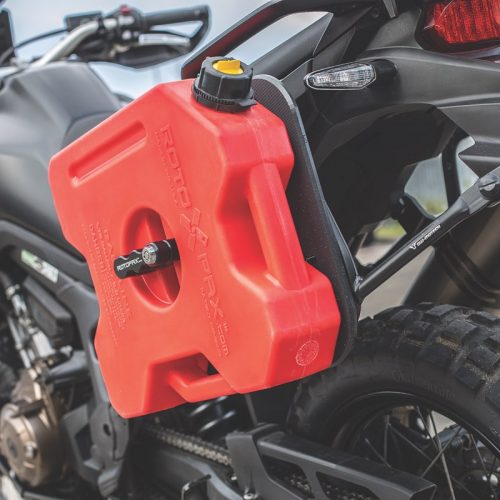
A company called RotopaX makes specialized jerry cans that have a unique mounting system that solidly fastens the can to your bike, while a simple twist of a knob releases it effortlessly and quickly. RotopaX jerry cans have flat sides, letting you stack luggage on top of them so you don’t have to give up any storage space. The cans can be mounted vertically or horizontally, and range in volume from 3.8 to 15 litres, and in price from $80 to $175, plus an additional $50 for the mounting bracket.

If that still exceeds your budget, a simple, cheap solution is to carry a 4-litre jerry can, which is small enough to bungee onto your bike’s luggage rack, yet holds enough fuel for about 70 kilometres. However, it can be
cumbersome to carry, and bungee cords don’t guarantee it will stay on your bike, especially if you’re riding off-road.
An even simpler solution that I resort to is carrying one litre of fuel in an aluminum water bottle. Just verify beforehand if the bottle’s cap and seal are compatible with gasoline. This $10 bottle stores conveniently in a tank bag or saddlebag, and it’s tough. Of course, it only provides fuel for about 25 kilometres, but sometimes that’s all you need.
If you’re low on fuel and are uncertain you can make the next gas station, you can up your odds by “hypermiling,” a riding method that applies various techniques to lighten the load on the engine as much as possible, and thus increase fuel mileage. Some of these techniques should be used only if you’re in a jam and shouldn’t be applied to regular riding.
First, reduce your speed to about 80 km/h. You want to ride slowly enough to save fuel, but fast enough to stay in top gear. Use momentum to get you up hills as far as you can in top gear, then downshift as needed to maintain your speed; lugging the engine at low revs burns fuel. If the descent is long, pick up some speed at the top, then pull the clutch and use the kill switch to shut off the engine; don’t use the ignition switch or your lights will turn off. Any time the bike is moving without the engine running is free mileage. Don’t slow down too much as you reach the bottom of the hill: you want to fire up the engine and release the clutch slowly while still in top gear.
 You can use the draft of larger vehicles to cut the fuel-sapping windblast, but keep a safe distance. If you must come to a stop for an extended period, like at a traffic light, shut the engine off. When accelerating from a stop, use light throttle, but do it briskly so you reach your cruising speed as quickly as possible, since this is when the bike is most fuel efficient.
These are just some of the ways to make sure you don’t run your fuel tank dry. But the best way to avoid running out of gas is to plan ahead, because I can assure you that if it does happen, it will happen at the most inopportune time.
Technical articles are written purely as reference only and your motorcycle may require different procedures. You should be mechanically inclined to carry out your own maintenance and we recommend you contact your mechanic prior to performing any type of work on your bike.
Spain’s diversity offers magical moments to the motorcycle adventurist
Some things in life are meant to go together – a crisp glass of wine with a delicious meal, a chunk of hard cheese with fresh crusty bread, scenic motorcycle touring with track time. Cat MacLeod of Leod Escapes has found the perfect pairing by combining 4-6 days of breathtaking road riding with two days of exhilarating track riding – on world-famous Moto GP circuits no less!
Having participated in one of his combo tours two years prior through the Italian Alps and on the Sachsenring circuit, I had high expectations of this inaugural trip through the Spanish Pyrenees and on to the Moto GP circuit of Aragon. The bar was set very, very high.
MacLeod has been running these perfectly blended tours for six years, offering international choices: Australian Curves to Phillip Island, Italian Dream to Mugello, or California Curves to Laguna Seca with the California Superbike School. In his quest to create the ultimate riding experience for the adventurous rider, MacLeod ran a contest asking the public to choose where his next tour should be. Czech Republic and Brno? Portugal and Portimãu? Thailand and Chang International Circuit? Or Spanish Pyrenees to Aragon?
The votes were counted and the Spanish Pyrenees to Aragon won as the most requested next trip, and so began many months of planning.
After extensive searching and testing various vendors, Leod Escapes chose IMT (International Motorcycle Tours) to provide local guides and a fleet of BMW motorcycles. Together they designed the routes that would include the things that he wants most for his customers to experience, like incredibly diverse roads, stunning scenery, local cafés and restaurants, authentic food and wine and, of course, two full days of track riding on a Moto GP circuit. There were 17 of us in total – two Canadians, 13 Americans and two Catalan guides would be the first group to enjoy this custom-built and specially requested tour.
High Standards
 However, with the epic experience of my first Leod Escapes tour, I was almost expecting this one to fall short. How could any trip possibly be better than Italian Alps and Sachsenring? My friend Nicole, who accompanied me on the last trip, was my motorcycle-riding sidekick on this tour as well. We spent the first day comparing this new group of participants and the first day of roads and riding with the last trip. Even when we rolled into the town of La Seu d’Urgell to our castle accommodations, I was still content in believing that this would be the second-best Leod Escapes tour I ever participated in.
But then, as day two wound its way to an end in a flurry of twisty roads winding through desolate villages dotted with crumbling stone walls, we rolled up to a beautiful majestic castle surrounded by what our animated guide Sergi described as a “circus of mountains,” and I realized I was experiencing something beyond magical. There was no longer any need to make comparisons. This would be epic in its own way and would be a different kind of special. There we stood, flushed and tired from the day of riding but completely rejuvenated by the 360-degree view of purple-tinged mountains, touching the sky.
We snapped pictures, trying to capture the richness of the moment. Within seconds, another dash of pink by way of the clouds swirled in the ever-changing sky. We drank wine and Spanish liquor under the shadow of the mountains, thick and full, and so began the complex formations of deep and binding friendships under a canopy of stars.
Ribbons of Curves
 The following days unfolded almost like a roller coaster ride that only goes up, each day building on the previous, getting better and more amazing with every twisty road and mountain pass that we traversed.
And just when we thought it couldn’t possibly get any more stunning, an outrageous, beautiful ribbon of road would appear in the middle of an idyllic town surrounded by lush, green hillsides and dotted with stone farmhouses and churches, and on the top of one of those hillsides would be another stately castle. “It’s like they just put a curve here for the sake of putting a curve here,” said Justin, a fellow tour participant from Detroit. “They could make the road straight, but they filled it with curves instead!” We were awake, but it felt as if we were dreaming.
On day three, we wound our way through single-lane, well-paved roads with broken white lines on each side – no centre line – as if riding along a paper map with edges that dropped off steeply to vibrant hillsides with goats and cows roaming below. We rode over the stunning 2,072-metre-high Port de la Bonaigua pass before we dipped into France. From the top of the pass looking down was like a scene from a fantasy novel – richly olive-tinged with dark, curvy roads thrown in for fun.
We then crossed Col du Tourmalet pass. At an elevation of 2,115 metres, it’s the highest paved mountain pass in the French Pyrenees and is a famous section of the Tour de France. We stopped for lunch in the small village of Luz-St. Sauveur, which happened to be hosting Festival Du Foire, a fair to celebrate the fall lamb harvest. We improvised with parking and then wandered the streets, hungry but too curious to sit and eat. With a big band playing trumpets and clarinets, we danced and frolicked while browsing local vendors selling wine and craft beer, rounds of cheese and fresh sausages, and cooking up meaty lamb chops on homemade grills.
Some Things Never Change
Our day in France felt soft and lovely, like riding through an ancient romance novel. I was lost in the passion of it all, new friends growing closer with each minute, beautiful scenery and flowing roads. Suddenly, our riding was halted for a few moments while we waited for weathered old men and sheep dogs to corral a herd of sheep down the road. As if we were riding 100 years ago, the hollow clang of bells being rung by farmers wearing caps and trousers, sheep dogs working the herd back and forth instinctively as they slowly meandered down the road and finally over the stone walls back into the verdant hillside.
The most beautiful vista of Arrens-Marsous came next – the place where I pulled over and stood in awe: a picturesque town nestled in rolling green hills as far as the eye could see, surrounded by higher jagged mountains and what I thought were dark clouds, which turned out not to be clouds at all but mountain peaks that rose so high I believed them to be actually touching the sky. And then, of course, when trying to return to the group, I had to patiently wait for cows to leisurely cross the road while a free-range horse stood vigilant nearby watching, the curvy road disappearing ahead.
This spectacular pass was closely followed by the most challenging and frightening pass, through the town of Béost and up over the Col d’Aubisque; carved into the side of a rocky cliff, it was barely wide enough for one car. While I’m not scared of heights, I couldn’t allow myself to look down over the edge for fear of riding over it. How exciting! How beautiful and startling all at once.
“That was a whole different universe of sheer terror,” said Tom, one of the more cautious riders in the group and who did happen to be terrified of heights. “I did it! I loved it! The views were amazing! This is what touring is all about, growing as a rider and a traveller as well.” We were so high we were actually in the clouds and snaking through a thick, foggy blanket, back down the other side.
Riding through the Spanish Pyrenees to Aragon is a little like enjoying tapas – you get a little sampling of everything: spicy, rich, flavourful and filling. As we traversed southeast across the country, the air warmed and thickened, and the scenery morphed from lush, green hillsides to dry, rocky vistas mixed with varying shades of red, pink and orange. Even the pavement changed from deep and murky greys to an orangey pink hue and widened as we rode closer to the track: Motorland Aragón!
Listen to Your Heart
 As the road opened, so did the throttle, and suddenly we were speeding toward the town of Alcañiz in a steady line, back and forth, smoothly and evenly, and I fell into that trance, in the zone, one with the motorcycle. I could see Sergi a few riders ahead, intuitively reading the group, allowing this burst of speed but keeping us all in check. “Listen to your heart when riding,” he had warned us on day one. “If it goes bap bap bap bap bap really fast, then maybe you’re riding over your head. Try always to ride with the heart that goes duh dum duh dum, duh dum.” He’s the same guy who also described his work as a guide for IMT as a “dream job, like surfing a cloud.”
As we paused at the base of the pastel-coloured town of Alcañiz – looking like a Lego block mash-up of light pink, orange, yellow and white pieces surrounded by stone towers and buildings – we could see the formidable castle at the top of the hill, almost glowing with the slowly setting sun. I can’t begin to explain the sheer joy and happiness I felt while winding through the narrow cobblestone streets, bells jangling, wafts of coffee and cigar smoke filtering through my helmet as we weaved higher and higher to the entrance of the Parador de Alcañiz. High castle walls tinged a burnt orange from the setting sun, towering archways, and right out front, marked with black ribbon, a parking area for our motorcycles – the sign: “Grupo Alojado IMT BIKE: Passion for Motorcycling.” That was a wow moment.
Exceptional Accommodation
One thing that set this trip apart from the last was our accommodations. Most nights we stayed in four- to five-star paradores – think luxury “hotels” in converted medieval castles, monasteries and fortresses; it’s a way to help fund the upkeep of these historic monuments. Stunning, majestic, impressive, unique and exquisitely beautiful. Consistent with the rest of the tour, somehow the paradors seemed to get more and more impressive as the days unfolded. And the food and wine! No matter if you are Catalan, Basque, Galician or one of the other 14 different cultural identities, Spaniards are proud of their regional menus and wines. Wine is part of the Spanish dining experience, and each evening we were offered an extremely reasonable, pay one price, try all the red and white to your liking. We enjoyed locally produced wines from unique varietals such as Tempranillo and Garnacha, and menu items like Iberian pork, fresh hake, veal and Mediterranean seafood paella.
Through relaxed dinners that started around 9 p.m., as customary, and ran long and leisurely into the night, we got to know and like each other deeply. “These two absolutely make the trip,” said Paul, a soft-spoken financial planner who’s willing to twist the throttle open on the road and track. “It wouldn’t be the same without them,” as he toasted our IMT guides.
We all agreed. Sergi Besses, or “Slim,” as he was affectionately called, was vibrant, full of energy and always smiling. A talented rider and excellent guide, he entertained us each morning for around five minutes while giving us a quick rundown of the route and the roads we might expect to encounter. “Today, we add some pepper to the ride,” he would say, grinning while pointing to the map and then throwing his hands in the air shouting, “Yella ramella!” An inside joke, which very roughly translates as “Let’s go, sheep!”
And then there was David Noya, our humble driver who followed behind in our support vehicle and luggage transporter, always looking out for anyone who may need any extra support and ensuring all the details were well taken care of. Quiet and serious at first, he quickly revealed himself as a passionate and sometimes silly instructor of riding and driving, who just so happens to be extremely fast, holding the 2004 Catalunya Championship title for racing 600 cc.
We were a mishmash of personalities, falling in love with the entire Leod Escapes experience.
Moto GP Circuit and Troy Corser
Our last night in Alcañiz was so special. Having just spent two full exciting days of track riding on the world-class GP Circuit Aragón with two-time World Superbike Champion Troy Corser instructing us through the Race Academy School and growing and improving as riders, a celebration was required. Where better to commemorate motorcycle riding and cherished memories than in a tiny hole-in-the-wall restaurant in a cave that just so happened to be filled with pictures of famous world-champion motorcycle racers who frequented the same place. Wine, shots, toasts, speeches, delicious food, hugs, laughter and then singing as we walked back up to our castle on the hillside full up on life. And then, as if the night wasn’t epic enough, sharing drinks with Corser himself in a stately bar in the massive castle under a sky sparkling with stars. Awake but still dreaming.
Slightly hung over (again) and under a sky of soft feathery pink, we rolled out of Alcañiz and toward our next destination, Cardona and the final parador of the tour. I did not expect what came later. Exhausted after another day of impressive touring, we rounded a corner to behold, there in the distance, a fortress more massive and impressive than all the others combined. Wild hand gestures ensued as we neared Parador de Cardona, a ninth-century castle built by Wilfred I of Barcelona.
An Emotional Last Night
Words cannot describe this place or the emotion that came from it. It was here that I broke down in tears in the grand medieval dining room, in front of everyone, knowing that our experience was winding to a close. So full up and so empty at the same time. The stone walls and archways, the ancient paintings and the silence that fell around me as I stood on the top of the tower, under a waving Catalan flag, was too much. It was as if the ghost of Cardona Castle, the one that was said to frequent room 712, the same room that Nicole and I had specially requested, had bequeathed her grief on me. Legend says she died of sadness of a broken heart, and in those stones and arched doorways, I felt something so strong and ancient. Nicole, the more empathic and intuitive of us both, felt tapped into something spiritually higher than my melancholy. Hers was an energetic, more psychic experience from within the emotionally filled walls.
We ate grapes warmed by the sun that fellow rider Brad had chopped off a vine from a vineyard on the side of the road, and we toasted each other with full-bodied wines and Blanca de Navarra liquor. It was almost time to say goodbye.
I fell in love there, in that country, with the pavement and the mountains, the valleys and the stones. I let go. And that is the magic of travel, something about movement and motion, propelling you forward even if you don’t know where you are going.
In the end, it wasn’t so much about riding motorcycles through a storybook of the most incredibly stunning scenery, or even about turning laps on the exhilarating Moto GP Circuit of Aragón, but of the coming together of a unique group of people. Riding into Barcelona after an intense and emotional nine-day adventure, I noticed an ease in which we rode beside each other, more tightly condensed and connected, in perfect formation. Gone was any fear of riding in an unfamiliar city next to new people, and in its place a sense of comfort and finality, the best ending to a life-altering experience.
We pulled into IMT bike headquarters with gas tanks empty but memory cards full, physically and mentally exhausted but emotionally fulfilled and with excellent timing . . . just in time for a cold drink and a siesta.