
Going-From-the-Sun Road
Everyone should ride Montana’s Going-to-the-Sun Road at least once. And then ride the surrounding roads forever more
It’s one of those famous roads people like to name-drop: “Going-to-the-Sun Road.” It’s right up there with “Beartooth Pass” and “Million Dollar Highway.” And with good reason. Montana’s Going-to-the-Sun Road has been titillating road travellers since 1932, bravely winding its way west, up the steep, narrow waist of the Rocky Mountains known as the Crown of the Continent, tipping over Logan Pass at the Continental Divide, then tumbling swiftly down the east side in undulating drops that eventually level into short-grass prairie.
It’s a world-class road, right up there with the famous passes in the European Alps, and if it weren’t for Going-to-the-Sun’s smothering crowds and snail-slow National Park speed limit of 25 mph, it would be just as fun to ride, too. Still, everyone should experience the scenic extravaganza at least once, taking time to marvel at the accomplishment. Imagine the sweat and peril involved in constructing such an ambitious road using equipment available in the 1920s. It took more than 10 years. Heck, it still takes 10 weeks to plow the top of the road each spring, and that’s using modern equipment that can move 4,000 tons of snow per hour.
In fact, it was this last season’s delayed opening and record near-30 metres of snow on Logan Pass that stopped me in my tracks. I’d entered Montana’s Glacier National Park from the Columbia Falls side at first light, anticipating an empty road up Going-to-the-Sun Mountain, but alas, the valley was already swarming with amateur photogs bending out of car windows and anglers practically elbow to elbow on the edges of Lake McDonald. Somehow I’d miss the memo regarding the prolonged closure, a circumstance that left the throngs of tourists sequestered in the valley.
And so I retreated back into town, depressed that the much-anticipated zenith of my Montana travel was suddenly quashed. It was too early to drop into Packers Roost, Columbia Falls’ popular biker pub, to commiserate with the brethren, so I slumped down in a booth at the Huckleberry Patch Cannery and fed my disappointment a huge slice of homemade huckleberry pie, a local specialty.
Mad About Maps
 And I thought, Man, I miss maps. You know, paper ones, with notes and highlights and green dotted lines that show you where the good stuff is. Sure, there are great things about travelling with a GPS, but that pulled-back big-picture look with all its possibilities is never as compelling on a tiny screen. After about 30 minutes of scrolling around on my handheld electronic map, I decided to circumnavigate the National Park in order to re-enter from the east side, via U.S. Highways 2, 49 and 89.
Now U.S. 2 I’ve ridden before, all the way from Washington state to Michigan, and it’s a fantastic alternative to American interstate travel (though it doesn’t hold a candle to the Trans-Canada Highway in British Columbia for scenery and small-town flavour). From the west gate of Glacier Park, Hwy 2 keeps step with the fast-moving Middle Fork of the Flathead River, and thanks to the generous speed limits outside the park, I could follow just as rapidly. This is great riding, with smooth, long sweepers and little traffic. Just a few corners in, I was over my disappointment and beginning to realize Mother Nature had thrown me a bone.
On this stretch of U.S. 2, you’ll cross Marias Pass, which offers superb views of the east side of Glacier Park. It’s the lowest pass over the Continental Divide, at 1,589 metres, and has been the route of the Great Northern Railway and its successor, BNSF, since 1889. Railway buffs still gather at Marias Pass to watch the heavy freight trains crest the oft-snowy summit.
By the time I reached Essex, I was thoroughly invigorated and not missing anything about the snail’s pace of the park. I’d first ridden Going-to-the-Sun Road and Montana’s Rockies in 1990 on a Kawasaki ZX11 test bike back when it was the fastest production bike ever built. At the time, the state’s highway system was known as “America’s Autobahn,” legendary for having no posted daytime speed limits. The ZX11 was of course a terrible influence, and it didn’t take long to learn that the “reasonable and prudent” speeds permissible did not include triple digits.
Today’s speed limits are still some of the highest in the country, though the scenery in northwestern Montana begs for moderate speeds. By the time I turned north on Hwy 49, I was happy to snick my BMW K1600GT into a restful gear and revel in the unspoiled landscape.
A Land Without Borders
 This is the territory of the Blackfoot Nation, a people who believed these bare, jutting mountains were the backbone of the world. The Blackfoot people are from several tribes that still live across great swatches of Saskatchewan and Alberta, as well as the Great Plains of Montana, and are recognized as a single cross-border Confederacy. It’s rather beautiful, then, that Glacier National Park on the U.S. side and Waterton Lakes National Park in Canada have also dismissed the national border to become a single entity, Waterton-Glacier International Peace Park, all in a cooperative effort to protect a contiguous wilderness that remains much as the Blackfoot tribes would have known it hundreds of years ago.
If you’re travelling east on Hwy 2, your GPS might recommend you travel to Saint Mary and the eastern terminus of Going-to-the-Sun Road via Browning, where U.S. 2 converges with U.S. 89. Don’t do it. Head north instead on 49 in East Glacier Park Village and get ready for some gorgeous views. Highway 49, which is closed in winter, climbs and twists through aspen groves and beautiful meadows, offering some of the best views of the glaciers in the distance. When you arrive at Two Medicine Lake, take the park road to the Two Medicine Campground (within the park) for a 28 km out-and-back that’s bursting with big views.
The breathtaking Hwy 49 ends at U.S. 89, also known as the National Parks Highway, since it strings together six of North America’s most beautiful National Parks along its 3,200 km north-south course. This particular section of U.S. 89 between Kiowa and Saint Mary is exceptionally beautiful, with awe-inspiring views of the sentinel-like Rockies, the exact scene that must have blown the minds of the early pioneers approaching the Great Divide from the east 200 years ago.
Today I’m very happy to have 160 horses to rush me up and into the Rockies. The K1600GT’s surreally smooth six purred sweetly as I untangled Hwy 89, growing ever closer to the backside of Going-to-the-Sun Mountain and its namesake road, which slumbered out of reach, deep beneath heavy snow.
Out of the Know
 You’ll see glacial pocket lakes and bands of loose horses here, and, best of all, a mostly empty road, even on days when the park right next door is at capacity. It’s a great time to pull over and breathe in the quiet. Don’t even bother checking the cellphone – you won’t have service. The only sound is the mountain air rustling the prairie grasses and clearing your thoughts. It’s a perfect spot to relish being Out of the Know. No politics, no protests, no pressures out here. Well, except the pressure in your tires, of course.
After some exploration into the Many Glacier area to the north, I finally turned west in Saint Mary on Going-to-the-Sun Road. This less-travelled section of the famous highway sweeps gracefully around the shores of Saint Mary Lake as it slowly rises toward Logan Pass. As the peaks draw nearer, the colour that from a distance looks grey shifts to distinct tints of burgundy, light green, red and tan. The true glacier that carved and coloured this park melted 12,000 years ago. The glaciers that exist here today are new, and tiny by comparison.
Twenty-four kilometres in, I’m stopped once again, this time just 13 km short of Logan Pass and the most famous stretch of Going-to-the-Sun Road. But I’m not sad. Perhaps on a perfect day, Going-to-the-Sun would be open and I’d close the loop with a sloth’s-pace ride through the park, but today I’m just grateful. I’ve had an utterly fantastic afternoon of riding. I’ve enjoyed countless empty corners and heart-goosing views. I’ve seen mountain goats, a grizzly bear, a moose, a wolverine and very few people.
And by the time I turn in tonight, I’ll have bookended my day with a second slice of delicious homemade huckleberry pie. This time with ice cream. Because just outside Glacier National Park, you can always have your pie, and eat it a second time, too.
It was forty years ago that this Canadian started his racing career on the dirt tracks of Eastern Canada, and this year he’s celebrating on his way to the top.
There’s uniqueness in being the only Canadian motorcycle racer at the Pikes Peak International Hill Climb (PPIHC). I tried to keep this in mind as I headed out from Moncton, N.B., for the long 4,100 km drive to Colorado Springs, Colorado. As this was my third year in a row making the trek, the itinerary was well sorted: 1,000 km per day for four days. As a privateer, there’s no glamour in the trip. Each night I bed down in the back of the same Ford F-150 crew cab that’s pulling my 7 x 14-foot enclosed trailer, packed to the brim with race bike and endless totes of spare parts, tools, equipment, gear and the like.
Founded in 1916 by Spencer Penrose, the Pikes Peak National Hill Climb, and the road he built to accommodate it, has presented a unique challenge to generations of racers. The Pikes Peak toll road winds its way up the length of the course 19.98 km with 156 turns to the 4,300-metre summit, providing an incredible drive and views that draw hundreds of thousands of visitors annually. Because of this popularity, the road is closed for only one day per year – race day. That means all testing, practice and qualifying is scheduled between sun-up and 8:30 a.m., when the road opens. Conditions on the mountain course are what could reservedly be called “variable,” especially hazardous for vehicles with only two wheels; race morning in 2016 saw snowplows scraping thick sheets of ice off the top of the track.
A Sparse Racing Career
 For 2017, I was entering a 2015 KTM Super Duke 1290R, the same bike I’d ridden to a third-place finish in the Heavyweight division the previous year. We’d made improvements to the suspension, as well as added some aftermarket electronics but had not been able to test over the winter.
Our one opportunity for a shakedown came in May at the first round of the Society of Atlantic Roadracing League series at Atlantic Motorsport Park in Shubenacadie, N.S. It should be said that I’m by no means a road racer, having only dabbled in it over the years. Visits to Shubie have been few and far between, with races in 1984, 1993, 2005 and 2016, though my return in 2017 broke the long-standing tradition of one visit per decade.
I came away from the weekend taking first place in the Pro Twins, first place in the Formula 46 class and third place in the Pro Superbike. More importantly, we had a good baseline as we began the trek to Colorado and America’s second-oldest motorsports race.
Our arrival in Colorado Springs for the test weekend on June 10 and 11 was greeted with 70 km/h winds, gusting to 95 at the peak, which understandably had officials anxious, resulting in a group test run for safety. Even at that reserved pace, we were being pushed around on the road, with the wind most noticeably, and uncomfortably, doing its best to suck the bike off the side of the mountain.
America doesn’t have the stomach for race fatalities as in the road-racing cultures of Ireland and the Isle of Man, and this fact very nearly ended the event for motorcyclists. The top section has not been kind to motorcycles over the past few years with fatalities in 2014 and 2015. After Carl Sorensen slid off the high-speed 19-Mile corner and plunged to his death in a practice run in 2015, it was said that in the days after the race, the PPIHC administration had made a decision to cancel future motorcycle participation in the event. Thankfully, that ruling was not made official.
Tight Field
This year’s competition was expected to be very tough. Returning for his seventh year was last year’s King of the Hill, Bruno Langlois from France on a specially prepared 2017 Z900, bristling with advanced race parts and electronics. Also back was Rennie Scaysbrook on a new KTM factory-backed Super Duke 1290R, looking equally race-prepped. He had been well on pace last year to win the overall, but entered the hairpin at Elk Park with too much steam and put himself into the guardrail. The biggest threat, though, was rookie Chris Fillmore from L.A., also on a KTM factory-backed Super Duke 1290R. At 30 years old, Fillmore has spent most of his last 15 years as a KTM-backed pro AMA Supermoto and Superbike racer. I first met him in 2006, when we were racing a national Supermoto event in downtown Toronto. It’s a huge task to arrive at Pikes Peak for the first time and compete for a win, but Fillmore is not your average rookie.
Testing early in the morning always has its challenges, the first of which is getting up at 2 a.m. to be on the hill at 3 a.m. But being early has its rewards in getting first choice of pit area – the closer to the starting line, the easier it makes getting situated for each practice run. Both days we were first in line to take advantage of the valuable lessons learned in years past.
This year, my crew for the test weekend was veteran Canadian road racer and Harley-Davidson XR1200 series front-runner Blaise Fougere from Halifax. With time at a premium, we’re always under the gun to learn quickly and make smart adjustments, meaning I rely heavily on Fougere and his experience as a national-level road racer to move us in the right direction.
All Together
 We never actually get to run the entire course until race day; instead, testing, practice and even qualifying are completed on various sections. This first day of testing was spent on the top half of the hill, and after a few tentative passes, the surface began to warm and the pace picked up. We’d eventually manage the fourth-fastest time of the day.
The second day’s testing took place on the bottom of the circuit, with its fast and flowing corners favouring the guys with a road-race background. The first series of corners is the most dangerous, with speeds high and tire temperatures at their lowest. The catch here is that the harder you charge out of the gate, the more temperature the tire builds and can hold onto for the cold climb to the top. By the third session, we were ready to lay down a fast time, but four corners into our run, at full throttle and maximum lean angle on a 160-plus km/h sweeping right-hander, my engine abruptly shut down. The suddenness of it locked the rear tire and sent the big twin into a skid toward the guardrail on the outside of the turn. I gathered it up just as I went over the white line, within a metre of disaster. Coasting to a roadside stop, I tried to digest what had just happened. I turned the key off then on, and it fired up immediately. The course was promptly red flagged, but not in time to stop the next bike, Fillmore, who seconds later flew by at a race pace just metres away.
I unceremoniously rolled back down the course to the pits, the bike cutting out twice more along the way, suggesting a fuelling or electrical problem. We were done for the day.
Gremlins
I stayed in Colorado Springs for the week trying to solve our mechanical problems. Fougere flew back to Halifax for the week, to return next Sunday for the “Peak Week” schedule of events.
I was offered a fuel pump from the KTM factory team as a possible solution. The difficulty was, there was no place to test the bike during the week. I discovered that the following Saturday, there was a track day down at Pueblo Motorsport Park, an hour south of Colorado Springs, so I registered for that. Unfortunately, the fuel pump hadn’t fixed the issue, as the problem once again reared its head on my first out-lap.
After some phone calls and pondering of the situation, I felt the issue must be with the aftermarket tuning electronics I’d installed on the bike to help with fuel mapping at race elevations. I spent the remainder of the day in the desert heat ripping off all of the new electronics and returning it to stock, only to miss the last practice session.
I knew I couldn’t afford to miss any more practice runs on the mountain, so, at the suggestion of some well-informed locals, I rolled the KTM out of the trailer at the crack of dawn the following morning next to an abandoned warehouse in nowhere Colorado, surrounded by an expanse of flat desert, on an arrow-straight road that went on forever. Of course, being on public roads, in a foreign country, aboard an un-plated competition motorcycle with no insurance, carries with it a certain gravity, which I weighed with great care against the toils of an entire year. On this occasion, fortune favoured the bold, and my hunch about the wiring as the Super Duke was back on song, albeit down horsepower and a quick shifter in this stock form.
Main Event
 The Peak Week schedule began on Monday, June 19, with registration and technical inspection. My crew this year was the same as in 2016: the aforementioned Fougere and Caleb Noiles. Noiles is an experienced Canadian road racer from Moncton, who’s been running up front in the 2017 Atlantic Pro Superbike and Supersport Championship series.
On Tuesday morning, I decided to put all the problems of the past week behind me and come out swinging on the middle-section runs. I led the field with the fastest time on each of the first three runs of the day, with only one minor hiccup. Coming into the final turn of my third run, I reached for the front brake and the lever went straight to the bar – no brakes at all! I locked the rear brakes and dirt-tracked it through the corner in a panic. Safely back in the pits, we bled a large amount of air out of the brakes and surmised it had gotten in there from the violent headshake the bike had been through the previous weekend when the engine shut down.
The remaining two runs of the day were not comfortable ones. This mountain is no place to be without brakes unexpectedly. I kept one finger on the lever for most of the runs, pulled in just enough to feel there was brake pressure there. Surprisingly, though, I ran faster times, but was eventually shuffled back to fourth fastest once again thanks to improving times from the factory-backed guys.
Fingers Crossed
While taking care of the brake issue, we also decided to try reinstalling the electronics I’d removed when trackside in the desert. Despite the risks, it would give us the fuel injection map tuned specifically for the race elevations, and it also meant the quick shifter I’d done without all morning would be back on line and saving me precious fractions of a second with each use. Our hope was that loose connections and not the units themselves caused the stalling issues.
The next day, we were back on the top section of the mountain and spent much of the day working with the people at Pirelli to get the most out of the tires. We made headway, but it was difficult to attack the course at 100 per cent without feeling safe entering and exiting every corner. I kept one finger pulling the brake lever all day, hoping for the best.
Friday, June 30, was qualifying day, with the best time of the day determining the race order, from slowest to fastest. On the first run of the day, thick fog covered the mountain from Picnic Grounds to Glen Cove. Visibility in some areas was nil, and I had to look down and follow the yellow lines to stay on course. I just backed out of the throttle and completed the run. After I returned to the pits, the session was suspended; when the fog didn’t lift, the morning session was cancelled. The one run we’d completed was used for our qualifying times and race order. The riders who went up first got the clearest run and best times. I think some gambled, perhaps knowing this may be the only run. In the end, I was seventh fastest and my starting position was 23rd for Sunday – race day. Just another wacky situation that makes up a Pikes Peak experience!
My girlfriend, Melanie, flew in for race day and some good ol’ boys from home made the trek down as well. The familiar faces and camaraderie were a welcome addition to an otherwise tense couple of weeks. We were all up and driving to the mountain by 1 a.m. that Sunday. Once on site, we readied the KTM, making final adjustments, and I went through course videos, pictures and notes, and triple-checking everything. All prayers were answered, as it was a glorious clear and sunny morning on the mountain. The road temperatures were coming up steadily and ensured good grip for our run. That was a huge relief – a dry mountain course is dangerous; a wet mountain course is deadly.
The Intensity of Pikes Peak
The mood on pit lane was positive and jovial, but tensions clearly rose in the moments leading up to the start. The atmosphere was much like an X Games, with riders chatting, backslapping and hugging, exchanging “See you at the top” vows.
I felt ready and calm. Every day for a year I worked on something to get to this point. It was time to put aside the week’s issues and enjoy my turn on the mountain.
We got the signal to go, and the tire warmers were whipped off and the KTM was fired up. I rolled down to the start and took the starting position. At Pikes it’s a flying start. With the wave of a green flag I roared off the line and was in third gear wide open around the first tight left-hand corner and through the start timing gate.
I pushed through the lower section harder than I’d ever dared before, the extra speed causing me to miss a few braking points. The momentum continued to build until I drifted onto the yellow lines coming around Tin Barn and lost the front end for a moment.
With renewed focus, I barrelled through Glen Cove and into Section 3. The climb through the Cove really shows what you’re made of as you keep the throttle pinned, banging up the quick shifter from first through fifth while double-apexing a long blind right-hander around the mountainside – this is the essence of Pikes Peak. It only intensifies when the Elk Park hairpin appears and you need to throw out the anchor while still turning. Experienced racers Don Canet and Rennie Scaysbrook both made friends with the guardrail there. It’s one of the few places a guardrail is your friend, or at least friendlier than the endless cliff behind it.
Over the Top
Section 4 takes you over the top of the mountain, from Devil’s Playground to the Summit. It’s called Devil’s Playground for the spectacle caused by the way lightning dances and bounces about the area from rock to rock during alpine electrical storms. Up here, the road is colder and the drops are much longer. Road conditions are also at their worst, the surface having to endure the harsh and ever-changing climate at these altitudes. Each turn requires a little more care to avoid bumps and settle the bike while still trying to fight for every second on the clock. The final left-hand corner to the Summit finish line is no place to relax. It’s a tricky camber with rough and broken pavement. I raced for every fraction of a second through it and crossed the finish line in full tuck, then carefully decelerating, thinking of Texan Bobby Goodin, who was killed here in 2014, having lost control of his bike at the finish line.
I slowly rolled across the dirt parking lot to the race director’s position, where I received a big handshake and my race time of 10:28. Truthfully, I was disappointed for a moment. I’d beaten last year’s time by eight seconds, which was a significant improvement. However, the run was nearly flawless and had just felt so much faster. But the clock doesn’t lie, and the mountain has no favourites. I stood on the edge at 4,300 metres, watched the clouds roll by, counted my blessings and sunk a beer. Life goes on.
It had been a full year of painstaking preparation. As a 53-year-old privateer and part-time rider from Irishtown, New Brunswick, I was incredibly proud of the team and our accomplishments – and what turned out to be a fourth-place finish in class. Not bad for a retired accountant.
Can Harley’s newest midsize offering impress on some of Europe’s finest motorcycle roads?
The invitation could hardly have been more specific, and enticing. “You are invited to Marbella, Spain, to view, ride and understand the new Harley-Davidson Street Rod. You will be able to ride the new model in urban and country locations for a full day, including along two of the routes widely recognized as being among the most enjoyable and demanding biking roads in Europe. You will ride along the twisting A366 tarmac roller coaster via El Burgo to the historic city of Ronda, spectacularly located in the mountains above Marbella. You will then descend back to Marbella along the legendary A397 – a sinuous length of challenging road steeped in automotive and motorcycling history.” Yes, please!
Hang on, though – you’re inviting me to ride a Harley along those fabulous racer roads where I’ve had the thrill of exploiting the performance and especially the handling of successive Ducati, Triumph, KTM, BMW and Yamaha models down the years – and have left witness marks to say “I Was Here!” by grinding their footrests in the asphalt to prove it. So, what can this new Street Rod be then? A Harley that handles?
Europe Every Time
 Harley-Davidson Europe was indeed confident enough in the company’s new Street Rod model to invite me to tackle the Ronda roads on it. That contrasted with Harley’s head office, which held its U.S. press launch in Florida, where anything other than a right-angle turn is alien territory, and elevation an abstract concept. Okay, so it was Bike Week in Daytona – but even so, gentlemen, you should have had more faith in what your R&D guys have come up with. Their job may have been to produce an urban streetfighter aimed at bringing younger riders into the Harley fold, but the result is a great deal more than that, which deserves to be ridden hard and not simply treated as a simple traffic tool, effective as it may be at this.
A 220 km high-speed day’s ride along some of the most demanding two-wheeled territory in Europe indeed underlined the broad capabilities of Harley’s new Street Rod package, in delivering H-D dealers with a genuine rival to the Triumph Street Twin, Yamaha FZ-07, and especially the Ducati Monster 797 and its Scrambler cousins – albeit one with a truly American personality at a super-competitive price. “We’re reaching out to customers in a space where we didn’t really have a product before now, who are already perhaps well-disposed toward Harley-Davidson, but haven’t yet found the bike in our lineup to meet their needs,” Jeff Strunk, H-D’s motorcycle product planning manager, says. “They’re primarily a younger crowd, living in a more urban environment, looking for a bike to get around on in a more exciting way.”
Purchase the issue to continue reading
West Coast pilgrimage on a shoestring budget.
The best things in life are free. That’s what they say, though I’m inclined to believe that the best things in life can be had with a modicum of cash and a motorcycle licence.
 Riding a motorcycle on Vancouver Island comes with a unique set of blessings and challenges: On one hand, minimal snowfall means a 12-month riding season for those with a healthy sense of adventure and warm, waterproof gear. On the flip side, living costs are high and wages are low, so expendable income and time for extended trips are virtually non-existent. Case in point: I had neither. So, naturally, I was planning a solo bike trip to Southern California. It was going to have to come in under three weeks and cost less than $2,000 – virtually impossible, especially with a departure date set for the autumn storm season. This was going to be a low-budget, old-school mission: I was dirtbagging my way to Joshua Tree, California, and it was going to take some planning.
I signed in to all the motorcycle websites and Facebook pages I could find, places like advrider.com and motostays.com. I reached out to friends and friends of friends down the coast and sent messages on couchsurfing.com to potential homestays. I pulled out the camping gear, changed my oil and got ready to leave.
Departure was set for mid-October. In the week approaching the date I had set, Environment Canada started putting up dire warnings: storms, typhoons, historic rainfalls, high winds. Bulletins were posted: Baton down the hatches, scoop up pets and small children. Stay inside, and whatever you do, don’t set out on a motorcycle! Naw, I thought, I’ll just beat the system, literally. Leave a day early, beeline it south as fast as I can and stay a step ahead!
Back on Schedule
On day one, I made it off the island as far as Vancouver before my Triumph Tiger 955i died – so much for staying a step ahead. I was four hours waiting for BCAA to boost the bike; by then it was too late to break for Seattle with a dodgy battery and failing daylight. I spent the night at a cousin’s house, drifting off a mere 250 km from home to the sound of rain starting to fall. It was to be my steady companion for many days, and in the morning I limped the bike through torrential rain and ominous wind to Rising Sun Motorcycles in East Vancouver. Day two was to be another late start, but happily the guys at the shop were extremely helpful. There was a cheery blaze crackling in their woodstove, and after an hour or two at the shop, a new battery and a surprisingly modest bill, I was back in the saddle for a wet, blustery second attempt to leave the country.
On a motorcycle, the heavy traffic on I5 to Seattle is stressful and dangerous on a good day. This was not a good day. Sideways rain blinded me, spray from 120 km/h traffic reduced visibility to virtually none, and massive gusts shoved at the bike and me mercilessly. It was with profound relief that I finally pulled into Seattle and spent a warm night with dear friends, good food and stimulating conversation.
The weather, however, was not going to cut me a break, and what had hitherto been the worst day of riding weather I had ever experienced became merely a warm-up for what I would encounter over the next week. Days in the saddle were punctuated with fuel breaks where I would shake the tension out of my shoulders, field incredulous questions from disbelieving passersby, change my socks, source new bags to line my boots with, and duct-tape the cuff of my outer pants to my feet so water would at least have to try a little harder before making it through my defences. It was easily the most challenging riding I’ve ever done.
Holed Up
 Despite the rogue weather, it felt amazing to be on the road. When I pulled over to ease the cramps in my shoulders and hands, the ocean vistas were wild, swarthy expanses of frothy waves and wind-bludgeoned trees. In Manzanita, Oregon, I narrowly missed a tornado that had touched down an hour before I passed through. Roads had just reopened, and though the 200 km/h winds had caused considerable damage to the town and buildings, fortunately, no one had been hurt. It was a humbling experience crawling through town, picking a careful line through shredded tree limbs and random detritus. The path where the tornado had crossed the road was clearly marked with trees completely smashed, power lines down, havoc and destruction everywhere. The wind was still furiously hammering the coast, everything felt raw and scary. I had never been so close to a natural disaster of that magnitude, and as soon as I could, I pulled over, took a hotel and holed up for two nights waiting out the weather.
I was thrilled to reach the northern border of California. The weather improved to merely “bad,” and there were even moments of watery, blustery sunshine. Near Eureka, I enjoyed warm hospitality from James, my first motostay. He and his daughter welcomed me into their home, allowed me to dry out my gear and myself, fed me and spoiled me rotten. It was to set the tone for the remainder of my trip, with complete strangers opening their doors and seeming to enjoy the visits as much as I was.
Passing over San Francisco’s Golden Gate Bridge truly felt as though I had crossed a threshold into “California.” The overcast lifted dramatically like a curtain and I easily slipped through the city. A friendly local surfer with a board considerably longer than his tiny car guided me quickly and safely out onto the Cabrillo Highway, beautiful Route 1. This was what I’d been waiting for. I opened the throttle along perfect, nearly empty twisties, between palm trees and sand dunes, under a bright blue California sky. The ocean had changed moods, and now winked and sparkled at me like a cheeky friend. I luxuriated for an evening in posh Carmel, where a fellow adventurer put me up, and we swapped stories all evening. Big Sur took the highway, lifted it into the sky and folded it back on itself over and over in tight, technical, empty switchbacks. I revelled in the warm, comfortable breeze as it tickled my nose with the scent of eucalyptus while my Tiger purred happily along. I was in heaven.
Burnt Rubber
Around this point, I realized that the long kilometres and extra weight had worn my tires much quicker than I had expected, and alarmingly, a little patch of steel belt was showing on my rear wheel. I called ahead to a shop in San Luis Obispo that could take me in in the morning and that had a decent selection of rubber in stock. The boys at CoastRiders Powersports traded me roughly half of my remaining budget for a set of Metzelers and several new lifelong friends. They then suggested that I detour from Route 1 and head inland to a much lesser-used route – 33 – which would spit me out at my next planned stop, Ojai. It may have been the single best piece of advice I’ve ever followed.
California State Route 33 started with a quick pit stop for stretches, a pee, a cold iced tea and easily the best pistachios I’ve ever eaten: organically grown, freshly roasted, and tossed with garlic or chili lime or just plain sea salt. There’s a short period of 40 km or so where it warms you up on a series of quick, gentle twisties and broad, grin-inducing sweepers. Then you make one final curve to the summit and everything you’ve ever loved about motorcycles suddenly comes together in one joyful, never-ending afternoon of absolutely primal delight. The pavement felt freshly laid; there wasn’t a crack or a piece of gravel to be seen. No cars or other traffic appeared ahead of me, the sun was hot and the wind highly scented with pitchy, spicy chaparral, pine and herbs.
My brand-new tires never once rode their centreline that afternoon as I pushed the loaded bike deep, deep into countless twists and turns and corkscrews and exhilarating plunges down steep canyons, through tunnels and past stunning vistas. It never seemed to end, and when it finally spit me out into gorgeous Ojai, I was exhausted, dusty and happier than I ever remember feeling in my adult life.
Devil in the Desert
 The remainder of the road to Joshua Tree was a fast, windy highway, and I made good time through straight stretches of desert. I shunned the bigger routes and instead took the smaller, more direct route via Victorville, approaching Joshua Tree from due west. In Victorville, I lost the highway for a bit and finally had to pull over for directions. A strongly built, swarthy man at a tattoo parlour looked somewhat surprised when I pulled in. He had huge forearms, neck tattoos and a strong Hispanic accent, and when I asked how to get to the Lucerne Valley, he replied, “No, man, you don’ wanna go there. I been there, man, there ain’t nuthin’! The Devil, he went there, too. He screamed for two days and no one heard him!”
He did, however, point me in the right direction, and still chuckling about a place so desolate that it could make the Devil scream for two days, I finished the last of the road south. The event I was attending in Joshua Tree was dusty, hot and as much fun as you’d expect a gathering of 1,600 or so women on motorcycles. Many rides, drinks, hugs, meals, new friends and good times later, I reluctantly pointed my front tire north and headed for home.
I now had new friends to visit along the way: girls from the event, the guys from the shop in San Luis Obispo. A host in Santa Cruz met me in Big Sur and led me through a series of back roads that, even on a fully loaded bike, were tight and fun enough to have me laughing out loud as we snaked up impossibly tight and steep canyon walls. Often I could see my guide 12 to 15 metres directly above me on the road, and the bike rarely made it out of first and second gear for nearly an hour. Another friendly, generous host and another evening of superb company and storytelling.
Trick or Treat?
The rain met me shortly after San Francisco and kept me company all the way home to Vancouver Island. I rolled into my own garage on Halloween night, wet, tired, happy, fully 100 per cent over budget, and ready to hit the road again in the morning. My first big solo mission was a complete, utter success and had lit the fires of inspiration for more trips in the future.
The saying about packing for a trip is true: Lay out all of your gear and all of your money before a trip. Then take half the gear and twice the money. My motto, through all the weather and adventure and crazy loneliness and beauty, became “Do or don’t.” Despite a grievous financial situation and no real ability to take time off work, I had chosen “Do.” And as always, it was the best decision of my life.
Could this be the best-kept secret in the Smoky Mountains?
Nestled between the Great Smoky Mountain National Park and Nantahala National Forest lies beautiful, resplendent Maggie Valley, arguably the motorcycle touring hub of the southern Appalachians. As the morning mist dissipates, unveiling the lush upper reaches of the surrounding mountains, the only sound is the humming of my tires and the purr of the Gold Wing’s engine. I spot Maggie, walking along the sidewalk. She is the village’s iconic tourism tactic, dressed in her period clothes. She gives us a pleasant wave, as she does to everyone passing through the village.
Rubbernecking left and right, Tina and I, along with Rich and Liz, pass by the early-morning risers at the breakfast joints along the way. From Soco Road, Highway 276 climbs up and over the hills, skirting Waynesville, and rolls on to NC 74, the Great Smoky Mountain Expressway. The sun is peeping through the clouds, heralding another grand day as we take exit 81 and sweep around onto NC 23 into Dillsboro.
Derelict Movie Star
 State Road 23 goes through town, and after a right onto Haywood Road, we find the Great Smoky Mountain Train Depot. The sign says “No Trespassing,” so pleading ignorance, I ride tepidly down into the greasy repair yard where men are working on train cars and engines. I tell the approaching man in authority that we would like to see the train wreck from the Hollywood production The Fugitive, but despite all my pleading, we are rejected, so we downheartedly make our way back up the hill. Not one to accept rejection, however, I park the bike at the end of the chain-link fence, only to find another barrier: poison ivy. Through the trees, I can see the wreck from the movie and the bus that carried the prisoners. Too expensive to move after the filming, the locomotive and bus still lie where they were left between the tracks and the Tuckasegee River.
Backtracking to Sylva, Hwy 107 threads us through Nantahala National Forest. Like a wriggling eel, the sinewy blacktop winds through villages with Cherokee names, Cullowhee and Tuckasegee, along the shores of Lake Glenville, originally known as the Thorpe Reservoir. In 1940, the war effort created a need for more raw materials, so the Lake Glenville Dam was built at Onion Falls, by Alcoa Aluminum, creating the present-day lake. The lake occupies the entire valley north of the town of Cashiers – a beautiful, peaceful vacation destination, except when Duke Energy does a water release and Glenville Falls, at the south end of the lake, becomes a raging torrent, much to the delight of kayakers.
Heading out of Cashiers, we’re treated to a ride along State 64 through dense North Carolina forest on our way to Highlands. For 16 km, curves and hairpins roll through bower-like overhanging trees; it’s like riding through cool, green tunnels protecting us from the sun. Finally, bursting out of the forest into the sunshine, we arrive at Highlands. At Buck’s Coffee Cafe, a cute hangout, we relax for a bit. The girls entertain themselves with some window-shopping in the well-to-do artsy town while Rich and I sit on a bench and do some people watching.
All That Glitters
 Just west of Highlands on NC 64, as we round a sweeping bend, there it is: Bridal Veil Falls. From a huge rock overhang, an 18-metre curtain of water sprays downward on its way to Highlands Lake. Old Highway 64 once ran behind the falls, but winter ice caused problems, so the highway was diverted. Today, it’s a highly unusual and popular photo-op.
That gnawing feeling tells me it’s time to feed, so we hurtle onward, following the meandering Cullasaja River into Franklin, the self-described Gem Capital of the World. Sapphires and rubies are in abundance under these hills, and following that theme of glitter and gleam, the Motor Co. Grill, a 1950s-themed diner, is our choice for lunch. Embellished with polished chrome and shiny red vinyl, it reminds me of Arnold’s, the restaurant in the television sitcom Happy Days. The menu of burgers and shakes takes me back to a simpler time in America. But the gems we’re after today are made of asphalt, not precious metals, so in short order, we’re on the road again.
Four-lane Murphy Road zooms us quickly out of town to Patton Road, where a couple of turns puts us into the hills of thrills, Wayah Road, aka Thunder Road. Wayah is also the Cherokee word for wolf, and for the next 45 km, this pretzel-like rhapsody in blacktop will twist and turn us, snaking its way up the Nantahala Mountains through Wayah Gap, and then careen us down its western slopes. This gem is off the beaten path for most motorcyclists, who are drawn to the more renowned, but heavily populated, Deals Gap, just a few hills yonder. No traffic here, except for some repaving work that slows us momentarily. Nobody knows how the name Thunder Road became its moniker, but moonshiners, fast cars and an old Robert Mitchum movie come to mind.
It Was Worth the Adventure
After 14 km of curves and sweepers, we turn right onto the gravel of National Forest Road. Not for the timid, and definitely not for 900-pound Gold Wings with passengers, we bump, twist and turn through washboard corners, fighting for balance as we terrace upward for almost 7 km to the mile-high Wayah Bald and its stone tower. Built as a fire tower in 1937 by the Civilian Conservation Corps, it was decommissioned in the 1940s. Now it serves as a panoramic lookout with views of the Great Smoky Mountains and as far south as Georgia, and it’s here that the Appalachian Trail and Bartram Trail cross.
Skittering downward to Wayah Road, we begin our descent on the west side of the mountain. Unlike Deals Gap, Wayah Road has driveways that sometimes, after heavy rains, can wash gravel onto the road. A rider must be aware of the possibilities of a day’s ride ending in disaster and ride accordingly.
Just a Big Sport Bike
 The blue May sky reflects off the waters of Nantahala Lake as we wind along its shoreline with just the silver guardrail and a few trees between us and the water. The Nantahala Lake Dam, 76 metres tall, serves the electricity needs of the area. Diving into the curves of this crooked mountain trail, I cast glances at the passing lake, delirious with the excitement of the moment. It doesn’t get much better than this. Circumspect of the disastrous possibilities, the penalty for inattentiveness, I rein in the big Wing and cool my heels a bit. I always find it amazing that a bike as big as this still handles so well in the tight going. Under that comfortable big-bike Gold Wing ride hides a sporty spirit.
Long past the apex of Wayah Road, we now hug the whitewater shoreline as the Nantahala River whooshes onward to provide more electricity at Fontana Dam near Deals Gap, and the Cheoah Dam, made famous by Harrison Ford’s spectacular dive in the movie The Fugitive, although it was actually a stunt man. In the Cherokee language, Nantahala means “Land of the Noonday Sun,” and because the river runs through such a narrow, steep gorge, it only sees sunlight when the sun is directly overhead.
Regardless of the sun’s position, any time of day is good to ride Thunder Road, one of the nicest, least ridden and most crooked roads in the Smokies. So please, don’t tell anyone about this two-wheeled Shangri-la.
Twenty-Five Years of an iconic Canadian brand.
After more than four decades in the power sports industry, the effervescent and seemingly ageless Bruce Parker has touched, in a positive manner, a great number of people. He has furthered the careers of many racers, partners, friends, employees, clothing manufacturers, suppliers, distributors and dealers. Within the industry, it’s easy to find people who only have good things to say about the man who did so much for so many.
Maybe it’s because Parker has always done things with his own brand of flair and style. His humour and a self-effacing attitude are instantly likable. His ego always seems to be in check; in the time I’ve known him – and that goes all the way back to the mid-’80s – he’s always been quick to offer a sincere hello and a joke. Parker’s also a high-energy super-salesman who could easily sell screen doors for submarines if he wanted. Around the time we met, he owned a Windsor-based motorcycle dealership selling Kawasaki, Yamaha, Suzuki, Harley-Davidson and Bimota motorcycles. He expanded into two more locations, including one in Etobicoke, Ont., that was managed by then top-250 cc road racer Dave Grummett. “Parker’s greatest asset is his drive to win and succeed. ‘Work hard, play harder’ describes Parker best,” Grummett says.
A New Venture Begins
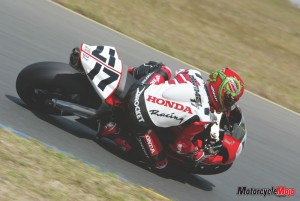 By the late 1980s, Parker decided that clothing and accessories was the best part of the business, and he chose to produce suits and jackets under the name Body Guard by Parker Bros. Ultimately Parker and his then employee Marc Bay developed the Joe Rocket brand, the name coming about during a brainstorming session in a bar fuelled by libations and good humour with long-time friend Chris Ellis. The Joe Rocket name was born on a proverbial beer-soaked napkin, and Parker has never looked back.
Using crayons, coloured pencils and markers, Parker and Bay penned the original logos and designs. Although neither is a professional graphic artist, the signature Joe Rocket look caught on quickly, and those scribblings established trends that are still in play today.
Joe What?!
Grummett continued, “In the beginning, Joe Rocket’s product range had names that were offensive and in-your-face but unforgettable. Names like Joe Schmo, Joe Highside, Joe T.O. and the most controversial – Joe Bitch. Originally, we didn’t think much of the Joe Rocket name, but it worked, and we sold a ton of jackets and suits. The first Phoenix jacket was awesome. When I saw the prototype, I knew we were going to sell a lot of those. One of the secrets to the Rocket brand was North Americans could pronounce the name, as opposed to some of the European brands.”
Eventually, Grummett went on to buy the Etobicoke Parker Bros. store when Parker dedicated his time to the wholesale side of the business. When asked what was the most memorable moment in his relationship with Parker, Grummett quickly replies, “Bruce sponsored me during my racing career starting in 1987; I was the first road racer to wear Joe Rocket gear. In 1990, I had a brand-new Yamaha TZ 250, which is a full-on Grand Prix road-race bike. Bruce wanted to ride it real bad so we fired it up, and wearing only a T-shirt, shorts, beanie helmet and sunglasses, he did laps on Walker Road in Windsor out in front of the store. We were killing ourselves laughing.”
Humble Beginnings
 The company’s first brochure was shot by shutterbug extraordinaire Bill Petro. “The cost of shooting the photos for the first brochure nearly broke us,” Bay says. “These days, we’d love to have such reasonable prices for photography.” The first Joe Rocket textile jackets were made in Quebec using, at the time, a revolutionary Canadian-made material called 600D polyester, which is now an industry standard. Parker and Bay added abrasion-resistant Kevlar panels and amour in all the key areas using material they found at a military surplus vendor that had an overstock of Kevlar.
They were faced with constant challenges, one of which was sun fading; some jackets faded from red to pink within a year. The problem was solved by a Canadian fabric mill, which developed a suitable UV-resistant material for the harsh conditions. “We tried to keep our customers happy, and we replaced or repaired defects without question and have always stood behind Joe Rocket clothing,” Bay says.
Attention to Detail
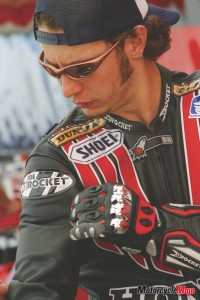 Bay adds that their “early design process was archaic. We’d send black-and-white faxes to the manufacturer and sometimes spend up to 18 days in a row at the Quebec factory tweaking the designs to get things just right. All the work and attention to detail paid off: the Joe Rocket Ballistic jacket sold like hot cakes and is still produced, albeit in an evolved form.”
Bay also has a story related to the in-your-face-style Joe Rocket used to sell clothing. “One of our original logos was a cartoon of a rider, called Joe Speed, flipping off a cop. We never used it, but we did use a lot of lightning bolts, racing stripes and flames – our racers gave us a great canvas to try out new designs.” Bay explains that once a racer wore a design, “the following year we’d have a replica jacket available to the public. Over the years, we had a series of racer’s jackets, such as the Lawson 21, the Nicky 69 and the Schwantz 34. All of these rider replica jackets sold well for us.”
Own the Podium
Business was good for Parker. In Joe Rocket’s heyday, the company signed big name riders to wear its gear, and subsequently the motorcycle magazines gave the brand tons of exposure and, as a result, sales boomed. Joe Rocket riders swept the podium at the famous Daytona 200 a number of times. In 2006, three stand-out riders, Mat Mladin, Ben Spies and Miguel Duhamel, carried the Joe Rocket name to the top. Most of the premier racers during the ’90s wore Rocket at one time or another, including Chris Carr, Doug Chandler, Jordan Szoke, Pascal Picotte, the Hayden Brothers and, most recently, Michael Jordan’s race team.
Paying for riders’ endorsements was expensive, but was viewed as a capital investment and an investment in the sport that made a significant difference in brand recognition at dealer show rooms. According to J.D. Power surveys, Joe Rocket often led sales of motorcycle clothing during this era.
“Two milestones changed Joe Rocket,” Bay recounts. “One was signing Steve Crevier in the late ’90s. Crevier did wonders for us; he won races and championships – plus he had that edgy image – you’d never know what he’d say or do next. In June 1999, we got a cover shot on Motorcyclist magazine that featured a Crevier jacket. I was paying for my subscription at the time and it was huge to see that, we thought we’d really made it when that issue came out!” They sold Crevier jackets hand over fist as a result of support for the iconic racer and that magazine shot.
Moving On
In order to focus on designs and marketing, Parker and Bay decided to forego distributing the Joe Rocket brand to snowmobile clothing entrepreneur Randy Robison, instead selling it outright in 1996. Parker re-acquired 10 per cent ownership back in 2001, but left the company in 2007 and started another brand called Speed and Strength the following year. However, times changed, and in 2008, the real estate slump in the U.S. and ensuing slowdown in road-racing activity in North America saw a significant drop in sales for the Joe Rocket brand, and the industry in general. In 2009, Parker acquired the Joe Rocket rights for the Canadian market and enjoyed commercial success with, until recently, Motovan acting as the Rocket distributor. Currently, Gamma Sales distributes Joe Rocket in Canada, while another entity, Parker Synergies, operates the design team that works on both the Joe Rocket and Speed and Strength brands.
Sticks and Stones
Parker has been called a rapscallion and an incorrigible prankster, but he’s been called worse. He made the cover of a 2003 issue of the Canadian Motorcycle Dealer and Trade magazine, a now defunct insider industry rag. The close-up cover shot was so revealing you could count his nose hairs. The headline boldly stated: “How Did the Most Hated Guy in Retail Become an Aftermarket Superhero?” Undaunted, Parker seems to revel in the spotlight despite his ups and downs. When asked about the history of Joe Rocket, Parker responds that Joe Rocket wouldn’t exist if not for the Parker Bros. stores. “In its heyday, the Toronto store on Dundas Street had up to 40 race suits in stock and helmets piled to the ceiling. They said we tried to put Cycle World [which was next door] out of business. That wasn’t necessarily true; however, I am quite sure John Bagby, the owner of Cycle World, would love to have put us under,” he says. “At one point, we found them looking through our garbage. Instead, we survived and flourished. Our customers would park in front of Cycle World and walk over to buy from us. It must have frosted their cookies, to say the least.”
Chris Ellis, Triumph Canada’s general manager, remembers an era that built legends in the Canadian motorcycle industry. He fondly recalls a Yamaha dealer trip to Japan in 1982 that had Mike Inglis, Danny Baldwin, Peter Hurst, John Mochrie, Bruce Parker and himself pull some shenanigans that are probably still being talked about in the Land of the Rising Sun. “We stayed at Yamaha’s corporate retreat, called Summagoi, and visited pagodas – it was full-on frivolity, the details of which will stay in the vault forever,” the guarded Ellis replies, unwilling to elaborate, despite my pressing the subject. But he does say that “Bruce helped me get back on my feet after my shop closed. In hindsight, it was probably the best thing that happened to me career-wise.”
Give a Little
As a visionary, a philosopher and creative genius, Parker rose to meet every challenge that came his way. The ebb and flow of business never got the better of him. He is most definitely a survivor; his business sense, his boundless energy and his motivation are probably Parker’s most endearing qualities, but his generosity is likely his most notable quality of all.
Over the years, I’ve worked some shows with Parker Bros., helped out in the shop and wore Joe Rocket clothing, and I continue to enjoy the man’s company on any occasion.
The one thing I regret is not wearing Joe Rocket gear to ride the Paris Dakar Rally in 2001. I still remember Parker’s words: “We want to dress you for the Dakar.” But I had already committed to wearing another brand through another old friend and couldn’t go back on that deal. Sorry, Bruce, I wish the timing had worked out better.
When asked how he got Michael Jordan’s race team to wear Joe Rocket, Parker’s reply reveals volumes: “You pay! It’s that simple.” Parker was and is never afraid to invest, and some may even consider him a fast-and-loose gambler, but it has paid off.
The year 2017 is a big one for Canada – 150 years since Confederation, and it’s also significant in the life of Parker; it’s the 25th anniversary of the iconic Joe Rocket clothing brand, and he’ll also be turning a spritely 65. So, look out for big things from Bruce Parker and Joe Rocket in the near future.
Feel: My Story is an autobiography by three-time World Champion American motorcycle racer “Fast Freddie” Spencer. The only rider in history to ever win the 250 cc and 500 cc MotoGP Grand Prix World Championships in the same year opens up and tells us, in his words, how it was all made possible.
From riding for hours and hours in his backyard as a four-year-old boy to driving back and forth across the country with his dad to race dozens of races per season, Feel is part career race report and part philosophical life reflection. Spencer’s ability to remember dates and events in such incredible detail allows the reader to go back in time and relive moments vividly as if racing alongside him, crashing and recovering from injury with him or watching it all take place from the grandstands.
This book is a fascinating story of perseverance and talent, of drive and accomplishment, and it’s a story that doesn’t stop at the height of achievement, but goes on to discuss what happens after you win it all. Where do you go when you’ve done everything you’ve set out to do?
Spencer bravely opens up about things he has never before talked about and respectfully admits that he made decisions based on intuition and feel alone, something that many people are afraid to do. He also admits to times where he didn’t listen to his inner voice, and shares with us some of the regrets that followed.
There are points where it’s hard to follow along as the book jumps from the present to the past and back again; Spencer uses a unique method of blending moments from the past into corresponding lessons of the present so that readers will be encouraged to listen to their own intuition and let their sense of feel guide them toward the intended path.
My favourite part is when Freddie meets Mr. Honda for the first time after winning both Championships, not only accomplishing his own dreams, but also those of Mr. Honda. He says, “And in that moment I knew all the things I had thought about, all the snapshots of something more, the victories and the crashes and the nagging doubt, all of it was for this moment. It was as if a jigsaw had been completed right then and there.”
This is a fantastic read for anyone who was a fan of Fast Freddie at the height of his racing career, as it’s his story, told from the perspective of the man inside the helmet. It’s especially engaging for those of us who appreciate the feeling of being on a motorcycle and who understand what those feelings can teach and where they may lead.
Feel: My Story by Freddie Spencer is available through Amazon for under $25 at amazon.ca; ISBN 978-0753545614.
There are many full-face helmets on the market these days, and they all do the same basic job – protect your head in the unfortunate occurrence of an accident. One of the biggest differences in the various full-face helmets, though, is that prices can range considerably, from $200 to well over $1,000.
At $299.99, the LS2 Vector Wake falls in the lower half of the price scale, but comes with a full array of higher-end features.
The LS2 Vector Wake helmet has been designed for the oval-shaped head across three different shell sizes, and features a multi-density EPS liner, scratch-resistant optically correct face shield, flip-down sun visor, plenty of vents, quick-release strap, removable and washable hypoallergenic comfort liner, well-marked pull tabs to release the cheek pads in case of emergency and an LS2-designed fog fighter system (similar to Pinlock) – all rolled into a fibreglass composite shell.
The finish on the Wake is clean and crisp; it’s obvious that care was taken when applying the final finish to the helmet. It fits snug, as it should, with no pressure points (at least on my head) and offers plenty of room in the ear ports should you choose to add internal speakers for an intercom system or listen to music. Doing up the quick-release strap, with wide padded liners so the strap doesn’t dig in, is easy and efficient, and equally easy to undo with just a pull of the release tab. The sunshade is easy to access and use with gloves on, while the face shield is crystal clear with no distortion when pulled down in place. When the face shield is clicked into its closed position, the helmet is surprisingly quiet. Tipping the scales at 1,550 grams, the medium-sized Wake weighs in as one of the lightest helmets in our full-face helmet arsenal.
The main face shield is easily removed for cleaning or replacement, but the mechanism, although it works fine, seems to be overly complicated in design. The Wake has a two-stage chin vent, a large top vent and an exhaust vent – all easily accessible while riding and wearing gloves.
Overall, I was quite happy with the LS2 Vector Wake helmet. It’s a comfortable, well-appointed and affordable full-face helmet. The Vector line offers a variety of helmet models and colours.
Go to kimpex.com or see a Kimpex dealer for more information or to purchase.
Reviewed by Glenn Roberts
A revolutionary change in full-face helmet design.
Some people zig while others zag, and it’s no different for companies. Vozz Helmets, an Australian company, is one that zags and is taking a different approach to designing what it claims to be a safer motorcycle helmet than the traditional pull-on, pull-off full-face helmet. Let’s face it, in its most basic form, the traditional full-face helmet has not changed in several decades – you pull it on and do up the chin strap until it’s tight, then reverse the operation to remove it.
Starting from a clean slate, Vozz Helmets has redesigned the full-face helmet in a staggering way by creating a rear-access, dual-locking helmet, and hopes to make the chin strap-equipped, pull-on, pull-off helmet extinct.
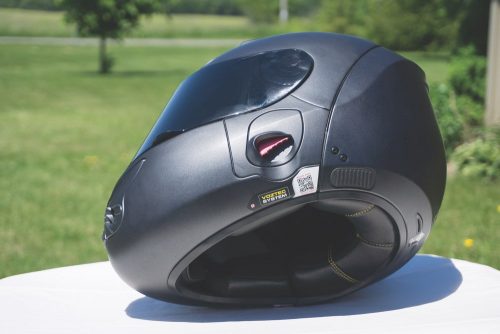 The design process began in 2005 – John Vozzo was working in his garage on a rear-opening sky-diving helmet when he met Mark Bryant. Bryant immediately realized the potential for other applications, and so began the process of redesigning the motorcycle helmet. Today, the Voztec System has secured a global patent on the design and holds DOT, ECE and AS/NZ certifications.
Now that I have your attention, let me explain how the Vozz helmet works.
You’ll first notice when holding the helmet that the neck opening is considerably smaller than normal and there is no chin strap. By opening the visor and grasping the chin bar portion of the helmet, you’re able to push a small recessed lever on each side with your thumbs. This action unlatches the back of the helmet. With your thumbs holding the lock levers, hold the helmet on top of your head; a slight pull forward opens the helmet back, allowing your face to slip into the helmet. Wiggle your face into the helmet and your chin into the chin cup. The chin cup is easily adjustable with a slot screwdriver by removing the cheek pads and adjusting to fit (this is a one-time fit adjustment that won’t need to be done again).
Once the helmet is fitted to your face, move your thumbs to the back portion of the helmet and gently squeeze the back to the front until you hear a click on each side. That click means the back is now locked to the front. There isn’t any ear folding over or scrunched-up faces while trying to squeeze your melon through a foam liner designed to fit as close to your neck as possible.
To remove the helmet, lift the visor, hold the helmet and push the locking levers. Then just roll the helmet forward and down. And that’s it. It might sound awkward because it’s unconventional, but once you try it a couple of times, it’s very quick and easy. For a video of how the helmet works, go to vozzhelmets.com.
It literally takes about five seconds to put the helmet on, and two seconds to take it off. Remember that when your buddies catch you off guard and start to leave while you’re still fumbling to frantically put your helmet on and cinch up the chin strap. You can even put this helmet on or remove it while wearing eyeglasses, and while wearing your gloves. Try that with your regular full-face.
Instead of using the same shell and thicker or thinner padding to adjust for different helmets sizes, Vozz uses three different shells and three different EPS liners to ensure a proper fit regardless of the helmet size. Venting is standard chin and forehead vents, and the visor is one of the easiest on the market to remove and install.
My medium-sized RS 1.0 weighed in at 1,850 grams. It’s not the lightest helmet in our stock, but it’s one of the most comfortable and quiet. In addition to the Vozz, I randomly selected three street-riding full-face helmets to compare and I rode the same route back to back. The Vozz had no “hot spots” and fit with even pressure over my whole head – it fits like a glove and continues to be very comfortable. Without a sound meter jammed in my helmet, the Vozz RS 1.0 seemed to be the quietest of the four helmets. The company claims that because the neck hole is smaller and the chin bar portion of the helmet rolls considerably under the chin, when compared with a traditional full-face, there is less wind getting up into the helmet, which also means less lift. And that makes complete sense. Vozz also claims that this design is less prone to buffeting – I didn’t feel any during my riding with it.
In accidents where the rider has been unconscious, EMS personnel have had to cut the traditional helmet off the
rider’s head in some cases, but not so with this helmet.
The Vozz Safety Release System consists of two red plugs at the top of the helmet that conceal two screws. With a flathead screwdriver, emergency responders simply remove the screws and then move the levers for the locking mechanism, allowing the front and rear of the helmet to completely separate, leaving the head lying on the helmet back while the front rolls off, giving full access to the patient’s face. A QR code is even affixed to the helmet explaining the emergency removal procedure.
The Vozz RS 1.0 retails in Canada for $849.99, which includes a very stout, padded helmet bag and both clear and tinted visors. For dealers, contact information and a video of how the helmet works, go to vozzhelmets.com.
Forming a reasonably priced hangout for fellow gearheads to wrench and create.
Wouldn’t it be great if you had a place to store your bike, work on it and use that same place as a social hangout for your bike-riding friends, summer or winter, all at a reasonable cost? Or, even if it weren’t your own place, it would still be quite convenient to have access to a bike lift, tools and equipment to perform your own simple maintenance or more involved repairs, possibly saving you a costly trip to the local shop. This would be especially helpful if you own an older bike in need of repairs, the cost of which might exceed the bike’s value if you were paying the full hourly rate at a professional service department.
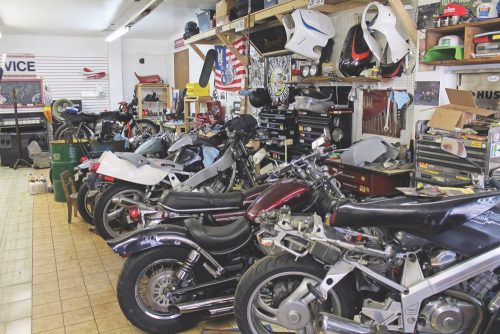 Well, you can consider getting yourself involved with a communal motorcycle shop. The idea is simple: Gather a few of your motorcycle-riding friends, rent an appropriately sized garage or other suitable space, and set up shop. By involving several people in this co-operative endeavour, you can split the rent among each other, which reduces costs for everyone. Having several “members” also helps equip the shop, as everyone can bring in some tooling or contribute toward the purchase of larger equipment, like a compressor, a welding machine, or even something as elaborate as a lathe or milling machine for those larger projects. And if you get creative, you can cut costs even further, but more on that later.
That’s what Montreal resident Paul Davenport has done with six of his buddies. When looking for a place to work on his bike five years ago, Davenport and two others started looking for a spot to rent, but in their price range they could only find a vacant ground-floor apartment, so it became their impromptu bike shop. They soon outgrew the small single-bedroom apartment and moved (their bikes) into a larger three-bedroom pad in the same building. When the landlord decided to renovate the building, they looked into getting a larger place, preferably commercially or industrially zoned. They lucked out when they found a vacant commercial space in town that used to be a skateboard shop.
Since the rental cost of the commercial space was considerably higher than the apartment’s, Davenport enlisted a few more partners and rented the place. An unexpected benefit of renting a former skateboard shop was that it was equipped with a properly ventilated paint room. Each partner has a workspace, albeit a tight one, and there are several projects on the go. Among the current projects are a Yamaha RD200 dirt tracker (you read that right) that is being put back on the road; a chopper that seems to be built on a vintage Paughco plunger frame; an electric bike that for now is just a bare Kawasaki frame; and Davenport’s own Honda NT650 Hawk.
To help further reduce rental costs, Davenport rents out a workspace with tools, through word of mouth and social media, to do-it-yourselfers working on their bikes. He even has a retired motorcycle mechanic on call to help with more involved repairs.
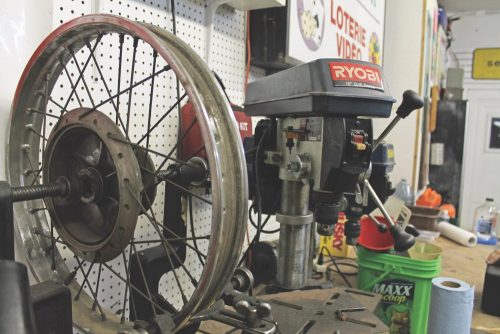 But there are a few things to consider before signing the lease. If the rental space is in a residential area, make sure you can operate a shop in the vicinity, even if it’s not for profit. Regardless of the location, be respectful of your neighbours by not firing up any motorcycles indoors, but if you do wish to do so, that you’ve installed a proper exhaust ventilation system. Keep the noise down indoors and out – you don’t want complaints to convince the landlord you shouldn’t be there and thus evict you. Also make sure you handle gasoline carefully and don’t have any leaking carburetors, gas tanks or petcocks – aside from the fire hazard, the smell will likely bother others. If oil is leaking (and it’s going to happen, considering the age of the bikes likely to inhabit the area) use pans to contain it so the floor isn’t damaged for future renters.
You can also transform the space into a proper hangout by installing a big-screen television or, as Davenport has done, adding a vintage jukebox. If it’s a large enough space, you can set up a kitchen, or at least plug in a fridge to keep the beer cold. And if you plan on making this spot profitable by regularly renting out workspaces, you will probably have to register it as a business.
This phenomenon is not unique to Montreal, and there are several of these community bike shops springing up across the country. If you’re thinking of starting your own, call up a few friends, pool your resources and build your ultimate moto cave.
Technical articles are written purely as reference only and your motorcycle may require different procedures. You should be mechanically inclined to carry out your own maintenance and we recommend you contact your mechanic prior to performing any type of work on your bike.
Transport Canada Recall # 2017343
Models: 2013-2017 BMW R1200GS, 2013-2017 BMW R1200GS Adventure
Number of Units Affected: 1,556
Details: On certain motorcycles, the upper fork seal plug could loosen after severe impact, such as a large pot hole or an accident. Loose fork seal plugs may not be noticeable by the rider. This could result in oil leaks, a rattling noise and unstable steering. If operated in this condition, the plugs could separate, affecting vehicle handling. These issues could increase the risk of a crash causing injury and/or damage to property.
Correction: Dealers will fit an additional fixed fork bushing, or replace the forks with an improved design, as necessary.
Press Release

Varese, July 24th 2017 – MV Agusta Holding consolidates its equity investment through ComSar Invest; an investment fund part of Black Ocean Group, owned by Timur Sardarov, a Russian dynasty key player in the production of oil and gas in East Europe.
Along with the transaction, MV Agusta Holding announces the purchase of the 25% shares held by Mercedes AMG in the historic Italian motorcycle manufacturer MV Agusta Motor S.p.A.. The closing of the deal, whose financial terms are not disclosed, is set simultaneously to the capital increase of MV Agusta Holding in MV Agusta Motor S.p.A. expected at homologation of the company restructuring plan, which has been approved by the quorum of the creditors.
The new shareholding structure of MV Agusta Holding, which will control 100% of MV Agusta Motor S.p.A., will see ComSar Invest as a strong minority shareholder and GC Holding, the investment company of Giovanni Castiglioni, owning the controlling stake.
The finalization of the transaction adds another important element to MV Agusta deep turnaround plan started in 2016, based on the repositioning of the MV Agusta as a prime producer of super premium motorcycles, that brought the company back to positive Ebitda.
Giovanni Castiglioni, President of MV Agusta, commented: “The transaction with ComSar Invest in our holding company through a capital increase and the acquisition of the shares previously held by Mercedes AMG in MV Agusta Motor S.p.A., represents an important milestone for our plan which has as a main objective the reinforcement of MV Agusta core business: the production of high-performance, high end motorcycles. In the last 12 months the implemented measures, has brought MV Agusta back in positive cash flow generation, allowing to complete the restructuring plan and to consistently support product development and consolidation of our key markets.”
Timur Sardarov, controlling shareholder of ComSar Invest: “MV Agusta is for us the most iconic brand in the industry; a company that in the last 5 years has invested heavily in new product development creating a extensive, enviable range of motorcycles which results today is a unique asset for a successful future. Our presence in the capital, with a clear long-term vision, as well as in the key management of the company, has the objective, through our core competences and skills to support and strengthen MV Agusta in the coming years consolidating its position of super premium motorcycle producer. We will focus our funding to reinforce MV Agusta sales network and service and our knowledge in the technology fields, web and marketing to reach and enhance new markets, strengthen our digital and social presence enlarging MV Agusta’s consumer base.”