
EatSleepRIDE Motorcycle GPS App and H-D 100 Challenge
 Canadian startup EatSleepRIDE, in partnership with Harley-Davidson Canada, is excited to announce the final phase of the H-D 100 Challenge. There’s no better way to love Canada.
The H-D 100 Challenge is Harley-Davidson’s way of celebrating the company’s 100 years in Canada and Canada’s 150th birthday.
Together, EatSleepRIDE and Harley-Davidson offer unique challenges to riders in Canada via the EatSleepRIDE Motorcycle GPS app. Riders explore Canada’s iconic motorcycle roads and quintessential points of interest to collect points and win the grand prize Harley-Davidson Street Glide Special Motorcycle with a limited edition 100 years of Harley-Davidson paint kit (retailing at $28,000). There are also 500 secondary prizes of Harley-Davidson merchandise prize packs (retailing at $50) to be won.
Thousands of riders nation-wide have already taken the challenge and more riders are joining every day.
When riders accept the H-D 100 Challenge in the EatSleepRIDE app, geo-aware and Bluetooth technology make it easy to collect points for every ride and rank on the leaderboard. Every time a rider collects 500 points, they receive a ballot for a chance to win.
New points gathering challenges have been ‘opened-up’ to kick off the last segment of the contest:
1. Ride any road to collect points for distances of 100 kms to 1600 kms
2. Visit any of the 20 iconic Points of Interest and see Canada’s most beautiful spots by motorcycle
3. Ride one or all of 20 iconic motorcycle routes across this great nation
4. Visit any one of 70 Harley-Davidson dealerships across Canada
5. Drop in to a Harley-Davidson Test Our Metal event (Dates subject to change depending on weather conditions):
– July 7-8, 2017: Pfaff Harley- Davidson, Richmond Hill, ON.
– July 8, 2017: Barrie Harley-Davidson, Barrie, ON.
– July 9, 2017: Jacox Harley-Davidson, Mississauga, ON.
– July 14, 2017: Duke’s Harley-Davidson, Chatham, ON.
– July 15, 2017: Thunder Road Harley-Davidson, Windsor, ON.
– July 15, 2017: Premont Harley-Davidson Laval, Laval, QC.
– July 23, 2017: Carrier Harley-Davidson Drummondville, St-Germain de Grantham, QC.
– July 24, 2017: Sherbrooke Harley-Davidson, Sherbrooke, QC
The H-D 100 Challenge rewards Canadian motorcyclists for their love of the road, and encourages them to get out, connect with other enthusiasts, and explore Canada’s best riding no matter what they ride. The contest ends on July 29, 2017 at 9:00 am EST, and the grand prize draw will take place on August 21, 2017.
Have you heard about the EatSleepRIDE Motorcycle GPS app?
It’s a social, tracking, and safety app for motorcycle enthusiasts nearby and around the world – helping riders explore and share the best roads, track each other, and find other riders nearby. EatSleepRIDE’s CRASHLIGHT safety technology, which is built into the app, automatically detects a crash and notifies contacts of the rider’s location.
For more information please visit www.EatSleepRIDE.com
Maximum slide protection without bulky inner liners
It just makes sense that most of us want to be protected while we’re out riding – those who ride wearing shorts and flip-flops can turn the page now. There are a number of riding pants on the market designed specifically for motorcycle safety that wouldn’t look out of place at a social hangout or even walking down the aisle in the grocery store.
But not all riding pants are created equal. Most use regular denim and are lined with a material that’s designed to withstand a slide on pavement, such as Kevlar. You know how they say TV adds 10 pounds? Well, so do some riding jeans. It’s that protective lining that adds to the bulk of many of the riding jeans on the market today.
Saint’s Unbreakable Jeans, on the other hand, have a different approach to motorcycle safety. Instead of denim lined with a protective layer, the jean material itself is made from UHMWPE (ultra-high-molecular-weight polyethelyne) fibre, branded as Dyneema. No bulky liners needed. Dyneema fabric is 15 times stronger than steel (weight for weight), yet light enough to float on water. Search “world’s strongest denim” on YouTube to get an idea of the punishment this material can take.
Unbreakable Jeans feel a little stiffer than regular denim when brand new, but they aren’t uncomfortably so by any means – I’ve worn them several times for full days both riding and walking around town. Having never tried Dyneema material before, it feels as though it will loosen up with regular use, but time will tell. In addition to this crazy-strong fabric, the hips use CE-certified Level 2 activated removable armour, while the adjustable knee armour is activated CE Level 1-certified.
The Model 1 jeans, as tested here, are the world’s first CE-rated denim, and use Dyneema in various degrees. In the high-impact zones such as the knees and the seat, there is 66 per cent Dyneema blended with 34 per cent cotton; the rest of the garment uses 10 per cent Dyneema and 90 per cent cotton.
Although I wasn’t able to test the durability of the material as it’s designed for (I’m a little averse to purposely dumping my bike on the road), Saint claims that the Dyneema fibres will withstand a six-second/75-metre slide. To put that into perspective, the company website says that protective race leathers have a slide time of seven seconds. And I can tell you from personal experience that these jeans are far more comfortable than race leathers.
The five-pocket jeans feature an elasticized accordion stretch panel behind the knees that considerably adds to the comfort and avoids the uncomfortable feeling of material bunching up. The bottoms of the legs on these Model 1 regular-fit jeans are snug to most boots I ride in; with other boots, the pant legs must be tucked inside. Other styles are available. Ordering from this Australian company can be done through saint.cc. Keep in mind that because there isn’t any lining material in these jeans, the sizing chart on the website holds true to the size of jeans you regularly wear. My Model 1 jeans retail on saint.cc for C$320, with free shipping. Go ahead, save your hide, literally.
This is the first ride of the all-new 2017 Kawasaki Z900 ABS. It’s the newest addition to the Z family and it represents the next evolution of their storied Streetfighter models.
A radical reduction in weight and a 10 percent increase in power over the outgoing Z800 make this Z900 a proper menace on the road.
At just $9,699 CDN for the optional ABS model, and only slightly down on performance compared to the Z1000R, this might be the Kawi to have in 2017.
The love of two wheels brings us together
It’s called the Sunshine Coast, though that seems quite a euphemism when you’re a transplant from Southern California. But granted, for British Columbia, this region of the rugged coastline, only accessible by ferry or float plane, does see a bit less precipitation than other areas of the rainforest-fringed province.
It’s also a hugely scenic riding area, and always fun to take your bike on the ferries. The last time I explored the area, I’d ridden up from California and was making a loop from Vancouver, jumping ferries up the Sunshine Coast to Gibsons, then across the Strait of Georgia on another ferry to Vancouver Island for a fast out-and-back on the steep and squirrelly Highway 4 to Tofino – a favourite ride. And I was testing one of my all-time favourite bikes, BMW’s K1600GT. When I pulled up for the first ferry ride in Horseshoe Bay, I was, as usual, directed to the front of the line of cars because my bike and I are so cool. Yeah, right. As always, bikes board the ferries first so they can be settled in the prow, which is a great perk, because that means we’re also first off when we get to port. After I passed the 50 or so waiting cars and trucks, I saw I was destined to be shipmates with a KLR650 and its rider.
Time to be Social
Now, admittedly, I can actually be a bit antisocial on these solo rides. At the time, the BMW was pretty new, and riding it anywhere meant being peppered with questions. So, when I parked next to the well-flogged KLR, I basically ran away. I didn’t make eye contact, and abruptly headed into the terminal for a pre-departure espresso. But while I was sipping that stuff, I warmed up to the idea of some biker chat. The KLR has always been another favourite of mine; I’ve owned one and tested many. So, by the time I head back to the bikes, I’m looking forward to swapping KLR adventure stories.
And that’s when I noticed the Harley that’s pulled up next to my bike. It had a furry seat cover, lots of shiny bangles, straight pipes and a tiny Pekingese-like pooch poking its head out from a plastic dog carrier that’s bungeed onto the pillion seat. All I could think is, wow.
A Joining of the Tribe
The Harley guy and the KLR guy were already chatting, and I walked right up and joined in. I mean, wouldn’t you? We are a tribe after all. Despite our preferences, it’s natural, almost impossible, not to feel connected to other people on two wheels, especially when you’re on the road.
After we talked about our bikes, we chatted about where we live. They both lived on the Sunshine Coast and were returning from road trips: Harley Guy to visit his family; KLR Guy to get away from his.
Once on the ship, we walked upstairs and gravitated toward the sandwich bar, still talking. Now it’s about Vancouver Island and where I should go. Now about motorcycles. A little politics. Dogs. Back to motorcycles. Before we knew it, we were back on the bikes and being directed off the ferry. And, of course, we were going to ride together. We were all headed in the same direction, up to Earl’s Cove and the next ferry jump. Again, it just seemed natural. I’m just glad I had earplugs for Harley Guy’s straight pipes.
On the next, smaller ferry, we sat at a table and drink coffee. We talked about families. Countries. More about motorcycles. It seemed as if we had known each other for a long time, yet we had just met. Three people who would have never exchanged a word, or even a glance, had it not been for the motorcycles and shared love of riding.
Unforgetable Connections
Harley Guy lived near the ferry dock in Saltery Bay, and we all waved frantically as he turned off. KLR Guy agreed to guide me to my hotel in Powell River, which was only a short distance from his home. We shook hands and said how fun it was to have met.
And it was. I smiled to myself a lot that evening, thinking how those two guys out of nowhere had made my ride that much more enjoyable. It’s a couple of years later now and I don’t remember their names, but I’ll never forget what our connection described.
Motorcycle travel is so special. You get to be alone, yet you’re always a part of a huge group. Yeah, sometimes with your actual friends, but other times may be just with a guy you share a lane with for 10 kilometres. The connection is remarkable, isn’t it? Something really worth riding about…
Where custom, vintage and race bikes go to hang out
 Jeff Kerevan is a busy man. Not only is he head mechanic at Rising Sun Motorcycles, a full-service and custom bike shop in East Vancouver, he is the owner and wrench behind Slick Cycle Works, operating from his home garage, where he builds some pretty slick customs, to be sure. But hey, what’s a gearhead to do in the off-hours of his two jobs? Ah, what the hell, let’s put on a bike show. How hard could that be?
Well, it’s hard. And time-consuming. But he did it. The end of April 2017 saw the first-ever Oil and Rust Motorcycle Show on Vancouver’s Eastside. Housed in the Ellis Building, a structure built in 1907 on Main Street, the vibe was decidedly vintage, including the pinball machines in the hospitality area (where I heard they were serving adult beverages).
 Lined up atop the ancient wooden floors, and lit by what appeared to be ancient lighting, were 43 hand-picked bikes of assorted vintages and styles, each on display by invitation. “I wanted to find top-calibre bikes that hadn’t been seen a thousand times,” Kerevan says. “I combed social media, thought about friends and customer bikes and found enough bikes with enough variety to put on a show. Seventy per cent of the bikes were plated. There’s no point building them if they’re not ridden.” And indeed, even during that rainy period in Vancouver (shocking, I know), they were ridden. As were many show-goers’ bikes. In fact, about the only bikes without plates were the flat-track race bikes.
The idea for the show had come about during conversations with Ezra Kish, the building’s leaseholder. Kerevan feels there aren’t enough of these types of shows in the Vancouver area anymore. “I wanted to do something like The One Show in Portland [Oregon]. You know, a little of everything, including photography and art.” So Kish took care of the hospitality end, while Kerevan took care of the art, bikes and space.
 Needing some help, Kerevan reached out to enthusiast-owned businesses in the area, such as International Motorsports, the local Triumph, Aprilia and Moto Guzzi dealer; Bent Bike in Langley; and Rocket Fuel Supply Co. in Burnaby for sponsorship, which they all gladly provided. In turn, he provided free space for Bikers for Autism and Flat Track B.C., a collective of three clubs holding races across the province. And as a little extra incentive, he provided a custom 1977 Kawasaki KZ1000 as a raffle prize. “The show was absolutely a success,” Kerevan says. “Even the raffle bike got paid for!”
So, what’s the future for Oil and Rust? “I’d like to make it an annual thing. Maybe just grow it and add more variety. I just need more help!” Kerevan says, explaining that he was there for almost 24 hours setting up, then adds, “It was a lot of work, but I’m just glad that people could come out and have a good time.”…
The riding heats up in the Buckeye State
Light-headed and nauseous, I sank onto the seat in the air-conditioned burger shop and held the ice-cold drink to my temples. I had come to explore the forested hills of southeastern Ohio, but the thick humidity and exceptionally high temperatures had pushed me – I later discovered – into the first stages of heat exhaustion. Responsibly, I was riding “ATGATT” (All the Gear at Tremendous Temperature), but clearly I had some things to learn about travelling during a heat advisory.
Days earlier, I had ridden my V-Strom DL 650 from the east, crossing over the Ohio River from Wheeling, West Virginia. I was impressed that even the interstates are photogenic here as they twist and turn, rising and falling, through the densely treed Appalachian Mountains. Highway 7
followed the bank of the river to Hannibal, Ohio, and I was reminded of the other Hannibal in Missouri, home of Huckleberry Finn, and of his slave Jim’s escape to freedom up this same Ohio River. As the border with West Virginia was a major division between slave and free states before the U.S. Civil War, the flight of African-Americans was a theme I would encounter many times in the days to come. The river is still a major thoroughfare as it’s lined with coal-burning and nuclear energy plants, and giant barges shuttle loads of coal to markets abroad. The tired houses speak of hard times.
The Other Dragon
 Turning west into a more pastoral setting, I scouted Hwy 536, which locals call the “Ohio Tail of the Dragon,” 16 km of continuous tight turns and switchbacks, ups and downs through some of the steepest farmland ever to feel a tractor’s tread. I found myself wanting to stand up, not for balance or traction, but simply to see where the road fell away beyond the crest of each next hill. Perhaps never as race-worthy as the Dragon itself, with its nicely cambered corners, this one of late has suffered abuse from oil fracking trucks, and the surface was often broken and patched.
As evening fell, I encountered numerous deer in the fields and along the roadside. That was my cue to be off the bike, and I found a secluded hayfield along Six Points Road to camp for the night. Because of the heat, I didn’t even unroll my sleeping bag; I lay on top of my cot, enjoying the faintest breeze and the song of crickets as the full moon cast shadows all around.
Ohio’s Dragon was only the beginning. The terrain was so pitched and varied that you would be hard-pressed to find a straight road anywhere in this quarter of the state. Even Route 800, which appeared more or less straight on the map, turned out to be a beautiful series of alluring curves. It didn’t take long for both Garmin and me to become wholly lost in the web of back roads, a mishap that brought the pleasure of discovering trails, barns and covered bridges in various states of repair. I emerged on Route 26, a National Forest Scenic Byway offering 50 km of wonderful twisties in rapid succession, the excellent paved surface allowing me to use all of the tire in the corners. The countryside was dotted with white churches that, along with Biblical place names like Sardis, Antioch and Pisgah, were a reminder of the area’s fundamental religious revivals of the mid-1800s. I passed signs for Moss Run Road, Hog Run Road and, to my amusement, Beer Run Road. “I bet that’s a popular detour,” I said in my helmet. But a second glance corrected my mistake: it said “Bear Run Road,” and in fine print (I swear), “Take a break before dehydration takes over completely.”
The Hub
 Riding into Athens the next morning, I stopped at the Visitors Bureau, where I was greeted with enthusiasm, maps, and stickers for “Ohio’s Windy 9,” a series of half-day loops totalling nearly 1,600 km through national forests and historic villages. On the map, they resembled an orchid, with my approach the ornately winding stem. I set out on routes 78 and 216, following the loop they had called the “Hocking Hills Nipper.” This Scenic Byway is a fantastic rolling and winding road with perfect pavement. I wove through Wayne State Forest for 30 minutes before coming into New Straitsville, “Home of the Moonshine Festival,” and site of a larger-than-life set of stone tablets engraved with the Ten Commandments. It seemed appropriate to the life of a vintage coal-mining town to find virtue and vice so closely thriving. Nearby, I discovered Robinson’s Cave, where disgruntled miners had met to discuss the formation of what would become the United Mine Workers of America. In 1884, during a bitter strike, the miners loaded kerosene-soaked timber into coal cars, set them on fire, then rolled them back into the mines. This resulted in a persistent underground fire that has consumed untold deposits of coal. In the 1920s, the fire threatened the town as it broke through the surface and caused yards and basements to cave in. And as recently as the 1970s, the fire neared the surface along Route 216, where people could be seen frying eggs on the highway. A historical marker even shows a Mrs. Clara Wells making coffee from the boiling water she had just drawn from her well. To this day, a small remnant of the fire still burns underground to the southeast of town.
I continued on 595 and 33 to Logan, home of Paul Johnson’s quirky Pencil Sharpener Museum. Although displaying thousands of items, the diminutive building, not more than four metres square, is more than adequate. Beautiful Route 664 led me to Hocking Hills State Park, where I stopped to explore “Old Man’s Cave.” It’s named for “old man” Richard Rowe, a recluse who, seeing the unfolding of the War of 1812, decided to inhabit a cave in the gorge. It was easily accessible via stone stairs, bridges and short tunnels. I enjoyed the relief of cool shade below the rim of the gorge, and marvelled at the rich colours of every stone, fern and tree.
To the east I followed 278, which wound through Zaleski State Forest and around to Albany, once a major stop on the Underground Railroad and educational centre for African-Americans in the late 1800s. Nearby I noticed a small white Quaker church that was still in use. A historical plaque told how the “inner circle of old and reliable Friends (Quakers)” had played a major role in conducting slaves to freedom. And I just had to stop just north of Pomeroy at Jorma Kaukonen’s Fur Peace Ranch and Psylodelic Gallery. The name alone was enough to draw me in. Kaukonen, I learned, was one of the founders of Jefferson Airplane in 1965. And I discovered a guitar player’s paradise, complete with cabins, a dining room, workshops and classes, a concert hall and an art gallery devoted to bygone psychedelic days.
Regretful Decision
Another intensely hot day gave way only slightly to an oppressively warm night, and I wild camped again without shelter atop my camp cot. At dawn, temperatures were already stifling, and I couldn’t bring myself to pull on all that hot gear. I rode out wearing none of it, not even my helmet. It was a decision I would learn was the wrong one, and not for the most obvious of reasons.
Under the bright sun, I followed Route 50 out of Athens to 689 and 160, both of which were in good condition as they snaked their way through more sloping farm country. At Vinton, I took a detour to Rio Grande, the site of the original Bob Evans’ Farm and Homestead. Of course, I had to order a second breakfast before taking the short tour of the homestead-turned-museum. Highway 7 from Gallipolis to Pomeroy bore signage calling it the “Ohio River Scenic Byway,” which to me seemed a misnomer. However, following the river on 124 through Racine, Portland and Reedsville, I got a look at both the beautiful Appalachian Mountains and the intrusive smoke stacks and barges, as well as regal homes and littered shacks. In fact, I began to conclude, the entire region was a study in contrasts: poverty and wealth, vice and virtue, filth and beauty. That is to say, it was a microcosm of the complicated realities of modern life.
By noon, the harsh sun was beginning to burn my forehead, and I once again donned my helmet. I stopped at Buffington Island State Memorial, the site of a decisive Civil War battle that would determine the fate of millions of African-Americans. The Ohio-West Virginia border was hotly contested, and the outcome was by no means certain. To consider the cost in young lives is quite sobering. Route 124 brought me back along the Hocking River to Athens feeling nauseous and weak. And the fast-food cup of cold Cola felt like a gift from the gods as I held it to my throbbing head.
 Later, as evening approached and the heat began to subside, I set out for what would be, hands down, the best ride of the day: Ohio’s Windy #1 – “Rim of the World.” I rode along winding ridges overlooking forests and gullies, rivers and villages, carving Hwy 337 north of Athens, then 266 to Stockport on the banks of the Muskingum River. Stockport was another of several important stations for the Underground Railway, and is the location of the last hand-controlled marine lock in the United States. I stood and talked with the muscled operator, who said he had handled 16 boats that day, and in this heat, that was enough. After continuing along the breath-taking number 78 all the way to Nelsonville, I found a bunk in a rustic hostel for $15. It wasn’t fancy, but it offered the two things my body craved: a cold shower and air conditioning. And ice water. I drank and I drank. It was then that I realized I must be on the brink of heat exhaustion and dehydration. From then on, I forced myself to drink lots of water at every stop, whether I felt thirsty or not. And I determined, when I got home, to research the science behind safely riding in hot weather.
State Capital
Another day of exploring led me to Columbus, where I spent midday touring the inspiring (and climate controlled) AMA Motorcycle Hall of Fame. And then it was south to Little Hocking on the banks of the Ohio River, where I was positioning myself for a ride home the next day on Hwy 555. The locally famous “Triple Nickel” is a long and curvaceous ribbon with no attractions or lunch stops. It would be just the road and me. As I found a place to camp for the night, I began to reflect on my discoveries. I could feel the weight of recent history, and a growing admiration for the courageous men and women of this rugged hill-country, living by their consciences and risking themselves for the rights of others. The first cool breeze in days came to me across the dark water, and together with our forebears I breathed deeply – the fresh air of freedom on the banks of the Ohio River.
Surviving the Heat
Since that Ohio ride, I’ve learned the magic number is 34. Below 34 C (93 F), it’s fairly easy to stay cool as long as you’re moving fast enough to get some wind against your skin for convective and evaporative cooling. Mesh gear or good venting works great. But above 34, the wind is no longer your friend. Think of a hot hair dryer. Although it may be counterintuitive, stripping down as I did is exactly the wrong thing to do. Rather, like a traditional Bedouin wrapped head to toe in the desert sun, you now need to minimize your body’s exposure to direct windblast.
Doing so actually reduces the amount of heat your body must lose through evaporation (sweating), allowing you to use less water, which, in tandem with temperature, is the other critical factor. In fact, the difference in water usage between covering up and not is about 600 ml/hour and 1,200 ml/hour, respectively. That’s a big difference. Hydration is critical. Carry lots of water and drink frequently.
Wearing a hydration pack, such as from Camelbak, allows you to take regular sips as you ride, which may be the most effective way to stay hydrated. Roughly one litre per hour is recommended in high heat, and drinking only at fuel stops will not be sufficient. If you aren’t going to use a hydration pack, carry a large jug of water and stop to drink every 20 to 30 minutes. Water, rather than caffeine or sugary drinks, is still the best option. Additionally, wearing moisture-wicking base layers can enhance the effects of evaporation, further reducing body temperature.
In extreme conditions, some riders will also soak a base layer T-shirt, while others will wear a high-tech “cooling vest” to bring temperatures down. Other useful tips include wearing a white helmet to reflect heat and throwing a white towel over the seat when you’re off the bike. If all else fails and you begin to notice signs of heat exhaustion (such as nausea, headache, cramps, dizziness, fatigue, flushed or pale skin, or heavy sweating), get off the road and find shelter in an air-conditioned convenience store or rest stop. Drink lots of water and rest until symptoms subside. Heat exhaustion, leading to heat stroke, can be fatal if ignored.
“Created to provide quintessential performance.” That’s Ducati’s proclaimed axiom behind the development of this bike, and after riding it, I reckon its engineers have hit the bull’s eye
It’s become a bit of a cliché to call something a mechanical work of art, but if ever a motorcycle deserved that accolade, it’s the Ducati 1299 Superleggera. Dripping in carbon fibre, replete with titanium and flaunting endless examples of technological innovation found on nothing else with two wheels and an engine, the whole clothed in bodywork of stunning beauty – this is the latest testament to Ducati’s ability to combine exquisite looks with a stellar level of performance sourced from winning countless races and championships.
The Superleggera was launched at the EICMA Milan Show last November as a limited edition model of which just 500 examples will be built. Unfortunately, if you were slow to put a deposit down on one via its dedicated website, you’ve lost out. At around C$85,000, all of them have been sold, and it’s said that 16 are coming to Canada.
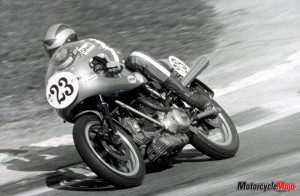 Yet the 1299 Superleggera also marks a significant landmark in Ducati history, beyond its sheer unmatched excellence in conception and execution. For with the advent next year of the Italian firm’s first V4 superbike, this is the last of the line of the its series of desmo V-twin street-legal race bikes, the ultimate evolution of this unique format that has so far garnered 14 World Superbike rider’s titles and 15 manufacturer’s crowns, in winning 329 races to date in the past 30 seasons. It’s a line that began in 1974 with the debut of the green-frame 750SS, of which just 401 examples were ever made as a pretty close replica of Paul Smart’s Imola 200-winning factory desmo V-twin, just as the new Ducati 1299 Superleggera is to the factory F17 superbikes that are at the front of the field in WSBK competition. Actually, it’s even better chassis-wise, with a carbon fibre, semi-monocoque frame structure that saves 1.7 kg over the racer’s heavier aluminum equivalent. And it’s pretty close in engine performance, too, with a claimed 215 hp on tap at 11,000 rpm – 15 hp more than the Panigale R currently leading the FIM Superstock series.
Having begun my racing career back in the mists of time as one of the 401 lucky owners of the aforementioned green-frame 750SS, which I had bought new in 1974, I still race in Classic F750 events on what is apparently the last such genuine bike to be used in something approaching anger on the racetrack. So for me, the honour – no other word for it – was especially meaningful to be one of only eight journalists from around the world invited to sample the 1299 Superleggera at the Mugello GP circuit just a couple of weeks before this year’s Italian MotoGP was held there. Riding this two-wheeled work of desmodromic art composed of magnesium, titanium, aluminum and carbon fibre – scaling a featherweight 178 kg ready to roll with a full 17-litre fuel tank – was an undoubted thrill.
Purchase the issue to continue reading
Working without a safety net
We’re encountering a renaissance of sorts in the sport standard segment at the moment: a return to responsibility rather than restriction; a dialling back of the nanny state in favour of more affordability and fewer dash-enabled menus. Several competitors in this class are currently offering sportbike performance at a bargain, and it’s the lack of advanced electronics that’s helping to make it possible.
If any manufacturer was likely to give riders the benefit of the doubt, it was Team Green. After all, look at what it’s given us in the past: The 1972 Z1 was originally planned as a 750 cc machine, but had its production delayed by a couple of years after the introduction of the Honda CB750 in 1969 so that the engine could be enlarged to 903 cc, and it could once again be marketed as the most powerful Japanese four-cylinder four-stroke ever. More recently, there was the 2004 ZX-10R, arguably the hairiest-chested, most delinquent superbike to date, followed by the drag strip-conquering ZX-14. Of course, if ever there were a bike to prove Kawasaki has the utmost faith in the consumer, it’s the H2 series – both modern and classic – which will happily turn you a whiter shade of pale with little coaxing. And now for 2017, the company has rolled out the Z900 ABS: a 948 cc streetfighter that’s shed almost 21 kg over the outgoing Z800. They’ve given us this wailing four-cylinder streetfighter and said, ‘There you go, do as you please.”
Unbridled
 Here, your traction will not be controlled, nor your wheelies mitigated, and it does not come standard with a “magic box” capable of sensing every dynamic of a vehicle in motion. However, the Z900 will intuitively interface with the rider; it’s just a simple matter of plug and play, really. The bike even comes with a standard dock – I believe it’s still called a seat, last I checked.
From atop that firm saddle, the rider will find all the ingredients Kawasaki got so right with the Z800: stable handling, smooth power delivery and a comfortable riding position. Despite being offered here for only a single year, the Z800 made a favourable impression on many, myself included. During testing of the Z800, I was repeatedly struck by the attention to detail paid to things like textures and finishes. Ironically, on the day I returned that bike to Kawasaki, the senior staff had just gotten out of a meeting and I found myself surrounded by the top brass, along with a special guest from Japan, aka their boss, who immediately began questioning me about my thoughts on the bike, to which I responded by pointing out the various improvements I’d been taking note of. In hindsight, I could have left out the reference to Yamaha’s FZ-09 and its current (at the time) benchmark in the class, though I think he appreciated the comparison, that or the wry smile he returned could very well have been a hint at what was to come.
Evolution
 There are two primary contributors to the rebirth of this platform; the first is a liquid-cooled, four-cylinder powerplant that’s been enlarged from 806 cc to 948 cc, and now delivers 123 hp at 9,500 rpm and 73 ft-lb of torque at 7,700 rpm. The engine’s tuning favours a mid to top-end power delivery with a noticeable surge beginning at 5,500 rpm and building to above 9,000 rpm. Power is smooth and precise, with no hiccups in the fuelling, making it a perfectly well-behaved companion on the road and in traffic.
The second, and more significant, change for the Z900 is its all-new trellis frame, à la H2. At just 13.5 kg, the frame represents much of the 21 kg weight loss over the Z800, and transforms the new bike into a proper menace that has the agility to match its engine’s eagerness.
The emphasis on balance extends to the KYB suspension; both spring preload and rebound damping are adjustable front and rear, though compression has been fixed to favour a more plush ride on typical roads. I had zero complaints about the suspension setup and fiddled around with the adjusters enough to safely say they’ve got the vast majority of riders covered. Hard-core canyon carvers and track day junkies are going to notice the slightly softer ride quality, but that’s bound to happen with a 210 kg bike – yes, even after all that weight loss, it’s still no lightweight in this class. The little extra bit of heft translates into the stability and composure that’s long been a hallmark of Kawasaki bikes.
We’re Going Live
 As has become habit, I wear video cameras to document most every ride these days, especially to capture initial reactions – you only get one first kiss, as they say. In the case of the Z900, I pushed play on the GoPro, started up the bike and rolled down the front walkway, feet on the pegs, clutch in and foot on the back brake. It practically wanted to stand up on its own, happily coming to almost a complete stop. By the time we’d rolled the 10 metres into the parking lot, there was a feeling of familiarity. A few figure-eights later and a quick check of the rear ABS’s very noticeable attempts to ruin my fun and prevent any unwanted skid marks in the Kawasaki parking lot, and I was feeling pretty good about our first time.
In the city, the Z900 is a doll, thanks to a very manageable 795 mm seat height, the soft low-end power delivery and a little beauty called the cam-assisted clutch; this thing is right up there with sliced bread, perforated toilet paper and tablets for toddlers – there’s just no reason to go back to the old ways after stuff like this – it would be cruel and unnecessary. We’re talking one finger clutch pulls, maybe even pinky finger. Actuation of a gear is evident at the lever, where you can feel the positive engagement and can easily modulate the lever, which has a friction point that’s a little farther from the bar than I’m partial to. The light action makes up for some of that, as does the adjustable span on the lever. The clutch also has a slipper action to counter premature downshifts resulting in rear-wheel hop or lock-up.
Voice of an Angel
With a little bit of open road ahead of you, the bike wants to spool up into the power and show off its lungs, or rather the wail that’s been intentionally engineered through the use of uneven intakes, benefiting both torque output and my auditory senses. It’s meant to sound aggressive yet playful – I’d say if by playful they mean a panther doing a little mauling, then they nailed it. Wind it to just shy of the redline and the sound is almost as impactful as the speed that’s piling on.
All the controls are light and give satisfying feedback. The gauges just sort of hover down there below your line of sight, as if to say, “We’re here if you need us.” But you barely do, despite all the usual useful info being displayed. Instead, the wind, the sounds and the constant prodding of the ever-enthusiastic powertrain tell you when you’re travelling at a legal pace and when you’re clearly not.
The brakes start soft and build in strength, but don’t offer as much feel and involvement as the rest of the bike. A set of braided lines and good pads would unlock some potential for aggressive riders. The wide bar and upright seating position is road-friendly, and the duration of your ride will come down to how long you can deal with the saddle. There’s an option for a 25 mm-taller saddle with more padding, and I suggest it, because you won’t want to stop if you don’t have to.
Middle Ground
As far as styling goes, I liked the Z800, but the Z1000, not so much – it’s a little too Sugomi for my taste; but the Z900 is a nice middle ground between the two. Its trellis frame adds not only style, but also function in regard to weight-savings, rigidity and better handling qualities.
With this new bike also comes a restructuring of the Z family. The Z1000 is no longer available in the States, and here in Canada, we’re only getting the up-spec Z1000R, its premium electronics and components serving as a justification for the $14,149 price tag. At 10 kg lighter, and producing about 20 less horsepower, the Z900 ABS at $9,699 is looking like a pretty good deal at the moment. It’s right in the mix with the FZ-09, Street Triple, GSX-S750A and a couple of others for best bargain of 2017.
Set Free
I’ve always been a fan of less is more, and have often stated my appreciation for bikes like this Z900. While it’s not 100 per cent tech-free, and does have ABS and a slipper clutch, it still embodies the kind of bike that I, and many others, prefer: something with personality that’s simple and intuitive. And those aren’t exactly traits associated with modern four-cylinder motorcycles, so good on Kawasaki for striking a balance that makes sense – to me at least. And, if the ABS is still too much intrusion, you can opt for the non-ABS version, which will save you $400 along with a couple kilograms, allowing you to cast off the last oppressive shackle of electronic restraint.
LIST PRICE
$9,699 (ABS)
WARRANTY
12 months, unlimited mileage
CONTACT
kawasaki.ca
ENGINE TYPE
Liquid-cooled, inline 4-cylinder
DISPLACEMENT
948 cc
POWER
123 hp (92 kW) at 9,500 rpm
TORQUE
73 ft-lb (99 Nm) at 7,700
BORE AND STROKE
73.4 x 56 mm
COMPRESSION RATIO
11.8:1
FUEL DELIVERY
36 mm throttle bodies with sub-throttles, digital fuel injection
TRANSMISSION
6-speed
FINAL DRIVE TYPE
Chain
FRONT SUSPENSION
41 mm inverted fork, rebound and preload adjustable
REAR SUSPENSION
Horizontal back-link shock, rebound and preload adjustable
WHEEL TRAVEL
Front: 120 mm (4.7 in.)
Rear: 140 mm (5.5 in.)
BRAKES
Front: dual semi-floating 300 mm petal discs, 4-piston calipers
Rear: single 250 mm petal disc, single-piston caliper
WHEELBASE
1,450 mm
RAKE AND TRAIL
24.5 degrees/103 mm
TIRES
Front: 120/70 ZR17
Rear: 180/55 ZR17
WEIGHT (WET)
210 kg (462 lb)
SEAT HEIGHT
795 mm
FUEL CAPACITY
17 L
FUEL ECONOMY (TESTED)
5.8 L/100 km
FUEL RANGE (ESTIMATED)
293 km
Repurposing the Ninja 300 powerplant into a competent adventure-type bike proves to be a resounding success
Eating dirt is underrated, especially in the case of adventure riding. The fact my teeth are very well coated in red dust today simply means I can’t stop grinning. I’m riding full throttle up a rocky dirt road in ridiculously beautiful Utah with a pack of mates – certainly cause for glee – but what’s really behind the grin is the fact I’m having this much fun on a 300 cc adventure bike. What a great surprise.
 Kawasaki has hit many marks with its all-new small-scale adventure bike, beginning with stature. It doesn’t feel like a small motorcycle, though it does feel extremely light and maneuverable. And it’s this combination of lightweight agility and upright roominess that sets a perfect stage for riders of any ability to utilize and enjoy the bike’s remarkable performance features.
The first Versys launched by Kawasaki was the 650, back in 2007. I was there for that introduction and remember the bike being positioned as a kind of multi-tool: a flexible platform for commuting, sport riding and light touring. The category of ADV, along with its swashbuckling fan base, was yet to ignite. Since its inception, the Versys line has added a 1,000 cc model and has evolved to offer improved engine characteristics, suspension and amenities such as ABS, though neither the 650 cc nor 1,000 cc version has been pitched directly to the ever-eager adventure crowd.
No One-Trick Pony
 Kawasaki’s tag line for the 300 is “Any Road, Any Time,” and while the marketing department doesn’t go as far as to say the little chain-driven Versys is purposed for off-road use, it wouldn’t be a stretch. The 19-inch front and 17-inch rear spoked wheels and tubed tires alone tell the intention. It might not be the “Street Legal Dirt bike” Honda has brought to the entry-level ADV party in its CRF250L and new CRF250L Rally when it comes to roosting, but the Kawasaki does work quite well off pavement and will happily play Tonto to a larger ADV bike, no problem.
The Versys-X 300’s suspension is well balanced, with a 41 mm telescopic fork offering 130 mm of travel up front, and a Bottom-Link Uni-Trak gas-charged shock with adjustable preload and 147 mm of travel out back, just enough for some mild off-road antics. I’ve only had the fork bottom once during our dusty, fast-paced romp along some fairly rocky fire roads. Adding luggage and certainly adding a passenger might hasten some hits, but all in all, the Versys is a totally viable option for the type of on/off-road touring most would do with a much heavier, more traditional adventure bike, and way – way – easier to ride.
 It’s also a featherweight champ in the full range of street settings, from urban commuting to canyon carving to legitimate long-distance touring. The liquid-cooled, eight-valve parallel-twin engine borrowed from the ultra-sporty Ninja 300 has been tuned to deliver strong low- and mid-range torque, which results in smooth, predictable power delivery at low speeds. And that power band is vast, spooling nicely just above idle and stretching taut all the way to a 12,000 rpm redline. Gear ratios encourage mid-range shifting, so achieving freeway speeds is surprisingly relaxed business. And when I say freeway speeds, I mean proactive speeds, not necessarily posted limits. Reaching and maintaining 125 km/h is quick and silky smooth, with the nicely balanced twin spinning comfortably right around 8,000 rpm.
Speeding for Research
At one point – strictly for the sake of research – I had my test unit flying across the high desert landscape at 164 km/h for a sustained period with the tach quivering against redline, and still the ride was remarkably smooth. The engine emits a manic hum and a high-frequency shiver can be felt through the bar and foot pegs, and that was it.
The chassis is likewise unflustered at open-road speeds, providing a very stable platform whether you’re barrelling along an arrow-straight highway or dipping into fast sweepers. In tighter cornering, there is an urge to stir the gearbox, but really no need. The engine delights in being revved, and subsequent engine braking serves well to moderate speed through successive corners, but since there is proportionate torque down low, you can also select a tall gear for a quieter, yet no less impressive experience.
Mind you, acceleration is not going to be dramatic in any gear, but it will be sufficient for fun and defensive safety. The same goes for the braking system. The Nissan petal discs, a 290 mm up front and 220 mm in back, are entirely up to snuff, drawing the little bike’s speed down quickly. The test bikes Kawasaki turned us loose on were all equipped with the U.S.-optional ABS, a super-practical feature that’s included in the reasonable $6,399 base price for the Canadian edition. The ABS is not at all intrusive, and is very useful during all types of riding, especially for beginners and urban commuters.
Some experienced riders will miss using the rear brake as a steering element off-road, but this engine is so flexible and tame you can pop the throttle to steer just as effectively. The Bosch 10M ABS unit can’t be disengaged, as systems on more dirt-oriented bikes in this lightweight adventure class can be, but it’s hard to imagine an occasion you’d flog the street-bias Versys-X 300 in a way that warrants such aggressive braking control.
The Real Miss America
If the 50 states were in a beauty pageant, Utah would wear the crown. She’s a toppled layer cake: her reds and creams and pinks and browns askew; sedimentary layers representing millions of years’ worth of geologic history, laid yawning and bare. Around every corner and over each rise your eyes are greeted with natural wonder, your mind with intrigue. As you would imagine, the roads negotiating this rugged, high-altitude landscape are ideal for motorcycle travel, and the little Kawasaki is a fun choice of steed.
At low speeds the Versys-X 300 is extremely friendly, with a tight turning radius and light feel at the bar. The bike responds eagerly to input and rider position on the bike, something the engineers at Kawasaki have made a priority. The result is a trust-inspiring sense of back-and-forth feedback that will encourage new riders.
Another super-friendly feature is the light, goof-proof assist and slipper clutch. The assist cam pulls the clutch hub and operating plate together to compress the clutch plates, creating a truly featherlight clutch feel at normal rpm, while the slipper cam relieves pressure during excessive engine braking by forcing the clutch hub and operating plate apart, which helps to reduce rear-wheel hop or skipping if you prematurely shift into too short a gear.
The Versys-X 300’s many amiable characteristics are ideal for touring Utah, where one minute you’re tootling around a crowded viewpoint parking lot and the next you’re flying through a set of sweepers or racing up a dirt road. The little Kawasaki is even pleasant for droning along the freeway, though long stints in the stock saddle will produce a major bum ache. It appears, however, the seat will eventually break in, as proven by a stint on one of the long-ridden pre-production units.
One Size Fits All
I’m 5’ 10” with a 34-inch inseam, and the bike, with its roomy ergonomics and relatively low 815 mm seat height, felt very spacious and comfortable, even during long days. At a standstill, the narrow seat and frame makes it easy for a rider to get his or her feet firmly planted on the ground. Our group of nine riders ranged in height from 5’ 5” to 6’ 3” and everyone, including those at the extremes, seemed impressed by the fit. The taller riders, myself included, opted for and enjoyed the addition of the accessory Ergo-Fit extended reach saddle (see “All Dressed Up and Everywhere to Go”), which adds 25 mm of height over the stock saddle.
If you fell from a clear-blue sky and landed in the cockpit of the Versys-X, you would never guess it is a 300 cc motorcycle. In stature it feels more like a 650. I’ve owned and loved more than one KLR 650, and I have to say this 300 is a tad more comfortable and stable-feeling on the highway. And by utilizing a twin instead of a single cylinder, it’s also much smoother than the KLR or, for that matter, Honda’s comparable CRF250L, which is also powered by a single.
I once rode a KLR650 to Alaska and had a great time. But would I ride a Versys-X 300? This is the idea I entertain as we sweep through the stunning Utah scenery headed for our final hotel and flights home. “It sure would be interesting to know how long it takes to break in this seat,” I think. “And what does this cool instrument pod look like at night anyway? Hmm. At best guess, my fuel economy I’ve been getting here in Utah sits at around 3.6 L/100 km, times another 5,300 km from here to Anchorage, I’d be looking at less than $250 for fuel. Plus hotels. And oh yeah, I’ll have to buy all those extra toothbrushes.” For all those dusty smiles.
Polar opposites collide to form this Jekyll and Hyde ride
It’s hard to think of two kinds of bike more radically different from each other than a chopper and a superbike, the Arctic and Antarctic of planet motorcycle. Yet, if there’s one man capable of blending those two polar opposites into one combined package, it’s Roland Sands – and that’s exactly what the Los Angeles-based fusion chef of custom cool has done in creating his award-winning Black Beauty, which took home the second-place Sponsor’s Choice trophy in the Modified Harley class sponsored by the Motor Company itself at the prestigious AMD World Championship of Custom Bike Building, staged at the Sturgis Rally in South Dakota. Only second place, though? That’s because Sands beat himself, as well as all the other contestants, to win first prize with his radical Bu-hell – a superbike that thinks it’s a chopper, whereas Black Beauty is a chopper that thinks it’s a superbike. Pretty schizy, huh?
 Black Beauty is indeed a radical example of two-wheeled schizophrenia, with its thin-wall, spliced, ape-hanger handlebar festooned with Performance Machine (PM) Contrast Cut hand controls guiding a skinny PM Assault 21-inch front wheel shod with 120/70 Dunlop Elite rubber via raked-out Kayaba upside-down forks sourced from the ’08 Suzuki GSX-R1000 parts bin, mounted in black-anodized PM Contour triple clamps. There’s a similar mechanical juxtaposition at the rear, where behind the hand-tooled leather seat created by Mauricio at Aztec Custom Cars in L.A. sits a fat 195/65-17 hand-cut Dunlop KR108 road-racing slick mounted on a six-inch Assault wheel hung on a curved TIG-welded Gregg’s Customs 4130 chrome-moly single-sided swingarm, modified by Roland Sands Design to pivot in the stock Harley-Davidson Softail frame. For beneath the refined glitz of this black-and-gold SuperChopper is a pimped-out stock ’03-model Harley Softail that got turned into a bike with a split personality by Sands and his guys at RSD in the space of just a few weeks, after he was invited to let his imagination run riot in building a bike for one of his clients.
Customer’s Always Right
 “I had a customer who just said he wanted ‘something crazy,’ so I decided to give him the baddest chopper I could build,” Sands says with a smirk. “I’m proud of all the stuff we do, but I really, really like this bike, because everything a chopper ought not to be, it is. It’s absolutely minimalistic, really lightweight, all stripped out – there’s nothing on there that doesn’t need to be there. You know, a lot of people think that building a chopper means basically chopping the front up to rake out the forks, and leave the rear half alone, but we did it the other way round. This has stock geometry, and the wheelbase is standard Harley Softail – maybe even a bit shorter with the upside-down forks. And the rest of what we did change was because of aesthetics, like the single-sided swingarm and stuff, which is what makes this bike so cool.”
With 11 full-time RSD employees who laboured all day and a good part of the night to get Black Beauty born in time – completing it barely in time before wheeling it out of the workshop and into a truck for the drive to Sturgis, and presenting it to the judges exactly three days later. “It was cool to get the Sponsor’s Choice awards from Harley-Davidson themselves, because that showed they appreciated what we’d done,” Sands says with the air of a kid who’s been given a credit mark by his schoolteacher.
Purchase the issue to continue reading
Showing off the talents of the garage-based motorcycle builder at an upscale venue
When an abstract idea becomes a concrete creation, we call it art. From Jean-Michel Basquiat to Vincent van Gogh, interpretation of the presentation is in the eye of the beholder, and the range of reactions can be extreme.
 Masterpieces or not, in early May, close to 40 hand-built motorcycles rolled into Calgary’s Christine Klassen Gallery for the third edition of the IFK Kickstart Show. Celebrating the garage-based builder working with metal, grinders, welders and a variety of hand tools with the motorcycle as the medium, Kickstart is all about gasoline and spark plugs.
“There’s a great sense of satisfaction when you put together a motorcycle – the machining, the fabricating, the welding – and then when it’s all done, you can take it for a ride,” says Kickstart co-coordinator Kenny Kwan of Ill-Fated Kustoms + TANK. “There won’t be another machine around quite like it.” Kickstart 2017 featured a diverse range of machines, from custom Moto Guzzi adventure bikes to Triumph pre-unit bob jobs, and restored and modified Yamaha RD400 café racers. There were rat scooters, pristine Royal Enfields and several Harley-Davidsons, from a uni-body Sportster to an Evo chopper. Perhaps the most interesting build was Marco Luk’s 1982 Harley-Davidson FLHS. Although the machine defies categorization, it earned him second place in the Vintage class.
 Luk epitomizes the garage-based motorcycle builder. In his early 20s, he modified a Honda CB750 in his mom’s unheated Edmonton garage, working with a basic socket set from Canadian Tire and a used MIG welder. His feet would get so cold he’d thaw them out with an electric heat gun. After moving to Calgary, he continued refining his skills and bought a lathe. Luk worked on his projects in a number of borrowed garages until he bought his own house, complete with a two-car garage, now equipped with TIG welding gear, a heater and much better tools. He rides every motorcycle he’s built, sometimes as far as Mexico.
For his latest build, Luk spent countless hours modifying his Harley-Davidson’s frame, painstakingly cutting it apart to add castings and tubes, giving it a wishbone-style front and a Duo Glide’s dropped seat rails. His intricate, handmade details are endless, including the springer front end modified with dual disc-brake mounts machined and then shaped as though they had been cast. No stranger to custom motorcycle shows, Luk has visited events such as Born-Free and the Brooklyn Invitational, and as an invited builder to the One Show in Portland, Oregon.
 For Calgary’s Kickstart, Luk and other custom builders submitted registrations and were selected to display their one-off motorcycles. This year, more than 1,000 people flowed through the two-day event, taking in the machines, vendors, food and libations. Plans are underway for Kickstart 2018. Of this year’s Kickstart , Luk says he enjoyed the less chaotic pace, as the machines were displayed as objects of art. “It’s a smaller show, and the gallery setting forces people to slow down, stop and really look at the motorcycles,” Luk says. “Kickstart was more about the bike, and the artistry of the build, than anything else.”…
Regular maintenance keeps the fleet running.
I never thought I’d be working as a paid mechanic again, yet here I am elbow-deep into an old Honda. It needs a fork seal, a valve adjustment, an oil change and a new rear tire. There are about a dozen more bikes lined up behind this one waiting for some kind of pressing service.
No, I haven’t taken on a full-time job in a motorcycle shop. My job as a licensed motorcycle instructor has recently expanded to include servicing the school’s fleet of hard-working Hondas. My new position came about with the recent acquisition of an enclosed storage area.
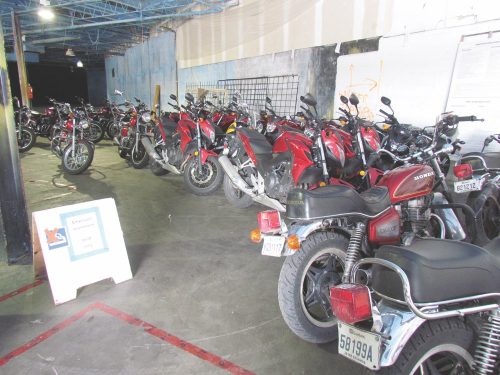 Because there’s limited space in the city to set up a proper training facility, the riding school I work for used to store bikes in shipping containers. A recent vacancy in a building adjacent to our closed-course circuit provided the opportunity not only to store our motorcycles, but also to set up shop. There are, after all, more than 50 motorcycles that get a regular, abusive workout.
I went through my inventory and put together a secondary toolbox (spending 20 years as a motorcycle tech usually means you gather more tools than you need) with all the basics, as well as a few specialized Honda tools. I also finally put to use an ancient motorcycle lift that I had put into storage more than 30 years ago. It’s a simple device made of wood that probably dates back to the early 1970s, and has a pivoting tabletop that you push the bike onto, pivot until it’s level, then lock into place with a steel pipe. It’s an archaic item that’s likely more suitable as a museum piece, and by today’s standards is entirely unsafe, but it places the bike to be worked a little more than a half-metre off the ground, for which my back is thankful. Lighting was inadequate, so a couple of portable, clip-on lamps provide additional illumination where needed.
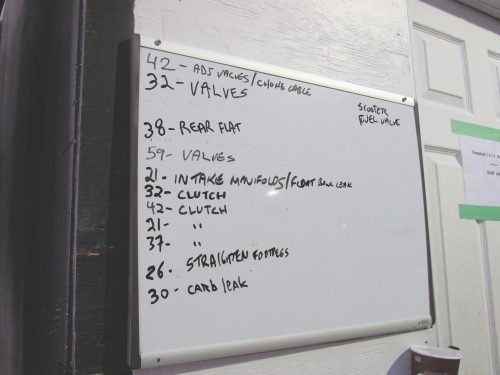 The fact that some of the bikes are more than 30 years old doesn’t make the job any easier. Most of the ones that do the hardest work – on the closed course, at low speeds – are early 1980s Honda CB450SC Nighthawks. The reason is simple: They are just about the toughest bikes for the job. These things were overbuilt, with robust clutches and solid gearboxes, and they’re easy to maintain. Valve adjustments are by screw and locknut, making it a half-hour job. When we used to store the bikes in the containers, I would perform the valve adjustments outdoors, but only when the weather was nice. Now I can do it any time.
Despite the clutches being tough as nails, the almost daily abuse they receive by inexperienced hands takes a toll. Most of them last a couple of seasons, which is remarkable under the circumstances, but there are now about four bikes that move when cold but don’t once they warm up, and two that refuse to move regardless of engine temperature. Fortunately, all the parts needed are available through the aftermarket, and are very affordable.
Other issues we experience regularly, especially when the bikes come out of winter storage, are fuel leaks. While some originate at the petcock, most come from the carburetors, but not from overflow due to sticky float valves – we do, after all, take the proper pre-storage precautions by adding fuel stabilizer to the gas and draining the float bowls. The leaks come from the junction between the float bowl and carburetor body due to dried-out gaskets. Remarkably, and with the experiences to back me up, most of these types of leaks fix themselves after a few hours with gasoline in the float bowls, saving me the trouble of pulling the carbs. Tire pressures are checked and drive chains are lubed weekly, levers and gearshifters are straightened regularly, and there’s almost always a tire to change.
Some of the CB450s have been retired over the years, but they continue being useful by being cannibalized for parts. Replacing them with new ones is becoming difficult; some good, affordable used ones still appear in classified ads, and we quickly snap them up, but this new café racer craze is driving prices up, since CB450s are a popular choice among backyard builders.
Because the owner of the riding school has had such a great run with the old Hondas, two years ago, he began replacing the aging road bikes with brand-new CB500Fs (ironically, he rides a Yamaha). Being used solely on the road, these bikes have had an easy life so far, but they’re soon going to reach the mileage threshold that will graduate them to the closed course. Time will tell if they’re as tough as the CB450s, but in the meantime, I’m going to do my best to squeeze as much life from the aging twins as possible.
Technical articles are written purely as reference only and your motorcycle may require different procedures. You should be mechanically inclined to carry out your own maintenance and we recommend you contact your mechanic prior to performing any type of work on your bike.