
ROK Straps
One of motorcycling’s simplest gadgets.
I first discovered Rok Straps around 2004, at the Vancouver motorcycle show. After years of dealing with metal- hooked bungee cords, one look at the Rok Straps and I could envision their functionality; and I bought a package of two of the 150 cm (60-inch) straps. I haven’t used a traditional bungee cord since. I have, however, purchased more pairs of Rok Straps over the years – they’ve gotten misplaced, or I’ve given them to family or friends.
The beauty of Rok Straps is the strong 15 cm elasticized section that offers a limited amount of stretch combined with the regular nylon strap that has attachment loops at each end, making it easy to secure the straps to any mounting point of your motorcycle. The fact that there are no metal hooks to damage painted or chromed surfaces is an added bonus.
The limited stretch of a Rok Strap keeps your cargo snug at all times, no matter how rough the road is, but has just enough stretch to maintain the proper tension – something that a straight strap can’t do, while a full-length elastic strap has too much give to keep a consistent tension.
It’s easy to use: Undo the plastic side-release connector and simply feed the strap through the loop at each end to secure it to any mounting point of your motorcycle. Reconnect the side-release connector and pull the loose end of the strap to cinch down your cargo.
To loosen the strap, just lift up on one end of the plastic connector to relieve the elastic’s tension and undo the clip. So simple and so efficient. Once you try them, I doubt you’ll use bungee cords ever again.
A package of two 46 to 150 cm straps retails for just $25, while a shorter strap package sells for $15. To purchase or to find a dealer near you, go to rokstrapscanada.com.
An outstanding tool to help reduce rear-end collisions.
The goal of every motorcyclist is to enjoy the ride while out on the open road, but more importantly, we need to stay safe. We are all aware that one of the biggest dangers to a biker is the dreaded left-hand turn from an oncoming vehicle.
But equally dangerous is having an inattentive car driver following us. This threat requires a constant eye in our mirrors and, as with the left-hand turn situation, a quick formulation of a possible escape route if things don’t go according to Hoyle.
But there is a tool on the market that helps to capture a following driver’s attention when a regular brake light doesn’t seem to be enough.
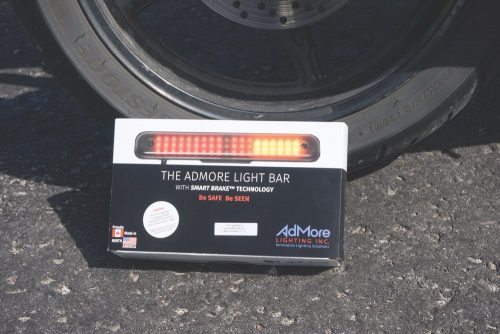 AdMore Lighting has been in the business of making our rides safer for many years by producing LED brake light bars and a variety of turn signal options for the front and back of bikes. But it’s the company’s newest brake light bar with Smart Brake technology that sets a new standard in getting the attention of a driver behind you.
The AdMore Smart light bar has all the basic features the previous-generation light bar has, like taillight, eye-catching progressive turn signals, and a modulated three or four flashes of the brake light before it lights at full intensity.
But the SMT light bar with Smart Brake technology goes further. Not only does it offer more safety features right out of the box, it’s also programmable via a laptop to work the way you want it to work. And it is CANbus compatible, as are all AdMore lighting products.
Some of the features of the latest high-intensity light bar include a three LED white strobe when you apply the brake, a lightweight aluminum housing and an LED licence plate light. The coolest enhancement to the light bar is a sophisticated accelerometer sensor that detects rapid deceleration of the bike – either by chopping the throttle or downshifting – and alerts the driver behind you that you are slowing down, but not necessarily braking.
The Smart light bar comes with the latest firmware already installed, but this is also upgradable by the end user when new firmware comes available. Programmable features include the sensitivity of the accelerometer (default is medium), brightness of the brake light (default is the brightest setting), modulation of the brake light (default is four flashes), licence plate light (default is off), taillight (default is on), turn signal action (default is sequential) and the white LED strobe (default is on).
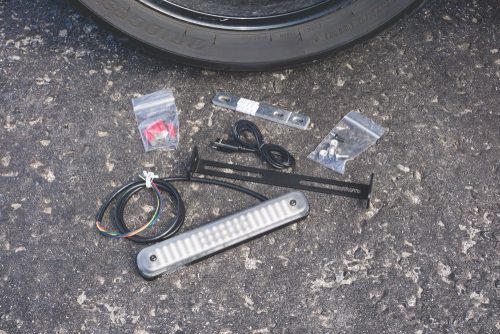
Installation of the light bar is easy and took me just over an hour. Most of that time was deciding where to run the wire harness from the light bar to under the seat on my Triumph Tiger 800XC for an invisible install. I installed the light bar above my licence plate, but installation can also be done below your plate. All of the hardware needed is included in the kit.
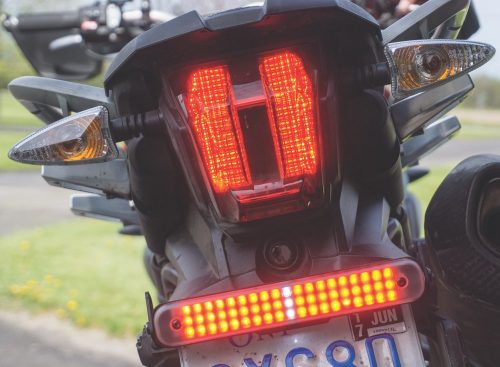 After mounting the black powdercoated bracket behind my licence plate and running the wires inside the inner fender to tap into my stock brake and turn signal wires, I used the supplied Posi-tap premium wire connectors. What a dream these connectors are to use – anyone who has used Scotchlok connectors knows how bulky and flakey they can be, and will appreciate the ease of use and compactness of these Posi-tap connectors.
Checking the lights and functionality is the last step for the basic hardware install. If you wish to further program the light, you’ll need to go to admorelighting.com to download the configurator software for Windows. Macs and Linux machines must use the command line to further program the light’s functionality. The AdMore website offers a complete set of command line instructions.
By default, the licence plate light was not lit, but because I mounted the light bar between the plate and the stock licence plate light, I thought I should turn it on – I don’t see the sense in being stopped by the police for something as simple as not having my plate illuminated. A few keystrokes later, the plate LED was turned on and it was time to hit the road to see how the accelerometer works at the default medium setting.
 I ended up changing the accelerometer setting to high, to be a little more sensitive, since my test bike is a very smooth triple cylinder and chopping the throttle, in most cases, wasn’t enough to activate the light. The medium setting would probably be fine on a different style of engine with stronger engine braking, like a V-twin, for instance.
I think it’s always better to be safe than sorry, and the AdMore SMT Light Bar with Smart Brake technology adds extra comfort knowing that you are more conspicuous by giving the driver behind you a better chance of seeing you slowing down or stopping.
Go to admorelighting.com for more information on this and other AdMore Lighting products.
Press Release
We are still feeling the Ride for Sight spirit after last weekend’s event in Fenelon Falls. As always we had a great time at the Bike Games, the Burnout Pit, the Show ‘n’ Shine and of course, dancing to some great live music! Not to mention that you campers braved the wet weather, and a severe tornado warning too!
And the feet-up parade from Stouffville to Fenelon Falls – what an amazing experience! The line of bikes up and down hills, around corners, along straightaways, and through towns was an inspiration to see. It felt so great to all ride into the Fairgrounds together too!
There are so many great pictures from the weekend so be sure to check them out and post your own on Instagram @rideforsight_official and Facebook and make friends with Joe Rider as well.
Thank you to everyone who came out or made a donation to this year’s ride. Because of you, the Foundation Fighting Blindness can continue to fund vital research to treat and cure blindness.Your support makes a real difference and we could not be more grateful.
Each year we look for ways to make the ride a better experience for everyone. Please fill out our rider survey to let us know what you thought of the event and you could win a prize pack from Stanley and Dewalt.
Thank you all so much again for sharing your donations, community and memories with us. We can’t wait until next year…

Press Release
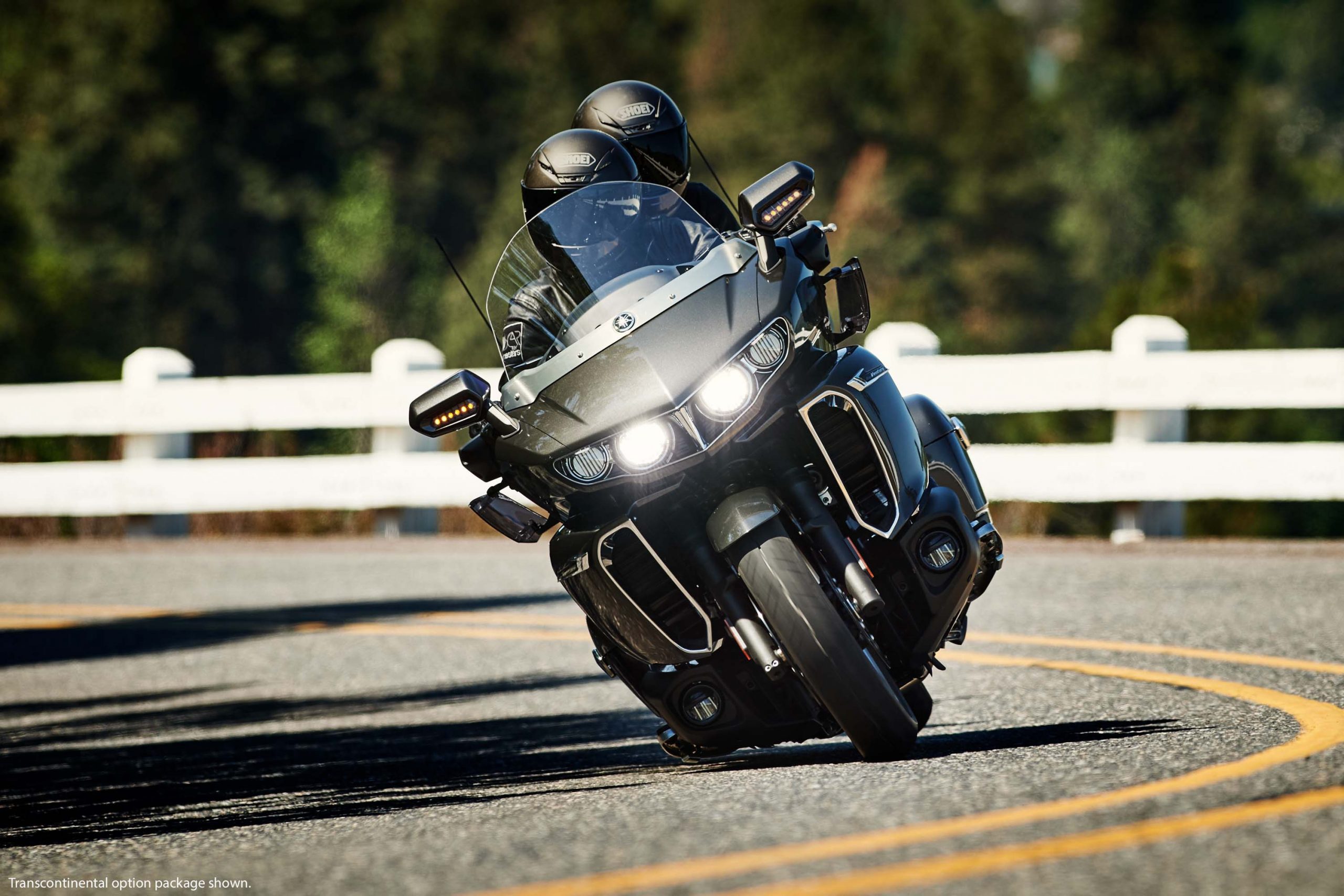
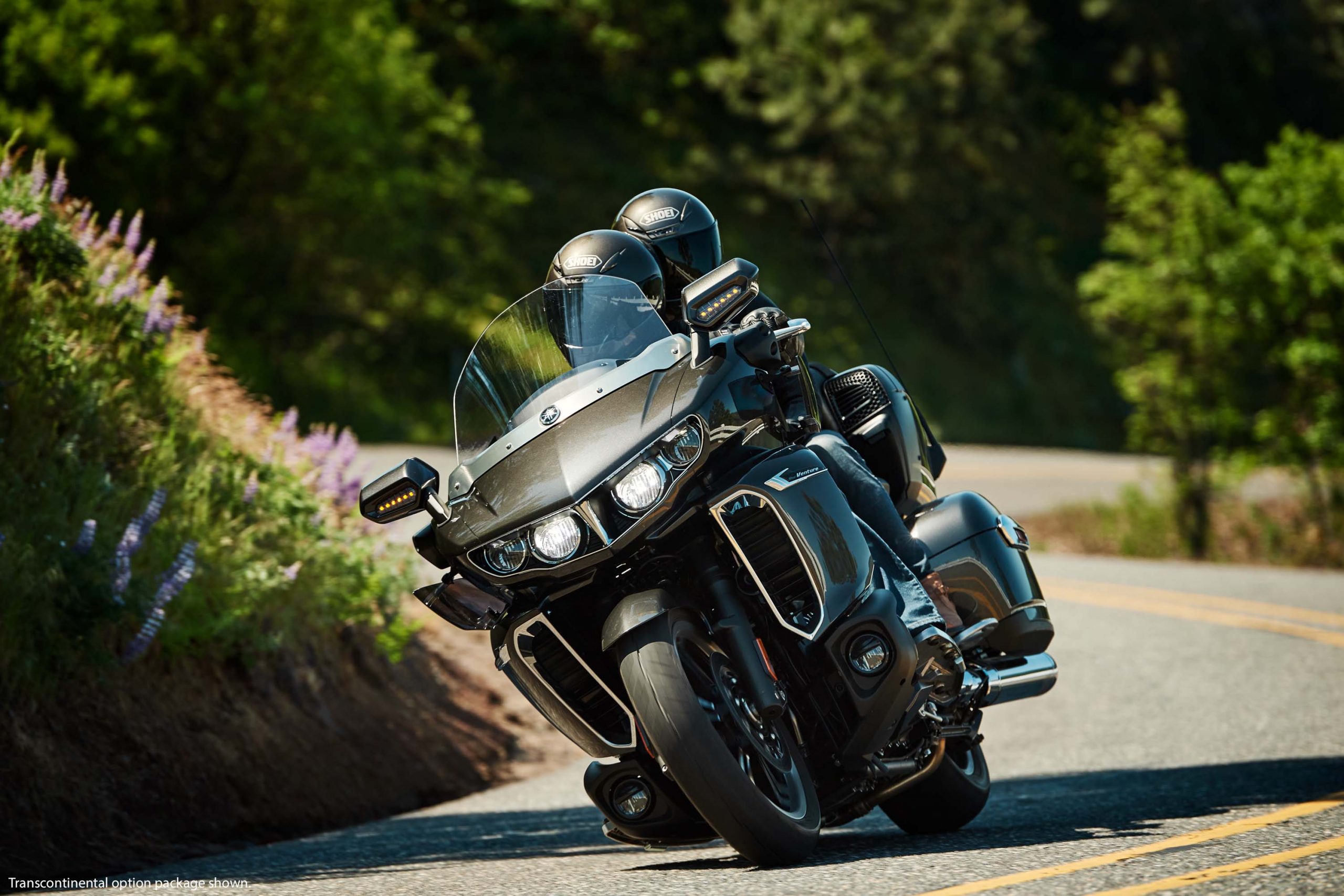
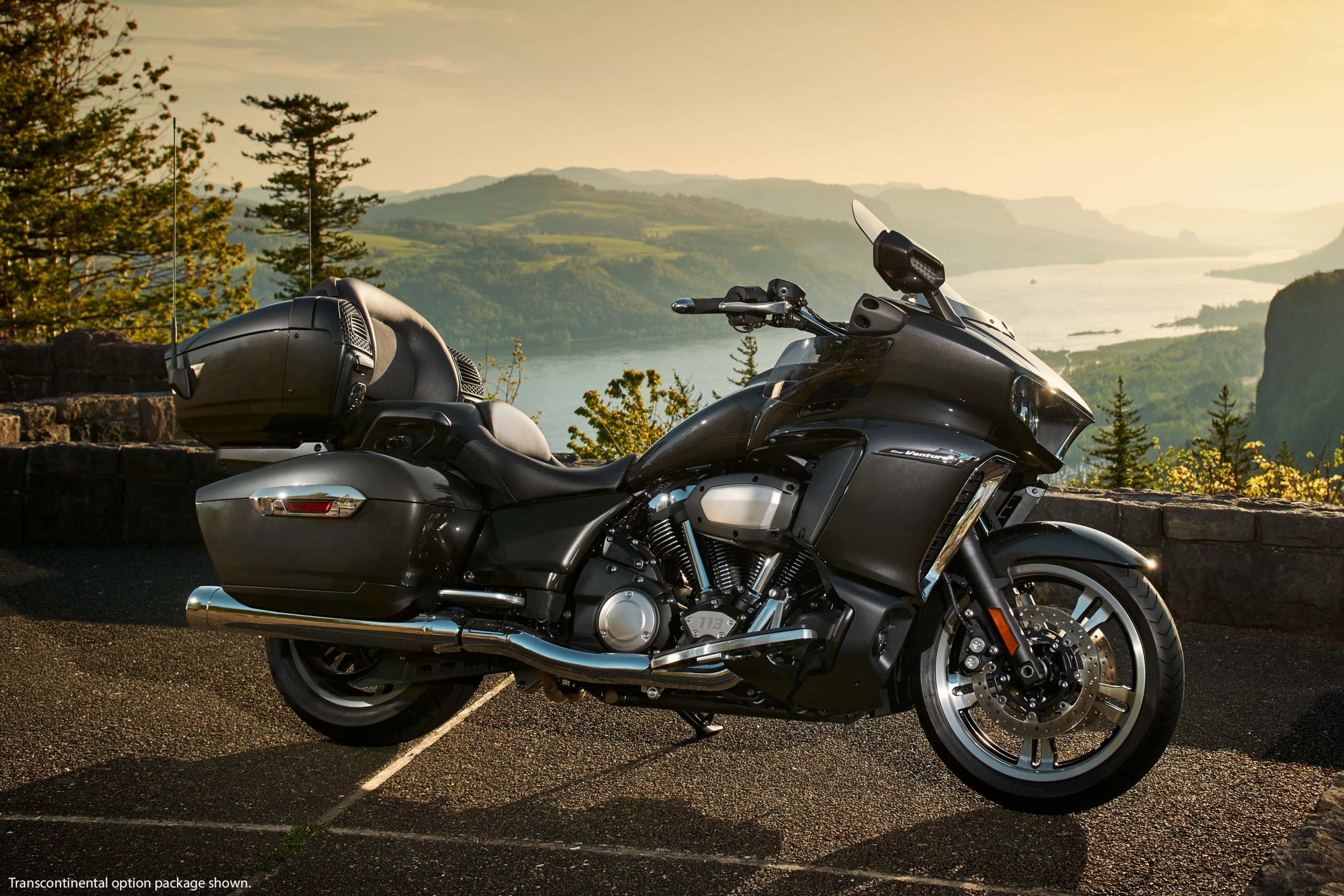
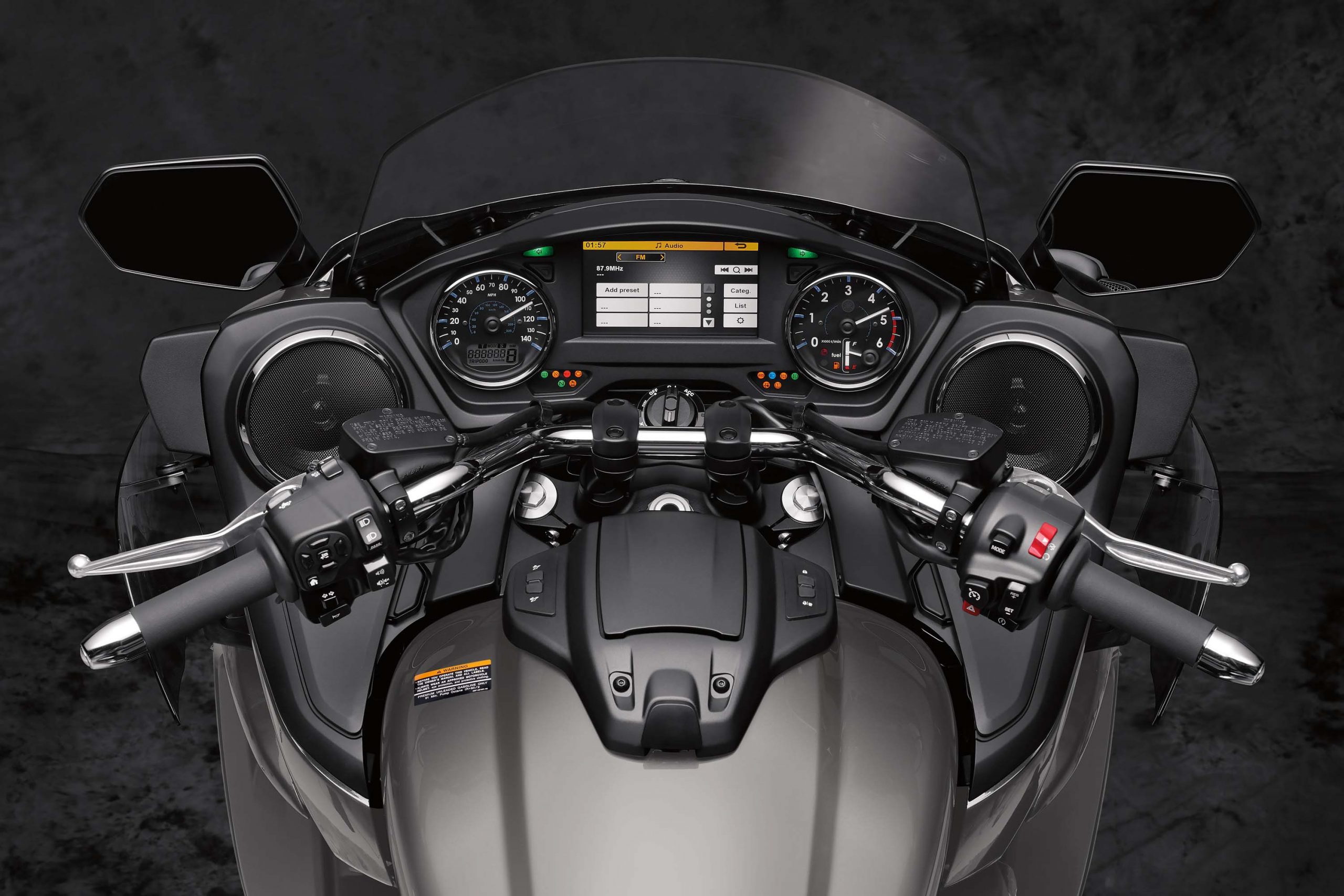
Yamaha has released the luxurious, new from the ground up, 2018 Star Venture TC bringing greater convenience, comfort, and long-distance enjoyment to those who choose to journey further.
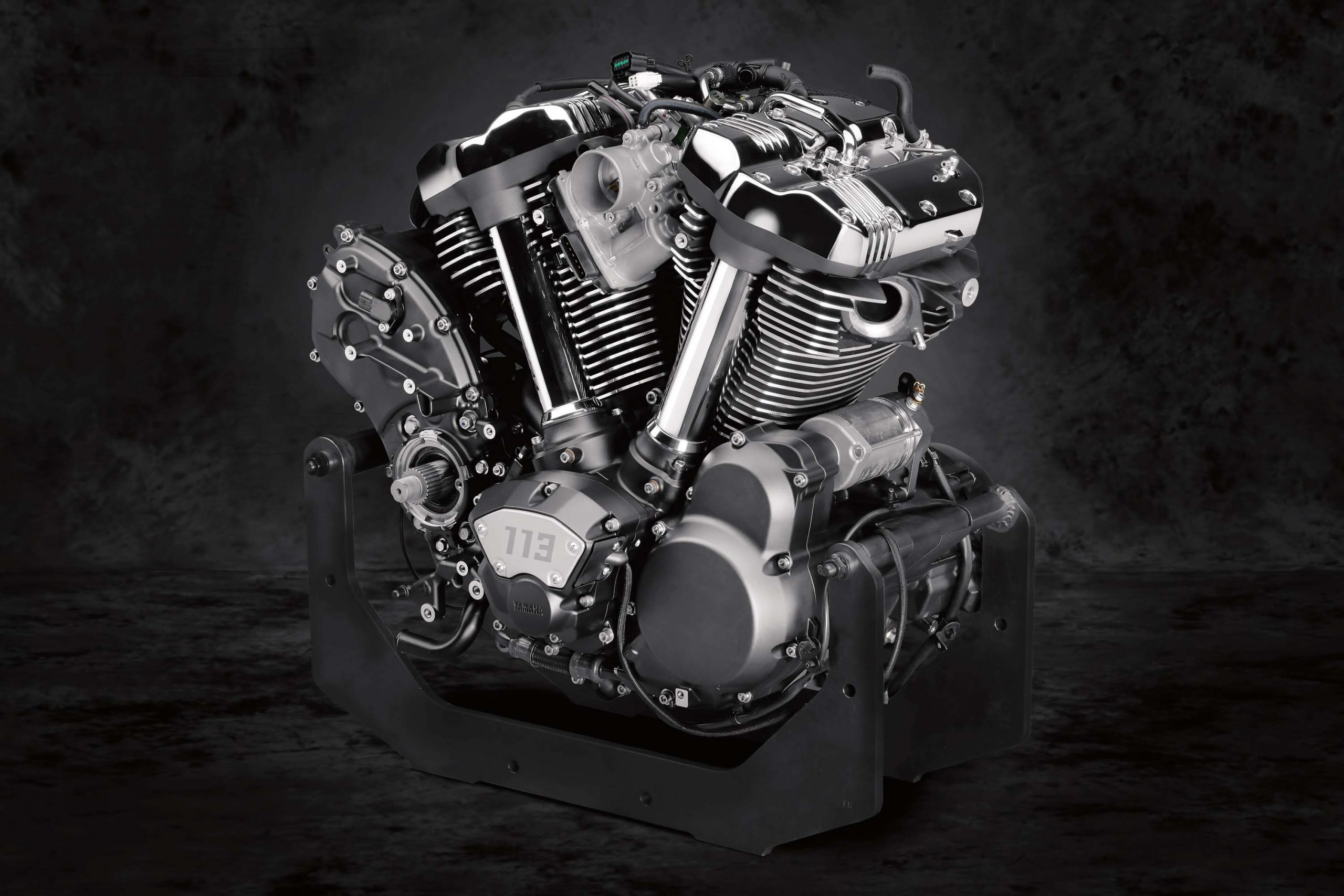
The experience and emotional connection to the all-new Star Venture TC begins with the powerful 1,854 cc air-cooled V-twin. Cruising at highway speed, passing, and even carrying a full load is effortless and with the addition of Yamaha’s YCC-T ride-by-wire throttle control and 6-speed transmission with overdrive, the ride is ultra-smooth.
Whether touring across town, province, or country, comfort is among the top desired characteristics for both rider and their passenger. To make the most of enjoyable rides, Yamaha has spent countless hours considering the comfort and rider ergonomics of the Star Venture TC with standard features like electronic adjustable windshield, a spacious cockpit, and heated rider and passenger seats. Long-distance hauls are made easier with plenty of storage in the saddlebags, top trunk, and readily accessible passenger storage compartments.
Operation of the Star Venture TC is made easy with features like traction control, ABS/UBS braking, user-friendly Smart Key technology, and Yamaha’s all-new Sure-Park system that makes moving the motorcycle convenient and hassle-free. Sure-Park employs an electric motor to slowly move the bike forward or backward to aid maneuverability when parking.
The user-friendly infotainment system on the all-new Star Venture TC comes factory installed with a 7-inch LCD display complete with audio, navigation, communication, vehicle status and equipment controls and can be controlled via touch screen, the 5-way D-pad on the handlebars, and even voice recognition.
Cross-Continental touring is a beautiful thing. The Yamaha Star Venture TC makes it a luxurious pleasure.
Motorcycle Racer, Avionics Expert, Land Speed Record Holder!
TOP 1 ACK ATTACK became the world’s fastest motorcycle when it set the Land Speed Record of 376.363 mph/605.697 km/h back in 2010. Although no one has beaten his twin-engined streamliner in the better part of a decade, builder Mike Akatiff is not the type to rest on his laurels. Rather than retiring, he is going after 400 mph on the Salar de Uyuni salt flats in the Andes mountains August 3-8, 2017.
“I’ll never retire,” he says. “The day I retire, I’d be dead. I always need to be doing something.” Since 2000, that something has been the quest for the motorcycle land speed record. He has succeeded in building the world’s fastest motorcycle — three times — but the fact that going more 400mph is theoretically possible continues to motivate Mike. “We touched 400 mph, but it doesn’t mean anything because it’s not officially recorded… we had onboard equipment that showed about 402.6 when we set the record.”
Largely self-taught, Mike Akatiff cut his teeth tinkering with motorcycles…and developing a knack for proving people wrong when they tell him something is impossible. As he puts it, “I was always interested in mechanical stuff and explosives, too — like making my own fireworks.” From his first bike build at 13, through a career of flat track racing, tuning and tinkering, starting a motorcycle dealership in his 20s, developing several successful aftermarket companies to switching gears and going into the Avionics field, Akatiff has also seemed to succeed at doing the impossible. However, the LSR chase has proven to be the most challenging and rewarding job he has ever had… and it still has its share of explosive moments.
Fast forward to September 3, 2006 and perfect conditions on the Bonneville salt flats when the TOP1 ACK ATTACK, driven by Rocky Robinson, broke the land speed record. The twin Suzuki Hayabusa engines propelled the 20-foot long streamliner to a two-way average speed of 342.797 mph, which was approximately 20 mph faster than the previous record — a record that had stood for 16 years! It was a remarkable achievement for everyone involved, and as Mike said, “we thought that record would stand forever.”
As it turned out, the record lasted just two days. Chris Carr in the BUB Lucky 7 streamliner built by Denis Manning eclipsed the ACK ATTACK’s record by going 350.884 mph. The next year was more fireworks as pilot Rocky Robinson crashed at a little over 300 mph. “He wasn’t hurt, but the bike was pretty well messed up,” Mike recalls. What do you do after wet and slippery conditions caused a crash at the 2007? Come right back and go for the Land Speed Record again! “We’re racers… we’ve got to get the record back!” But when the team went back out to Bonneville in 2008, they really struggled with problems. “Handling was an issue. But in the very end we were able to up the record to 360 mph. We again had the record and thought we would hold it for awhile… it lasted less than a day as another team went out and ran 367 mph on the last day of the time trials.
A host of modifications were made before TOP1 ACK ATTACK finally took to the salt again in 2010. “We wanted to take it to the dynamometer just to make sure the bike was running right. We thought what would be one day on the dyno became almost three weeks of thrashing the bike.” No matter what they did they could not figure it out. “We had some of the best people on it, but we couldn’t make the bike run cleanly.” Still not satisfied, the team ran out of time and headed to Bonneville. “It was just one challenge after another out there! First thing we ran into was the bike wouldn’t go straight. It wanted to turn left no matter what we did. Rocky would have to lean it to the right to try to keep it going straight.”
Turned out one of the changes from 2008 was swapping the rear tire. An accomplished pilot (as could be expected from his Avionics background), Mike flew back to San Jose in the middle of the night, found the old tire and then flew back to Bonneville. “Worked fine and the bike ran straight… however it wouldn’t shift into low gear!” The team decided to swap out the front engine right there on the salt, which took them 24 hours straight.
After the marathon engine swap, the bike ran straight as an arrow and Rocky was happy with how it was running… then it wouldn’t shift out of 4th gear. It wouldn’t shift into 5th or 6th, so Rocky suggested they put the highest gear they could and run for the record in 4th. “Theoretically it was possible… but the bike accelerated so slowly that we passed him up in the truck by the first quarter mile,” says Mike. Perseverance paid off and the record TOP 1 ACK ATTACK set on the last run of the day back in 2010 stands to this day.”
Fortunately the run for the record in Bolivia in August should be anything but wet and slippery! “I haven’t seen salt this good in 40 years,” said fellow LSR icon Mike Cook after visiting the Salar de Uyuni last month. With a few years to work the bugs out and with the help of sponsors like TOP 1 and Ace Cafe, ACK ATTACK is ready to blast by 400 mph mark.
“TOP 1 Oil offered their support before we ever went out to Bonneville or broke any records,” says Mike. “Since then, they’ve been a tremendous sponsor through all of our record-breaking runs. I would not have taken the ACK ATTACK as far as I have without them. I can’t say enough about the Ryan family and the other TOP 1 Oil guys.”
“The funny thing is that Mike didn’t want our sponsorship in the beginning,” chuckles TOP 1 VP of Sales & Marketing Frank Ryan. “He could do it all on his own and saw sponsorship as being more trouble than it was worth. But once he started using the products, he came around. We share a bond based on trust, a passion for superior quality… and like Mike, we don’t like to be told something can’t be done!”
You can see an extended interview with Mike describing his 15 year quest for the land speed record on the next episode of the TOP 1 ACK ATTACK video series:
https://youtu.be/Sf9DrkUXCb4
Follow along in the quest for 400 mph at https://www.facebook.com/top1ackattack/
Tiger 800 models will be the first to get crash and engine protection
Timing is crucial and in Outback Motortek’s case it was definitely on their side. Triumph Tigers (XC, XR, XCX, XRX) have been sold for nearly 7 years, which should mean a tremendous disadvantage introducing accessories so late, unless there’s a large percentage of Tiger 800 owners who are not happy with the current aftermarket accessories other manufacturers offer.
“We always listen to what riders have to say about their crash bars and skid plates and we try to improve upon their feedback and keep the trusted features. Hence we’ve had a surprisingly great reception when I first posted the prototype products’ photos. So many Tiger 800 owners are now eagerly waiting for our products to be released”, said Outback Motortek founder, Lorry Gombos.
“Timing is crucial and it could not be any more perfect: riding season is in full swing! We are stoked to announce that the Outback Motortek Triumph Tiger 800 accessories will be available in Canada by the end of June, 2017 via our Canadian distributor DualSport Plus (www.dualsportplus.com).”
Outback Motortek offers two colour options for its accessories. View colour options and images on the Outback Motortek blog at https://outbackmotortek.com/black-vs-silver-triumph-tiger-800-crash-bars/.
For more information contact:
Lorry Gombos
Founder and Owner, Outback Motortek
Pickering, ON
Toll Free#1-877-931-3636
Email: lorant@outbackmotortek.com
www.OutbackMotortek.com
Press Release
While others are scaling back 600 cc supersport production, Yamaha is ramping its up
There was a time not that long ago when 600 cc supersport motorcycles were the pinnacle of high performance. So popular was the category that the Big Four were redesigning their respective 600s every couple of years. And we’re not just talking plastering on new graphics – 600s were being completely made over from the ground up with new frames and new engines, and with each makeover they got lighter and more powerful. This frenetic pace in development was partially driven by the 600 Supersport class, which was at the time the most popular race class, with 600 cc machines filling race grids across North America. The cost of this rapid development must have been staggering, though worldwide sales made the expense worthwhile.
 Then the economy tanked in 2008, sapping the disposable income of the largest segment of buyers of middleweight supersport bikes – twentysomething males. Sales took a nosedive almost overnight. Yamaha, for instance, sold about 110,000 R6s in the U.S. in the first nine years of production, and only another 40,000 units in the nine years since the market crash. Race grids subsequently dried up, and motorcycle manufacturers rolled back on 600-class development. To give you an idea of just how much they rolled back, while the R6 saw three major updates in the eight years following its introduction, it’s been 11 years since the third-generation model rolled off the factory floor in 2006.
Perhaps more telling, Honda no longer offers the CBR600RR in Europe, and Suzuki is rumoured to stop producing the GSX-R600 when the next-generation GSX-R750 is introduced; the two were usually developed simultaneously. Nonetheless, Yamaha felt it was time to refresh the YZF-R6 for 2017. Although this fourth-generation R6 looks very different from the previous model, it’s actually an evolution of the model it replaces.
Why Change a Good Thing?
 Aside from the reduced demand for 600 cc supersport machines, perhaps another reason that they haven’t been experiencing major overhauls every couple of years in the last decade is they had already evolved into very potent track bikes. From 2015 until this issue went to press, the R6 had recorded 56 wins out of 58 Moto America Supersport and Superstock races, as well as winning this year’s Daytona 200 – and that’s on a bike that hasn’t changed much since 2006, though to be fair, neither has the competition.
It’s for this reason, and perhaps because it’s more economically viable, that the 2017 YZF-R6 retains its major components, like the same 599 cc inline-four and aluminum deltabox frame as the previous model. The engine uses ride-by-wire throttle control (introduced in 2006, though it has been better exploited in the new bike), as well as twin injectors and electronically controlled intake stacks that help boost low-end torque. The R6 also retains the slipper clutch introduced in the previous-generation model. And that’s pretty much it – everything else is new.
Big Brother Styling
 Styling is now modelled after the YZF-R1, which itself is modelled after Yamaha’s YZR-M1 MotoGP bike. The new bodywork is more efficient aerodynamically, with improved wind protection for the rider and reduced wind resistance. Tucked underneath the fairing’s nose are LED headlights, and in the new tailpiece is an LED taillight.
The fuel tank is now made from aluminum and is 1.2 kg lighter, and it’s reshaped at the rear for a more comfortable fit. The seat is also flatter and has less of a forward slant, so there’s less of a tendency to slide forward into the tank.
The big improvement within the powerplant comes with the addition of adjustable traction control and selectable ride modes. The traction control uses front- and rear-wheel sensors (though it is not lean sensing), and in addition to its six levels of intervention, it can be turned off; three ride modes (A, STD, B) provide progressively softer throttle mapping. For the first time since its introduction, the R6 gets ABS, though it’s not adjustable and can’t be turned off. The bike is prewired for an accessory Yamaha quick shifter ($290) that works only when shifting up.
KYB provides a new shock, as well as the new, larger-diameter 43 mm (was 41 mm) inverted fork that now has the preload, compression and rebound damping adjustments located conveniently at the top of the fork tubes. Because the larger fork tubes are more rigid than before, the lower triple-clamp has a thinned midsection that actually induces some flex into the front end to maintain a balanced feel. Front brake calipers and the radial master cylinder are lifted straight from the R1, and the discs are 10 mm larger, at 320 mm.
Serious racetrack types can also buy the Yamaha Telemetry Recording and Analysis Controller (Y-TRAC). This data logging system uses GPS and features
Wi-Fi connectivity to transfer lapping data to an Android- or iOS-based device. Pricing has not yet been released, but a similar system for the R1 retails for $1,657.
Track Time
For our track sessions during the YZF-R6 press launch at Thunderhill Raceway in California, our hosts installed the accessory quick shifter, and they swapped out the stock Bridgestone S21 tires with stickier R10s. The forecast called for rain, so they also brought W01 rain tires, also provided by Bridgestone. We got a chance to ride in dry and wet conditions.
It’s been three years since I last rode a 600 cc supersport machine on a racetrack, and after numerous track launches on open-class bikes, I had forgotten what it was like to have to spin an engine to 16,000 rpm to maintain fast forward momentum. This requires a different kind of concentration than on a big bike – mainly trying to keep the engine in the strongest part of its power band, which on the R6 is above 12,000 rpm. You also have to stay busy at the shifter, which emphasizes the advantage of the quick shifter – just hold the throttle to its stop and lift your left toe. A quick shifter that also works on the downshift would be even more convenient, though that would require a different ECU, which would substantially raise the price of this accessory.
Comparing Old to New
Our hosts had the foresight to provide a 2016 R6 for a direct comparison, and this is where the changes to the 2017 model became immediately evident. The engine felt very similar between the two bikes, though the lack of the shifting aid on the previous-generation model required you to shut the throttle on every upshift, which would probably be worth several tenths of a second in lap times. I also locked the rear brake on the first lap out on the 2016, having forgotten it lacked ABS. And that ABS worked flawlessly on the new bike, remaining completely invisible, even when hard on the brakes for Thunderhill’s tighter turns. Brake feel has also improved greatly on the new bike, with a more progressive lever feel providing more accurate feedback.
Probably the biggest difference was in the steering, which was more precise on the new bike. I noticed this the first time I pitched the previous model into Turn 5, which is like a miniature version of Laguna Seca’s Corkscrew, and had to correct my exit, having steered too tightly and missing the ideal trajectory. This was mostly due to the different feel of the two bikes, and it took a couple of laps to overcome. Whereas my head bobbled about behind the windscreen when tucked in on the faster straights on the previous model, the new bodywork provided smoother, turbulence-free airflow over my helmet.
Rain started falling hard after lunch, so I went out for one wet session on the rain tires. I initially set the ride mode in the softest position, B, but bumped it up to STD, as it proved too soft for the incredible grip of the W01 tires. Even the ABS remained mostly unnoticeable, triggering only once in the rear.
I’m not sure if the remaining Japanese bike makers will follow Yamaha and refresh their middleweight supersport machines any time soon. The fact remains that 600s have seen their heyday, and to compound their accessibility, they are no longer inexpensive. The Yamaha was the least expensive bike in the bunch last year, at $11,999 ($13,799 for the Honda, $13,399 for the Kawasaki and $12,299 for the Suzuki). However, the improvements made to the 2017 R6 have bumped its price to $13,999, now making it the most expensive in its class. With its comprehensive electronics package, though, it’s the most advanced, and for a rider looking for the ultimate track bike that is more manageable than an open-classer – and considerably less expensive – it’s probably the best choice out there.
Off-road specialist KTM bridges a gap in its lineup and proves that a big trailie can also be a competent canyon carver
Let’s face it, most adventure-bike riders use their bikes for touring, commuting or exploring dirt roads, rarely taking them truly off-road. And there’s nothing wrong with that; adventure bikes are powerful, they’re comfortable and their long-travel suspensions are better suited to deal with broken, pockmarked pavement than any naked, sport or sport-touring bike.
However, there is a small percentage of adventurers who do dare take their big bikes where only 250 cc dual-sport bikes should go. Some hard-core riders don’t hesitate to take bikes like the gargantuan BMW R1200GS Adventure off the pavement and onto technical, single-track trails or up steep, rocky hillsides, or to even use them as oversized trials bikes. And in the right hands, the big bikes are very capable off-road machines. But they are a lot of work to manhandle in the tighter, rougher stuff. Serious off-road adventure bike riders do have other big-bore options, including the Honda Africa Twin introduced last year, and now the new KTM 1090 Adventure R tested here.
Although KTM makes some true street-oriented models, its specialty is making off-road bikes. The Austrian company already had a few potent adventure bikes in its lineup last year: the 1290 Super Adventure, the 1190 Adventure and the 1190 Adventure R. However, the two non-R models were better suited for the street; it’s the R model that was equipped with the 21-inch front and 18-inch rear wheel combination that facilitated serious off-road riding. The R also boasted 150 hp, which is really overkill when throwing a roost off the rear tire, and it cost more than $18,500.
A More Realistic Big Trailie
 KTM has reshuffled those big adventure bikes for 2017. There’s an all-new 160 hp 1290 Super Adventure R (which now has off-road wheel sizes) for riders who want to use the rear tire like a Gatling gun, and for more sensible riders who are also on a tighter budget, there’s the 1090 Adventure R, which replaces both 1190 models.
Its 1,050 cc V-twin is a destroked version of the 1190’s engine (63 mm versus 69) with a 2 mm smaller bore, at 103 mm, and it uses a mix of parts from different KTM twins, such as valves from the 1190/1290 and cams from the European 1050 Adventure. It produces 125 hp and 80 ft-lb of peak torque, and includes four ride modes (Sport, Street, Rain, Off-Road) that adjust throttle mapping and limit output for the different riding environments. It also has switchable and adjustable traction control. KTM left out the cruise control and tire pressure monitor found on the 1290, and uses simpler traction control and ABS systems, neither of which is lean-sensing. The ABS is not linked as on the bigger bike, but it does include an off-road mode.
The chassis is tuned for serious off-roading, with 21/18-inch wheels that sport tubeless Continental TKC 80 knobby tires. To reduce the risk of a flat at the launch event here in Temecula, California, our hosts installed inner tubes, though I question the logic behind that move – it’s easier to repair a puncture on a tubeless tire, unless it’s a tire-destroying slash, in which case it wouldn’t make a difference whether there was a tube or not. And it wasn’t because they ran particularly low pressures, since we’re told the tires were set to 32 psi. WP provides the fully adjustable suspension, with 220 mm of travel at both ends, though unlike the 1290, changes are made manually, not electrically.
No Pavement Needed
 We picked up the test bikes at KTM’s North American headquarters in Temecula and headed out on a two-day trek. We’d be spending the night at a camp at Chaney Ranch, an off-road riding and training facility in Warner Springs that’s about an hour from Temecula as the crow flies, but about a day away by our route. The folks at KTM weren’t kidding when they said we’d hit the dirt almost immediately – after leaving the parking lot, we rode on pavement for about 150 metres before turning onto a gravel road that led to a series of trails.
The 1090 comes fitted with crash bars, but if you plan on going deep into the woods, you should add the optional aluminum skid plate to avoid those dreaded adventure-ending crankcase punctures – our test bikes had the skid plates. Wider accessory foot pegs were also installed, since about 80 per cent of our ride route was off-road. With a seat height of 890 mm, the bike is tall, but the suspension squats considerably when seated, making reaching the ground easier. At six feet tall, though, I’m still on my toes. The riding position is more like a dirtbike, with low-mounted foot pegs and a high-rise handlebar that helps stand-up riding, which is the riding position we used most of the day. At my height, I’d consider a set of accessory risers to raise the handlebar about 25 mm, since I started to feel my lower back strain from bending over for so many hours.
Big Dual-Sport Feel
 The only features that give away the 1090 as a big bike are its wider midsection between the knees and, of course, its 207 kg dry weight, which is 3 kg lighter than the 1190 it replaces, and 10 kg lighter than the 1290. Despite its heft, it handles remarkably well when the pavement ends. Throttle modulation in Off-Road mode is easily managed, and this mode also lets the rear tire spin up considerably before the traction control intervenes, allowing nice long slides through corners, and easing steep uphill climbs. An accessory dongle was plugged into the bike that allows you to turn off the ABS (which I found no reason to do), and maintains mode settings rather than defaulting to standard when the ignition is switched back on. A reminder that the dongle is plugged in is a “Not Legal” message that flashes in the dash display when you switch on the bike.
A large portion of our route took us along sandy trails, and sand isn’t my preferred surface texture. Neither is it the preferred surface for the TKC 80s, which handle commendably on hard-packed and rocky terrain, but return vague feedback and sketchy traction when things get loose. Despite this, I charged along at a reasonable pace on the loose surface, with only a couple of eye-opening front-end slides. I also discovered that my sand riding isn’t all that bad; previous rides on the stuff in Namibia and Mozambique have instilled in me the proper body language, as well as the reflex of gassing it instantly as soon as the front end gives. On hard-packed gravel roads and tighter trails, the 1090 feels more like a big dual sport than an adventure bike. Its suspension soaks up most bumps and rocks effortlessly, though the fork did bottom with a loud clunk a few times when riding over wider rainwater ruts that were gouged across the trail.
Day two began in sub-freezing temperatures, which prompted me to raise the adjustable windscreen by simply releasing two levers and lifting it. The taller height cut most of the wind from my torso until temperatures warmed up and I dropped the screen for more ventilation.
From Trail to Canyon Carver
We rode mostly on pavement on the second day, along very twisty canyon roads, and the 1090 surprised again. Despite its larger wheel sizes and soft, off-road suspension, we maintained a pace that would make sportbike riders sweat to keep up. The 1090 is not a hard-charging, trail-braking kind of bike, but if you maintain your momentum, it flows through esses quickly and without wallowing. It’s only on tight turning transitions that you feel the bike’s height, as you arc high above the pavement coming out of one lean into another. In Sport mode, the engine pulls hard in a linear manner, and just keeps pulling hard until well into the triple imperial digits on our U.S.-spec machines.
The addition of the 1090 Adventure R to KTM’s lineup now better fills the gap – both in price and performance – between the 690 Enduro dual-sport bike and the power-be-damned 1290 Super Adventure R. Its closest competitor is the Honda Africa Twin, which costs $400 less and, on paper, looks to be at least as serious an off-road machine as the KTM, though I haven’t ridden it yet and can’t offer a comparison. The KTM is more nimble off-road than the R1200GS, though the BMW has the edge in on-road performance and comfort. The BMW model that probably most closely resembles the 1090 Adventure R in off-road performance is the discontinued HP2 Enduro, which was a limited edition special that was a very capable big dirtbike, but was a compromised road bike. That’s not an issue with the 1090, which sacrifices very little in on-road ability in return for exceptional off-road performance. And now, it’s more affordable as well.
Mountain roads and historical highlights await the two-wheeled traveller
Home to 541 proud Vermonters, Weston is a pastoral village nestled in Vermont’s Green Mountain National Park. Picturesque stone fences divide emerald-green pastures that fade upward into tree-covered mountains as the West River threads its way through the valley alongside Route 100. It’s all reminiscent of a picture postcard – a pristine village where time has stood still.
As with many New England towns, names were derived from the motherland, each with a central park from which the villages radiate outward. Across from the park, the six-pillared Weston Playhouse Theatre gleams in the summer’s sun. A few steps up the street is the Vermont Country Store. A walk along the store’s squeaky wooden floors, down its narrow aisles stocked with miscellanies from apple peelers to old wooden clothes pegs, is a walk through American culinary history.
Tina and I wing quietly through town, then upward through a bower of trees. We savour the aroma of pine pitch from the tall white pines, and soon break free from the forest covering the hillside to find an uncut field of green clover; on the other side of the field is our destination. Claimed by New York and then New Hampshire, Vermont eventually became a state in 1790, coincidently, just one year prior to the construction of the red clapboard Colonial House Inn, our home for the next few days. It’s a place where you immediately feel like you’re home.
Jeff and Kim Seymour are the third family to own the inn, and as they greet us at the front door, I see that Jeff is a fellow enthusiast. His two-wheeled therapy, a BMW R1150, sits by the front stoop at the ready. What better place to stay than at a fellow motorcyclist’s inn?
Silence. Just Eat Your Breakfast
 Morning arrives, and with it the tantalizing aroma of Jeff’s tasty breakfast creations. Interestingly, we share our table with older ladies and I share a bit of our itinerary with them. As I tell them about a certain monastery we’ll be visiting and the oath of silence taken by the monks, I make light of how I could possibly get one of them to talk. Unknowingly, these ladies are retired nuns who are spending a week at the Weston Priory just up the road. Thankfully, they have a sense of humour, and apprehension gives way to conversation and there is never a pause throughout our breakfasts each morning of our stay.
Leaving the inn, there’s hardly a car in sight as we freewheel along the curvy road heading south through the forest-filled valleys following the river to Londonderry. After a right onto Vermont 11, we soon sweep past Peru (pronounced “pru” by the locals), and later, the expansive Bromley valley opens before us. We coast downward and cruise by the ski village, with its water slides and summer entertainment facilities, then climb upward again to another awesome view of ski slopes etched into a far-off mountain’s forested flanks. The roadside is dotted with inns and restaurants to assuage the ravenous appetites of winter skiers and summer hikers. Thousands of kilometres of hiking trails in Vermont overlap and interlace these mountains, including the renowned 3,500 km Appalachian Trail.
At the intersection of Route 30 and VT 7A sits picturesque Manchester. Pristine white-shuttered clapboard homes with Victorian-era gingerbread embellishments, along with white-pillared mansions, line the streets. It’s apparent there were a few affluent citizens here when the town was founded in 1761.
Famous Sons
 Jake Burton, one of the inventors of the snowboard, called Manchester his home, but its most famous citizen was Robert Todd Lincoln, Abraham’s only surviving son. Robert made a fortune as a lawyer, politician and, later, as president of the Pullman Car Company – and he fell in love with Manchester. In 1902, he purchased 500 acres of land and built his mansion, known as Hildene. After his death in 1926, his daughter Jessie, Abraham Lincoln’s last undisputed descendant, used Hildene as her summer home. She died in 1948, and the home fell into disrepair until 1978, when the community formed a non-profit organization called the Friends of Hildene. They’ve since restored the property to its original grandeur and opened it to the public.
Winding south again to another bend in the road, the toll house for the Mount Equinox Road beckons us, and we begin terracing up the snake-like ascent to its 1,172-metre summit. The reward is a breathtaking panorama of Vermont’s Green Mountains, New Hampshire’s White Mountains, the Adirondacks of New York, the Berkshires of Massachusetts and, on a clear day, Montreal’s Mount Royal. Private construction on the toll road began in 1941 and was completed in 1947. At 8.3 km, it is the longest privately owned, paved toll road in America. On our descent, the white stone of the Carthusian Monastery gleams amid the surrounding greenery below. The Carthusian Order originated in 10th-century Europe. Talking is prohibited, which fits perfectly with its tranquil setting.
Vermont is a plethora of American history, and while rambling past immaculate farms and through charming villages, thoughts of the Revolution and Ethan Allen leading his Green Mountain Boys roll through my head. Kill is an Old Dutch name for “creek,” and at Arlington, we turn right and parallel Battenkill River along VT 313. We cross over the river through a red covered bridge, pass by a little white church and arrive at the Inn on Covered Bridge Green. It’s here that Norman Rockwell called home during his most productive years and painted most of his many, memorable works. Inspired by Franklin D. Roosevelt’s famous Four Freedoms speech on the eve of the Second World War, Rockwell created his Four Freedoms on canvas, depicted by simple family scenes. His artistic illustrations graced more than 40 books, including The Adventures of Tom Sawyer and The Adventures of Huckleberry Finn, as well as an unprecedented 322 covers for the Saturday Evening Post. Behind the inn, Rockwell’s historic studio has been converted into a cottage accommodation.
Frost
 With the Wing humming along in the shade of the overhanging boughs, I crane left and right hunting for a certain stone house, and suddenly there it is. We ride up the gravel driveway, past a lovely one-and-a-half-storey stone house: the 1920s home of the legendary American poet Robert Frost. Through the orchard I spot a single surviving birch tree beside the barn, the last of several birches planted by the poet’s hands. Frost remains one of America’s most celebrated poets, and it was in these inspirational surroundings that he wrote many of his most famous compositions. As we meander back to our home base, VT 313 takes us to US 7 and then north on VT 30, following the Winhall River. Near Bondville, local citizen Grant Bercik began using the rocks in the Winhall River to create sculptures. It was his personal therapy after his dog died, and he went on to create hundreds of sculptures. Unfortunately, a local oddball decided to destroy them with a garden rake. Only a few remain today. Vermont 30 takes us to the hamlet of Jamaica and then Windham Hill Road. This narrow winding bit of paved trail passes through Vermont backcountry, dotted here and there with subsistent farms. At Burbee Pond Road, we turn left onto a gravel road and wiggle our way to Hamilton Falls Road. A precipitous pathway, more for goats than humans, leads me walking downward into a valley and the base of Hamilton Falls, Vermont’s most beautiful waterfall. Here, Cobb Brook slices its way 38 metres sideways and downward through layers of granite schist. At the top of the falls, a swimming hole with steep ledges is a huge temptation for young boys, but tragically, it has cost 12 lives so far over the past 30 years.
Deep in thought I slowly slog back up the trail to my waiting wife, who thinks I’m nuts. Ravenous, we backtrack to Peru and the J.J. Hapgood General Store & Eatery. Established in 1827, it’s the longest continuously running general store in Vermont and a wonderful off-the-beaten-path restaurant. We dine on a hamburger, and French fries cooked in duck fat – a tasty, satisfying finish to a great day.
Morning Sugar Fix
The next morning, well sated from another of Jeff’s creations, we climb over Chester Mountain to Andover. More of Vermont’s wonderful early-morning scenery takes us to Baba À Louis Bakery in Chester. With its heavy beamed arches, it looks more like a church than a bakery, but the cinnamon buns are incredible and a huge variety of other calorie-enhanced sweets start the day right. At Grafton, memories flood my mind of 1970, when I raced here in what was to be the last Canada vs. U.S.A. Challenge Match of motocross. It’s a beautiful, peaceful little town – its church steeple piercing the deep blue sky. The lovely Victorian Grafton Inn graces the main street, while other streets tumble off into forested lanes beckoning to be explored. But we wind on southward to meet our friend Tony Fletcher, who has travelled down from Montreal to spend a day riding with us. We make one more stop along the way at West Dummerston Covered Bridge. Covered bridges always intrigue me and I cannot resist stopping to inspect. They are unique and part of our heritage that, unfortunately, is rapidly disappearing.
Spanning the West River, this is the longest covered bridge in Vermont. It was built in 1872, and at 85 metres long, it’s diminutive compared with the New Brunswick Hartland covered bridge, at 390 metres, but is still a masterpiece of wooden architecture. It’s a hot day and traffic is busy as we stop-and-go through Brattleboro, and eventually pause for an early lunch at the Whetstone Station Restaurant and Brewery overlooking the Connecticut River. Being on the state line, you can enjoy a glass of brew while standing in Vermont and New Hampshire at the same time. Tony is waiting for us, and after a fine lunch on the patio high above the river, we mount up and head south. Long-Ago Competition In 1973, the United States hosted the 48th International Six Days Trial (ISDT), where competitors endured a most torturous motorcycle endurance event.
Thirteen hundred miles of trails through not only the Berkshire Mountains of Massachusetts, but also New York and Vermont, where I tested my mettle and the metal of my machine – for all six days. And today I must find this place that I have not seen since then. We follow the signs to Greenfield and come upon a serendipitous detour that takes us along a fantastic route I will never remember through the Berkshire Mountains. Finally back on MA 2, we stop for gas just outside Dalton and I realize that my memory fails me. It was 43 years ago when I competed in this ISDT and all I saw in those six days was forest and mountains, rocks and mud holes. Sadly, we head north again and back into Vermont on VT 7 where we take Tony to our now favourite restaurant in Peru, and we feast on duck-fat fries once again while talking about the day’s wanderings. Like all trips, this one is too short with too much to see, so next year I will be back again, touring the Berkshire Mountains of western Massachusetts to find some of those elusive trails and sights of many years ago.
Deadly Friendships
During the Civil War, Robert Todd Lincoln was travelling home by train from Harvard. While standing on the crowded platform in Jersey City with his back pressed against the train, he fell between the train and the platform. Miraculously, a hand reached down and plucked him to safety. Ironically, that hand belonged to a famous actor, Edwin Booth, the brother of infamous John Wilkes Booth, who would later assassinate Lincoln’s father. In 1881, Lincoln was Secretary of War for President James Garfield.
While waiting on a train platform with Garfield, the president was shot by one Charles Guiteau and later died from complications. The pattern continued in 1901 as Lincoln was invited by then president McKinley to travel to Buffalo to attend the Pan-American Exposition. McKinley was shot and killed by Leon Czolgosz while Lincoln was en route to visit the president. After this, Lincoln refused to attend any presidential functions, stating, “There is a certain fatality about the presidential function when I am present.”
Incremental lessons in off-road education
Hatton told us to turn off our traction control and ABS. He wanted to get a sense of where students were in terms of their abilities.
We were to stand on our pegs and ride down a slightly damp grassy hill, make a U-turn and then ride back up a slightly damp grassy hill. I made it down all right and managed the turn, but halfway up the slightly damp grassy hill, the rear wheel started spinning up and the bike started fishtailing. Being the pro that I am, I sat down, and in doing so, applied an ample dose of whisky throttle. The mighty V-Strom 1000 threw me like a pissed-off bronco at the rodeo. I hit the ground and rolled back down the slightly damp grassy hill. The thought flashed through my mind that perhaps the mighty V-Strom would follow me down and try to crush me, but when I looked up, I saw that it lay exactly where I’d left it, silently mocking my ineptitude. I wasn’t even an hour into my two-day training.
As some of you may know, I prefer to do things the hard way. That is, I prepare not a jot; no sir – it ruins the experience. What’s more adventurous than not having a clue about what you’re doing? But my off-road riding had shown me that it’s easy to get into trouble out there with 275 kg of bike and gear – plus me – all trying to go in opposite directions, at times, on very loose surfaces. And here in British Columbia, there are bears and cougars out there. And I tire easily. So, I finally decided to forgo my usual ignorance and actually try to learn something about off-road riding.
The Backwoods
 After some searching, I concluded that the cream of the crop were instructors who’ve been certified by BMW Motorrad in Germany. Now, Mojo’s own Clinton Smout is BMW-certified, and has a dandy school called Smart Riding Adventures over there in Ontario, but I’m over here in B.C., and never the twain shall meet, so I decided to look around here. I came up with a couple of names. Don Hatton [see a profile on Hatton in Sept/Oct 2015] runs a school on Vancouver Island called Off-Road Skills Canada that is serious backwoods off-road tough stuff that only the experienced and adventuresome young people would ever attempt – and me. But Hatton tailors the course to the most inexperienced rider in the group – like me. The rest of the group comes across as fairly experienced on their (mostly) big GSs. They talk of making plans to ride to Alaska or through South America. I’m unusually quiet.
It’s two days in the saddle, so we begin by practising proper stance (mine was not good), clutch and throttle control (mine was not good, as illustrated in the above anecdote), riding at a walking pace (I did it!), swaying slowly through cones using the pegs to steer, bumping through lumpy fields, and picking up your bike when the inevitable happens. Many of us fell, but it’s surprisingly easy to pick up a big bike once you know how.
Sadly, by lunch time my asthma was kicking up bloody murder due to the dust, rolling in grass and just everything possible that I am allergic to. And it was hot. My name is David G. Williams and I am not a He-Man. I had to bow out of the rest of the course and retire to my air-conditioned hotel room with ample doses of medicinal scotch and asthma inhalers. Hatton and his son, Kevin, checked in on me regularly by phone to make sure I was alive. They’re good people.
Survival
 Day two of the program involves an all-day ride over a big mountain that’s far away, and which I would never have survived. However, over coffee that evening on his back porch, with a view of said mountain, I ask Hatton for a key take-away from the course. He tells me a story: “Let’s call this student ‘Doug.’ So Doug was coming down a gentle slope, at the bottom of which there was a sharp left. For some reason, as he neared the bottom before the turn, Doug applied a generous dose of whisky throttle and seemed to freeze, crashed through a wooden cattle gate, then into my parked 1200GS. There were some resultant injuries to both bikes, but forever more, that gate is known as Doug’s Gate. Do not crash into it. The lesson here is that the clutch is your friend and it will take a lot of abuse. Use it to control your speed if things go sideways.” What should I have done to prevent my first big off? Pulled in my clutch.
Even with only a half day of training, I’d learned quite a bit, so once I could breathe again, I was determined to try again.
I heard that Chris Birch was putting on a one-day clinic north of Squamish and cleverly finagled the secret meeting location out of one of the attendees, who gave me GPS coordinates. When I arrived at the abandoned ski lift in the middle of nowhere, I was the only one there. It was quiet. Too quiet. I started thinking about all those bears and cougars. Then I heard it…
A horde of KTMs (and one big GS) came screaming and skittering into the dirt and gravel area. There were wheelies galore, and much jumping of bikes off high ledges, suspension bottoming, rooster tails, a couple of falls, and general horseplay and larking. This was not the Germanic discipline of Hatton’s school.
Cream of the Crop
 Birch is a young New Zealander (by way of Australia). He’s eight-times New Zealand Enduro overall champion and three-time Roof of Africa winner, and has been on the podium seven times at Red Bull Romaniacs. Birch has ridden and raced in more than 30 countries and has been in partnership with Red Bull and KTM since 2007.
He’s putting on clinics across Canada, New Zealand and…
After a decades-long run, a staple in Honda’s lineup gets a makeover
The Honda Rebel is one of those bikes that have had an unusually long production run, and for good reason. First introduced in 1985, the 250 Rebel has had a healthy run for decades, and was a mainstay of Honda’s entry-level motorcycles as well as a staple mount for training centres across the country. The Rebel was also the first bike of many of today’s riders. In fact, there was one in my garage in the late ’80s, as it was my wife’s first bike.
There are various reasons for a bike to be on the market for several years or even decades: perhaps it continually serves the purpose it was designed for, or it’s reliable and just plain works well in its original form. In other words, why change something that isn’t broken? Every manufacturer can lay claim to one model’s longevity in its inventory, and in Honda’s case, it was the CMX250C, otherwise known as the 250 Rebel.
 But all good things must come to an end. Over the past few years, Honda has been introducing a staggering number of newly designed engines and repurposing these powerplants into a likewise staggering number of new models. Understandably, the old must eventually be replaced with the new, and the 2017 Rebel is the company’s most recent entry-level offering aimed directly at a new generation of riders. And with a low seat height of only 691 mm and weight of 165 kg (185 kg for the Rebel 500; add 3 kg for ABS), I doubt whether there is a person of driving age that this bike won’t fit.
Meet the New Rebel
 I was fortunate to attend this past spring’s international press launch for the new Rebel 300 and the Rebel 500 in Venice, California, to try out these new offerings from Honda. The two Rebels have been designed as simple and raw. True to that description, they are no-frills, yet offer a unique look and stance unlike anything else on the market.
It’s as if the Rebel’s designer blended a cruiser with the styling of a bobber and a little chopper thrown in the mix. How you interpret the bike is up to you, but the overall solo seat design, fat tires, side-mounted ignition, and chopper-style frame and gas tank would insinuate a melding of coolness associated with the bare-bones bobber or chopper scene. The bottom line is that you’ll get noticed when riding this blacked-out modern take on an old-school minimalistic design.
Having a press launch centred in a major metropolis is not unusual, although having the majority of seat time spent on city streets is a little odd. But let’s face it, these are not sport bikes made for carving canyons, nor would the general consumer consider these minimalistic urban dwellers long-distance touring bikes. They are small and nimble bikes, and both the 300 and 500 versions are well suited for city life or taking on commuter duty. The latter can expand on that scenario based solely on engine size and would also be suitable for extended highway travel.
 Both versions are constructed on unique but identical frames and bodywork, with the exception of the engines, of course, and therefore curb weight, and colours. These powerplants are derived from proven platforms: the single-cylinder CBR300R and the parallel-twin CBR500R, but have been retuned for a cruiser feel and sound. It goes without saying that the 500 pulls harder and smoother on acceleration than the 300, but both are fun in the city. That’s the beauty of a small engine – it lets you work the full range of rpm and row through the gears and, in turn, keeps you engaged with the machine. It just isn’t the same with a bigger engine with tall gearing that can launch between stoplights without the need to even change gears.
Faster Pace
The 500 handled freeway duties without any drama, and while the 300 single more than managed the much faster pace of freeway traffic, the engine sounded very busy. Mind you, at one point traffic was moving at around 115 km/h, a pretty good pace for a small single-cylinder engine. I can’t tell you the rpm of either engine at higher speeds, as neither bike has a tach, but we were told the 500 redlines at about 9,000 rpm and the 300 in the vicinity of 10,000. Engine tuning and fuel delivery were spot-on, in true Honda fashion.
The 471 cc of the 500 is vibration-free, thanks to the crank pins being phased at 180 degrees, which in itself helps to cancel out any vibration, but in addition to that, the twin has a balancer shaft that quells any vibes that might get through. I didn’t feel any vibrations from the 500 anywhere in the rev range. I did feel a little vibration in the foot pegs at high rpm on the 286 cc smaller Rebel. It, too, uses a balance shaft, and the end result is quite impressive, considering how high the single revs on the freeway.
Shifting of the six-speed transmission was always smooth and precise with just a light effort at the shift lever, and the gear ratio worked well with the engine’s fairly wide power band. Even on the 300, modulating engine rpm in conjunction with the clutch’s light lever effort resulted in a clean getaway that never once left me with a stalled engine.
At Pavement Level
On both the 300 and the 500, power is transferred to the pavement via chain final drive and a wide 150-section tire. The 130/90-16-inch front tire is also larger than you might expect on a bike of this small stature, but this follows suit of the bobber styling. The wide tires also help in the city when you encounter streetcar tracks.
Stopping the Rebel is a single 296 mm disc up front with a two-piston caliper doing hydraulic duty, while the rear has a 240 mm disc and a single-piston caliper. While nothing fancy, they easily did the job at hand and slowed the bike quickly with a moderate squeeze on the front lever. ABS is available on both models for a paltry $200 more over the base price, making it a no-brainer for the added safety ABS brings to the table.
Suspension duties are handled by a pair of coil over shocks on the rear and traditional forks up front. Even though I was riding in Southern California, I was on a few roads with questionable tarmac in places that mimicked the quality of our Canadian roads, and while the front and rear suspenders worked well, the rear did bottom out on me once over a large bump.
Part of the draw of riding in the Los Angeles area is that even though it’s a massive city, it still has twisty roads, particularly as elevations climb west of the city in the residential area of Beverly Hills. The Rebel handled well in the corners, and steering was predictable and responsive with just a light push on the grip to initiate the turn.
Riding position is relaxed and neutral with mid-mount pegs and an easy reach to the hand grips. As mentioned, most of the riding was within the sprawling metropolis of L.A., so there was plenty of stop and start, allowing movement and not being stuck in one position for hours on end. While some of the other riders found the seat uncomfortable, I didn’t have a problem with it at all.
A Custom Rebel?
Honda claims the Rebel is ripe for customization, and in fact there were a couple of models on display that were indeed customized, but Honda’s website doesn’t offer any customization parts other than saddlebags, a fly screen, a luggage rack and a pillion seat.
As for custom parts, I’m sure the aftermarket will pick up on the new Rebel, and I expect that soon there will be loads of accessories available to personalize your own ride.
Whether you choose the 300, at $4,799, or dig deeper for an extra $1,900 to purchase the 500, at $6,699 – plus $200 for ABS – either one is a bike that will stand out in a crowd on its own merit, whether you throw trinkets at it or not.
While Canada celebrates its 150-year milestone, we celebrate 15 years with a few excerpts from our many travel articles across this great country we proudly call home
There are a vast number of amazing roads to experience in Canada, and each possesses its own charm and challenges. In the east, you move from the breathtaking beauty of our Maritime roadways, as well as the less travelled ones leading to quaint fishing villages of Newfoundland, to the colourful red roads of Prince Edward Island and the charming roadside churches and architecture of days gone by in Quebec. As you travel farther west into Ontario, you can’t help but be impressed by the rugged scenery as you skirt Lake Superior. The landscape changes drastically upon your arrival in Manitoba, where the land eventually becomes wonderfully flat with a seemingly endless sky. Southern Saskatchewan is rife with beautiful, sweeping river valleys that are well worthy of a journey in themselves, and who cannot be impressed with the foothills and glorious Rockies as you pass through Alberta? Yes, the majestic Rockies are a wonderful site of grandeur and elegance. As you travel past, through, over – whatever the case may be, you are simply humbled and left awestruck at the sight of such a magnificent backdrop.
2. Winter 2004/2005
The 1,000-Kilometre Day (Ontario)
By Steve Bond
We took Highway 41 north from Napanee, Ont., basically a boring two-lane, farmland drudge until approximately 20 klicks from Kaladar, where we hit some interesting fast sweepers through dramatic rock cuts.
Just past Northbrook on 41, we hung a right on 506 (which becomes the 509) and on through Plevna and Ompah (home of the Ompah stomp). Highway 509 is an excellent bike road with varying landscapes ranging from swamps, lakes, rock cuts and elevation changes – but mostly countless corners.
3. September/October 2005
A Room with a View (Yukon)
By Mike Missalla
After two more days of exploring and a night in an abandoned mining camp, we rode into Dawson, Yukon. It had been five days since we last bathed and things were getting a little ripe. It was time to treat ourselves to some civilization. Dawson is a friendly town of about 2,000 people, and despite the fact that it is geared almost entirely to the short tourist season, it does so without the usual tackiness that often accompanies a tourist town in so many other places. The gold rush spirit and small-town northern charm really grow on you, and we could have easily spent several days exploring the town and its surroundings.
4. September/October 2006
New Boots and a Wee Ride (Alberta)
By Stu Seaton
As you start coming into the Rockies, you see the outline of the huge, jagged snow-capped mountaintops – fabulous. I couldn’t help but wonder what the first settlers who were hell bent for leather to get to the Pacific coast thought of that mess. This is more than just a picket fence; this sight gives you a “Holy-Crrrap-lookat-that” kind of feeling. I start the climb into Canmore and pass the Three Sisters mountains. I have goosebumps. The weather changes, a little rain then sun, there are great roads and I feel what it’s like to lean into a corner again. Far-out! I’m finally in the Rockies on two wheels!
5. November 2015
Shediac Motorcycle Rally (New Brunswick)
By Glenn Roberts
Unlike my usual modus operandi – which leaves me with the absolute minimum amount of time to get from point A to point B and forces me to take the Trans-Canada superslab – I changed my ways this time and left with a whopping extra half a day and just a ballpark time to be at my destination. The resulting ride took me from Ontario along the west and then east side of the St. Lawrence Seaway, and then once in New Brunswick, the Saint John River Route, which was the highlight of my trip east this time and one I would do again in a heartbeat.
6. September/October 2007
Alberta Bound on the Road Less Travelled (Saskatchewan)
By Glenn Roberts
I was about halfway to Shaunavon, Sask., my intended stop for the night, and the road was glass smooth leading me into Frenchman River Valley, a beautiful deep valley with a few houses and, of course, Frenchman River snaking its way along the bottom. There have been quite a few times on this ride that, as I rounded a corner, a view unfolds that will knock your socks off, and this was one of them. Not bad for a “flat province.”
7. May 2014
PEI – Personable, Extraordinary, Incredible (Prince Edward Island)
By Ron Keys
Suddenly, a voice calls out, “Can I help you find your way?” A lady steps down from her porch and asks where we are going. We tell her, and she insists on driving us back to our B&B. Unaccustomed to this kind of genuine friendly outreach, I am taken aback by her hospitality and do not know what to say. On this island, people actually stop their cars so they will not spoil the picture you are taking, and they insist that you cross the road while they wait. Maybe it’s because many islanders are fishermen and farmers who are dependent on each other, or maybe it is just the island mindset. Regardless, people here are refreshingly polite and friendly.
8. January/February 2012
Tofino Turnaround (Vancouver Island)
By Lawrence Hacking
I tanked up for the ride out to the coast, and then headed west on Highway 4. Civilization quickly disappeared from my rearview mirrors, and this section of my trip turned out to be a 124 km romp on a remote mountain road with virtually no service or support until Tofino. The route has to be one of the best riding roads in the world, with its major elevation changes and jaw-dropping views of dense rainforests and towering mountains. The farther west I went, the more challenging the road became.
9. May 2017
Going Coastal on the Eastern Shore (Nova Scotia)
By Ron Keys
Over the hills and through the spruce forests, we enjoy the gentle curves on the recently resurfaced highway to Canso. Canso is land’s end, a postcard-perfect fishing village established in 1604. At the pier, we strike up a conversation with a young lad who is fishing for mackerel. I thought the locals would eat the mackerel, but he tells us it’s actually used to bait lobster traps.
10. March/April 2006
The Gaspé Peninsula (Quebec)
By Glenn Roberts
Most of Hwy 132 is only a couple of feet above sea level along this stretch of road, so close, at times, that you swear if a half-decent wave rolled up, it would wash you right off the road. The steep terrain on the south side of the road makes it evident why the tarmac is at water’s edge and forces the road to twist and turn as it follows the shoreline. The road was impeccable at the lower elevations, affording time to look out over the vast stretch of water beside us, when corners didn’t take all our attention.
11. August 2016
From Cow Head to Tilting and Back (Western Newfoundland)
By Ron Keys
Just past Sally’s Cove, we park the bike. It’s a 3 km hike across bogs and boardwalks to one of the most awesome places on earth: Western Brook Pond, a freshwater fjord nestled between the mountains. Surrounded by 600-metre-high stone cliffs, the lake is as deep as the walls are high. Waterfalls abound around every turn, with 350-metre Pissing Mare Falls being the highest.
12. October/November 2009
Atlanticade 2009 (New Brunswick)
By Stu Seaton
Moncton is right in the heart of the Maritimes, history flows everywhere and the main drag is loaded with one very good microbrewery after another, not to mention the many pubs that line Main Street and the immediate side streets.
I remember hearing a few years ago on CBC that Moncton was declared “the friendliest city in Canada,” and after this weekend, I think that still holds true. Establishments throughout Moncton welcomed motorcyclists and opened doors to our motley crew of riders from all over.
13. June 2017
Mountain Madness (B.C. Rockies)
By Emily Roberts
Once we arrived, an overwhelming sense of serenity and joy came over us. We had made it. This mystical, wild place allowed us to be engulfed in its absolute beauty. As we sat and took in the sun and crisp breeze this place offered, the rider with the 1190 that we had passed earlier rode up.
***
I had to stop again – this time to take in the immensity of this mountain that we had made our way onto. I looked down upon my friends, who were now ant-size at the bottom of the bowl.
14. April 2015
Monashee Madness (British Columbia)
By Glenn Roberts
I was pumped to learn that Emily had reserved a couple of snow bikes for us. In basic terms, they are off-road bikes with a ski replacing the front wheel, and the rear wheel and swingarm assembly are swapped out for a frame made to accommodate a track.
***
We had a hot sunny day on the mountain and could see the cloud cover more than 1300 metres below us hovering over Revelstoke. It was the most spectacular view I had ever seen.
15. January/February 2014
Just a Casual Winter Ride to Hudson Bay (Manitoba)
By Oliver Solaro
Sure, there are a few areas where small lakes and salt swamps level things out a bit, but for the most part this is a snowmobile trail, complete with invisible white ruts and holes large enough to swallow a pickup truck.
I have no choice but to ride in the dark at minus 30 degrees. It’s here that the cornea in my right eye freezes to my eyelid, making it even harder to keep things vertical for more than a few hundred metres at a time.