
Motorcycling Through Time in Drumheller
An evolution of life and family in the Badlands
As I ride east across the prairies in southern Alberta, the road opens into infinity across a quilt of green and gold, melding into a brilliant blue and endless sky. My mission on this motorcycle adventure was to go back in time and follow the trail of my ancestors after they’d arrived in Canada as refugees in the 1920s. I hadn’t expected to go back 75 million years – to when Alberta was covered with lush jungles and shallow seas, and dinosaurs ruled the planet.
Ninety minutes northeast of Calgary, sculpted valleys worn smooth over time interrupt the flatness. More than 10,000 years ago, glacial flood waters cut a wide swath across today’s plains, carving the Red Deer Valley and exposing millions of years of evolution. The transformation that begins subtly quickly becomes dramatic as you descend through striated land formations into prehistoric times. Referred to as Dinosaur Valley, this two-by-28-kilometre stretch in the heart of the Canadian Badlands is named for the rich deposits of dinosaur bones discovered here. The same geological forces that compressed millions of years of history also created rich coal seams, drawing prospectors and entrepreneurs in the early 1900s. The Town of Drumheller was incorporated in response to the population influx.
Resettled
 The first places my grandparents called home had respectively been north of Saskatoon, Sask., and in the Peace River Region of northern Alberta. The families then moved south, trying to make a go of it on their own land, Mom’s near Michichi, 30 km northeast of Drumheller, and Dad’s near Namaka, about 100 km southwest.
I’d already ridden more than 5,000 km in just over two weeks and was ready to slow down for a few days. The natural forces that carved the valley set the stage for prime motorcycling roads, so I’d planned to establish a base camp for six days, ride the area, explore my family history and take in what I’d learned so far. I was also intrigued by what other riders had described as a magical place.
As I rode into town, the touristy feel tempered my initial awe, with kitschy dinosaur replicas on street corners, and the iconic creatures emerging from billboards, restaurants and other establishments. With its population of 8,029 (2011), I’d expected something a little more quaint and intimate. But the commercialism is understandable; the small town welcomes more than 375,000 visitors per year, drawn by the fascinating history and unique topography.
One thing that’s genuine is the Alberta hospitality and hometown feeling consistently extended by the town’s people, something all those visitors can’t deter. Even the garishly painted dinosaurs become quirky and entertaining.
My first stop in a new place is usually the visitor’s centre, in this case also the home of the world’s largest dinosaur. Most people come in asking questions about dinosaurs, not motorcycle routes, and those I spoke with really couldn’t answer anything outside the scope of their canned presentation. The only contribution they could make regarding scenic roads was to highlight the dinosaur routes on the tourist map. If anything, it was a good starting point, but fortunately I’d had plenty of recommendations from other riders.
Serendipitous
 Motorcycle trips invoke incredible serendipity in ways you can’t imagine, like my experience on the way to Drumheller. After his father died in northern Alberta when my dad was two, his mother moved them 800 km south to the nearby town of Beiseker (pop. 785). I had no idea where they’d lived, but stopped to see if I could find out. All I had was the name of the family where my grandmother had worked as a housekeeper for two years before remarrying.
In the course of asking questions and following leads, I was directed to contact Leah Uffelman, a lifelong resident who’s on the board of the Beiseker Station Museum. She didn’t have a lot to add to what the town clerk had already told me, but when she found out I was on a motorcycle and headed for Drumheller, she insisted I contact her daughter Verle-Ann, who lived there, because Verle-Ann and her boyfriend, Alvin Gerodo, were riders. When I did, it was as though we’d been friends forever. Alvin shared some of his favourite roads, and the next day I was off to check out a 200 km loop he’d recommended.
Sightseeing Ride
From Drumheller, I followed Highway 56 south to the town of Rosedale, stopping to view the 117-metre Star Mine Suspension Bridge. With a little imagination, you could see the coal miners trudging to work on the other side. For almost 20 years before it was constructed in 1931, they had to cross the river in rowboats to get back and forth to their job.
Continuing south on Hwy 10, the road hugs the bank of the Red Deer River and bends gently as it follows the contour of the valley. Immersed in the magic and history of this place, you ride between hillsides exposing the life that was here eons ago. The road becomes Hwy 570 and, just before the hamlet of Dorothy, climbs up out of the valley and turns east.
The landscape here is flat and covered in farm fields, giving no indication of the buried treasure so openly visible only a few kilometres earlier, though the Sheerness Generating Station, fuelled by coal taken from two open-pit mines, reminds you again. Coal tumbles from a gigantic conveyor to form huge storage piles destined to fire the generators. My maternal grandfather had described riding his horse 17 miles (27 km) across the frozen fields to work in an open-pit coal mine all winter. Although I’ll never know if this was his destination, it was in the right vicinity.
Polished Stones
 Now, many of the miners live just north in the town of Hanna. The Hanna Pioneer Village & Museum is filled with period artifacts, displaying the way of life typical of when my family lived there. A buffalo rubbing stone stands guard outside the office entrance. I’d never heard of a rubbing stone before, but learned the surface is smoothened and polished by generations of bison rubbing against it to remove winter coats or scratch an itch from insect bites. The stones were scattered across the prairies, but most were removed while clearing land for cultivation.
Despite me being on-site during posted hours and walking around knocking on locked doors, I couldn’t rouse anyone. Only when I was preparing to leave did a young man and woman appear, but by then I was on my way.
I headed west on Hwy 9 as far as the turnoff to the little village of Delia. Back in the day, the carefully restored wind-powered mill had pumped water, ground grain and powered a lumber saw. As fascinating as it was, it was the profusion of bright pink and fuchsia petunias throughout the sleepy streets that caught my heart. My grandfather loved the flowers and always filled his Ontario garden with them. Their Alberta farm wasn’t many kilometres away, and I wondered if the petunias had been here when he was.
Although I didn’t need any reminders that he was with me on this journey, those petunias spoke volumes. Continuing south and eventually east, the landscape begins to undulate, then flattens for a while, running atop Dinosaur Valley before dipping back down and entering Drumheller from the north. The bridge into town is modern, but it still brought back the story of the January night in 1931 when my grandfather had to manage the horses, slipping and sliding across the ice-covered surface pulling a wagon carrying my grandmother, who was about to give birth. They made it, and the little baby, now my 85-year-old aunt, was born in the hospital. Dino Road With more roads to explore, the next day I rode west out of town on a 50 km loop aptly named the Dinosaur Trail, following the Red Deer River upstream along Hwy 575, cutting off at Hwy 837.
It had the same enchanted feeling I’d experienced riding southeast in the same valley. The topography was very similar, except there’s a river crossing, which the Bleriot Ferry shuttles you across on a short five-minute ride. The approach was very steep, but it made for great conversation with the other riders who were waiting with me. The ferry crossing was so smooth I didn’t know we’d arrived until vehicles started leaving. Highway 838 took me across more dinosaur country to the world-renowned Royal Tyrrell Museum of Palaeontology, where more than 40 dinosaur skeletons and 110,000 fossils are on display.
Carnivores and herbivores were mixed in the bunch, but I figured if I saw one of them coming toward me, I wouldn’t wait to see if it was vegetarian. This is another stop well worth making. The museum does an excellent job of compressing 75 million years of life into highly informative displays. When in the area, another must-see is the storied Last Chance Saloon in the community of Wayne. Once a booming coal mine town with a population of 2,500, only 27 residents remain. It’s an iconic motorcycle destination, and with plenty of space and room for camping, it frequently hosts motorcycle events. You reach it via Eleven Bridges Road in Rosedale, on a twisty paved road with 11 one-lane wooden plank bed bridges, in an area that could pass as a moonscape. The last two bridges are past the turnoff to the saloon, where the road becomes rough gravel.
Veryl-Ann and Alvin park their RV out there most summer weekends and had invited me for dinner. It’s typical of the hospitality that awaits solo riders. We’d also stumbled across more proof of the popularity of the place for motorcyclists. The Cavalry Arrives The 3rd C.A.V. (Canadian Army Veterans) Motorcycle Unit was having its annual motorcycle rally there. The CAV is made up of veterans and veteran supporters from across Canada, as well as Silver Cross families. They raise millions of dollars each year for veterans and veterans’ causes, as well as other charities, including the Ride for Dad. Not only have CAV members served our country in the military, they also continue to serve through their outreach programs.
Vice-President Mike Lacharite explained they’re the only veteran motorcycle organization that has a seat on the council of Veterans Affairs, and both Veterans Affairs and the Royal Canadian Legion regularly consult the CAV. The 3rd CAV’s members come from Saskatchewan, Alberta, British Columbia and the Northwest Territories. They support their local communities with events like poker runs or special projects, such as working with the city of Grande Prairie to support the construction of a noble Afghanistan monument. Every year, they gather at popular riding destinations to plan their year and strategize how they’ll raise charitable funds. This year, they chose the village of Wayne and the Last Chance Saloon, and that’s where I’d found them. And where I left them, strategizing, reminiscing and enjoying their camaraderie.
Drumheller and the Dinosaur Valley is indeed a magical place, with a landscape and roads that call to the motorcycle rider. The connection to the land and the energy of the place is extraordinary. Not only are you exposed to the elements, you’re also literally exposed to 75 million years of life, while being profoundly in the present. August can be hot, but with the likelihood of sunshine and dry weather, it’s an ideal time to visit. This entire route was on well-maintained, smooth, paved roads with gravel shoulders, but if you decide to deviate, know that much of rural Alberta is still networked via gravel roads, including some of the roads in small towns.
There are a number of ways to lower your front suspension, but there are pros and cons to each.
When I bought my Harley XR street tracker two years ago, I knew that despite having logged only about 800 km since I had originally built it for a customer in 1994, it still needed some work. It needed tires and there were some issues with the engine, but I also wanted to perform some cosmetic work. When it was built, most everything but the frame came from a Sportster 883, including the fork. Unfortunately, the stock Sporty fork is too long for the XR750 frame, giving the bike a rearward slant that just looks wrong. The fork tubes are about 50 mm too long, and although I could have easily raised them within the triple clamps, this, too, just didn’t look right. For some of you, a shorter fork, in conjunction with a lowered rear end, might lower seat height for a better reach to the ground.
Several options are available to shorten fork slider tubes. One is to source shorter tubes, readily available through Harley-Davidson, and made for lowered Sportsters like the Hugger. But at more than $300 for the pair, as well as the added cost of shorter fork springs to maintain the proper preload, I was hesitant to go in that direction.
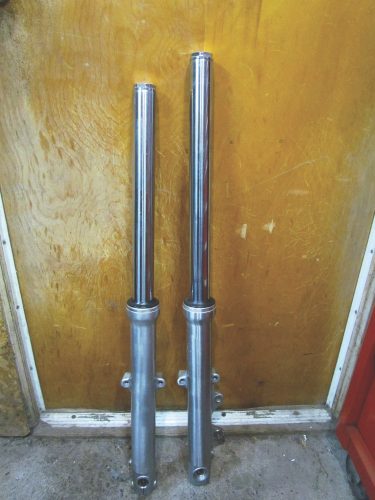 A friend of mine who builds custom bikes suggested a more affordable option: to have my original slider tubes shortened professionally, which would require that they be removed and sent to a machine shop to be cut, machined and threaded. But that sounded overly complex, and it would mean that my bike would have to be supported for several days without a front end while I waited for the job to be completed. And I would still have to buy shorter fork springs.
Somewhat surprisingly, it’s one of the simplest solution that came to me last. An online search produced two lowering kits for a Sportster fork, made by Progressive Suspension. The first I looked at, the Drop-In Fork Lowering System ($182), provided the simplest solution. As the name suggests, all you have to do is remove the fork caps, pull out the stock fork springs and drop in the new ones. The kit has two springs per fork leg; one provides the suspension duties, while the other is a very soft spring that compresses until it binds, taking up excess wheel travel and lowering ride height by up to 5 cm, according to the manufacturer. I didn’t take that route, because I wasn’t too keen on having 5 cm of free-ish wheel travel, and I wanted to service the fork, which the second kit allowed.
The Progressive Suspension fork lowering kit ($189) requires that you disassemble the fork, but this isn’t overly complicated, and it provides an opportunity to overhaul the front suspension. The only added cost, if all the seals and bushings are in good condition, is for a bottle of fork oil.
Older Sportsters have very common damping-rod forks. Taking them apart requires that you remove the forks from the triple clamps and remove the fork caps and fork springs. At that point, you can turn over the fork and drain the fork oil through the top. Since the slider tubes must be separated from the sliders, you must carefully lift off the dust seals to gain access to the fork seal lock ring; remove that, then remove the damping-rod bolt at the bottom of the fork. You can then pull the tube out of the slider with a hammering motion.
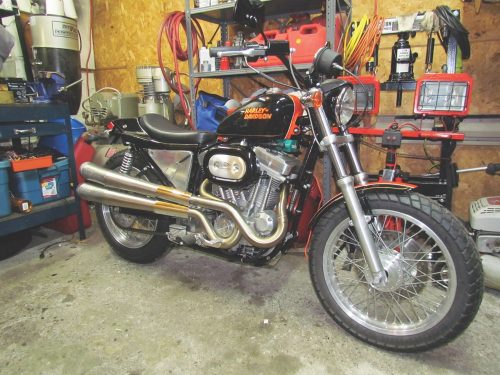 The way this kit works is that two top-out springs are provided for each fork, along with the main spring. Each top-out spring measures 25 mm, and you can use one or both, depending on how much you want to lower the front end. Adding a top-out spring to the existing one essentially pulls the slider tube deeper into the slider (the damper rod subsequently protrudes less), thus shortening overall fork length. Shorter main springs and spacers are provided to maintain the correct preload. Since I used both top-out springs to achieve the 50 mm height drop I was looking for, no spacers were needed.
There are several advantages to using this type of lowering kit. One, as mentioned, is that it gives you a chance to refresh your fork. Another is improved ride quality, since the new springs are progressively wound, but also because if you have a high-mileage bike and the sliders show some internal wear, the fork bushings will now ride in an area with less wear, thus reducing unwanted side play. The biggest disadvantage is that you will lose some wheel travel; on my bike, it went from 155 mm to 105 mm, which is still more than adequate for a street bike. Of course, the biggest advantage for me is that the bike now looks great.
Technical articles are written purely as reference only and your motorcycle may require different procedures. You should be mechanically inclined to carry out your own maintenance and we recommend you contact your mechanic prior to performing any type of work on your bike.
Clean with a Conscience.
This past March, I’m standing in our booth at the Halifax motorcycle show, preparing to welcome attendees as they wander down our aisle. However, before they reach me, the gentleman in the booth next to me intercepts the first of them and begins to demonstrate his cleaning products. The enthusiasm he displays is impressive, as is that of his partner in crime, and before long they have the attention of all in the area. It’s a good pitch and the product looks to be working as advertised. Then, just as it appears to be wrapping up, the gentleman demonstrating the cleaner turns it around and, to my disbelief, starts spraying it in his mouth! I see this unfold many, many times throughout the day and watch with concern for signs of wooziness. I even send a message back to Editor Glenn Roberts reporting what I’ve observed and that neither has dropped to the floor nor gone blind.
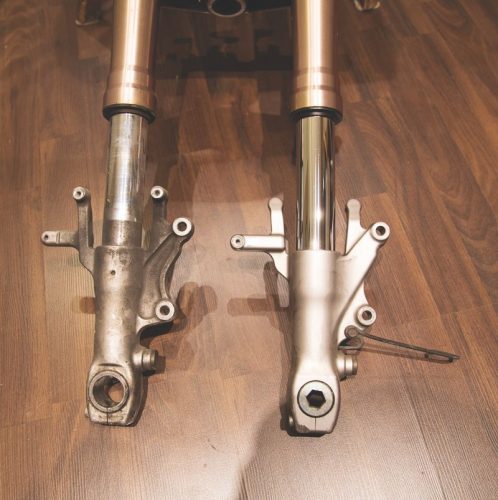 It turned out that there was no need for worry, as these were in fact “trained professionals.” Well, actually, they were the founders and creators of this company and its products: AMi (formerly AquaMedia Inc.). The products I had been observing in action were AMi’s Chrome Care and Screen Care (also marketed as Aqua Visor) line of cleaners.
My first real job around motorcycles was cleaning them, and that came about because the dealership didn’t have a job for me, so I just went out back and started washing bikes in my suit. After a couple of days, they hired me – probably out of pity – but by that point, my suit was ruined and the cleaners had already started to take a toll on my hands. I’ve washed a lot of bikes since then and have tried more cleaners than I can remember, not one of which was okay to swallow or spray in my eyes, I might add. So, you can see where the concern for my fellow exhibitors came from.
The base for these cleaners is an organic and all-natural calcium-based solution that is 100 per cent chemical-
free. In the case of the Chrome Cleaner, it’s simply applied liberally to a surface, then wiped off and buffed with a microfibre cloth. I’ve tried it on bikes, cars and all the household chrome I can find with great results, but the best part is that it leaves behind an almost chalky, though invisible film that prevents fingerprints from easily transferring onto the chrome – and the more you use it, the more resistant to fingerprints it gets. The same is true for the Screen Care product, which I’ve used on every TV screen, tablet and cellphone in my house since leaving Halifax, and I’m pleased to say that regardless of the substance our children smear onto said viewing surfaces, we’re able to wipe it away with ease. More importantly, it works just as well on my helmets, leaving a streak-free visor that is now easier to clean after each ride.
AMi is currently offering a range of cleaners, all of which are non-toxic, non-combustible, unscented, all organic
and natural. It’s even developed an oven/fireplace/barbecue cleaner that shares the same attributes; no small feat considering other products on the market that are meant to clean those items come with a long list of warnings to prevent things like fires, explosions and death.
With AMi’s products, if an infant got ahold of the bottle, you‘re biggest concern would be changing a diaper. These are the only cleaning products I’ve ever seen that do not have a single warning on the label – and did I mention, they’re all Canadian developed and made?
You can find out more about AMi cleaners, their availability and the proprietary technology behind them by visiting aquamediainc.com. We hope to see these products making their way into mainstream locations across the country soon, because cleaning organically, without chemicals, is important for everyone and every thing.
American motorcycle racer, Nicky Hayden has passed away at the age of 35 as a result of injuries suffered after he was struck by a vehicle while cycling in Italy late last week. Nicky was known as the “Kentucky Kid” and was famous for his flat track inspired riding style, his professionalism and perpetual positivity. His crowning achievement as a racer was winning the 2006 MotoGP championship in what remains one of the most entertaining seasons ever with Valentino Rossi and Hayden battling to the very end. He remains the last North American to win the title.
Fans of racing here in North America will recall Nicky and his brother’s Roger Lee and Tommy tearing up the AMA circuits, and of course their ever present parents and biggest supporters, Earl and Rose. Nicky also leaves behind sisters Kathleen and Jenny as well as his fiancée Jackie Marin.
Tommy Hayden issued the following statement after Nicky’s passing:
“On behalf of the whole Hayden family and Nicky’s fiancée Jackie I would like to thank everyone for their messages of support – it has been a great comfort to us all knowing that Nicky has touched so many people’s lives in such a positive way.
“Although this is obviously a sad time, we would like everyone to remember Nicky at his happiest – riding a motorcycle. He dreamed as a kid of being a pro rider and not only achieved that but also managed to reach the pinnacle of his chosen sport in becoming World Champion. We are all so proud of that.
“Apart from these ‘public’ memories, we will also have many great and happy memories of Nicky at home in Kentucky, in the heart of the family. We will all miss him terribly.”
“It is also important for us to thank all the hospital staff for their incredible support – they have been very kind. With the further support of the authorities in the coming days we hope to have Nicky home soon.”
Our thoughts go out to the Hayden’s, who are one of the truly great families in motorcycle racing – their loss is shared by so many.
Sometimes meeting new friends, pushing yourself on sketchy roads and learning a bit more about life can only happen on a solo ride
My wrist alarm was like an air horn in the silence of 4:30 a.m., but I wanted to see Great Sand Dunes National Park at sunrise, both for the colours and to avoid the heat. Unzipping my bivy sack, I noticed that although it had rained in the night, the clouds had moved on, leaving the sky a mass of brilliant stars. As indigo brightened to navy blue, I crossed shallow Medano Creek, which runs between the campground and the dunes. A strange movement caught my eye and I stopped to watch as small, regular waves advanced downstream – almost as if the creek had a pulse. I later discovered that, because of the sandy bottom, the running water builds up behind “antidunes,” which then collapse under the pressure of the water, only to again build and then break, build and break. In the spring, they can reach up to 30 cm high.
 On a dark dune, I waited in a biting cold wind. Still, this was preferable to midday, when the sand would reach temperatures of 60 C, and hikers would be warned not to wear sandals (much less go barefoot) for fear of scalding. At this early hour, I didn’t even have to worry about sweating. I was pleased as well that, because of the night rain, the sand was not being blown about by the wind. When daylight broke over the Sangre de Cristo Mountains, the massive drifts of sand were thrown into sharp and ever-changing relief – performance art, if ever I had seen it. I breakfasted at the local (and only) diner while the bivy, tarp and bike cover dried in the morning sun. After getting my park passport stamped at the visitor’s centre, I set my GPS for Echo Lake and Mount Evans.
Seeing the Big Picture
While a rider’s goal is to pack as lightly as possible, I always bring along paper maps for on-the-fly planning and to supplement the GPS. I love my Garmin Zumo 660; it certainly simplifies navigation, especially in the city. But I also like to watch my progress across a state or province, and a travel tip I discovered several years ago is the KOA Directory. The book is free at campgrounds (or you can order it online if you are willing to pay shipping) and it has individual state maps that are the perfect size for a tank bag window. I simply tear out the maps as needed and I can follow the bigger picture. Which is what I did now.
Looking ahead, I could see to the north that the wide open rangeland would soon be funnelled between the Sangre de Cristos and the Continental Divide. I followed good roads through Buena Vista to Leadville and over Freemont Pass (3,450 m), before taking a short run on I-70 through the Eisenhower Tunnel to Idaho Springs. There, I turned south on 103, which snakes its way up to Echo Lake. I had hoped to ride Highway 5, the highest paved road in America, to the peak of Mount Evans, but unusually harsh winter weather and heavy spring rains had washed an entire 60-metre section of the highway down the mountain. The route was closed to all but foot and bicycle traffic. Reconstruction would be completed next month.
Space Is Limited
 I was distracted from my disappoint-ment, however, when a thin, grey-haired man in a small pickup stopped at my campsite and asked if I would be willing to share, because the campground was completely full. Since I had only a bike and a bivy, I was happy to give another traveller the unused space. As we sat around the campfire sharing stories, he told how he used to own a BMW dealership in Reno, Nevada, before he had a stroke that left him temporarily blind, unable to speak and barely able to walk. He saw this as his wake-up call, sold the business and began bicycling to rehabilitate. Now, at 62, he was here to participate in the 22 km Bob Cook Memorial Hill Climb, an iconic bicycle race celebrating its 50th year. (So that’s why the campground was full.) It was an inspiring and cautionary tale – and, in my experience, the kind of connection one tends to find more often when travelling solo.
A Speck in the Big Scheme of Things
Following Hwy 40 the next morning, I climbed Berthoud Pass, one of the most notoriously difficult passes in Colorado for motorists, thanks to its height (3,446 m), as well as the steep grades and the large number of switchbacks. Being stuck behind a creeping transport truck gave me time to reflect: standing next to one of these rigs in a parking lot, you realize how big they are – the tires alone are higher than my waist. But on a ribbon of road etched into the massive Rocky Mountains, that Mack becomes a Matchbox. Letting your mind go, you realize not only is this big truck tiny, but the mountains themselves are mere creases on our globe – and our globe a mere dust speck in the galaxy. Surprisingly, this realization can have a nourishing effect on your frazzled soul. Like the truck, your problems begin to shrink. Everyday concerns appear fleeting among these towering peaks and ancient forests. Breathe deep. This is the stuff of which a rich life is made.
Make Every Breath Count
 In Rocky Mountain National Park, I met up with a lifelong friend who had moved to Colorado Springs several years before. Riding Trail Ridge Road, we stopped at the Alpine Visitor Center, and stood in silent awe at the high meadows that dropped steeply away and at the jagged rock spires beyond. I don’t know exactly when Julie Andrews began singing The Sound of Music in my head, but here I almost expected her to come dancing across the flowered tundra. We hiked the short Alpine Ridge Trail to an elevation of 3,660 m, and I wasn’t bothered at all by the lack of oxygen – until we tried to talk! We stopped for air and a July snowball fight, and suddenly looked up to see a herd of elk grazing right in front of us.
I had looked forward to riding up Old Fall River Road, which, until 1932, was the only motor route to cross the park. It remains a narrow gravel road with multiple tight switchbacks, steep slopes and no guardrails. I found the old route enjoyable, although it would have been improved by the absence of several cars moving so slowly that we were almost falling over. Also, the road led mostly through dense forest and offered nothing of the sweeping vistas of Trail Ridge Road. While exploring those breathtaking (in every sense) views, we enjoyed very close encounters with yellow-bellied marmots, bighorn sheep and, as mentioned, large herds of elk. We were just as pleased that night not to encounter the bear that we were warned had been breaking car windows in our campground.
A True Wild West Town
The next morning, we broke camp and aimed our wheels south. Not wanting to come any closer to Denver than to hum a few of his greatest hits, we took Hwy 7 south from Estes Park to Nederland, then continued on 119 toward Golden. We skirted the city and skipped west to 67, a tar-and-chip country road that led us to Cripple Creek. Riding into town, we encountered first one burro, then another, and then another, strolling about freely. Two local girls feeding one a carrot explained that the burros are wild but wander into town for treats, adding that once a year, donkey races are held on Main Street. Established for its gold mines, Cripple Creek was once a true Wild West town, complete with saloons, casinos and shady ladies. The most obvious remnant is the casinos, and we stopped for lunch at one called Maggie’s. (I recommend it!) I wanted to work on my off-roading skills, so after a fine meal, I bid my friend farewell and set off on Phantom Canyon Road past a modern gold-mining operation south of town.
Unplanned Detour
I selected this route, as it was the easier of two unimproved roads I could take to Cañon City. Eight kilometres in, however, I came to an unwelcome sign: “Road Closed.” No doubt the same heavy rains that had closed Mount Evans damaged this road. With some apprehension, I returned to Cripple Creek, took a deep breath, then set out on Shelf Road, which began at the road sign reading “4x4s and High Clearance Vehicles Only – Impassable When Wet.” It was a one-lane rutted road that was literally a shelf along a canyon wall for about 20 km. I’m pleased to say that by taking my time, I learned a little more about feathering the clutch in loose gravel and standing up on the pegs to to negotiate rough terrain – all without incident.
An Electrifying Ride to the Peak
In Colorado Springs the following morning, I was up before dawn. I wanted to summit Pikes Peak and be down again before noon. High-elevation electrical storms often form in the afternoon hours, and this year had been particularly “conductive,” with several lightning fatalities in and around The Peak. At 4,300 m, Pikes Peak ranks 31st among Colorado’s 54 “fourteeners” (peaks higher than 14,000 ft.). The road to the summit is so steep that riders are advised to have at least a half tank of gas before making the ascent; while it is only 61 km, you will consume more than twice the usual amount of fuel. The twisting road was paved and in excellent condition, but the wind made me extra cautious of the tarmac’s edge. And knowing the axiom that you will ride where you look, I resisted the urge to gaze out at the spectacular views. I did, however, stop at several pull-offs to absorb the panorama and the serpentine road coming up the mountain below me. As I wound my way along the mountainside, I realized that racers in the annual Pikes Peak International Hill Climb are a different breed. The road has a series of switchbacks, called “the Ws,” for their shape on the side of the mountain.
The Ws can be treacherous at high speed, and one minor miscalculation would be your last. Indeed, the previous month, Carl Sorensen, a seasoned motorcycle racer from Colorado, plunged to his death while practising for The Climb. At the summit, I watched as the world’s highest cog rail train pulled up to the platform. While it was a calm, warm morning in the Springs 2,400 m below, at the peak, the temperature dropped to 4 C with powerful winds. Unprepared visitors in shorts and T-shirts stepped out of the train and quickly began to hold themselves, looking a little blue around the lips as they made a dash to clog the aisles of the gift shop. Photo Op Wanting to get some photos of the many motorcycles riding the mountain, on my descent I followed a father-daughter duo, snapping photos on the fly. She was wearing a helmet painted in the Stars and Stripes – a particularly appropriate lid for touring “America’s Mountain.” Perhaps I was tailing a little too closely, because, about halfway down, they pulled over to let me pass. I stopped too, however, and after meeting them, told them I had pictures of them cruising Pikes Peak. They eagerly scribbled their email on a scrap of paper so I could send them their photos when I got home.
Suzuki returns as a major player in the litre bike battles
The mid-range power delivery on the GSX-R1000R feels almost docile, until I look down at the speedo just before braking for Phillip Island’s Turn 1 and see 290 km/h. In the interest of self-preservation, I do so only once though, and speeds increase in later lapping sessions. As I lap the famed Australian circuit, I glance occasionally in the mirrors, which offer mostly a view of an empty racetrack behind. On this lap, however, I glimpse a bike catching up to me, the only bike to do so thus far. As the rider pulls alongside and passes me, I recognize the red, white and blue helmet livery of Kevin Schwantz. The former world champion has been invited to share the track with us during the world launch of the 2017 Suzuki GSX-R1000.
Breaking a Sweat
 Schwantz graciously slows ahead of me and allows me to follow for three awe-inspiring laps, showing me a slightly different way around a few of the corners, and helping me pick up the pace. As I bust a sweat trying to keep up, he looks as if he’s on a cool-down lap, moving in slow motion and barely hanging off his bike. His unmistakable talent is evident as he lets the bike squirm around on the edge of traction while he gets on the gas hard exiting corners. After about three laps, he simply picks up the pace again and chases down another rider.
The GSX-R1000 has always been user-friendly, at least by open-class supersport standards, and although it has been completely redesigned for this year, that hasn’t changed, despite a relatively large jump in performance. The last major update came to Suzuki’s flagship sport bike in 2009, and for the first time since its introduction in 2001, there are now two models to choose from: the GSX-R1000 and the higher-spec 1000R we’re here in Australia to ride.
While its competitors have all inched their way up to the 200 hp threshold, until this year, the GSX-R1000 had to make do with a paltry 182 hp. The bike now claims 199 hp and, like its rivals, now has traction control to help keep the wheels in line. This new GSX-R also comes with ABS, which was actually introduced on last year’s model, but the system has significant improvements for 2017.
Pure Genius
The new 999 cc inline four has a 1.5 mm larger bore and a 2.2 mm shorter stroke, which allows it to rev an additional 1,000 revs, reaching 14,500 rpm. Suzuki has borrowed some high-speed trickery from its MotoGP program, such as variable valve timing. The intake cam sprocket has a mechanism that lets it advance up to eight degrees, enabling the engine to produce about the same amount of peak torque as before (up to 86.7 ft-lb, from 86) despite the shorter stroke, while maximizing output at high rpm. The system is very simple and requires no electronics or hydraulics, but rather relies on centrifugal force, using a series of rollers that ride in channels in the cam sprocket, thus turning it and offsetting the cam timing. A diaphragm spring returns the sprocket to its original position at lower revs. To deal with the increased revs, the valves now have finger followers instead of heavier bucket-type shims, and the exhaust valves are now titanium.
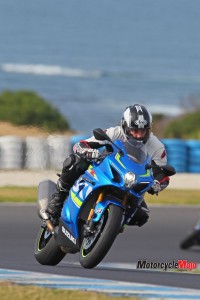 The engine is 6.6 mm narrower and 22 mm shorter, which allows for the use of a 40 mm-longer swingarm while increasing the wheelbase by only 15 mm. This gives the bike a more forward weight bias, improving traction when exiting corners. The gearbox is now a cassette type, so it can be serviced without splitting the cases. The bike also gets a mechanically assisted slipper clutch, which lightens lever effort and reduces wheel hop when braking hard.
Since the GSX-R was already a stellar handler, chassis geometry has been altered only slightly. Aside from the longer wheelbase, rake angle is almost identical at 23 degrees (the variation is in fractions of a degree), and trail is reduced by 3 mm to 95 mm. The GSX-R1000 has also lost three kilos, now weighing 202 kg, while the 1000R weighs 203 kg, due to different suspension components and added electronics. Both machines share engines, frames and brakes, but the R gets upgraded Balance Free Showa suspension (easily identifiable by the piggyback reservoirs on the forks), a lighter top triple-clamp, a quick shifter that works on up- and downshifts, launch control, a lighter battery and LED position lights in the fairing that run along the tops of the air intakes. Brembo provides front discs that are 10 mm larger at 320 mm, as well as monobloc calipers. ABS is now lean sensing and rear-wheel-lift mitigating, though it is neither adjustable nor switchable.
Aggression
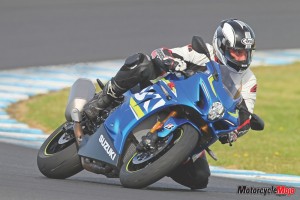 There are three ride modes (A, B and C), each getting progressively milder, though since the track was dry and fast, I used the most aggressive, A mode, exclusively. The traction control has eight levels, with the lower numbers providing less intervention, and it can be turned off; I started in level 5 and settled on 3.
Hopping onto the GSX-R1000R, I felt an immediate familiarity with the machine, maybe partly because the riding position is identical to the previous bike, save for a lower fuel tank. The bike is narrower between the knees (the frame is 20 mm narrower at the spars) and feels smaller than before. An all-new instrument panel is entirely digital, and it displays engine speed, road speed, gear position, fuel level, TC level, time, ambient and coolant temperatures, fuel consumption and two trip meters. The standard model’s gauge has a grey background, while the R’s is black, which also displays launch control and quick-shift info.
We rode the first three of five 20-minute track sessions on the OEM Bridgestone RS10 tires, then switched to race-compound R10s. The suspension was adjusted to the factory settings for the first session, which immediately proved too soft for me (220 lb. fully geared). When cranked over at high speed, the bike wallowed around, though it didn’t startle, and still provided great feedback. The front end also front end also chattered while braking into the Turn 10 hairpin.
Settling In
Compression and rebound damping settings were firmed up for later sessions, and I immediately noticed a reduction in the wallowing and wheel chatter. Speeds were limited in the first three sessions by the OEM tires, which returned some spectacular mid-turn slides at full tilt. Switching to the sticky tires and firming up the suspension further settled the bike down, thus raising my comfort level and my speed. Turns 3 and 8 are incredibly fast, taken at more than 210 km/h, yet the 1000R railed through them with confidence-inspiring stability, only occasionally squirming a bit on the edge of traction. Of particular note is just how forgiving the 1000R was through the fastest sections, providing excellent feedback, while allowing for effortless corrections if I trail-braked into the slower turns too aggressively. In level 3, the traction control allowed for some wheel spin, which was both felt and witnessed by the increasing amount of black stripes at the exit of every corner. However, it operated seamlessly, never giving a hint that it was managing grip. Power delivery in A mode is exceptionally smooth, and I found myself opening the throttle fully very early at corner exit.
Interestingly, in the later sessions, our hosts gave us the option of disabling the ABS by removing the fuse (it can’t be turned off otherwise), though I chose to leave it on; I figured if a high-performance supersport machine was designed with non-switchable ABS, I wanted to test it at its limit. This decision on Suzuki’s part led me to believe that maybe the system was not up to par with the race ABS systems on other open-class supersport bikes, but my suspicion was unfounded – it worked flawlessly at the limit, and beyond. The ABS was completely invisible, and only on a couple of occasions while braking exceptionally hard going into Turn 10 did it trip, and even then only with minimal intervention, allowing me to maintain my line.
Clutch Optional
A big plus for the new 1000R is the addition of a quick shifter, which works up and down the gearbox. It provided full-throttle upshifts with no throttle lag whatsoever, and let me hammer down two clutchless gear changes into second, coming out of Lukey Heights and into Turn 10, without missing a beat. Combined with the slipper clutch, the quick shifter is surely worth several tenths of a second when lapping.
Since the GSX-R1000’s last major upgrade, most of its Japanese competitors have been fitted with traction control and race ABS, and they now produce about 200 hp. In that time we’ve also seen the German introduction into the supersport class with the BMW S1000RR, which has proven to be a class leader, and whose design, incidentally, was inspired by the 2005 GSX-R1000. As for the CBR1000RR, it too gets a substantial update and equally substantial boost in performance with advanced electronics for 2017, though I haven’t yet had the chance to ride it.
The previous-generation GSX-R1000 was easy to ride, and Suzuki has now raised its level of performance to at least be on par with the competition, all the while maintaining its easygoing nature. There’s no wheelie control (though the traction control does provide some intervention), and even though the ABS is not as elaborate as the competition’s, I couldn’t find fault with it.
Pay to Play
Not surprisingly, this added performance and complexity comes at a cost, and the 2017 GSX-R1000 now retails for $18,399, an increase of $3,400 over the previous model; the 1000R retails for $21,899. If you jumped at that increase, note that the new CBR1000RR and Yamaha R1 start at $19,999 (the SP and R1M cost $23,999 and $24,999, respectively), while the BMW S1000RR and Kawasaki ZX-10R ABS both undercut the Suzuki by just $200. So, aside from being user-friendly, it’s also relatively affordable.
As to how it performs against its competitors, only a shootout will tell. But I suspect that just as when I was tailing Schwantz, they’re probably busting a sweat right now.
After two and a half years riding many parts of the world, this traveler lost her heart to Alaska
Skirting northeasterly around Denali National Park, I was hit with countless chevrons of snow-capped mountains and gigantic glaciers that did anything but disappoint – my hunger for wild lands was going to be well nourished here. I’m a wilderness seeker in lifelong pursuit of natural beauty; although nowhere on my moto radar did I expect my heart to be stolen at first sight by Alaska.
 The beginning of the end of our two-and-a-half-year road trip started with the Fishhook Fatties: a gregarious biking group from south-central Alaska whose ethos is assuredly “work hard, play hard,” at least during the summer months where daylight hours are in high demand. They also love big adventure bikes – the women riders being no exception – and all prefer dirt to pavement, ourselves (my partner, Jason, and me) included. That said, I remember screaming the maracas off my F650GS just to keep up with them from Wasilla to Dawson City, Yukon, and back to Fairbanks.
With the full-throttle eagerness of two Alaskan road-trip newbies, Jason and I jumped straight onto the George Parks Highway from the Fishhook Fatties’ base located on the northern point of Cook Inlet in the Matanuska-Susitna Valley. As day ones go on any impromptu motor-
cycle journey, my expectations comprised no more than finding my stride and settling into the saddle. Little did I know what lay in store: an Alaskan’s Alaska astride two wheels.
Out of the captivity that can be felt in cities – Alaska’s second-largest city being no exception – we all but raced out of town, northwest up the Elliott Highway. Our starting point for the 240 km munch to Manley Hot Springs via an old gold-rush route that gave us views of the vast Minto Flats and, on rare occasion, North America’s highest peak, Mount Denali,
at 6,200 metres; otherwise known as “
the Great One,” 320 km to the south.
Size Matters

Having fallen out of favour with Lady Luck, the rain drizzled relentlessly the entire way to Manley Hot Springs. We trudged our way through the calcium chloride sludge with some artful slides thrown in for good measure – it’s like riding on snot over marbles. I was on high alert, with backside muscles poised for a long cardio workout and my lips set to pursed.
What was I expecting on Pearl, my hefty F650GS, laden at 240 kg with luggage? I scrabbled, lost control and groused watching my wheels flinging manes of spray everywhere; I should’ve long ago embraced “less is more” on a bike ride from Argentina, where size matters off-road.
Having located a drier section, I shelved the dampened spirits for a sunny interval and went for it with a handful of throttle – I admit, I was amped. Failing to realize when we’d reunited with the viscous malevolence, I scared myself silly at 100 km/h as I squirmed in a mire mid-corner. “What the *@&?!” I cussed, careening horribly toward a ditch – my brain unable to gauge the speed. Language disappeared, and for a split second I prayed in a soft high-pitched lament any human listener would’ve termed a yelp. “Oh my God, I forgot who I was!” eventually emerged, exhilarated as much as frightened. That’s the problem with Lady Luck: she can turn her back at any hairy moment.
Those paired to my intercom roared in recognition of the self-induced blunder. It gave me a lift somehow. It’s mysterious how comfort arrives; the guys riding with us had calmed my shaken spirit. That’s the Fishhook Fatties for you: full of enormous energy that pops up to inject hilarity every mile of the way.
 Kicking the side stands down and now caked in mud, we observed a charming Post-It Note-sized village on the banks of the Tanana River. Just outside of Manley Roadhouse, a fine-eating establishment and roofed accommodation, we pegged the Dome Sweet Dome on a public campground (near the bridge over Manley Slough) to a regiment of twin-engine skeeters rushing to meet and greet us at full tempo. Having ditched the motorcycle gear, our newly exposed skin must have looked ripe for the feasting. With a smooth Alaskan IPA in hand, we jumped straight into the spring-fed baths, keeping the winged assailants at bay and our muscles set to soaking.
Camaraderie
The next dawn brought a win in the road surface lottery and a pleasant morning accompanied by lovely swaths of afternoon where we rode on dry satin all the way back to Fairbanks. Around 320 paved kilometres on the connecting Richardson Highway deposited us in a sea of bikers, courtesy of Thompson’s Eagle’s Claw Motorcycle Campground in Tok. It’s a popular choice for riders of any discipline. While the place is a forest of intimate snuggeries, the day rapidly becomes an amphitheatre of motorcycle noise filled with the unmistakable camaraderie that springs from the fellowship of the road. Sated on a mean Alaskan breakfast of reindeer sausage at Fast Eddy’s the following morning, and with no snot on marbles in sight, Mother Nature afforded us optimal conditions in which to wend our way out of Tok to Tetlin Junction, an easy 160 km on the Taylor Highway to the start of the Top of the World Highway.
Magnificently, riding in such a direction will bestow a further 300 km of beautifully paved and sometimes loose gravelly road connecting Tok with Dawson in the Yukon. Dust 2 Dawson If you haven’t heard about Dust 2 Dawson (D2D), you’re in for a treat. Just trace a line on the map to Dawson, hop on your moto in June and start riding. If you can, try not to rush at getting there, for a ride both rewarding and nurturing is likely to appear. Rock up to Dawson, but just don’t call it a rally. Despite such a disclaimer, you’ll be in the thick of an atmosphere abuzz with the boundless joy and warmth that is D2D. The backstory starts with three unassuming fellows: John (Cash) Register, Jim Coleman and Mike (Fighter) Stein. Dating back to 1992, D2D was loosely concocted over a few pints in Dawson’s Midnight Sun, a hotel bar where the trio first met. As Fighter recounts, an 800 km road trip between the amigos up the Dempster Highway to Inuvik was set in motion, during which Coleman and Cash deviated to Eagle, Alaska. Awed by the place, a pact was made that when one of them passed away, the other would return to the North Country with the ashes of the departed. Devastatingly, when Coleman was hit on his R1200GS by a Suburban in 1994, Cash re-enacted their road trip a year later. Kilometre for kilometre, he dismounted his bike at the same pit stops, refuelled at the same cafés and drank another cold one at the Midnight Sun, all the while carrying Coleman in the tank bag.
The dusty route to Dawson gained momentum annually, magnetizing many to pay their respects, come together and celebrate. Hosted by “Dawson Dick” and his wife, the 400-strong motorcycle event we attended in 2016 comprised three days of biker festivities, local charity fundraising and on-the-fly poker playing. After perhaps the liveliest non-rallies I’ve experienced, the return road to Tok beat backward under us. Peeling away from the Fishhook Fatties, I arose the next day muddy-eyed, having burnt the candle down to a nub. Wending out of Tok, Jason and I rode into a peevish wind toward the Dalton Highway. The last leg north until we run out of road. Lady Luck I’d somehow curried favour with Lady Luck again, as an uncharacteristically dry Dalton guided us for a glorious 400 km as we soared along on the dirt from Fairbanks, up the Dalton Highway to Wiseman, just 20 km from Coldfoot (the last place to gas up), and the halfway point to Prudhoe Bay. Sunrays gleamed down from the sky, and inevitably the landscape took on a raw, peculiar beauty: a bleak and unadorned Wuthering Heights quality. The only feature vying for our attention was the pipeline that followed us all the way from Fairbanks to the top.
That, and Atigun Pass across the Brooks Range – where the Dalton crosses the Continental Divide – which holds a strong resemblance to the iconic peaks found in Patagonia, Scotland or New Zealand. Take your pick – it’s impressive. Jason did let it slip, though, that he was starting to feel cheated by northern Alaska’s bluebird skies and optimal riding conditions, which are usually pretty unstable. “Really?” my eyes rolling to the top of my head. We carried on watching out for Dall’s sheep grazing on the upper slope, a herd of caribou crossing our path and bald eagles overhead. What a treat to see a family of muskox to boot, standing unperturbed in the grasses. It’s true what they say: Alaska has two seasons – winter and construction. Inching closer toward Prudhoe Bay treated me to a white-knuckle ride on a loose section of road under construction. If I got to cruise beneath warm sunny skies to this point, I’ve at least got to earn my spurs on the last smidgeon of it.
A stratagem came to me, like a god thundering in my head: just keep riding. I’ve surmised that after logging more than 76,500 km, my journey on Pearl was set to continue as a great enterprise of balance. Feeling good, we fly; feeling otherwise, we nosedive – oftentimes rather bluntly. Hurray! We’d Made It. Damn I Felt Good! Where there’s pinnacle pleasure, there’s Prudhoe Bay. There was a lot of time up here but not much to spend it on. Just like the road to get there, the memories of Alaska will calcify, and you won’t experience it without feeling you’ve blossomed many friendships, forged some intoxicating new ones and deposited heavily in the good times bank. For me, that’s riding with the Fishhook Fatties. Summer days I’ll remember as cloudless, the air gold and pumped with the excitement. An undeniable sense that making it this far, which had touched the vanishing point, mattered little. It was just part of the pathway astride two wheels to something else, a blissful elation. If “ecstasy” means the delicious intrusion of the wonderful into the ordinary, then it had just happened to me.
Extreme scenery and challenging riding make this competition a must for any experienced trail rider
When I was younger I would daydream about the Dakar Rally. I would rush home from school and watch the Dakar or any other motorcycle movie I could get my hands on at the time, with my parents and dream that one day I’d be doing this type of disciplined riding. In Grade 6, I even wrote my speech on the history and evolution of the Dakar. That was the only time I had gotten the best mark in my grade for public speaking. Not surprisingly, as the years went on and reality set in, I realized this would not be an easy venture to tackle.
But the Dakar isn’t the only serious challenge. Throughout the years, we’ve seen many extreme trials come about: from the Baja 1000 to the Orange Crush Rally, Romaniacs and the Erzberg Rodeo in Austria. While mostly suitable for professional riders, some of these challenges are offered to experienced enthusiasts to test their abilities and have a glimpse of what some more serious challenges may look like. The BMW GS Challenge is one of the only challenges where recreational riders can test their riding and navigational skills in a two-day event. The winners then move on to a world competition.
Humble Beginnings
 Another challenge for the everyday rider is the Horizons Unlimited Mountain Madness (HUMM), which had its North American debut during the summer of 2016 and is geared toward the regular motorcyclist wanting to challenge his or her navigational and riding skills. Originating in the Spanish Pyrenees in 2007, this event has been running ever since in various parts of the world. The challenge features different classifications for riders based on single- and multi-cylinder engines, and GPS or map and compass categories.
Some may be familiar with the organization known as Horizons Unlimited (HU), an international hub for motorcycle world travellers and enthusiasts. With gatherings in various countries throughout the year, its goal is to bring people together and share the potent desire that urges us to throw a leg over a bike and ride. Canadians Susan and Grant Johnson started HU in a roundabout way. Leaving home in 1987 on a BMW R80 G/S, they spent the next 11 years travelling around the world by motorcycle, and once the Internet took off, they began sending emails back and forth to their loved ones. They then discovered that a website could be created and their stories could be accessed and read by anyone using the Internet. In doing so, they inadvertently set up the base for the extensive community that now has followers from more than 150 countries. Since the website’s founding in December 1997, HU has grown into a main hub for many thousands of motorcycle travellers around the world to become inspired, ask questions and give advice.
HUMM’s North American Debut
The first North American HUMM challenge took place in the heart of the B.C. Rockies. Based out of Panorama Resort near Invermere, this two-day challenge saw riders gathered in teams of two to four riders, ready to test their wits, teamwork and skills. HU worked closely with Wanduro, a group of riders focused on minimalist off-road exploration, to set up tags and map the routes for the HUMM Rockies.
As soon as I heard of this event, I decided to give it a go and see how it worked. I had been on the lookout for a partner for quite some time, when one day at work I was sharing this story with my boss, Daniel, about how I wanted to enter this challenge but couldn’t find anyone to ride with. He immediately said, with great enthusiasm in his quirky Australian accent, “Oh, Em, I’d love to ride with you!” Although at the time I wasn’t formally inviting him, I was happy to have him as a riding partner. I would be riding a KTM 500 EXC and Daniel would be on his KTM 350 EXC.
Plan Your Strategy
 We arrived at the HUMM challenge, set up camp and registered for the single-cylinder map class. As we awoke the next morning, we could feel the energy among the riders as they prepared to start their first day and plan their routes. The seconds counted down to when the riders could receive their maps and waypoint descriptions so they could get on the road. Once we received our maps and began planning our route, it became immediately apparent that my and Daniel’s map and compass skills might have not been the most up to date. “Although they can’t be worse than everyone else’s, right?” we thought. During the ride, we had to gather tags at waypoint locations that were determined by the level of rider skill, ranging in complexity from 1 to 5 (with 1 the easiest, 5 the hardest).
We decided to head out for some 2s, 3s and 4s and see how we faired. Daniel and I quickly planned out a route for the day and thought it’d be best if we just hit the road and see what came naturally. As the flood of riders dispersed through different routes, we found ourselves alone, navigating through forestry roads and old 4×4 trails to find our tags. Some waypoints were obvious and easy to get along the way; others required a hike and turning over rocks or searching old cabins to find a tag.
 As we made our way back to base, we attempted to get one last tag before the end of day. Riding up a beaten track with switchbacks, we made our way to the top of a mountain where the trees opened upon a vast view of peaks for as far as we could see. It was hard not to stop and take a moment to realize what we were really accomplishing, but about five minutes later, we remembered that there was a deadline that we had to be back for, or else our points would mean nothing.
We made it back just as the deadline hit – and may have even lost a few points for our tardiness. Feeling a mix of mild disappointment and bliss from a great day of off-road riding and from the number of tags we had actually picked up compared with what we had planned, we drank beer and enjoyed hearing the stories of the day from other riders. At the end of the first day, Grant posted the standings, and to our surprise, Daniel and I had actually come in first in our category!
The Mysterious Waypoint
Throughout the first day and the introduction dinner from the night before, we kept hearing whispers of the incredible tag number 222. This was the hardest one to get to, and Daniel and I decided we would make this tag our goal for the second day. We heard it was slightly treacherous at times and was a little hard to find. With tag 222 in our sights, we had made our way into the middle of the wilderness, knowing that we were at least going in the right direction. We had stopped at a fork in the road to check our map when a group of four riders rode past with a sense of certainty – common sense would of course dictate that just because they looked as though they knew where they were going, it doesn’t mean they actually did. Daniel and I both fell for their confidence, however, and decided to follow. We soon found ourselves in the middle of a 1.25-metre-deep river crossing, only to get to the other side and realize that it led absolutely nowhere. The worst part was having to go back across once it was rutted out from our first crossing. Once we were back, we decided to take the higher route, based on the probability of less wetness.
We wound our way up the barren mountainside on what looked to be a hiking trail, and found ourselves riding through rock fields and rivers. As I struggled to get the 500 through the largest rock field, we passed a KTM 1190 Adventure, the rider looking calm and collected, as if he had methodically planned out the route and every aspect of it. The old-growth trees eventually faded to alpine elevations and we spotted a lake at the base of a large bowl; the water was crisp and untouched, and held a pristine blue clarity. We somehow knew this was the place.
A Zen State of Mind
Once we arrived, an overwhelming sense of serenity and joy came over us. We had made it. This mystical, wild place allowed us to be engulfed in its absolute beauty. As we sat and took in the sun and crisp breeze this place offered, the rider with the 1190 that we had passed earlier rode up. We congratulated each other, shared the experience and soon found out that this cool and methodical rider was actually just very hungover and had struggled the whole way in.
It soon sunk in that we weren’t actually at the waypoint yet, as it was halfway up the basin wall, accessed by a goat trail covered with shale and snow. I volunteered to go and retrieve it for everyone, given it wouldn’t be easy to get more than one bike up at a time. I climbed through boulders and over shale, and had to stop when I came up to a large section of snow. I walked across and got the waypoint, but I had to stop again – this time to take in the immensity of this mountain that we had made our way onto. I looked down upon my friends, who were now ant-size at the bottom of the bowl. Unfortunately under a time frame, moments like this don’t last a long time, so I walked back to my bike and started making my way down.
Tag 222 Captured
I was a quarter of the way down when I hit a rock that deflected my front wheel off the goat trail; now pointing down, I was facing the very steep shale slope beside me. Knowing that I wasn’t strong enough to pick up the bike and continue on the trail, I figured the path of least resistance would be my new route, and thanks to my vast amount of mountain bike experience, I realized this was my best option. I came down bouncing off boulders and bashing through bushes, but I finally made it back to the group and carrying a new appreciation of my riding ability.
Making our way back to the main logging road, we still had a few hours to retrieve some more tags before the event ended. We ended up riding almost every logging road offered to us. We handed in our waypoints and waited patiently for the final tally to see how we had done overall. Among the awards for most waypoints in each category, there were also awards for the oldest motorcycle ridden in the event, most breakdowns (one rider performed a full top-end rebuild on the roadside) for double-up riders; an award was also handed out to the first all-girls team to attend the challenge. Daniel and I ended up getting third place for our category. Although this was fantastic, the experience itself was more than enough reward.
A Well-Run Event
Overall, this event was absolutely incredible and well organized, as most HU events I’ve attended have been. A large variety of rider groups and skill levels had participated. We saw everything from XT250s from the ’80s to brand-new 1190 Adventures and even a Moto Guzzi Stelvio. Some riders were competitive, while others were there just for the experience.
Panorama Resort offered options for accommodations and great meals throughout the stay. I urge any rider to partake in this event based purely on the captivating experience you’ll receive and incredible people you’ll meet. HU even offers a day of off-road skills training through Touratech beforehand to familiarize yourself with techniques and tricks for riding dirt; this is great for those who may be hesitant about the terrain.
This year’s HUMM will take place in the Canadian Monashees near Nakusp, B.C., from July 28 to 30, and you can register at horizonsunlimited.com/
There are many obstacles on the road for a motorcyclist – some are more predictable than others
When I first started riding a few years back, I made a conscious effort to be aware of the other drivers on the road. We see them all the time – texting or talking on the phone, twisting and turning to check on their kids, turning without signalling – you know the ones I’m talking about. To this day, my eyes are constantly scanning for those with little regard for their own safety or the safety of others.
 The other danger on our roads is, of course, those that aren’t even aware that they’re an obstacle. These are our furry friends, either domestic or wild, that we share our roads with every day. Last summer, I had the misfortune of watching my good friend and riding partner collide with a moose while riding right in front of me. I’m hoping this story will remind you all of the dangers of the road. Here’s our story.
Midlife Crisis Observed
A few years ago, the age of 50 was creeping up on me. As a lot of you know, this special number makes you reflect on your life and what you’ve done with it. One rainy Saturday evening, I was sitting with my family and watching a movie called Wild Hogs. During the movie, I yelled out, “That’s it! I’m going to get my motorcycle licence!”
First thing that Monday morning I was in our local government agent’s office picking up the materials to obtain my motorcycle licence. While I had ridden a dirtbike as a kid, I had not ridden for a number of years, but the excitement brewing inside me was overwhelming.
 Within a few short weeks, I had purchased a brand new Honda Shadow from the local dealership and had contacted an old friend back from my 20s and asked him to be my mentor. I knew Darren very well and he had more than 30 years of riding experience, so I felt confident that I was in good hands. After several rides with Darren and with my motorcycle safety course under my belt, I was ready. After passing my road test, I really felt like a kid again as I rode my new machine up and down the streets of our small town.
Another Change in the Works
I rode the same streets for a number of years, but then longed for something more: more excitement – more adventure. A friend of mine told me about her BMW adventure bike, and the research began for my new ride. I eventually found my new companion in a used BMW F650GS that fit me well (I am somewhat vertically challenged). Shortly thereafter, my wife and I were having dinner with friends and I just had to tell them about my recent purchase. Across the table I could see my friend, Andrew, and his eyes went wild with excitement. “You bought an adventure bike!” he screamed. “Indeed I did,” I quickly replied, as I was only too happy to provide more details. Andrew told me then that he too had been considering a similar purchase, as he wanted to travel by motorcycle to the Yukon and Alaska. With that, our brains were churning with dreams of making this trip a reality.
 Andrew bought a brand new F800GS, and over the next few months, we ventured out on many local back roads with new-found friends from our Facebook Adventure Bike Group (NWBC Adventure Bike Group). We learned a lot from these experienced riders, as many of them had been riding for years.
Long-Awaited Ride North
On Canada Day last year, Andrew rode his bike to my house, where I was packed and ready to go. Our bikes were gleaming and packed with all kinds of gear that we likely didn’t even need. Having kissed our wives goodbye, we jumped on our bikes and started on what was supposed to be the trip of a lifetime. Day one was fun and and exciting, but uneventful in the sense that nothing happened. We were two guys at the age of 50 (and then some) heading out on the open road leaving behind all sorts of responsibilities. I can still feel the exhilaration I felt that day. We rode about 500 km and were lucky to find a great little motel with good parking for the bikes and a restaurant on site.
No need to dig into that freeze-dried food just yet. We met a couple who was staying at the same motel. They were riding shiny Harleys – we traded compliments on each other’s bikes and our new friendship grew from there. We were heading in the same direction, so we decided to ride together in the morning for the first leg of our trip. The next day was chilly in the morning, but not so cold that we needed our heated gear. At about 10 a.m., the sun began breaking through and we started to see the world come alive as the sun shone on the Stewart-Cassiar Highway (Hwy 37). My heart pounded as I rode past a bobcat on the side of the road that glared at me. “Nice kitty,” I said as I roared past. We stopped at the Dease Lake gas bar to refuel the bikes and ourselves. We had hoped to get to Watson Lake by the end of the day and we were well ahead of schedule.
Collision Course
Just before noon, we were about 50 km north of Dease Lake. We were riding in formation, with Andrew in the lead and our two new Harley friends directly behind me. As I came over a hill, I was enamoured with the beautiful scenery, and to add to my excitement, a moose was coming out of the ditch right in front of us! I watched in slow motion as the moose ran alongside Andrew, but I couldn’t tell whether he could see it in his peripheral vision. Mere milliseconds later, my buddy saw the moose and tried to avoid the collision, but it was too late – they collided. It all happened so fast – there was really nothing he could have done to avoid the crash. The bike and Andrew slid along the asphalt and the moose had collapsed onto her knees as I approached. As I got off my bike, the moose and I shared a moment, and I will never forget the look she gave me.
We were merely a few metres apart and her eyes were dark with fear – as were mine, I’m sure. I know that she was just as terrified as I was at that moment. She then stood up and ran into the ditch on the other side of the road. Andrew was unconscious but he was alive. Our two friends were on the scene right away. They both had industrial first-aid training, and without them, I shudder to think of how the next few minutes would have played out. I was in a state of shock as I frantically dialled 911 on our satellite phone to no avail; the sat phone had good reception, but unbeknownst to us at the time, 911 was not available in this part of the world. Help Arrives in Many Forms To say that the stars were aligned that day would be an understatement. Within a half-hour, several people had stopped to assist. One rider heading south told us he would stop in Dease Lake and notify the ambulance. A woman with her daughter helped direct traffic around the crash and assisted our friends in making Andrew comfortable.
A medic travelling from the U.S. stopped and took control, running Andrew through some tests, checking for broken bones and determining he had a very serious concussion. Over and over Andrew was heard saying, “Where’s my bike?” and “Is our trip over, Johno?” I’m sure that I had heard these phrases at least 40 times within the hour that we were sitting on the ground together. We knew that we were blessed when he was sitting up and making jokes with the crowd that had gathered now around him. As they rolled him into the back of the ambulance, Andrew gave me the thumbs-up, trying to reassure me that everything would be okay. I wasn’t convinced. I packed up my bike and followed the ambulance back to Dease Lake while the others stayed and waited for a tow truck to come and pick up the bike. The ride to the hospital was likely the most terrifying ride of my life.
I couldn’t get the thought of the collision out of my mind. I kept my eyes peeled, scanning the road in front of me and scanning the ditches from side to side. If you’ve ever ridden this stretch of highway before, you know that the canopy of the luscious green growth casts shadows over the ditches, hiding what might be lurking. I didn’t dare check my speedo to see how fast I was moving that day – eyes on the road at all times! The Right Kind of Doctor Again we were blessed with more good fortune, as the doctor in Dease Lake just so happened to be from a Vancouver hospital’s ER department up in the north providing a locum service. He ran Andrew through a series of tests, and we were all relieved to find that his injuries were limited to a fractured wrist, a sprained ankle and the severe concussion (thank goodness for quality riding gear).
One RCMP officer had told me that you seldom hear the words “collision” and “moose” in the same sentence without hearing the word “fatality.” They had arranged for air transport to a larger hospital in Whitehorse, where Andrew was released the following day. I fear that without those great people who crossed our path that day, the outcome of this story would have been different. I had chosen to carry on with the trip on my own. We were to meet a friend, Max, in Whitehorse, but after meeting up with him, I decided to cut the trip short – it wasn’t the same without my riding buddy by my side. Andrew’s bike was totally destroyed, but he is shopping for a new ride. We hope that we can try again next year and make the whole trip.
Every day we learn lessons in life. Andrew and I only had a few years of riding under our belts. We were on an ambitious trip, considering our experience – or lack thereof – but that’s what life is all about (if you are not yet 50, you will understand some day). We want to share our story so that others can learn from us. When travelling the back roads, it’s not only the other drivers who you need to be concerned with, but also God’s creatures that share this great place called Earth with us.
Experience has made the author ideally suited to help others
Did I mention that I’ve had cancer twice? Well, there you go. As such, I have a particular interest in raising money for research and spreading the word on early cancer detection, especially because both times I was diagnosed, I had no, or didn’t recognize, any symptoms. Had I not been diagnosed through regular testing, I wouldn’t be bringing you all of the semi-professional entertainment you’ve come to enjoy over the past few years. At any rate, I’ve participated in a number of riding fundraisers over the years, but one eluded me thanks to its relative exclusivity – the Distinguished Gentleman’s Ride (DGR).
Stylin’ on a Unique Ride
 Since September 2012, what has set it apart is that it requires distinguished gentlefolk to don their most dapper threads and straddle their classic, custom and vintage-styled motorcycles to raise funds and awareness for prostate cancer research and, since 2016, for men’s mental health issues.
“What’s with all the dapper-ness?” you may well ask yourself. Well, a fellow in Australia by the name of Mark Hawwa was inspired by a photo of actor Jon Hamm, in his role as Mad Men’s Don Draper, astride a classic bike. Hawwa decided a similarly themed ride would be a great way to combat the often negative stereotype of folks on motorcycles, while connecting niche motorcycle communities together. And in the Internet age, the idea took off in country after country.
Dapper Is as Dapper Does
 So, you may say, “Hey David G., you’re as dapper as a diamond in a goat’s butt. How is it that you haven’t done the ride?” Excellent question (and a fine observation). Yes, I am dapper, but for some reason my filthy V-Strom didn’t qualify as a classic, custom or retro-classic. It was just considered filthy. I mused about this one day while chatting on the phone with amiable sales rep Andrew Carroll at Vancouver’s Trev Deeley Motorcycles (which is celebrating its 100th anniversary in 2017). He said, “Let me call you back in an hour.”
Sure enough (because I was counting the minutes), Carroll called back an hour later. “I talked to Darwin Osarchuk, our GM. Why don’t you come by on Friday and pick up a new Heritage Softail Classic. Just bring it back on Monday.” Jumping Jupiter, it was like Christmas in September! As easy as that, I had a motorbike that would qualify me for the DGR. And I never questioned the irony of someone named Darwin working at a motorcycle dealership.
The Right Stuff
 I quickly ran over to Rocket Fuel Supply Co. and spoke with Jeff Chung, co-host (along with Mike Kehl) and one of the sponsors of the Vancouver ride. Chung steered me toward a totally dapper three-quarter helmet in silver sparkle with a simply spiffing black racing stripe. It was the last thing I needed for the ride.
September 25 dawned slightly rainy, but the big screen on the Softail kept my tweedy-self dry on the brief ride along Highway 1 to the morning’s meeting site for the kick-off. Fortunately, the rain stopped and we had a good ride (no one died, though an old Triumph coughed a lot) through 70 km of city streets with stops to regroup and rest at Stanley Park and the University of British Columbia. The ride wound up at Rocket Fuel Supply HQ in Burnaby.
Cancer Connections
About 200 riders raised some $10,000 for the Vancouver ride. People like Jacqueline Robins, on a vintage Honda that she wrenches herself and whose father had prostate cancer, and Mark Halpern, also on a self-wrenched vintage Honda, were a pleasure to meet. His grandfather had prostate cancer. In fact, many of the riders had a connection to cancer, but some were just out to help raise money and enjoy a good ride on cool bikes.
In all, more than 50,000 riders in 90 countries raised almost US$3.7million in 2016.
I hope that this year I’ll have my own classic worthy of the DGR, and another day well spent.
Behind the guise of tried-and-true lies a history on the cutting edge
What goes around, comes around, and with the resumption of tribal warfare between Indian and Harley-Davidson in 2017 – not only in the showroom stakes, but with full-on factory race teams pitted against each other in the revitalized American Flat Track Championship – it’s yesterday once more.
 For exactly a century ago, the Harley-Davidson Motor Company, which had been previously hesitant about going racing, took the fight to its dominant Indian and Excelsior rivals with its all-new Model 17 FHAC 61ci (998 cc) eight-valve racer, which made its competition debut at the gruelling Dodge City 300-mile race in 1916 – and won! This was the equivalent of the Indianapolis 500 on two wheels, held on a two-mile oval track in the heart of the Midwest.
The victory ushered in several years of Harley-Davidson success in U.S. racing, even after the company’s management discontinued running its official team after totally dominating in 1921, when it swept the board by winning every single National Championship category. After Indian’s 1-2 finish at the opening round of the 2017 American Flat Track series at Daytona on March 2017 with its new FTR750 V-twin, H-D fans will no doubt be hoping that the company’s equally young XG750R eight-valve racer, derived from the 750 Street road bike, will be able to improve on Jake Johnson’s fourth place in the Daytona TT, the only Harley in the top 10. But it’s early days yet, and the Milwaukee-based Motor Company knows just a little bit about how to win races and titles on dirt ovals, after nearly 50 years of dirt-track dominance with the legendary XR750.
Leading-Edge Technology

Of all the racing motorcycles ever built, any place, any time, the American V-twins of the ’teens and ’20s are unquestionably the most rakish. Lean but meaty, lithe but muscular, they simply exude speed and purpose. Yet at the same time, these early Americans possessed a degree of mechanical sophistication quite unmatched by their European counterparts. Born to race on the numerous dirt ovals and board tracks of pre-First World War America, nurtured in the intense competition between half a dozen rival factories, American motorcycles sported such innovations as countershaft gearboxes, all chain-drive transmissions, four-valve cylinder heads and pump-driven mechanical oiling long before these features gained acceptance on the other side of the Atlantic. Such novelties brought two attributes in their wake: speed and reliability, so that once the message had spread to Europe, U.S.-built bikes, especially Indian and Harley-Davidson, began to reap great success there, too.
Purchase the issue to continue reading
 Six young Yamaha stars are about to embark on an exciting chapter in their racing career at the third edition of the Yamaha VR46 Master Camp. The selected students will be taken under the wings of Valentino Rossi, the VR46 Riders Academy and its riders, three-time English Flat Track Champion and two-time American and European Flat Track Champion Marco Belli, and many more racing experts from May 10-14, 2017, to improve their racing skills.
As with the two previous editions, the new Master Camp riders will travel to Rossi’s hometown of Tavullia in Italy. There they will receive instruction and guidance to further their racing careers during an extensive training program.
For the third edition, participants were chosen from among young Yamaha riders based in Asia, Oceania, and North America, depending on their age, talent, and championship standings. The new Yamaha VR46 Master Camp rider line-up includes Yamaha Motor Canada’s Tomas Casas (17) who is the first Canadian rider to be selected for the Yamaha VR46 Master Camp. “This is a lifelong dream to be able to learn from one of the greatest motorcycle racers who ever lived in Valentino Rossi. I feel like I have been walking on air since I was notified. I want to thank Yamaha Motor Canada for giving me this wonderful opportunity and allowing me to pursue my passion,” said Casas.
The planned curriculum has full-time VR46 Riders Academy instructors teaching the Master Camp students various riding techniques as well as providing them with the necessary technical knowledge to make it on a World Championship racing level. The participants will put their skills to the test in various racing activities on YZ250F’s at Rossi’s Motor Ranch, on YZF-R3’s at the Misano World Circuit Marco Simoncelli, and on mini-bikes at a go-kart circuit.
There will be lots of fun and laughter over the five days of training, but the hours will be filled with hard work. The stakes are high for the young riders as they hope to follow in the footsteps of second Master Camp edition participant Apiwat Wongthananon (Thailand, 23), who last year secured Yamaha’s first-ever AP250 Championship Title and went on to kick start his international racing career as a member of the VR46 Master Camp Team in the Moto3 Junior World Championship class of the 2017 FIM CEV International Championship.
News, images and updates from the Yamaha VR46 Master Camp will be posted regularly on its dedicated media channels throughout the third edition:
Yamaha | VR46 Riders Academy Special Site race.yamaha-motor.co.jp/sp/vr46ra
Movistar Yamaha MotoGP website Yamahamotogp.com
Facebook @YamahaVR46MasterCamp
Twitter @YamahaVR46MasterCam
Press Release: Yamaha Motor Canada LTD