
J&P Cycles Founder John Parham Passes
Founder of J&P Cycles, John Parham passed away on Thursday, April 20, 2017 having succumbed to his battle with pulmonary fibrosis.
John began his business in 1979, and grew it into a world leader in motorcycle accessories sales.
His passion for the hobby and for collecting motorcycles can clearly be seen at the National Motorcycle Museum in Anamosa, Iowa where more than 300 of his examples can be enjoyed by the public. After retiring from J&P, he focused much of his efforts on growing the museum and its incredible collection.
As a member of both the American Motorcycle Association Hall of Fame and Sturgis Museum’s Hall of Fame, John’s legacy and contributions have been recognized and immortalized, and will continue to be appreciated for generations.
He’s survived by his wife Jill, son Zach, daughter-in-law Bree and his two grandchildren Kaiden and Kinlee.
John’s long fight with his disease resulted in a lung transplant back in 2010, which saved his life and gave him the opportunity to spend time with family, and to watch his grandchildren grow over the last few years. He was a big believer in the work being done by the Donate Life Organization and encouraged people to consider becoming organ donors, so that others could benefit as he had.
Not all seats are created equal, but with a bit of work, they can be more comfortable.
If you’re lucky, you and your bike’s seat get along fine – like a good friend, it’s supportive, non-intrusive and doesn’t break your butt. However, sometimes it might not be the ideal riding partner. It might be too wide to allow an easy reach to the ground, too tall or, like the one on my KLR650, be angled in an uncomfortable way. Ideally, you can find a suitable alternative through the aftermarket, but that’s a costly option, and there’s no guarantee it will be better than the seat you’re replacing it with.
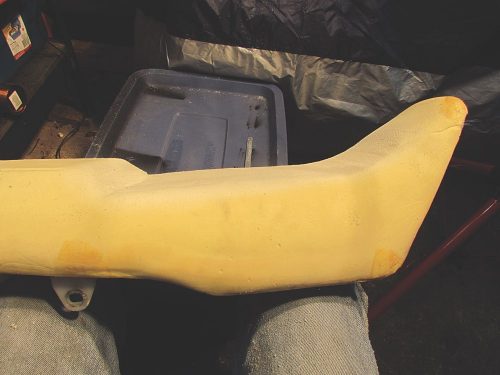 The other option is to modify your original seat. You can lower it, make it narrower or, as I did with mine here, reshape it for more comfort. This requires taking the seat apart, cutting the foam padding and putting it back together. The main tools needed are a powerful staple gun (electric or pneumatic), a hacksaw blade and some sandpaper. However, you should make sure the foam on your seat is thick enough before you cut into it; there’s not much you can do with a thinly padded seat.
Most seats have a vinyl covering that is stapled onto a plastic base. To remove the vinyl, just pull out all the staples using a pick or tiny flat screwdriver – without poking yourself. But before removing the staples, use a marker to make some locating marks on the cover and on the seat base to make reinstalling it easier. Upon removing the cover from my KLR seat, I discovered that the plastic covering under the vinyl that’s meant to keep the foam dry was damaged, so this was also an ideal opportunity to replace it.
The next step is to mark the foam exactly where you want to cut it. This takes some patience, and you should take some measurements from the edge of the seat to make sure your cut isn’t lopsided. Also try to give it a shape that will be aesthetically pleasing, so avoid right angles. My KLR seat sloped forward, which proved uncomfortable on longer rides, so my goal was to level it out. With the seat on the bike, I eyeballed an imaginary line that was more level to the ground, but I only removed 2.5 cm at the deepest end of my cut because I didn’t want to lose valuable legroom.
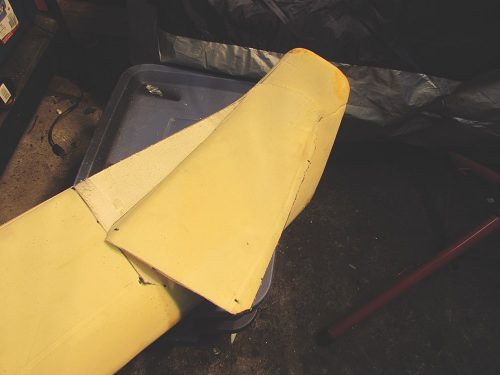 The trick to cutting foam is to take one clean cut; that way, if you don’t like the results, you can always glue the cut piece back on. Cut very slowly with a medium hacksaw blade (18-24TPI), and make sure the blade follows the line on both sides of the foam. The cut will leave sharp edges, which can be rounded using coarse sandpaper — 60-grit worked fine for me.
Once you’re satisfied with your cut and have sanded all the edges smooth, you can reassemble the seat, starting with the waterproof plastic liner. Since the one on my seat was torn, I replaced it with a repurposed plastic bag – but note that if you use a plastic bag that it is not one of those biodegradable bags that break down within a few months. The plastic is not glued into place, but is held in place by the vinyl seat cover, so you can leave it oversized and then trim it down after the seat cover is on.
Replacing the seat cover will be trickier now that its shape no longer conforms to the newly shaped seat foam, which is another reason you don’t want to remove too much foam in the first place. Locate the cover using the alignment marks you drew on earlier, and use a couple of staples at the front and rear to hold it in place. I use a Stanley adjustable electric stapler with ¼-inch T50 staples, which were almost identical to the original staples. Don’t use longer ones or they will come out the other side of the cover.
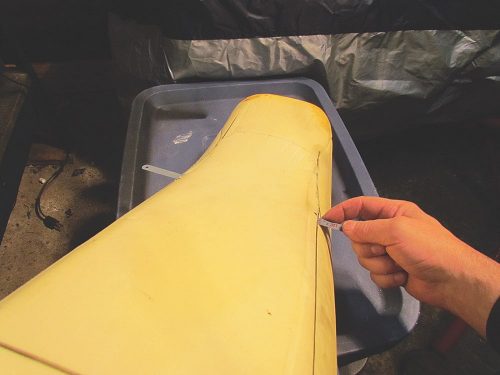 You’ll be stapling most of the cover at about the same location as it was stapled before it was taken off, but it will have to be drawn tighter where foam was removed so it’s not saggy and unsightly. This is the tricky part, and it’s where you should begin stapling the cover after your initial fore and aft staples are in place. You must be careful not to pull the cover too tightly to remove unsightly creases, because this will compress the foam beneath and make the seat uncomfortable. You will likely have to pull out some staples and readjust the cover as you go, so use wide gaps between the staples at first, until you’re satisfied with the way the seat cover fits. Once the cover looks relatively smooth (you might have to live with some additional creases), you can then staple the seat cover fully, and go for a ride.
Technical articles are written purely as reference only and your motorcycle may require different procedures. You should be mechanically inclined to carry out your own maintenance and we recommend you contact your mechanic prior to performing any type of work on your bike.
Comfort and efficient design in a superior package.
The name says it all – the Klim Apex jacket is at the top of the heap when it comes to sport-touring apparel. It’s kept me dry in the worst deluge and kept me cool on the hottest and most humid days; it’s been featured in more Mojo spreads than just about any other product; and it’s the one jacket that I repeatedly turn to for protection and peace of mind.
In the company of most other motorcycle jackets, Klim’s Apex stands out for a couple of reasons, one being price – this stuff is not cheap – and the other having to do with something it lacks: a removable liner system.
Upon receiving the Apex, I was puzzled by the basic shell and mesh liner design, and thought perhaps I was missing something. After doing a little research, it became obvious that when it comes to the Apex and many of its other products, Klim leaves the underlayers to the customer, and instead provides the best possible outer layer.
This particular model, with its high-viz-yellow-and-black combo, is aimed at the sport-touring segment. There are six exterior pockets, as well as five interior ones located within the mesh liner. Ventilation is excellent, with six vents in strategic areas like the arms, shoulders and down the sides, though it’s difficult to close the two large side vents when you’re on the bike because you need two hands. The benefit of the design is that it flows a huge amount of air. Conversely, zipping up the vents will keep out the cruellest of weather, as I discovered on many occasions; in one case, I rode for an entire day from Toronto to the Quebec-New Brunswick border amid pouring rain, winds and 18-wheeled convoys casting blinding spray, only to arrive at my motel and find not a drop had made it through the jacket.
In the two seasons that I’ve been abusing the Apex on every form of motorcycle and in every kind of weather Canada can muster, it continues to amaze me – I’ve even taken it out snowmobiling, ATVing and dirtbiking, and once brought it along for a little added protection while snowboarding, with great results, I might add.
The flexibility and durability of the Apex jacket comes from its four-season layered Gore-Tex Pro construction with perforated leather in impact areas such as the shoulders and forearms. That, along with the mid-length cut and the abundance of beefy D3O T5 EVO Pro XT armour on the shoulders, elbows and forearms, as well as the included CE Level 2 Viper T5 Pro Back Protector from D3O, makes it ideal for road riding.
The magazine received a size large for testing, which fit both Glenn Roberts and me perfectly, with a little adjustment provided by the waist and neck cinch cords and arm straps. We also had a gentleman try it out who was 6’ 2”, pushing 230 pounds, and there were no complaints. I believe Klim leaves a little extra room to accommodate underlayers – speaking of which, I generally wear a T-shirt under the Apex on pleasant days and go for a good long-sleeved base layer and thermal fleece sweater in the evenings or on cool days; that’s really about all that’s needed most of the time.
With a price tag that hovers around $1,100, the Apex jacket represents a significant investment for the average rider, but I can’t stress enough that you’re getting one of the best products available on the market. From quality to versatility to rider protection, this is indeed the apex of garment design at the moment.
We’re creating a short film to be screened at the Motorcycle Film Festival in Prince Edward County on Friday June 9, 2017, and we’re doing it with your footage.
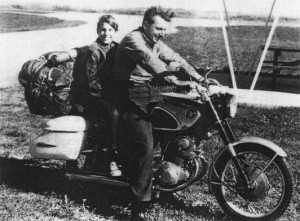 Author Robert M. Pirsig, best known for his book Zen and the Art of Motorcycle Motorcycle Maintenance, passed away at his home in South Berwick, Maine on April 24, 2017 at the age of 88.
His unlikely ‘best seller’ sold over one million copies in its first year – quite a feet for a book that began as an essay, which nobody had any interest in. It was eventually published in 1974, and recounted the tale of a motorcycle trip he had taken with his 12-year-old son Chris during the 1960’s. But it was, and still is so much more than just another tale from the open road; it forces the reader to question their own values and beliefs and sends the brain into a spiral of self-evaluation and enlightenment.
It took Pirsig another 17-years to finish the sequel, Lila: An Inquiry Into Morals, another fine example of his brilliance. During those intervening years, he avoided the spotlight at every turn, and he had good reason to; Pirsig suffered from debilitating anxiety. Despite this condition he had served in the Korean war and traveled the world, refining the unique outlook and moral compass that so many readers have come to appreciate.
Pirsig’s aptitude was evident early on, scoring an IQ of 170 at the tender age of 9 and graduating high school at just 15. He went on to study philosophy and after his service in the Army became a professor at both Montana State College and at the University of Illinois, where he was known for a rather unique teaching style.
Though he is now departed, his works will live on and continue to inspire and encourage others to think deeply about this life.
The horsepower wars are raging and manufacturers are pushing the limits of technology to find any advantage. BMW’s unveiling of the new HP4 Race in China illustrates the current cutting edge for the industry, at least in terms of something we could conceivably get our hands on – for around US$85,000.
The chassis is all carbon fibre, as are the wheels and bodywork. There’s of course more of that woven wonder-material throughout, along with a smattering of titanium to assist with the massive weight-loss when compared to the somewhat hefty S1000RR. Wet weight is just 377 lbs, and it’s now propelled by even more power – 13 more ponies actually – bumping the claimed output to 212 hp.
Of course the suspension, brakes and electronics are all top of the line components, as is everything on the new HP4 Race. The only real limitation it appears BMW have put on the development of this bike is that it’s not road legal and can only be ridden on the race track – and that’s probably for the best.
Twisted Throttle Canada Open House

Kick off the riding season at our Annual Open House!
- Meet factory reps from Klim, Arai, Sena, GIVI, and more
- Get a personalized one-on-one helmet fitting by Arai
- Learn about this year’s hottest moto events from the Rally Connex, Horizons Unlimited, and more
- Come in and test ride the new Africa Twin and other bikes courtesy of Honda Canada!
- Watch riding demos by Clinton Smout of the S.M.A.R.T. School
- Get special event-only discounts on select brands
- See what’s new in our expanded Moto Camping Section
- Take a break with a delicious BBQ lunch
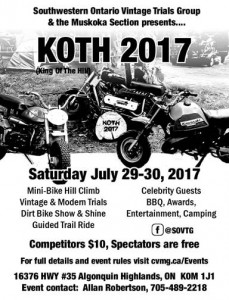 If you’re looking for something a little different than the usual weekend bike rally, and have a mini-bike or trials bike that needs a good punishing, KOTH 2017 is the place to be. Courtesy of the Southwestern Ontario Vintage Trial group and the Muskoka section, the King of the Hill (KOTH) event takes place on July 29-30, and will feature mini-bike hill climbs, trials, trail rides, awards, BBQ, camping, entertainment and more. It’s only $10 to compete and spectators are free.
All the info you’ll need is listed on the flyer above so give them a call to find out more about this unique gathering. Now you’ll have to excuse us as we’ve got to see a man about a mini-bike. . .
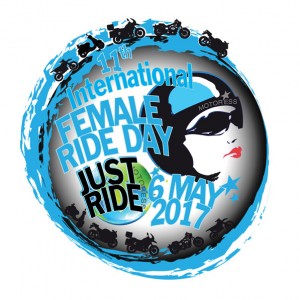 The world’s largest women’s motorcycling event, International Female Ride Day (IFRD) has women preparing to take over the world’s roads on Saturday, May 6, 2017 for its 11th occurrence. Women unite within the unique global action of “Just Ride!” to highlight and promote female riders. Each participant is a role-model for women in motorcycling, representing their individual ride culture, city/region, and country. The ride can be enjoyed alone, with a group and either on or off-road.
IFRD demonstrates the importance of its role to advancing women within the hobby of motorcycling. For the 11th year women unite from The Northwest Territories, Iceland, India, Australia, South Africa, Brazil, England, Germany, The Netherlands, Canada, United States, Czech Republic, Japan, and more.
The event has compelled not just women riders, but leading global motorsport associations, manufacturers, etc. to grow efforts towards representing women at all levels of the activity. IFRD demonstrates through its global immensity and increase in yearly participation, that female riders continue to be a respected and essential component of motorcycling.
For further information on International Female Ride Day please visit:
Website: International Female Ride Day
Facebook Page: International Female Ride Day
The inexperienced rider might call it the highway to hell; others call it the most exciting motorcycle loop in Tennessee
Gone are the past weekend’s ear-shattering crescendo of exhaust that reverberated through the valley during the Spring Thunder in the Smokies Rally. It has been replaced by the quiet serenity of nature, and the only sound this morning is the tack-tack-whistle of a red cardinal.
 Sitting in my squeaky red rocking chair on our porch, the chattering Campbell Creek tells me of its trek from high in the Smokies. This is Pioneer Village Resort, an assortment of log cabins that remind us of simpler times and our personal Shangri-La in Maggie Valley, North Carolina – the ultimate centre for hundreds of kilometres of the best riding in the Appalachians.
The smell of breakfast wafting from the kitchen breaks my reverie and soon my wife, Tina, and I are packed and mounted, and off to meet our friends Rich and Liz just across the wooden bridge from our cabin.
Meet Maggie
 Over 125 years ago, Jack Setzer applied to open the first post office here, but one of the requirements was a name for this place. His youngest daughter’s name was Maggie Mae, and today, Maggie Valley in the heart of the Smoky Mountains bears her name and echoes with the pleasurable sound of motorcycles arriving from far and wide.
Legendary rides with names like the Green-Eyed Snake, Hellbender, the Dragon and the Diamondback exude a tempered fear in the hearts of the meek. But today, our appointment with Lucifer is a temptation too great to pass up, so we thread our way through the valley, seeking one of America’s most challenging and beautiful stretches of interstate highway that will lead us to a devil’s den.
For 50 of America’s sweetest interstate kilometres, I-40 winds north through the Smoky Mountain National Forest like a giant green python wriggling through the valley. Tall oak-covered mountains rising up on either side complete the picture. Unfortunately, this morning the road is congested with cars, transports and motorhomes, so we thread our way from lane to lane through a muddled mass of humanity, and try to enjoy the beautiful curves and remove the surplus chicken strips from our tires.
Coming out of the mountains and past Douglas Lake, I-40 bends westward through the gently rolling hills of southern Tennessee. Knoxville soon becomes a distant memory as we exit onto TN 62 and roll by Oak Ridge, home to the Manhattan Project.
Maximum Security
 Just past Oliver Springs, we take TN 116, the beginning of the legendary Devil’s Triangle. We wind through hills and mountains to Petros, population 583 and home to many of the guards who worked at the nearby Brushy Mountain State Penitentiary. Heavily gated, this stone prison stands majestically cradled between surrounding snake-infested mountains, as it has for 120 years. This was home for James Earl Ray, the man who killed Martin Luther King Jr. Many other infamous killers and petty criminals used this as their home address – some walking away after paying their debt, and others who lie in unmarked graves down behind the boiler house. Our tour guide, Mark Tucker, a second-generation guard who served there for 25 years, regales us with story after story of murders and mayhem that make our hair stand on end. When the tour ends, we mount up and tentatively straggle out Brushy’s rusty gates. Immediately our minds are occupied with survival on the Devil’s Triangle. Newly paved, this road/treat has few guardrails, and with 30-metre-plus drop-offs down through the trees, a deep respect for speed and traction kicks in.
On the Edge
First thing, a long, uphill, never-ending left-hander greets us. The cement barrier at its outside edge is adorned with the spray-painted signatures and words of those who have passed this way, such as “Highway to Hell” and “Turn Right,” along with many of the usual assorted inscriptions of undying or unrequited love. Mottled sunlight filters through the forest canopy, providing a jungle-like feeling as we sweep into another 15 mph bend that terraces us downward into a valley. As we slow for a turn, we spot three riders gathered at the roadside waving to us. They alert us to some gravel on the roadway where a friend of theirs ended up in a shower of sparks and with a dented ego. Experience tells me that I always have to remember that these are public roads, not a racetrack, and unexpected surprises are ready to ambush me around every corner. Modest homes, trailers and double-wides dot the roadside as we turn from TN 116 onto TN 330. Here, the tight twisties give way to long, gentle sweepers unwinding us appropriately, because at Oliver Springs, we will have completed the devil’s 80 km triangle.
Stark Contrasts
It’s hard to believe that just 10 minutes away, in this pristine area, the mystery of the atom was unravelled, leading to death and destruction that would rain down on Nagasaki and Hiroshima and end the Second World War. Oak Ridge was not even a town until 1942, when the Manhattan Project site was chosen for a uranium enrichment plant and a pilot plutonium reactor. Suddenly, a town of 30,000 people was born. Back on I-40 and heading east, the late-afternoon traffic through Knoxville proves insignificant, but that meandering stretch through the mountains is quite another story and a great way to put a ribbon on the day. We’re home again at our log cabin and chock full of memories; the tales from Brushy Mountain prison will be with me forever. Yes, it is the Devil’s Triangle – and in more ways than one.
Opened in 1896, Brushy Mountain State Penitentiary was built by inmates with the stone quarried from the nearby mountains. Later, inmates did forced labour in the coal mines behind the prison, and if they did not meet their daily quota, they were whipped. Under the laundry area, there are several cells with no windows called “the Hold.” That’s where inmates who behaved badly were kept in complete darkness for up to 30 days, sometimes more, with only a pail of water and a pail for their personal refuse. They received a hard biscuit for food each day, and every third day they were given a modest meal of gruel made from turnip.
There was an electric chair here, but it was never used. Those sentenced to death were taken to Knoxville. Retired guard Mark Tucker says that you can’t take a step anywhere in “the Yard” without stepping where human blood was spilled. Infamous prisoners at Brushy Mountain include James Earl Ray, who attempted to escape at least four times; John Tate, the boxer; and Frank Randall, another famous boxer. Ironically, years ago, a deer managed to get inside the walls and became a pet of the inmates. They fed it scraps of food and nobody dared harm the deer for fear of retribution. Each year, the Barkley Marathon, considered one of the toughest marathons in the world, is held in the mountains right behind the prison. It’s referred to as being “60 hours of hell,” and since its inception in 1998, only 14 runners, out of more than 1,000 participants, have finished it.
Shaking the branch of a long-standing family tree yields a finer fruit
Kawasaki has a relatively long history of producing parallel-twin sport bikes, dating back to the 1983 GPZ305. It was a lightweight entry-level bike that mimicked the then new styling of Kawasaki’s bigger GPZ sport bikes. In 1988 came the Ninja 250, which has enjoyed an unbroken production run leading right up to today’s Ninja 300. In 1994, the company introduced the EX500, which proved a very popular choice among budding riders and racers alike. It, too, enjoyed a lengthy production run before Kawasaki pulled the plug on it in 2009. It was dropped because for three years it had been competing on the Kawasaki showroom floor with the Ninja 650R, which was introduced in 2006.
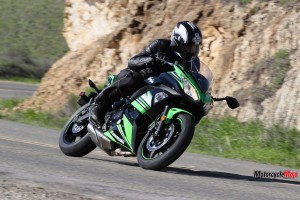 The 650R offered riders an accessible, affordable sportbike option that was much more modern and more powerful, and handled better than the EX500, but with more manageable power and a more comfortable riding position than the ZX-6R supersport. The 650R also featured distinctive styling among other Ninja models, utilizing a unique steel frame with large-diameter tubing up front, a single square-section backbone in the rear and a single shock absorber offset to the right side of the bike, which became the bike’s hallmark design feature. The bike received a major overhaul halfway through its life cycle, but it retained these characteristic styling traits.
Radical Redesign
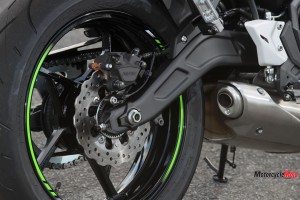 We travelled to Paso Robles, California, to ride the new Ninja 650 (Kawasaki has since dropped the R), which has been completely redesigned for 2017. And the change is radical – everything is new. About the only thing that is similar to the outgoing model, aside from the name, is the engine, though even it has seen a major revision. The 649 cc parallel-twin’s basic specs, such as bore, stroke and compression ratio, are the same as before, but the cylinders no longer have steel liners, which reduces weight and brings them closer together for a narrower engine. Within a redesigned cylinder head are new cams with slightly milder timing, and the throttle bodies are 2 mm smaller in diameter, at 36 mm. These changes combine with revised engine mapping to increase peak torque by 1.5 ft-lb to 48.5, while increasing available torque in the lower rev range. Gearbox ratios are unchanged, but the clutch is now mechanically assisted to reduce lever effort, and it incorporates a slipper function.
A Svelte Package
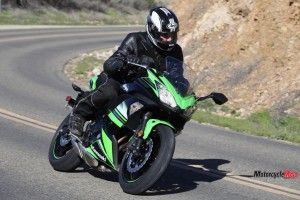 The frame is an all-new steel trellis design that weighs an astounding 8.6 kg less than before. And that’s not the only component that has seen a reduction in weight: the wheels, swingarm, engine and various other components are lighter than before, bringing the total weight savings to 19 kg, which is unheard of in a single model upgrade. Hard-core racers would be hard pressed to remove half that amount for the racetrack.
Steering geometry is more aggressive and much more sportbike-like, with less trail (99 vs. 110 mm) and a steeper rake angle (24 vs. 25 degrees), while the wheelbase remains at 1,410 mm. If you’re not yet convinced of just how sporty the new Ninja 650 is, take note that its chassis geometry is now almost identical to that of the ZX-6R, while wet weight, at 192 kg (426 lb), is identical to the 6R’s wet weight.
The bike’s lines are now much sharper, more angular and sportier, aligning the 650’s styling more with the company’s supersport Ninjas – much like that original GPZ305 looked like its bigger, sportier stable mates. Although the 41 mm conventional fork is retained, the 650’s trademark exposed shock absorber is gone, having moved to the centre of the frame and connected to the swingarm by linkage instead of directly. The fork has been retuned primarily to compensate for the weight reduction, while the rear suspension is more progressive through its travel, mostly due to the added linkage.
More Comfort in a Sporty Stance
The riding position has been changed for a slightly more sporting stance. The hand grips are farther forward and lower, though the foot pegs have also been moved forward and are a bit lower, while the seat height has dropped 15 mm to 790 mm, which is relatively low for a sport bike. Without a previous model on hand, it’s hard to tell what the changes actually feel like; the riding position is nonetheless much more accommodating than any supersport machine, placing you into a modest forward lean with a very easy reach to the handlebar. At six feet tall, I found the legroom a bit cramped, but Kawasaki does offer a 25 mm taller accessory gel seat, and I’d take it.
When you’re seated, the view forward reveals a neat new instrument cluster that features a prominent analogue tachometer with a digital readout to the right, and an array of warning lights to the left. The digital display has a black background and grey digits, providing an attractive, upscale appearance you’d expect on a high-end supersport machine. Display info includes gear indicator, time, coolant temperature, twin trip meters, fuel economy readout and fuel gauge. There’s also a programmable shift light that works in conjunction with the display’s backlighting, which changes hue from white to pink (at 500 rpm before the selected shift rpm) to red, when it’s time to shift.
This light show isn’t visible in daylight, though the yellow shift light is. You can also shut the system off. Looking down, you’ll also see an unusual three-piece cast handlebar bolted onto the top triple-clamp. This was designed to give the Ninja 650 a slightly more upscale look than the tubular handlebar used on the Z650 naked bike, with which the Ninja 650 shares platforms.
Unfortunately, the temperature in Paso Robles was very unseasonable during the bike’s press launch, dipping to just below freezing when we took off in the morning, with forecast highs barely touching the double digits. Recent rainstorms had also caused several road closures in the area, which forced our hosts to remap our route. Despite this, some of the roads we did travel on were strewn with debris, gravel, sometimes mud and often running water. This, of course, also prompted our lead rider to set a modest pace.
A Lighter Ride
Although there were no previous-generation Ninja 650s on hand, I have spent some hours on one several times in the past, including last summer, and I remember there was really nothing unpleasant about it. I also remember it felt lazier and more top-heavy than the new bike. This 650 is narrower between the knees and it does feel much lighter, whether at a standstill or at speed – a 19 kg reduction in weight will do that, after all.
Clutch effort is light, and the bike launches with very little throttle, accelerating away with a light throbbing vibration that gives the engine an almost big-twin feel. Although the engine isn’t electric smooth, it is mostly vibration-free until about 110 km/h, where some buzzing is felt in the fuel tank and seat, though the handlebar and foot pegs remain buzz-free, as do the mirrors, which offer a clear, almost unobstructed rear view.
Clean Acceleration
Although the pace was relatively subdued owing to the poor conditions, I did perform a few full-throttle roll-ons, and the engine does, indeed, feel more powerful than before, pulling in a linear fashion, with just a little drop in pulling power as the tachometer needle swings toward the 10,000 rpm redline. The engine feels strongest when gassing it from about 5,000 rpm, and it emits a very satisfying intake howl when you do so.
Steering is light and neutral, and contact-patch feedback is confidence-inspiring, an especially welcome handling trait considering the sketchy pavement we rode on. The seat is short front to rear, so you can’t really move around much, and it’s firm, causing me to squirm around near the end of the 200 km day – that’s another reason I’d opt for the accessory gel seat. Suspension is sprung on the soft-ish side, which is understandable considering the Ninja 650 is designed to put more miles on the road than on the track. It nonetheless worked just fine, providing good compliance over the majority of bumps, though I suspect it might be too soft for an aggressive sporting pace. It also proved a bit harsh over larger, sharp-edged bumps.
Excellent Value
Despite these minor kinks, the Ninja 650 is improved in all respects compared with its predecessor. And for all the new bits and weight loss, it costs only $200 more than before, now at $8,099, and that includes standard ABS. Add $300 for the green and black KRT (Kawasaki Racing Team) model like my test bike. It’s lighter and produces more mid-range torque than either of its four-cylinder competitors, the Honda CBR650F and Yamaha FZ6R, undercutting the former by $1,600 and costing just $100 more than the latter. This represents a great value, especially when taking into account that when the Ninja 650R was introduced 11 years ago, it retailed for $8,599.
The 2017 Kawasaki Ninja 650 is certainly an improvement over the model it replaces. It remains a great step up from a smaller bike, with enough power to satisfy even veteran riders. It is now among the sportiest bikes in its category, and not just in appearance alone, since it now rides as sporty as it looks.
Good looks and a plethora of accessories is sure to win over the urban renegade
If you’re not familiar with the term “bobber,” look it up in the Oxford Dictionary of English, you’ll find the literal description, which is either for a float placed on a fishing line or for a person who rides a bobsleigh. What you 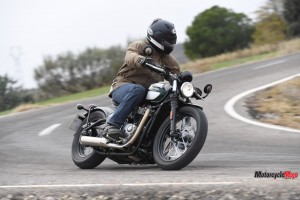 won’t find is what the word has represented in motorcycling since the mid-20th century. The term was coined in the late 1940s to refer to hardtail-framed motorcycles that were stripped of all unnecessary items (some items were actually necessary, like the front brake); the fenders were cut very short, or “bobbed”; and low, flat handlebars were bolted on. And bobbers were mostly rider-only machines, uncluttered by such trivial things as pillion seats.
When Triumph introduced the completely redesigned T120 and Thruxton with an all-new, liquid-cooled parallel-twin last year, the company was certain to follow up with additional Bonneville models, and it has this year, with the Bonneville Bobber.
Retro-Bike Revival
 The 2017 Bonneville Bobber is a custom bike unlike any other recent Triumph. Sure, like the slew of recently introduced scramblers and café racers (of which you can find examples from Triumph), the Bobber is part of the retro-bike revival that is proving popular among millennial riders, but this is one of the coolest-looking retro bikes out there. Triumph held the press intro of the Bonneville Bobber in Madrid, Spain, and we were there to ride it.
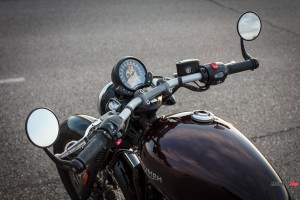
The Bobber’s styling is something you might expect from a low-volume boutique bike builder, but this is a production bike built by Triumph. It features a minimalist design with visual cues that hark back to those bare-bones customs of yesteryear, like the nearly flat handlebar, and the downward-
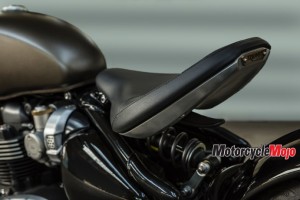
sloping rear portion of the frame that blends into a triangular swingarm, faithfully mimicking a rigid frame. The look is further accentuated by a tire-hugging rear fender with a solo saddle hovering above it. And that solo saddle is the only seating choice; there are no provisions to add a passenger seat or foot pegs.
Masters of Disguise
 But it doesn’t end there. There’s a fine attention to detail that makes the bike stand out whether you’re looking at it from a distance or up close. The mechanical parts meant to be seen are emphasized (like the exposed vintage-looking battery box), while the rest of the parts are well hidden – wiring is almost completely out of sight. Although the engine is liquid cooled, you won’t see a single coolant hose. What looks like a transmission cover on the right-hand side below the seat is actually a cover that conceals the rear brake master-cylinder reservoir and the coolant overflow tank.
The riding position is more cruiser-like than standard bike, but fortunately not an extreme, foot-
forward kind of cruiser. It’s a modest reach to the handlebar, and the foot pegs are placed just enough ahead to put your knees at a right angle. The seat is adjustable fore and aft, with a range of about 50 mm, and the bracket on which it slides slopes rearward, so the seat also drops a bit as it moves back. The seat adjustment is semi-permanent, as you must loosen a couple of bolts to adjust it. The seat is low (690 mm at its lowest), so it’s a very easy reach to the ground. I only sat on a parked bike with the seat in the rearward-most position and found the reach to the handlebar too long, so I kept the seat on my test bike in its forward position and found the riding position quite accommodating for our 200 km ride. Despite its rather skimpy appearance, the seat is wide, well shaped and supportive, providing a comfy perch for the daylong ride.
Useable Power
 The Bobber is powered by the same 1,200 cc High Torque six-speed twin as the T120’s, but it has a twin airbox and shorter mufflers, and is tuned to produce 10 per cent more bottom-end torque than the T120. It’s a smooth engine, with more than 70 ft-lb of torque available from about 2,800 rpm to just over 5,000 rpm,
peaking at 78 ft-lb at 4,000 rpm. That’s a very useable powerband that makes the Bobber a blast to ride in town. Switchable traction control is standard, as are two ride modes, Rain and Road. Horsepower is reduced a touch compared with the T120, by two horsepower to be exact, at 77 hp.
The mechanically assisted clutch is beginner-bike light, and the gearbox clicks into first with a light touch. First gear is surprisingly tall, requiring some clutch slipping to get going, but the torquey engine manages this quite easily. Rolling on the throttle in the top four gears pushes the bike forward forcefully, pressing you hard into the sculpted seat.
The Bobber exhibits light, neutral steering and exemplary stability, which coaxes me to ride it rather enthusiastically along the winding roads just outside Madrid. It powers out of corners with authority, while producing a rich, deep exhaust note in return (we were told that the mufflers were shortened for this reason). Slowing for the entry into those corners takes a fair amount of braking effort, though. To achieve a clean-looking front end, there’s a single 310 mm front disc, squeezed by a twin-piston caliper – not the most efficient setup, but adequate for the type of riding the Bobber was designed for. It also has standard ABS in case you do squeeze hard enough to lock a wheel.
Compromised by Design
Triumph’s press literature claims, “A bobber without compromise,” but there is actually a compromise made in the name of styling, and that compromise is in terms of cornering clearance. Suspension travel has been reduced to 90 and 77 mm front and rear, respectively, from the T120’s 120 mm at both ends. This means that the Bobber’s non-adjustable suspension is firmer, but also that its foot peg feelers touch at modest lean angles. It has much more cornering clearance than does the Harley Sportster Forty-Eight, which is one of the bikes Triumph is hoping to steal away sales from, and the Bobber corners better than the average cruiser, but if you ride with any gusto on a regular basis, you’ll have to stock up on peg feelers.
Another, perhaps lesser, concession made strictly for appearance sake is that the slender fuel tank has been trimmed down to a paltry nine litres from the T120’s 14.5 litres. Taking into account the factory’s claimed fuel consumption of 4.1 L/100 km, the Bobber could go about 220 km before it runs dry, but
you should probably expect less than 200 km under normal conditions.
Cooler Than the Competition
The back-to-basics Bonneville Bobber is a great choice for someone looking for a bike that will turn heads. It’s more of an urban runabout than a long-distance motorcycle, though it remains entertaining enough to make longer hauls an occasional possibility. It has more grunt than the Sportster Forty-Eight, has more sex appeal than the Yamaha Bolt, is more svelte than the Indian Scout and, frankly, looks cooler than any of those low-slung cruisers.
If you have a propensity for personalizing your bike, Triumph already has more than 150 accessories available for the Bobber, as well as two inspiration kits, which are a pre-selected assembly of parts designed to make altering your Bobber a bit easier. The Old School Bobber kit includes an ape-hanger handlebar and the required installation hardware, brushed mufflers, a brown leather seat, a swingarm-mounted storage bag and various trim bits. The Quarter Mile Bobber kit (my preferred variation) includes clip-on handlebars, a black exhaust system, even shorter fenders than stock, a black leather seat and black trim pieces. You can also get optional heated grips (which worked just great in the single-digit temperatures during our ride), and very non-bobber-like cruise control.
Highly Anticipated
This bike has apparently been greatly anticipated, and according to Triumph, initial deposits on the Bonneville Bobber are twice what they were when the liquid-cooled Thruxton was introduced last year. At $13,700, it’s priced to compete more so with its American rivals, and it looks equally good regardless of which of the four colour schemes (black, red, green/silver or matte grey) you choose, though colours other than black come at additional cost. There are other bikes I’d take on long or fast rides, but sometimes I just feel like donning my open-face helmet and jeans, and scooting about aimlessly (although that’s the gist of most of my rides, now that I think about it). For me, the Bobber would be an addition to my garage, a second or maybe third bike that I’d take to social gatherings or on shorter, fair-weather rides. The Bobber is the ideal bike to fulfill those needs and is better equipped to handle winding roads than a full-on cruiser, all while looking pretty damn good, too.