
Atlanticade
It just makes sense to stop for a few days during your tour of the Maritimes
Atlantic Canada’s premier motorcycle rally, Atlanticade, reached an important milestone in 2016 under perfect blue skies and warm temperatures. The rally celebrated its 10th anniversary and is showing no signs of slowing down any time soon. Started in Moncton, N.B., in 2007 by a handful of volunteers who form the rally’s executive committee, Atlanticade continues to grow year after year, thanks to the hard work by that small group of dedicated people. In fact, Dale Hicks, the committee chair, told me that planning for the 2017
Atlanticade started during the 2016 event.
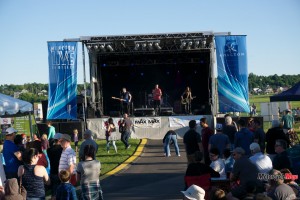 Part of the rally’s success is not only the hospitality and friendliness of the Maritime people, but also its excellent location. The Maritime provinces are a first-class destination for motorcyclists from the northeastern part of the continent, and beyond. Plates were spotted at the 2016 rally from seven provinces and eight states – from as far away as Alberta and Washington state. Riders will take in the 2017 Atlanticade festivities this year from June 22 to 25 while exploring New Brunswick, Prince Edward Island, Nova Scotia and Newfoundland and Labrador.
On the Move
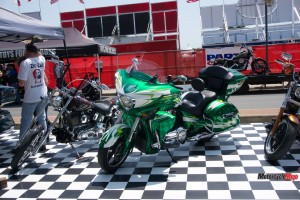 Atlanticade started in Moncton in 2007, calling the city home for the first few years before moving south to St. Andrews in 2010, and then across the Northumberland Strait to Summerside, PEI, in 2012, before relocating back to Moncton in 2015. Of course, volunteers are a special group of people, and there aren’t any more dedicated than the Christian Motorcyclists Association, which has helped with traffic and parking duties at every Atlanticade for the past 10 years, regardless of which town the rally has called home. Super Dave and his CMA team move in like a machine to keep order of the thousands of bikes on the move.
Lots Going on Downtown
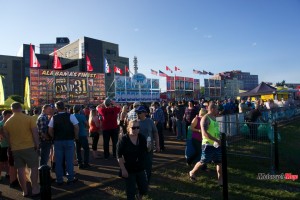 The bulk of the rally takes place in downtown Moncton, but there are a number of things to do at any given time during the four days that Atlanticade runs; there are guided tours, poker runs, bike shows, downtown street parties with live bands on the main stage, burnout competitions, beard and tattoo contests and much more. And if that weren’t enough, when you’re feeling a little peckish or just need a full-blown barbecue, there is a licensed ribfest and live music that also takes place on the Atlanticade festival grounds. Also, new this year is the Ride for Dad prostate cancer ride that will be wrapping up Atlanticade on Sunday afternoon.
Are You Feeling Lucky?
For the 2017 rally, the Atlantic Canada Kawasaki dealers all pitched in and have offered a 2017 Vulcan 900 Classic LT as a grand prize to one luckyregistered participant. The draw will take place on Saturday night in front of Moncton’s city hall. Be sure to check out atlanticade.ca on how you can enter.
During your summer’s tour through the Maritimes this year, plan to be in Moncton June 22 to 25th so you can attend the four-day Atlanticade rally. You won’t be disappointed.
RawHyde Adventures’ ranch is like Disney World for adventure motorcyclists
I was most intrigued with the road that served as the driveway into RawHyde Adventures’ camp. Even though we were in a van at the time, I thought that if this is indicative of what’s to come, then we should have an amazing next few days. Turning off the abandoned old Golden State Highway onto the severely broken pavement of a 1.5 km potholed single-lane driveway with plenty of blind corners and elevation changes led us into the RawHyde 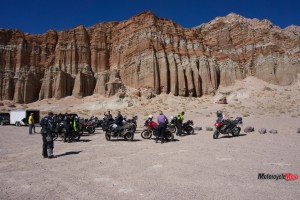 Adventures training property. A kilometre later, we started to see some training paddocks and various other signs of the RawHyde camp, and we eventually arrived at the camp’s home base, which consisted of a number of storage trailers, and permanent structures, including large tents built on platforms that would serve as sleeping quarters for most of the course’s students. Under the shade of camouflaged netting sat more than 30 school-owned BMWs – mostly 1200GSs, with a few 800GSs and a 650GS or two thrown in the mix for variety, all available to rent for the course.
RawHyde Adventures began in 2002, when owner Jim Hyde planned an eight-day, 1,600 km off-road adventure ride from Los Angeles to Las Vegas, and in only two short years, his dream had morphed into the number one enduro course in the United States. Today, RawHyde Adventures is an official BMW training centre, and therefore trains exclusively based on BMW’s prescribed off-road curriculum.
Contest Winner
Earlier in the year, Motorcycle Mojo ran a contest in conjunction with RawHyde Adventures operating out of Castaic Lake State Park, California, some 80 km north from the heart of Los Angeles. Far from the overpopulation of sprawling L.A., this 120 acres of desert-like property seemed like an ideal place to have a permanent off-road training centre. The muted brown landscape of sandy hills and the surrounding mountains with pale green flora reminded me very much of the Kamloops area in British Columbia’s southern Interior.
I was travelling with the contest winner, Steve Hubley. We had met for the first time at Toronto’s Pearson International Airport prior to getting on our flight to Burbank. When meeting someone for the first time and knowing you’ll be spending a number of days together, a lot can wrong, like personality conflicts, but any anxiety that may have been present was quickly swept under the rug. Steve is a great guy and we immediately got along.
Exploring the Grounds
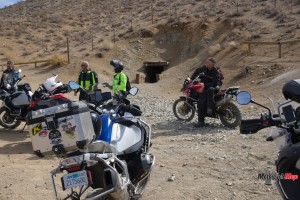 After dumping our gear bags, Lauren, the “mama bear” with an infectious, positive personality who was overseeing administration of the students, gave Steve and me a tour of the facilities that included the sleeping quarters, offices, kitchen, dining room, bar and shower area. We were then set free to pass the time however we chose. While I was wandering around the property, I heard a voice call out, “Are you a guest or do you work here?” I began speaking with fellow guest Julious as he unloaded his 800GS from the back of his van when a resident horse sauntered up and sniffed me from head to toe, looking for a handout, no doubt. I rubbed his nose just as four black cows also sauntered past, glancing at us. We were told later during introductions in the bar that the domestic animals are familiar with humans and motorcycles and won’t move out of the way, so you must go around them. We were also informed that on the property is a big mountain lion, a black bear that is more scared of you than you are of him, white scorpions and rarely seen rattlesnakes, so it’s best to wear boots.
Cordon Bleu Chefs
Sitting in the bar on the first night, we met our coaches as they went over the details of what we could expect during the next few days, and guests introduced themselves before moving into the dining room. The chefs at the RawHyde ranch are Cordon Bleu-trained, and if the salmon on the first night was any indication of what the food would be like for the next few days, thoughts of putting on a few pounds superseded any concerns of going hungry.
There were two groups of 13 taking part in the two-day Level 1 Intro to Adventure camp. A handful of us, Steve and me included, would stay on for two more days to participate in Base Camp Alpha – a ride through the Mojave Desert, with desert camping at the end of the first day.
Training Days
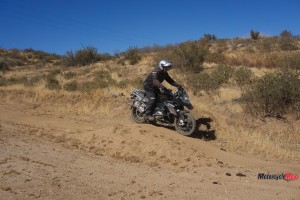 Jim Hyde was away riding in South America, so coach Travis was the main speaker during the first day’s morning orientation, but it seemed that in no time we were on our bikes performing braking exercises, slow-speed manoeuvres and counter-weighting to turn the bike. BMW’s curriculum is laid out like building blocks so that when the Level 1 course is completed, you have most of the skills to tackle many types of terrain.
After an excellent lunch, we tackled tight turns around pylons and then slow-speed turning exercises through trees on a hillside. The 1200GS is a big bike for the inexperienced in this scenario, and quite a few bikes went down, including mine, but no damage was done. Serious damage to a bike is the responsibility of the rider, but scratches are free, and expected, and given the windshields and mirrors have been removed, and the turn signals have been unbolted and zip-tied to the bodywork, not much damage could occur. All bikes are equipped with crash bars, bash plates and the regular protective equipment.
We knocked off about 4:30 on the first day, and since there isn’t a bartender at RawHyde, the drinks are free after training. A wide variety of cold beer was very welcomed to wash down the desert dust.
Coffee at six, breakfast at seven and be ready to ride at 8:30 was our final instruction for the following day.
Slow Motion
Slow-speed manoeuvres again began the day. While the BMW 1200GS is an amazing-handling bike, it is heavy, and you must keep in mind that it isn’t a small dual sport, so throwing it around really isn’t an option. It’s best to learn how to ride it slowly, which is emphasized in the BMW curriculum. I’ve always said that a monkey can ride a motorcycle at speed, but it takes skill and practise to ride a motorcycle slowly. If speed is your thing, it will come after learning the basics in what feels like slow motion sometimes.
Heading up the mountain on the RawHyde property taught us a wealth of different riding techniques, the most important of which was accelerating uphill on a loose surface and braking on a loose downhill surface.
The RawHyde property has a varied array of dirt landscapes, including deep sand, steep hills, trees and tight single track, all of which we sampled during the two-day intro course. Unfortunately, due to the geography and a multi-year drought, there aren’t any water crossings or mud to play in.
Disaster Strikes
Steve has a number of years of riding under his belt and was doing really well in the dirt – until he had a less-than-graceful dismount. I was in front of him, though, and didn’t see what happened. We were on a series of large whoops, which might have been about two metres high. I just heard an engine rev up behind me and I had a feeling it wasn’t going to be good. I immediately pulled off the trail and ran back to find Steve flat on his back with his 1200GS beside him pointing in the opposite direction that we had been travelling. A rider who did witness his accident said that as Steve was coming up the last whoop, he accelerated, launching the big bike in the air; both Steve and the bike settled on the ground beside the whoop. When I later talked to Steve, he wasn’t sure what happened. Luckily, one of the coaches teaching the other group was a paramedic and came to assess the situation. Once it was determined Steve was okay, the coach rode him back to camp. Lauren took him to the hospital to get checked out and, thankfully, in the end Steve was just very sore.
Base Camp Alpha
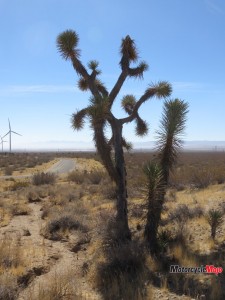 The next two days were spent on the road or on mostly sand trails riding into the Mojave Desert north of Trona, between Death Valley National Park and Sequoia National Park.
There were 11 riders for Base Camp Alpha, including coaches Wil and Chris. A chase truck, driven by Phil, the resident fix-anything MacGyver-type, took our tents and bedding, along with Steve, who was too sore to ride. They would take regular roads and meet us at the camp. We were glad to hear that our quality of food wouldn’t suffer, as chefs Kenny and Giuseppe would also meet us there.
We left the RawHyde ranch early, and with light clothing on and jacket vents still open from the day before, nobody was prepared for the temperature at only 10 C. But we knew it would warm up as the day went on. There are wide temperature fluctuations in the desert – night can become quite cold, while daytime temps can rise dramatically.
Although the official training days had ended, the coaches on the Base Camp Alpha trip were quick to give advice on the variety of real-world terrain we encountered.
I always find it exhilarating seeing fighter jets overhead, and given we were riding beside Naval Air Weapons Station China Lake, we had many chances to see and hear F/A-18 Super Hornets and F-22 Raptors, including one low-level flight of a Super Hornet coming straight toward us. I didn’t see or hear the plane until it was on us, and once it passed over, the sound from its jet engines was unbelievable. The riding was amazing, but seeing that made my day – and made me glad we weren’t the enemy.
Even though Base Camp Alpha is set in the desert with no modern amenities, the food was just as delicious as it was at the ranch, and the large campfire at night finished off an excellent day of riding. And with absolutely no light pollution, the stars and the Milky Way were spectacular.
Back to the Ranch
We had three riders who were struggling in the sand, so our group split up. They followed the chase truck to lunch at Jawbone Canyon, while the remaining eight of us took sand trails. It was decided that the afternoon ride back to the ranch would be some pretty intense riding over a mountain pass on sketchy trails with no guard rails, so the same three continued on with the chase truck back to the ranch.
That afternoon’s riding was the most epic I have ever done. Not only was the off-road riding over the mountain pass fast and adrenaline-charged, the pavement of the Caliente Bodfish Road, most of which is barely a thread width on a map, was a continuous series of high-speed mountain turns and switchbacks that I could only dream of having close to where I live.
The whole Base Camp Alpha trip took us several hundred kilometres each day over sandy and rocky mountain passes and desert trails to abandoned gold mines and through ghost towns with some of the best riding I’ve ever experienced.
A Class Act
The RawHyde Adventures camp is a top-notch training facility with 120 acres of the most varied terrain you could imagine. Most of the staff eat and sleep at the ranch, which makes for a close-knit group with no end to the camaraderie.
Who says you can get bored doing things over and over again? Everything about RawHyde Adventures was an experience I’d like repeat one day, and take the next level of training.
In addition to the California ranch, RawHyde also operates adventure training in Colorado. Go to RawHyde-offroad.com for more information.
Have you ever wondered how your motorcycle began its life?
Having worked on motorcycles for two decades professionally, and still personally, I’ve taken apart my fair share. But I’ve always been curious about how exactly they’re put together during the manufacturing process. Motorcycle Mojo was invited to Japan to visit the Suzuki factory, in conjunction with the launch of the new GSX-R1000R, which you’ll read about in an upcoming issue. Suzuki has six plants in Japan, and our hosts took us on a tour of the Takasuka engine plant and head office, the Toyokawa assembly plant and the Ryuyo test track.
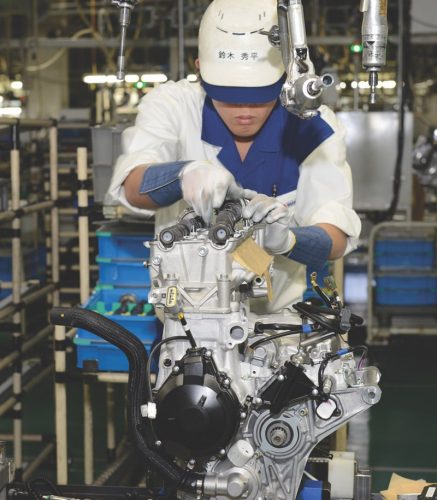 Unlike some manufacturing plants, where everything but casting is done in one location, Suzuki performs different tasks at its different plants. Raw engine castings and forgings arrive at the Takasuka plant, where all of the machining then takes place (any painting of the cases is done before any machining). Every machining process is measured and double-checked by laser measuring equipment. Once fully machined, the lower crankcase starts at one end of the assembly line and moves slowly along, collecting parts until it is a complete engine at the other end.
There are no robots on the assembly line, and everything is put together by hand, though there are some specialized machines that perform specific tasks, like the one that tightens the head bolts to spec all at once. I witnessed GSX-R1000 cams being installed and timed in about four minutes; it takes about 90 minutes to assemble a complete engine. Once the engine is complete, oil is added and it moves to a machine that spins the engine at about 1,000 rpm through the countershaft. This works all of the internal components and circulates the oil, while at the same time a worker inspects the engine for leaks. The engine is then put into a special crate and delivered to the assembly plant, which is 50 km away.
During our visit, one line was assembling GSX-R1000 engines and another was assembling V-Strom 1000 engines. Interestingly, also being built at the engine plant is the AR600, a highly specialized 599 cc, air-cooled parallel-twin that still uses carburetors, makes 59 hp and has only two speeds. Suzuki has been manufacturing this curiosity since the mid-1990s, and it is used solely in motorcycles taking part in Auto Race, a form of oval-track competition in Japan where spectators place bets, much like in horseracing.
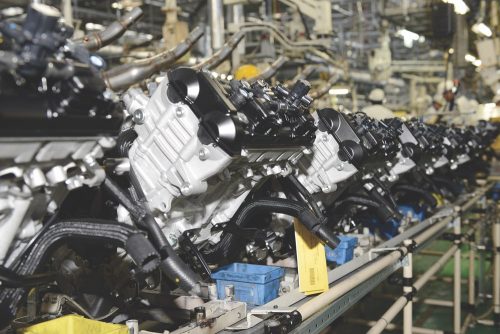 The Toyokawa plant was opened in 1971 and is Suzuki’s oldest plant. Suzuki currently manufactures 47 models, from 50 to 1,800 cc, but only a few models are assembled here, including the GSX-R1000, the GSX-S1000, the V-Strom 1000, the Burgman scooter and a 50 cc scooter. Suzuki also builds the TS185 dual-purpose bike here, an air-cooled two-stroke we last saw in Canada sometime in the 1980s. It’s still sold in South Africa and a handful of other countries that have lax emissions standards. Also being built at this plant is Suzuki’s largest engine, a 4.4-litre V6 that makes 300 hp.
Surprisingly, it is not built for a car, which Suzuki still produces for other markets – it’s an outboard.
Putting together a motorcycle on a mass-production assembly line is a curious thing. The first step included lowering the engine onto the exhaust header. The frame was then lowered onto that assembly, and it moved forward as it gained components, like the swingarm assembly with the rear wheel and rear brake already installed, and front end. The whole thing inches along the 80-metre-long assembly line, eventually rolling out the other end 90 minutes later as a complete motorcycle, save for the windscreen and mirrors, which will be inserted separately into the shipping crate and installed at the dealer, thus preventing them from being damaged during transport. Despite all the activity, the plant is astonishingly quiet, and none of the workers wore earmuffs. The tooling, much of it operated by compressed air, was mostly silent.
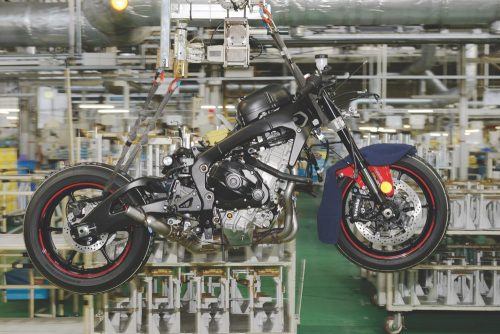 Soon after the bike rolls off the assembly line, a worker splashes some fuel into the tank, a battery is connected via cables and hung from the side, and the bike is propped up on a roller. This is where another worker sits on the bike, fires it up for the very first time and runs it through the gears. While on this machine, the ABS is also tested. With the proper approval, the bike moves on, the small amount of fuel is siphoned from the tank for delivery, and the bike goes for one final visual inspection under bright fluorescent lights, where the paint finish is scrutinized. It then moves onto another part of the plant where it is put into a crate and shipped to the various markets; the bikes we saw being assembled were going to Europe.
If you’ve ordered a new Suzuki GSX-R1000, it is probably being built as you read this.
Technical articles are written purely as reference only and your motorcycle may require different procedures. You should be mechanically inclined to carry out your own maintenance and we recommend you contact your mechanic prior to performing any type of work on your bike.
Sometimes a two-wheeled passion takes precedence over a lack of roads and a very short riding season
In 1969, I left the world of roads and flew to the Arctic in an old DC-3 on skis. I landed in Cambridge Bay, a hamlet on Victoria Island in Canada’s western Arctic populated mostly by Inuit, as well as a fair number of “southerners” at the Dew Line site, airport and a few contracting businesses. For a 20-year-old guy who liked bikes, I thought my three-year stint “Up North” would bring some cool experience, but, alas, with a regrettable deprivation of the two-wheel kind. Cambridge was a fly-in community, but I found that there were at least 20 km of gravel and dirt roads.
My buddy Neil and I learned that one of the airport guys had a Suzuki 80 street bike for sale, perhaps a 1967 model (no registration or plates were necessary then). I can’t remember much about the bike, but it had a kick-start and it was two-stroke, so it was pretty simple overall. We rode that bike to the Dew Line bar, up dirt roads to the river and a fishing lake, all around town (and at least once through the community hall at a Saturday night dance). We rode it in the winter, too, across the newly frozen bay in front of our house to jig for fish, and we could see them moving under the tires. We had paid something like $300 for the bike and definitely got our money’s worth. I sold my share to my replacement when I transferred to Gjoa Haven on King William Land, which is near the spot where Sir John Franklin’s ships Erebus and Terror were finally discovered at the bottom of the ocean.
Back to School
 I left the north in 1972 to return to university in Ontario, and at that time I was blessed to own a Honda CB350, followed by a new 1974 Honda 750-4. Lots of roads and a few speeding tickets in those days.
Having finished my degree, I was back Up North – seemed as if I couldn’t stay away. I landed in Resolute Bay on Cornwallis Island as manager of the local Inuit cooperative. Resolute is the second-most northerly community in Canada, which means long, dark and cold winters. The summers are short and give some relief, but it never really gets warm. I had a sweatshirt that read, “Resolute Bay: North of Summer.” Having said all that, one day I happened to notice an ad in the current Playboy magazine that was making the rounds. There was a beautiful colour spread of a 1978 Yamaha XS650 Special, a candy-apple red twin with chrome fenders. I drooled over that magazine in a way I never drooled over it before, and in less than two weeks, I had that bike delivered to me on a chartered DC-4 from Edmonton.
Tough Life for an XS
 Resolute had about 15 km of road, most of it between the Inuit community and the “upper base,” consisting of the airport and business/contracting nexus. That bike in that place made me a bit of a laughing stock with some of the upper base folks, but I didn’t give a hoot. The Yamaha, the most northerly 650 street bike in Canada for sure, gave me a lot of psychological satisfaction for a short part of the year.
Though it was a street bike and I wore grooves in all the well-gravelled road surfaces, it also made some trips over some pretty rough terrain and some spongy tundra to a fishing lake. The bike rarely got beyond third gear. After a year in Resolute, the bike (and my dog) went south with brother Mike while I relocated to Grise Fiord on Ellesmere Island, most northern Canadian community, with a population of 90 and perhaps only 5 km of road. Mike and our youngest brother, Randy, used that Yamaha 650 Special for well over 10 years.
Island Paradise
Fast-forward to Frobisher Bay, on Baffin Island in the eastern Arctic. I was again back Up North, and I stayed in that one place long enough to see the community’s name change from Frobisher Bay to Iqaluit (“Place of Fish”) in 1987, and the territory split from the Northwest Territories to become Nunavut Territory in 1999. As the capital of Nunavut, the city grew and accumulated more roads along the way. Perhaps the total kilometre value of the roads mushroomed to 30, including the “Road to Nowhere,” and the road to the abandoned Dew Line Station and to the dump. I was finally below the Arctic Circle again (just barely), so summers were relatively long and sweet. In Iqaluit, we got over three months of decent weather for motorbiking, compared to hardly two months in Cambridge Bay and Resolute Bay. I have to add that the seasons may have been short compared to southern Canada, but the near 24-hour daylight sure helped to take the pain away.
A Better-Suited Bike
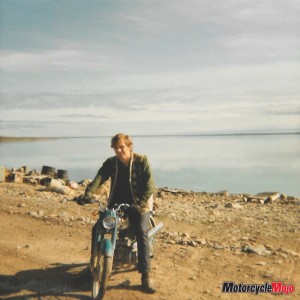 What did I do? I got a TW200 Yamaha shipped up from Ottawa, and so did my buddy Dave. That bike, a four-stroke with big tires, was perfect for Iqaluit, as far as two-wheelers go anyway. Most Inuit and Qallunaat (southerners) actually ride quads up there, useful around town and on the land for fishing and hunting. But, some of us like the two wheels. I rode the usual grooves into the gravel roads. Some of the roads, thanks to Iqaluit’s capital status, were even paved! Riding to the Sylvia Grinnell River and up to the old Dew Line site were favourite rides. It was a hoot and the bike never let me down. My daughter, Jean, wearing a sealskin riding jacket, took her road test for her bike licence in Iqaluit on the rider-friendly TW200.
Being Practical
One thing about a two-wheeler: It’s easy to throw it into a boat or even an airplane to go fishing. You can carry a tub of Arctic char on the back rack, or even a caribou. On one particular fly-in fishing trip to York Sound from Iqaluit, I used the TW200 to do some armed patrols of our tenting area just up from the coast. The area was thick with polar bears and we always had to have a rifle within reach. We had high-
voltage electric wire strung around our tents, and we had our valiant little dog, Cujo, to yap if any intruders came around (valiant but reluctant to sleep outside the tent).
Don’t Ask
I have been out of the Far North now for more than a decade. I hear that Iqaluit now has four TW200s there, a handful of other dirtbikes up to 250 cc,
a KLR 650, and even a couple of Harleys, the last of which are pretty much limited to the four kilometres of paved road. Motorcycles in Nunavut run the gamut from being practical to being the fruit of unrequited two-wheel passion and foiled touring dreams fuelled by long winters of 24-hour darkness. There’s no one easy answer to the question, “Why?” So better not to even ask it.
On Friday June 9, 2017, join Motorcycle Experience and Motorcycle Mojo for a one day motorcycle film festival at the Regent Theatre in Picton in beautiful Prince Edward County, Ontario.
The film festival kicks off at 3 p.m. with a matinee screening of the 1950’s classic, The Wild One starring Marlon Brando.
The Wild One is considered to be the original outlaw biker film and the first film to examine American outlaw motorcycle gang violence.
Then at 5 p.m. catch the 1966 Roger Corman film, The Wild Angels.
Shot in Southern California, the film stars Peter Fonda, Bruce Dern, Nancy Sinatra and Dianne Ladd.
This cult classic was made 3 years before Easy Rider.
At 7 p.m., the festival then snicks into high gear with a very rare sceening of the 1971 academy award nominated classic, On Any Sunday.
Starring Steve McQueen and Malcolm Smith, On Any Sunday is often credited as the best and most important motorcycle documentary ever made.
Tickets will be available from the Regent Theatre at theregenttheatre.org or at the box office.
$10 bucks a film or $25 for a 3 movie festival pass.
Also on hand will be Honda demo rides Friday and Saturday, food truck, local micro brews, door prizes and VIP party after the flicks at the Acoustic Grill.
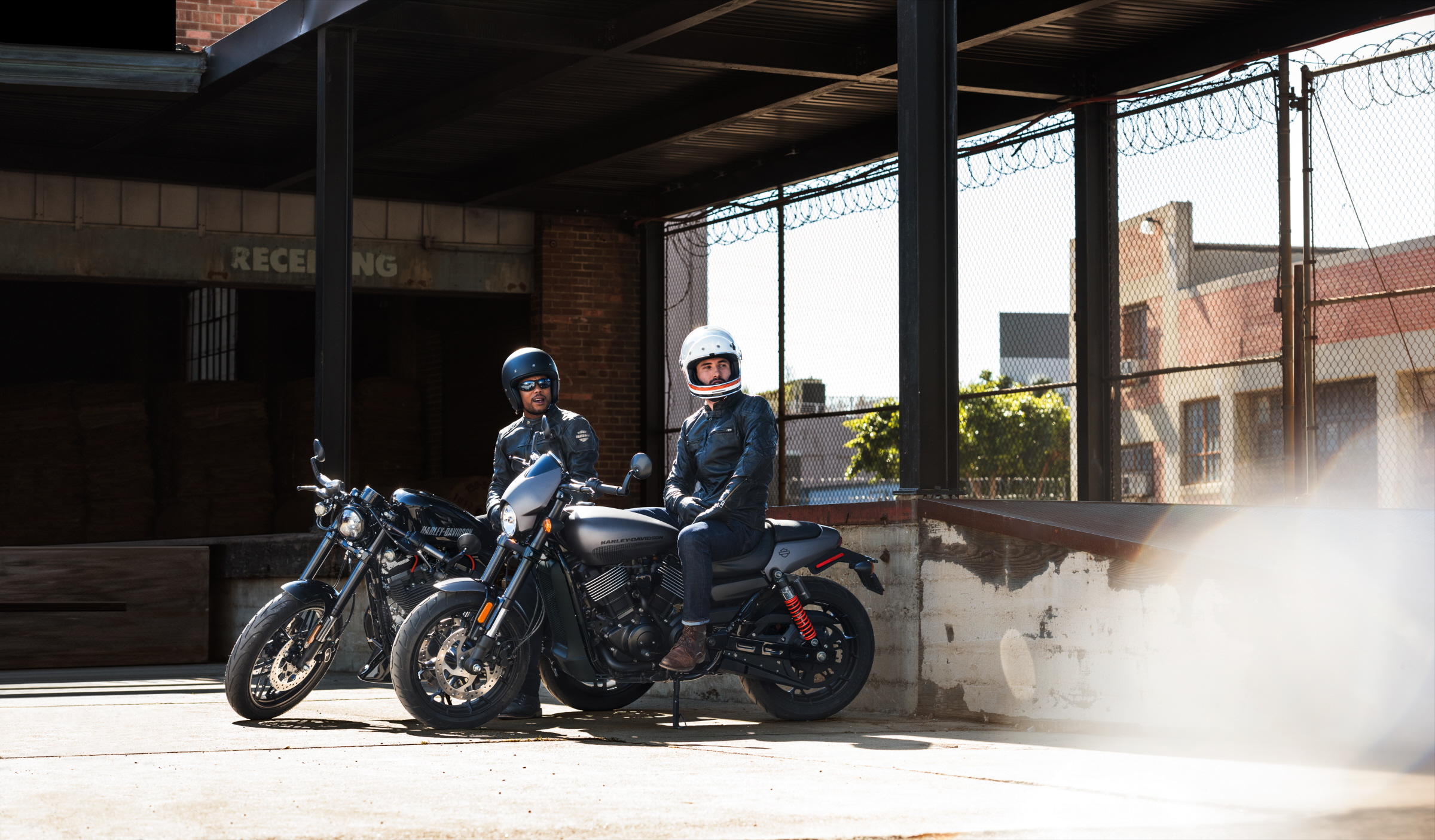
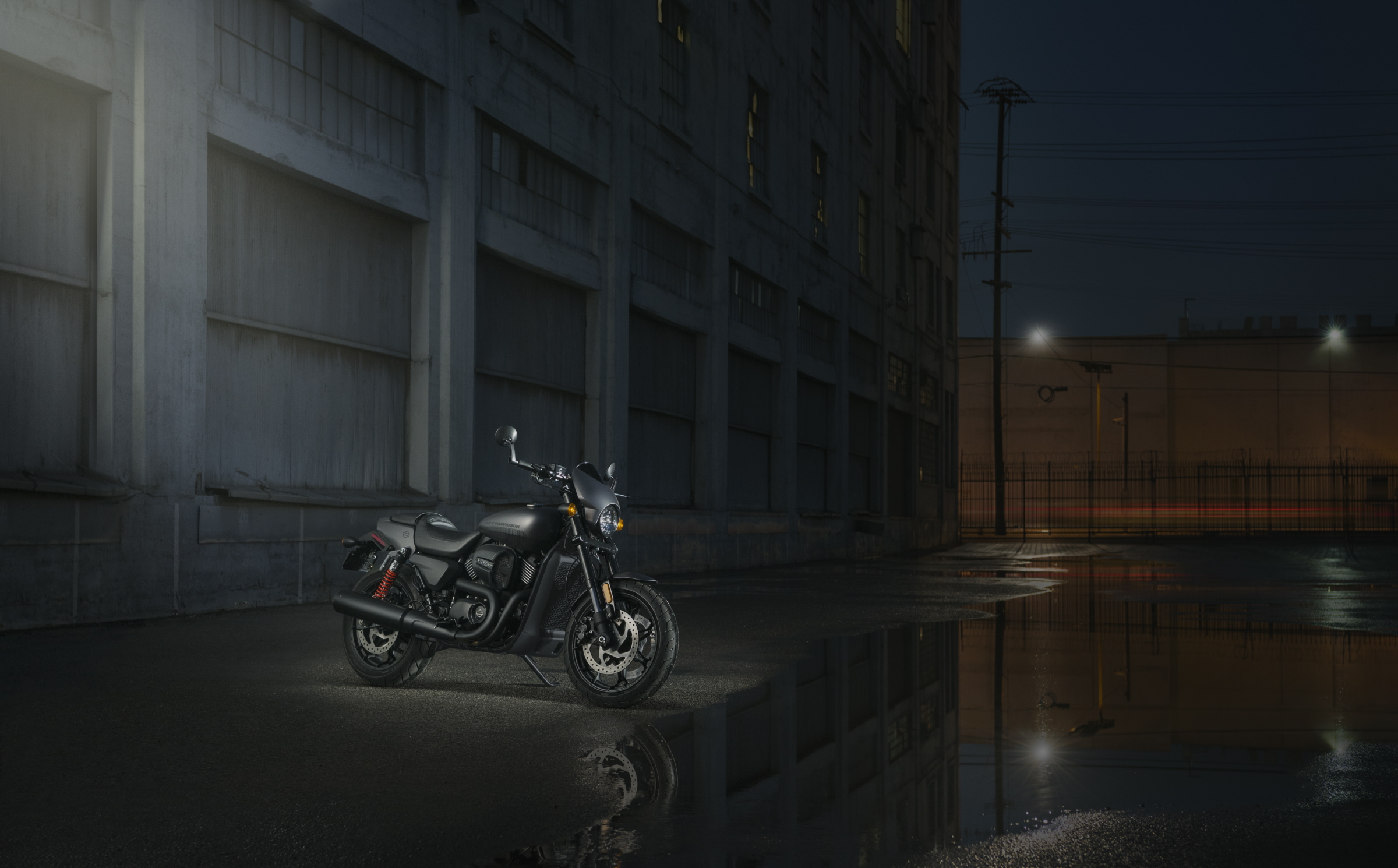
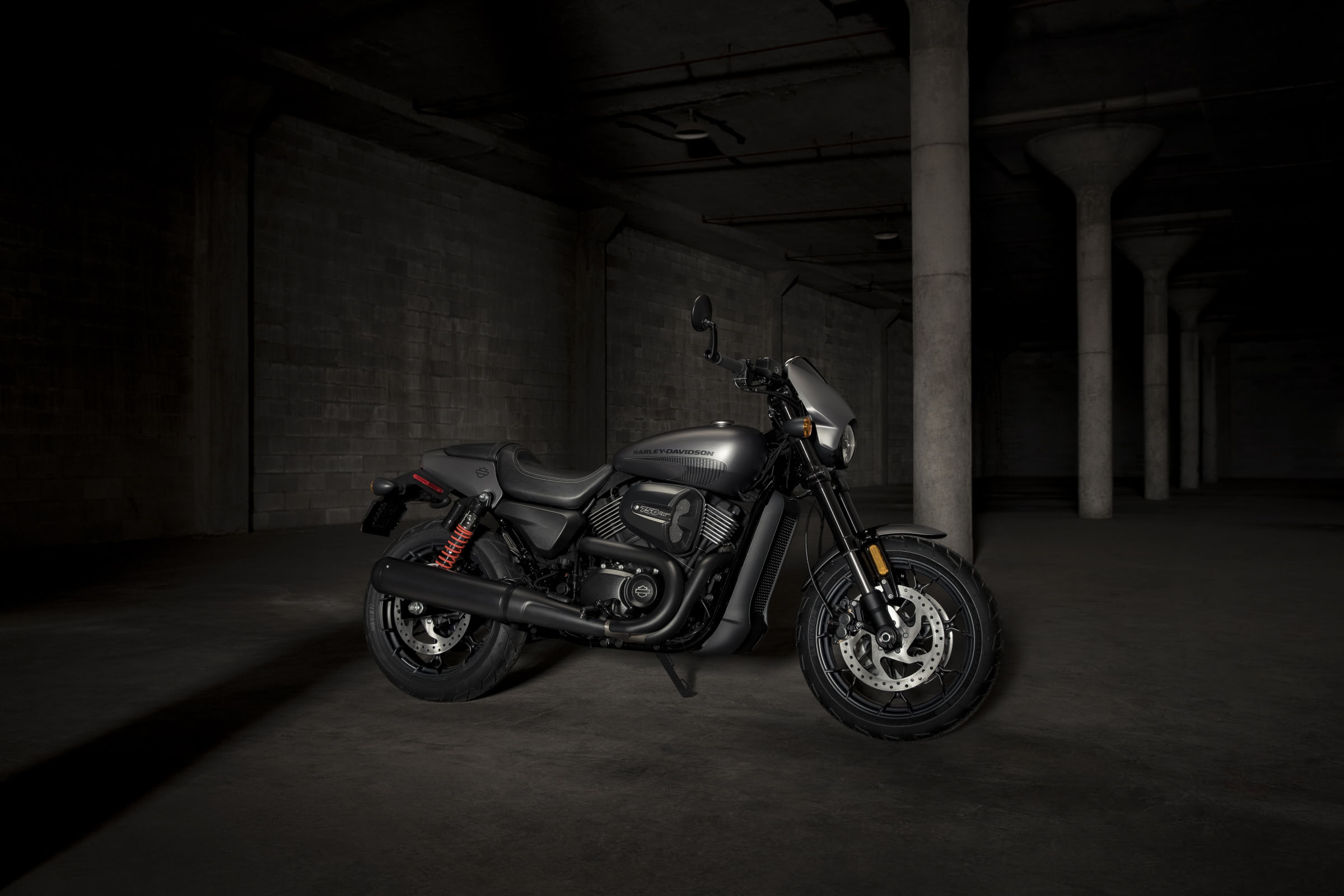
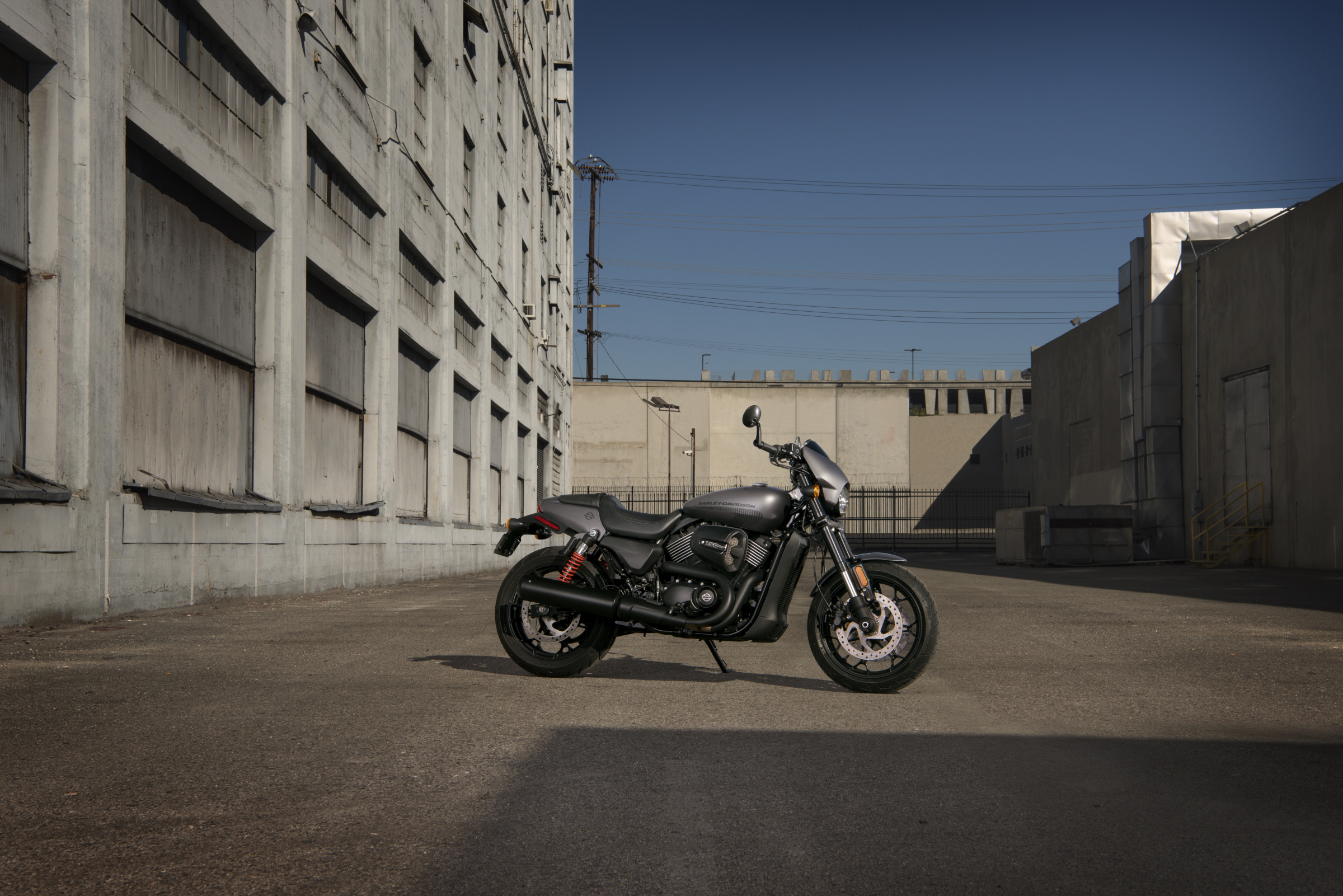
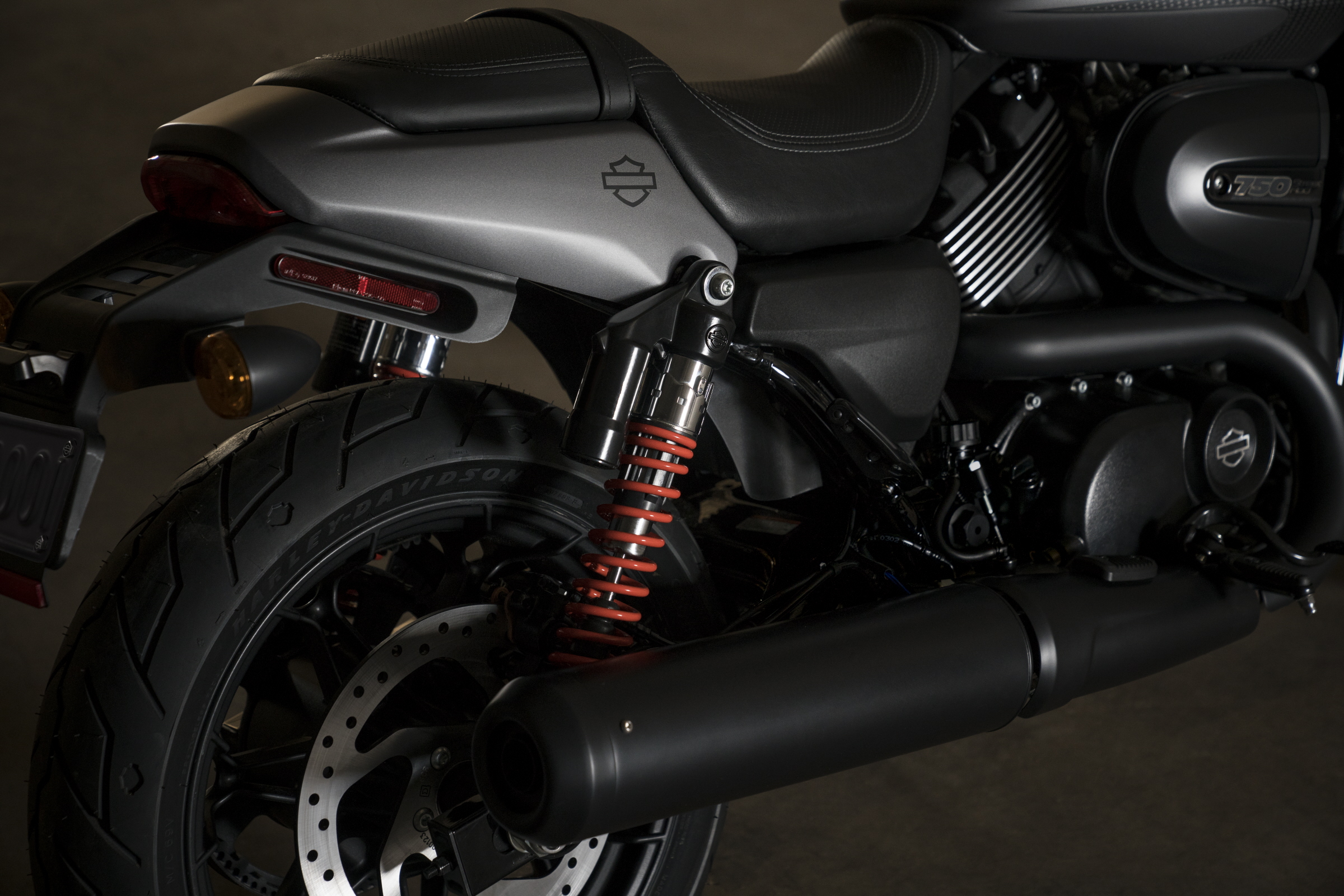
The 2017 Harley-Davidson Street Rod ads a little more punch to the mid-sized lineup as it expands on the Street 750’s performance capabilities.
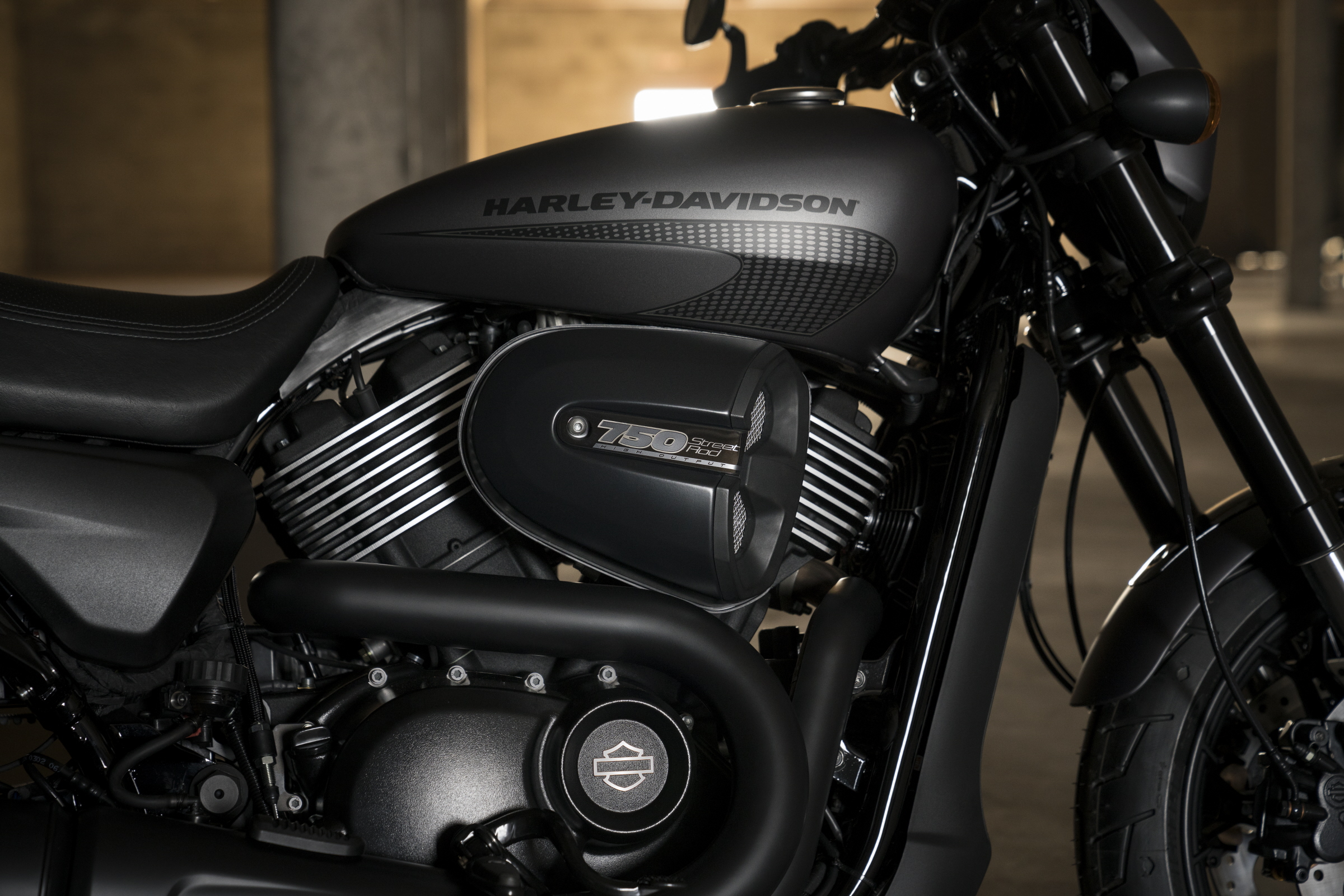
Its tuned High Output Revolution X 750 engine, producing more torque through the mid-range and power at the top-end, and also chases a higher redline. The bigger hitting motor is matched with sharper chassis geometry and aggressive riding position; there are also upgrades to the suspension, brakes and wheels.
And the Street Rod’s lines are very much its own. Its hunched forward, ready-for-action stance are more reminiscent of a streetfighter or muscle-bike.
The Street Rod will be offered in three colour options:
• Vivid Black
• Charcoal Denim
• Olive Gold
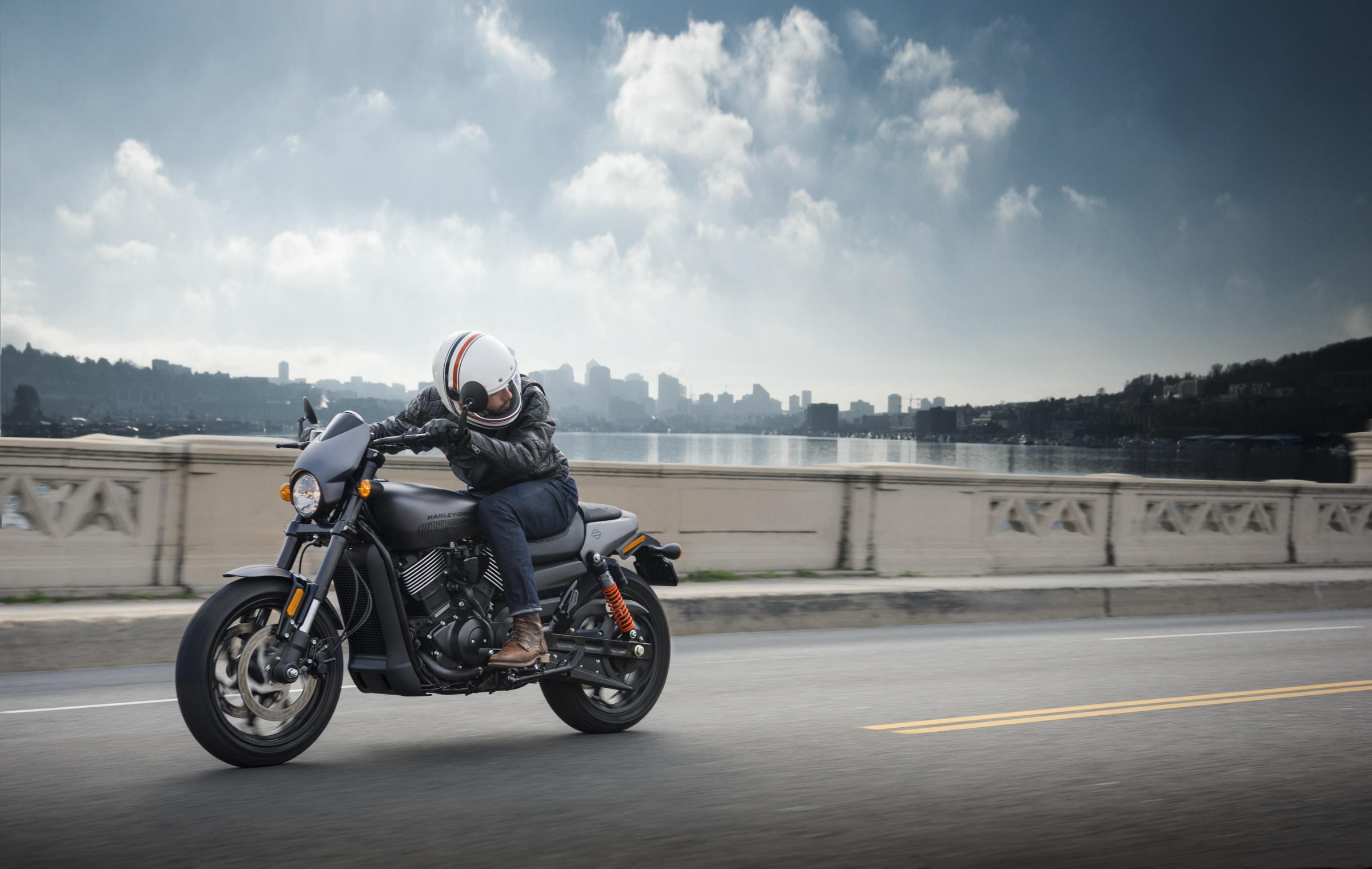
Mathew Weber, Harley-Davidson chief engineer:
“The Street Rod’s new High Output Revolution X 750 has got hot cams, gas-flowed heads, more compression and a higher redline. It gets your attention. And we wanted a chassis to match, sharp handling and aggressive, perfect for urban cut-and-thrust and canyon carving. Its attitude and the relationship between seat position, rearset footpegs and wide handlebars put the rider fully in control. The fact the Street Rod looks so good – and very close to our early sketches – gives us all a real charge too!”
More midrange torque, top end power and an extra 1,000rpm…
The Street Rod’s liquid-cooled, single OHC 8V 60° V-Twin High Output Revolution X 750 engine produces 18% more horsepower and 8% more torque than the Street 750; peak power arrives @ 8,750rpm, with peak torque delivered @ 4,000rpm. It’s tuned to deliver strongly between 4,000 and 5,000 rpm, with strong midrange performance that a rider can feel and exploit in real-world situations.
It features a larger volume air box and new dual 42mm throttle bodies, new four-valve cylinder heads and high-lift camshafts, plus a higher-volume exhaust muffler – all designed to increase airflow and efficiency. Compression ratio is raised from 11.0:1 to 12.0:1 and the redline goes from 8,000 to 9,000 rpm.
Sharper geometry plus new suspension and brakes deliver agile handling
The Street Rod chassis is engineered to match the performance of the engine. The front end features rigid 43mm USD forks gripped by lightweight aluminium yokes. Fork rake is tightened from 32° to 27° for quicker steering.
New rear shock absorbers feature an external reservoir to increase fluid capacity and maintain damping consistency; travel is increased 31% to 117mm. The swing arm is slightly longer to accommodate the taller shocks, with performance-inspired styling.
A new seat shape is designed to hold the rider firmly in place and seat height is raised to 765mm to enhance the rider’s view forward. The Street Rod also features new forged brake/gear levers plus aluminium rearset footpegs that aid control and make it easier for more riders to get good ground reach when stationary. To suit more spirited riding lean angle is increased from 28.5° left and right to 37.3° right and 40.2° degrees left, with a 205mm ground clearance.
The flat, drag-style handlebar creates an aggressive riding position; new bar-end rear-view mirrors can be mounted above or below the grips, and feature a patent-pending design that allows them to fold back without interfering with the rider’s hands.
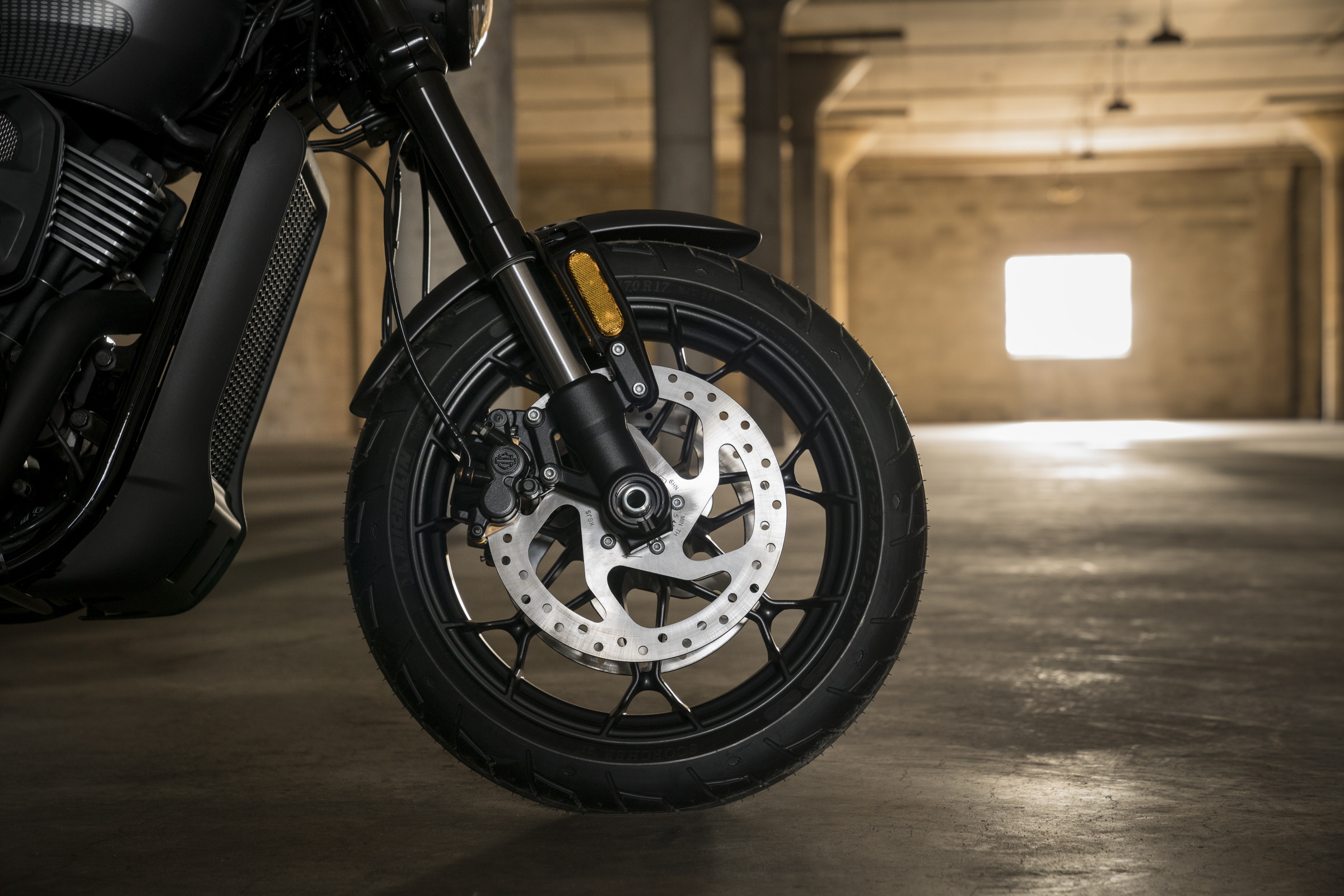
The Street Rod wears exclusive 17-inch front and rear Open Spoke Black Cast aluminium wheels and new Michelin Scorcher 21 radial tyres, sized 120/70 R17V front and 160/60 R17V rear; dual two-piston calipers and 300mm front disc brakes plus ABS deliver powerful, controlled stopping power. Harley-Davidson’s Smart Security System is standard fitment.
Dark Custom to the core with something extra all its own
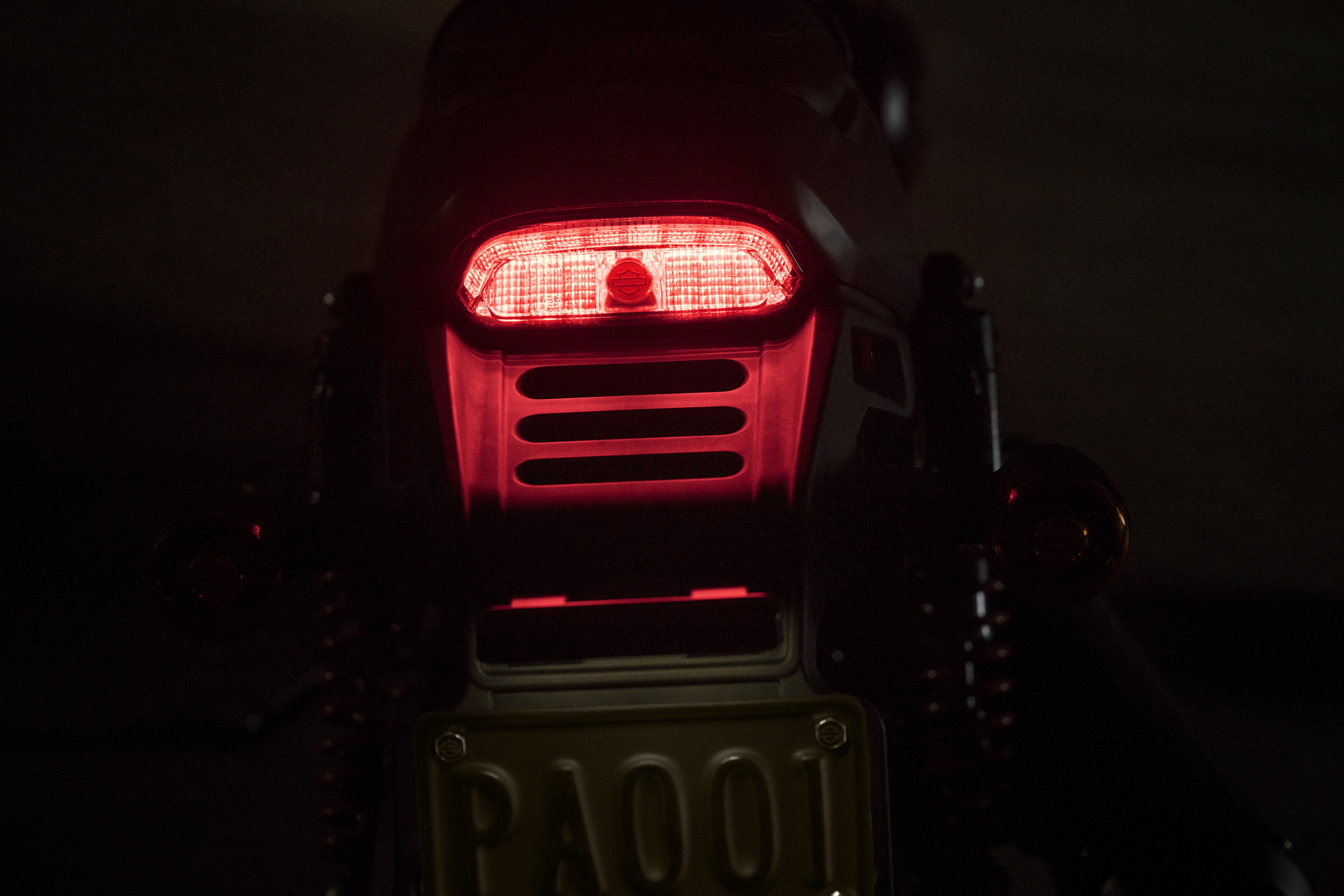
The Street Rod backs up its upgraded engine and handling performance with a liberal dose of Harley-Davidson Dark Custom styling. Thick, blacked-out forks and triple camps, topped with a new speed screen (colour-matched to the bodywork except for a black centre insert) add mass to the front end. A new tail section, with perforated rear mudguard, lightens the rear; the taillight is crisp LED, as are the indicators.
The raised ride height and 17-inch wheels inject the Street Rod with an athletic stance, while the new scoop-style air cleaner cover and sharper snap of the exhaust note draw attention to the engine’s strong design.
For more information on the Harley-Davidson Street Rod and full specifications visit harley-davidson.com
Engineered to bring a more refined fit to the KLIM lineup, the Kodiak collection enters the touring world in a sleek and tailored style built for abuse. Featuring fully armored KLIM Technology to battle the weather, abrasion and travel’s most troublesome obstacles, KLIM’s Kodiak is the high-mileage touring king.
Designed for riders looking for the ultimate in precision fit, Kodiak is built on a base of GORE-TEX Pro Shell GUARANTEED TO KEEP YOU DRY main body fabric. Integrated perforated leather overlays in high-abrasion zones add functional style while muted corporate branding finishes the rugged and durable look. Functionality is the core of any KLIM product and the Kodiak has more than most. Each piece comes equipped with genuine YKK zippers, D3O CE-rated level two armor, intelligent ventilation ports and functional cargo carrying pockets. Each piece also features Black 3M Scotchlite reflective material.
Kodiak is a name that should be taken seriously. As one of the most remote regions of the American frontier, it has a wild and unforgiving reputation. KLIM built the world’s most functional and aggressively tailored touring apparel to honour this region. After all, in Kodiak, there is no pretending or hiding behind claims. Out there, it’s simply perform or perish. And KLIM is riding on.
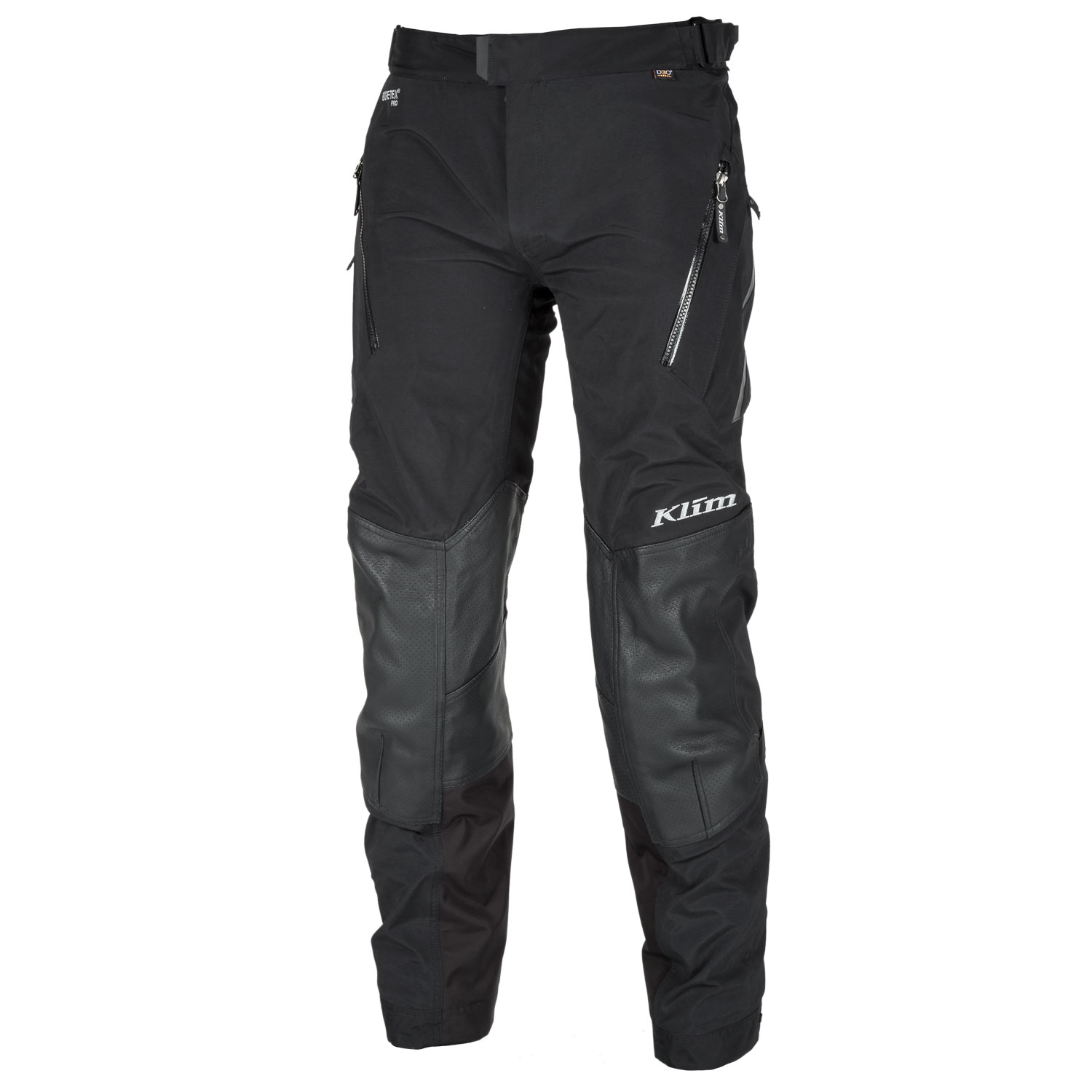
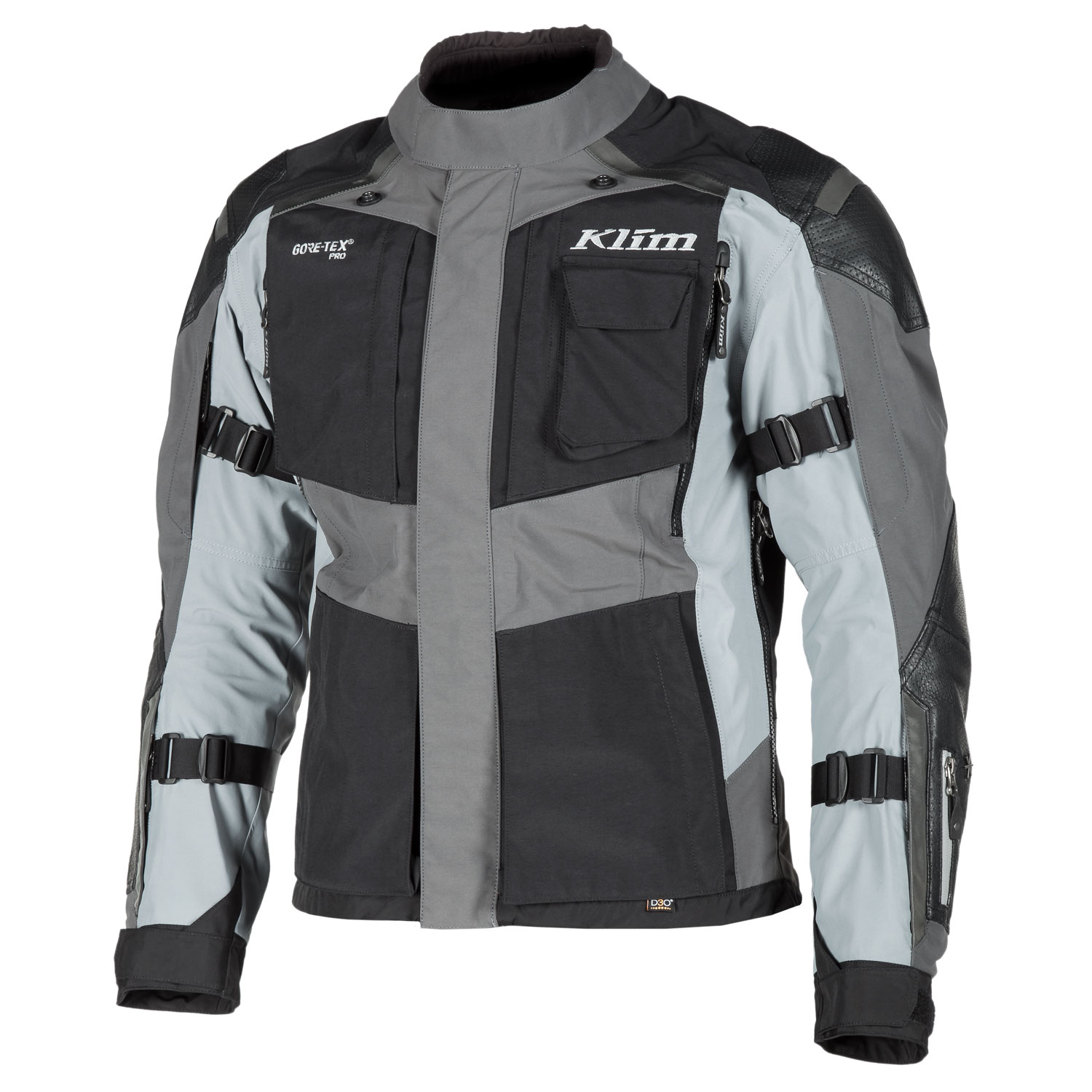
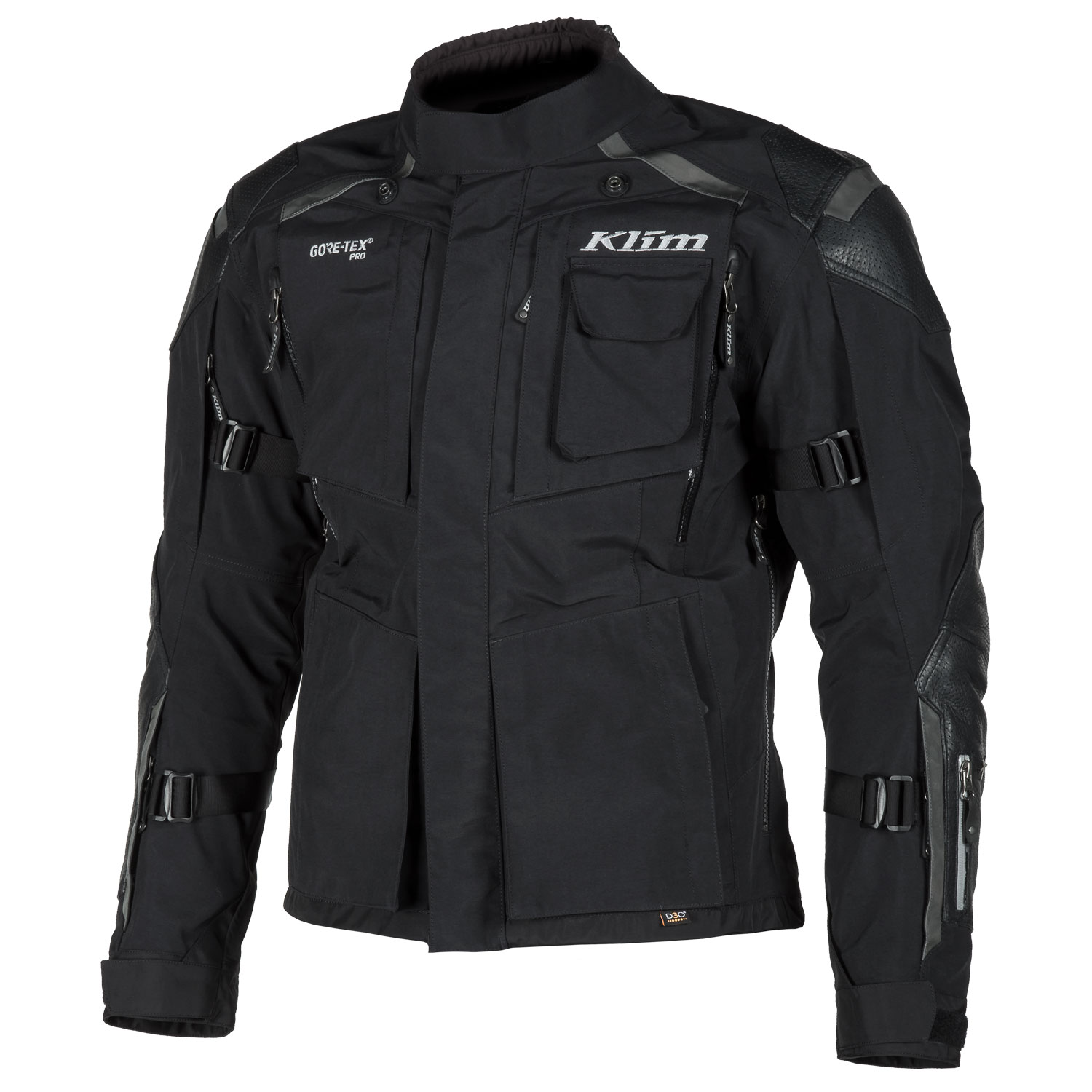
KODIAK JACKET
WEATHERPROOF/DURABILITY
- GORE-TEX PRO SHELL
- GUARANTEED TO KEEP YOU DRY
- PERFORATED LEATHER OVERLAYS ON SHOULDERS AND ELBOWS
- MUTED TONAL BRANDING
- YKK ZIPPERS
ARMOR
- D3O CE LEVEL 2 ELBOW ARMOR
- D3O CE LEVEL 2 SHOULDER ARMOR
- D3O CE LEVEL 2 BACK PAD
- SPACER MESH CHEST PADDING
CARGO
- 2 EXTERNAL CHEST POCKETS
- 2 EXTERNAL HAND POCKETS
- 2 INTERNAL ZIPPERED POCKETS
- 2 INTERNAL OPEN STASH POCKETS
- 1 EMERGENCY INFO CARD POCKET ON FOREARM
- 1 HIDDEN PASSPORT POCKET IN LINING
- 1 GPS TRACKER POCKET ON CHEST
- 1 WATER RESISTANT NAPOLEAN POCKET
VISIBILITY
- BLACK 3M SCOTCHLITE REFLECTIVE MATERIAL
VENTILATION
- 2 CHEST VENTS
- 2 SIDE VENTS
- 2 BACK VENTS
- 2 BICEP VENTS
- 2 FOREARM VENTS
- SNAP BACK COLLAR
FIT/STYLE/COMFORT
- ACTION BACK TAILORING
- REMOVABLE INTERNAL KIDNEY BELT
- ADJUSTABLE ARM STRAPS
- JACKET-TO-PANT CONNECTION
KODIAK PANT
EXTERIORFEATURES
- GORE-TEX PRO SHELL
- GUARANTEED TO KEEP YOU DRY
- PERFORATED LEATHER OVERLAYS
- YKK ZIPPERS
- MUTED TONAL BRANDING
ARMOR
- D3O CE LEVEL 2 HIP ARMOR
- D3O CE LEVEL 2 KNEE ARMOR
- SLIDER SYSTEM TO HOLD D3O IN PLACE
- PORON XRD TAILBONE ARMOR
CARGO
- 2 CARGO POCKETS
VISIBILITY
- BLACK 3M SCOTCHLITE REFLECTIVE MATERIAL
VENTILATION
- 2 FRONT THIGH INTAKE VENTS
- 2 BACK THIGH EXHAUST VENTS
FIT/STYLE/COMFORT
- ELASTIC BACK WAISTBAND
- REMOVEABLE KLIM SUSPENDERS INCLUDED
- JACKET-TO-PANT CONNECTION
Visit www.klim.com to learn more about the Klim line of apparel.
With inspired design from the scramblers of yore, this retro might be better sticking to hard-packed roads
Where’s a trend these days for bike makers to introduce a motorcycle, and then use it as a platform from which to spawn several different models. This makes a lot of sense from the manufacturer’s point of view, because it simplifies production and reduces costs. It also makes sense from a consumer’s point of view, because it offers several styling variations of a certain bike – if you’re not too keen on the styling of Model X, maybe Model Y will strike your fancy. An ideal example of this formula is the Yamaha Bolt. Initially introduced as a low-slung retro cruiser, it was soon also available in the slightly sportier Bolt R-Spec with piggyback shocks and cast wheels, and the sportier still Bolt C-Spec with taller suspension, and a seat cowl and low handlebar giving it a café-racer silhouette.
 For 2017, Yamaha has taken the Bolt platform in yet another retro direction, and it’s the most radical yet. It has been “scramblerized.” Yes, the Bolt has joined the likes of the BMW R nineT Scrambler, the Ducati Scrambler, the Moto Guzzi V7 Stornello, and the mother of all modern scramblers, the Triumph Scrambler, as a modern take on, well, the scrambler. And while the three previous incarnations of this cruiser kept the Bolt name, this latest one is simply called the SCR950.
Unique Profile
 There’s no mistaking the SCR950’s family resemblance to the Bolt, but its profile has been completely altered by the use of both new and existing components. Among the new components are a redesigned sub-frame, which provides a taller seat height (830 mm, a full 140 mm taller than the Bolt’s), and a long, straight seat. Also new is the 17-inch rear wheel, which replaces the Bolt’s 16-incher. Yamaha sourced the shocks from the Bolt C-Spec, which are a bit longer than the Bolt’s for added ground and cornering clearance, while some of the other retro styling touches include side covers that mimic number plates, and fork gaiters (those are rubber fork boots, if you weren’t around when the original scramblers were trailing about).
Swing a leg over the SCR950 and you’ll discover a very scrambler-like seating position, with an easy reach to the tall, wide handlebar placing you comfortably upright, and mid-mounted foot pegs providing a neutral riding position. The seat is straight, but it’s not flat with a rounded cross-section that doesn’t really spread the load equally on your backside. If anything, it actually feels like a dirtbike seat, which lets you move fore and aft easily, but it’s firm – comfy for about 45 minutes or so. The large, round instrument cluster is also from the Bolt C-Spec and has a small LCD display that shows speed, and either the trip meter, odometer or time. This is one item I’d really like to see offered as a simple analogue unit, both for appearance and to maintain the retro feel of the machine.
Just to Be Clear
 Now, to get things straight, here’s what the SCR950 is: It’s a cleverly styled retro bike that’s faithful to the original spirit of the scrambler genre, in that Yamaha modified an existing model with a wide handlebar, knobbier tires and an upswept exhaust pipe (all right, it’s not quite a high-mounted exhaust, but the idea is there).
Here’s what the SCR950 is not: It is not, by any means, a dirtbike. It is no more competent when riding off pavement than any true street bike would be. The only thing that makes it handle a bit better than an outright street bike when the pavement ends is the addition of the more aggressive Bridgestone Trail Wing tires, as well as its upright riding position and wide handlebar.
You’re reminded that the SCR950 is based on a cruiser platform as soon as you start riding at a moderately aggressive pace on pavement, where you soon discover it has limited cornering clearance, as its foot peg feelers touch ground at modest lean angles. Limited cornering clearance notwithstanding, the SCR950 shines on the road, with light, neutral steering and a very wide, flat power band. In fact, there’s nothing intimidating about its 942 cc air-cooled V-twin, which has five speeds and claims 51.3 hp and 59 ft-lb of peak torque at just 3,000 rpm. The gearbox and clutch action are smooth, light and very beginner-friendly.
Rough Landings
Take a turn off-road, though, and you’ll uncover the bike’s real limitations, as the rear suspension often bottoms after hitting even modest bumps at speed. And it bottoms hard after landing from any kind of jump. If you see any promotional pictures of the SCR950 mid-air, you can be assured that the landings were hard. Even standing up to help absorb bumps feels awkward, since the foot pegs are spaced unusually wide. The bike has a relatively narrow steering lock, so tight manoeuvres, like U-turns in the trails, require a bit of backing up.
Look at the spec sheet and you’ll understand the SCR950’s limited handling capability on and off the pavement. Its chassis and steering geometry are identical to the Bolt’s; the suspension components are straight from the Bolt, using the same springs but reworked damping in the forks; while the longer C-Spec shocks also have revised damping but offer the same wheel travel as for the Bolt, which is a very scant and cruiser-like 70 mm.
Urban Adventurer
The $10,199 Yamaha SCR950 is really a styling exercise, but admittedly it’s a very good one. It certainly looks the part of the scrambler, but like most modern scramblers, it should be limited to adventures in an urban setting. And if you do venture off pavement, you should stick to well-maintained dirt roads, where it’s actually a joy to ride. It’s definitely my favourite iteration of the Bolt, with roomier ergonomics, and it’s fun to ride if you don’t have expectations of traversing the country along remote, unmaintained trails. It’s not a bike you should pack your camping gear on for a weekend romp in the deep woods, because chances are it’ll be a long hike back.
Now should Yamaha ever consider using the FZ-07 platform to produce an SCR07 – now there’s a scrambler I think would be ready for some real adventure.
Missing out on the first scrambler era, BMW is making up for lost time by entering into the current trend
BMW has a storied history. In fact, the company celebrated its 100th birthday in 2016, tracing its beginnings as a maker of aircraft engines back to 1916. Its first motorcycle, the R32, was built in 1923, but despite producing motorcycles since that time, the company had skipped the original era of the scramblers – off-road bikes that first started appearing in the early 1960s. Back then, you could find high-piped, semi-knobbied scramblers like Honda CLs, Yamaha Big Bears, the Suzuki X6, and countless BSAs, cast-iron Harleys and pre-rebirth Triumph scramblers, among others. But you wouldn’t find a scrambler from BMW, at least not one produced at the factory.
 But the recent resurgence of the scrambler genre has proven popular, so it’s no surprise that this time around, BMW has such a bike in its lineup, the R nineT Scrambler, which we were invited to ride at its international launch in the countryside of New Jersey and in the hills of neighbouring Pennsylvania, as well as a quick romp in the traffic of New York City.
To get an idea of just how popular this new scrambler trend is, you just have to look at how many OEM versions are currently available. In addition to the R nineT Scrambler, there’s the Triumph Street Scrambler, the Ducati Scrambler, the Yamaha SCR950 and the Moto Guzzi V7 II Stornello, with probably more on the way. The R nineT Scrambler was the second model to be released in BMW’s “Heritage” collection, the first being the original R nineT introduced two years ago. More Heritage bikes have since been released, including the R nineT Racer, the Pure and the Urban G/S. The good news if you’re a potential Heritage bike buyer is that the Scrambler undercuts the R nineT by $2,600, at $14,250. Aside from being equipped with a conventional fork instead of the R nineT’s inverted unit, other cost-cutting measures include a steel fuel tank instead of one made of aluminum (the latter is a $1,175 option), cast wheels (tubeless spoke wheels are $520 more), and a simpler instrument cluster that displays just a speedometer. Curiously, the Scrambler has available traction control ($420), which isn’t an option on the R nineT roadster. If you want heated grips, you’ll have to dish out an extra $275.
True to the Style
 All of the Heritage bikes use BMW’s previous-generation 110 hp, 1,170 cc, air-cooled boxer twin. Although the Scrambler looks very similar to the original R nineT roadster, aside from the engine and headlight, the two bikes have little else in common. The Scrambler has a different frame with less aggressive steering geometry, and it also has longer suspension travel front and rear (125/140 mm vs. 120/120). Its front wheel measures 19 inches, compared with the roadster’s sportier 17 inches.
Just like that of its roadster brother, the Scrambler’s styling is understated and classic. Its exposed engine and mechanical nakedness hark back to the time when these kinds of bikes were authentic. There’s very little plastic on the bike, and subtle styling touches like fork gaiters and perforated muffler shields accentuate its retro design. A keen eye will notice that the muffler tips look strikingly similar to the outlets of SuperTrapp mufflers, a common exhaust system choice among dirt track motorcycles, which at one time weren’t too far detached from scramblers.
BMW’s minimalist approach with the R nineT Scrambler is deliberate; the bike is designed to be readily customizable by its owner, with an easily removable sub-frame, and a wiring harness that separates lighting from engine functions to facilitate the addition of accessories, like swapping out lights and such. BMW has a small array of accessories for the Scrambler, but it’s the aftermarket that will likely provide a plethora of bolt-ons for those wintertime projects.
Proper Posture
Just like the R nineT, the Scrambler has a rich, growling exhaust note that is surprisingly robust for a stock machine. Clutch effort is light, and a very gentle flick of the shifter nudges the gearbox into first gear, with each successive gear change equally light. The riding position is typical of the genre, so it’s mostly upright with an easy reach to a wide handlebar, though the foot pegs are more naked-bike high than scrambler-like relaxed. I’d opt for the 12 mm-
taller seat (no extra cost) for the added legroom. The standard seat is more of a short-hop perch than a cross-country saddle; it’s flat, thinly padded and firm. It nonetheless proves tolerable for a couple of hours, especially if you’re primarily riding on winding roads like the surprisingly serpentine asphalt of New Jersey and Pennsylvania, where you’re not planted in one position for very long.
The Scrambler immediately distinguishes itself from the R nineT roadster at the first few revolutions of its wheels, however. Unlike the R nineT, which has light, neutral steering, the Scrambler has unusually heavy steering at low speeds, and it tends to resist leaning initially, before falling into a lean as you pitch it into a turn, thus causing you to counter your countersteering. This unusual handling can likely be traced to the Metzeler Karoo 3 dual-sport tires, which have an unusually flat rear profile. I suspect the tires, because I’ve felt these exact steering characteristics after replacing street tires with knobbier dual-sport rubber on other street bikes. The Scrambler comes standard with more street-oriented Metzeler Tourance tires; the Karoo 3s are a no-cost option.
Overwhelmed
At higher speeds, steering is more neutral and the bike is exceptionally stable. My biggest gripe with this machine, however, is with the suspension, which feels soft when you bounce on it, but proves extremely harsh over sharp bumps. It’s firm enough to provide very good control at a quick pace on smooth pavement, but bounces you off the seat and jolts your hands on the bars over frost heaves and potholes. This is especially unnerving if wannabe scramblerists decide to take this BMW off-roading. Probably like the original scramblers, it’s just not designed to handle anything more than smooth, hard-packed dirt roads – anything else and you must either slow down considerably or pick your lines carefully to avoid dips, ruts, rocks or any other off-road obstacles. This isn’t the case with the BMW alone; all modern scramblers I’ve ridden are primarily road bikes, and they handle like road bikes on dirt. There’s a reason the Japanese invented the dirtbike 40-odd years ago, probably because scramblers didn’t work that well off road. If the unpaved road is hard packed and smooth, however, the Scrambler rails along, and with the traction control off, you can slide the rear end out at will. The engine has that typical boxer power band we’ve become accustomed to: it’s wide and flat, and it pulls with gratifying force even high into the rev range, which means shifting is optional if you so desire.
Urban Player
A quick trip through the Bronx and Brooklyn during rush hour reveals that an urban setting is the Scrambler’s true playground. In a sprawling city teeming with busy traffic, it easily squeezes its way through the worst congestion, its wide handlebar and low centre of gravity making tight turns and quick, evasive manoeuvres a breeze.
The BMW R nineT Scrambler should help broaden the appeal of BMW’s retro bikes, especially since it’s priced considerably lower than the roadster. You shouldn’t have aspirations of strapping on a knapsack and hitting the trails, though, since this bike, like the entire scrambler phenomenon, is a fashion statement. But that doesn’t detract from the Scrambler’s most redeeming features: It’s fun to ride, it’s fun to look at, and when you put it away during those winter months, it’ll be fun to work on, too.
While it isn’t impossible to take your bike to Cuba, it certainly isn’t easy. But this intrepid traveller has found a way
My Cuba journey is already six weeks old by the time I have ridden from Nova Scotia through the United States to Mexico’s Yucatan Peninsula. It’s pretty much a blur now, yet there are some indelible memories of the U.S. southwest and the west coast of Mexico, some of the latter being mixed with the dark side of things, including endless speed bumps and drug cartel shoot-outs along my route. As always, we filter out the bad and keep the good – the serendipitous encounters and experiences that dot the journey.
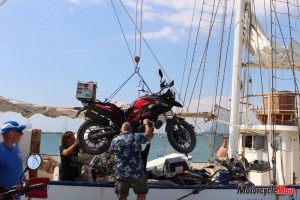 Near Cancun, my bike and I board the sailboat Stahlratte, my mission being to experience Cuba by motorcycle before it is overwhelmed by a projected four million American tourists per year as the U.S. trade embargo unwinds.
From the port city of Cienfuegos, my exasperation with two days of bureaucratic inefficiency soon fades and, legitimized with a Cuban licence plate, I point my front wheel toward Santiago at the southeast end of Cuba, the second city after Havana and my favourite. I have good friends there, having been to Cuba many times and travelled by rented car and bicycle, bus, train and even by thumb. But now I’m here on my own motorcycle! The Pope is gone, President Obama is visiting and the Rolling Stones are arriving next week. I feel connected to history in the making.
For Richer or Poorer
 My first waypoint is Trinidad, famed for its UNESCO-recognized heritage and its cobbled streets with horse-drawn carriages. The twisty road through the mountains is as therapeutic as the brief stop. Heading south beyond Sancti Spiritus, I literally come to the end of the road and have to hit my brakes at those coordinates where the Russian subsidies dried up. I take secondary roads through small towns and cities that do not have bypasses and continue to Bayamo to spend the night in a casa particular (like our B&Bs), where prices are up 30 per cent over the last two years. I see that the trend of owners of casas particulares and paladares (private restaurants), not to mention taxi drivers and hookers, making much more money than state-paid doctors and teachers has only accelerated. Those paid by the state in the old Cuban pesos struggle, while those with access to CUCs – the convertible pesos pegged by the U.S. dollar and used by tourists and upper-class Cubans (yes, access to CUC defines class now) who work in tourism (hence tips) and those who receive remittances from family in the U.S., mostly Miami (Little Havana) – rush into the consumer frenzy for cellphones, electric scooters and Miami fashions in government-owned “dollar stores.”
I am thrilled as Santiago’s rugged urban charm fills up my visor and hammers me with nostalgia. This has to be one of the best places in the world, rivalling even Cape Town, to sweep out of the mountains and arrive at on two wheels. Santiago is the most Caribbean city in Cuba, known as the origin of Son music, and heralded as a heroic city by Fidel Castro.
Luxurious Food and Beer
 My good friends Andres, an electrical engineer, and his wife, Asela, an actress, are both state employees. When I take them out and buy them dinner and beer at 1 CUC a bottle for the potent Bucanero beer, this is a treat they cannot afford on their combined monthly state salary, equal to 40 CUC a month. Out on the town, I see cellphones and laptops everywhere in new Wi-Fi hotspots in reinvented public squares. People are dressing fashionably and are eating better, too, not as thin as they were 20 years ago when circumstances had them eating less and walking more.
After a couple of days of reminiscing with friends and pondering the changes sweeping Cuba, it’s time to move on. While relaxed “Cuba time” predominates, the clock on the Stahlratte is nevertheless ticking away on my three-week stay. Andres wants to join me for the first leg of my trip, westward to Pilon on the enchanting coast road sandwiched between the Sierra Maestra Mountains and the blue Caribbean. This road is my favourite in all of Cuba, but this time I will take a long-anticipated turn northeast into the mountains on an elusive dirt road that is impassable for a good part of the year. This route is a challenge for a solo rider on a bike with off-road capability, more so with a passenger.
The road gets wilder as we head west, and at some points seems to be fighting a losing battle with the sea. Just before our turn into the mountains at Marea del Portillo, we stop to visit my old friend Joel and his family. Six years ago, I was hitchhiking with a broken bicycle when a hospital bus carrying sick along with heavily pregnant passengers dropped me at the roadside house of Joel, a renowned bicycle mechanic. Joel went to work on my bike while the family recharged me with rice and beans and jugs of cool mountain water. A lasting friendship bloomed with three generations of family. We start into the mountains the next morning. Soon we are over a winding and climbing path that competes with the scenery for our attention. Andres gets to stretch his legs on trickier sections. Up and up and up we go. It is easy to see how Castro held out up here against Fulgencio Batista’s soldiers for so long. Perhaps 30 km east of us is Pico Turquino, the highest peak in Cuba, at almost 2,000 metres. Exotica on Two Wheels We pass through a few small mountain settlements, including Habanita and Las Mercedes. One of them has a café with, blessed be, cold beer. The mountain folks, though surprised to see us, are friendly enough, albeit with a dash of reserve. The horse- and mule-riding compañeros I see through the café shutters are keenly interested in my BMW F 700 GS motorcycle. Cubans are familiar with the older Ural motorcycles and East Bloc MZ and Jawa motorbikes, but my exotic high-tech mount is something else. My wife said my older BMW GS back home looks like a German soldier, while this new incarnation of dual-purpose bike looks like a scrappy Italian lady of the night, with its in-your-face red-and-black paint job (lipstick and hose?) shielded from abuse by a skid plate, and engine and hand guards, and heeled with aggressive enduro tread. All in all, a volatile package that Cuban men appear to swoon over, particularly when iced with that honey note that comes after touching the starter button.
Beautiful Ladies of Cuba
After fording a lot of streams and dodging numerous pigs and chickens, we approach Bartolomé Masó, where the road improves and we almost reluctantly pick up the pace. We are soon in Manzanillo and hang a left for Niquero on the southwest coast, where we will spend the night. Strangely, there are a lot of blondes here, and fewer of the typical mixing of blood you see everywhere in Cuba. Cuba is known among other things for its exotic ladies. The country is likened to a pressure cooker kicking out steaming-hot beauties of all hues in assembly line fashion, drawing from a simmering gene pool of African, Spanish, native Indian, Russian and even Chinese contributions. A national melting pot pulsing with Cuban drum beats. Castro blessed the mixed gene pool by declaring that all Cubans are mulattos, in an effort to downplay racial differences. The next day, we complete the loop and are back in Santiago. In the evening, we explore the city and stroll down to the new waterfront, a microcosm of the kind of accelerated change taking place all over Cuba to prepare for the tourism influx. Back in the city centre at Parque Céspedes, I decide to top up my cash reserves at the bank. My pockets replenished with CUCs, it’s time to say my goodbyes to Andres and his family and resume my counter-clockwise loop around the island. Solo Rider Baracoa, the first stop of Columbus’ in North America, will be my next overnight stop. After Guantanamo, the road slows down and clings to the coast for a stretch before swinging inland toward the mountains. It’s a long, twisty climb over the mountains; very scenic, but it’s best to keep those eyes on the road. I’m forced to a stop when I come to yesterday’s landslide with heavy equipment digging out a new path.
I find a lot of tourists in Baracoa, it obviously being on every tourists “to visit” list. The next day, I am headed west toward Moa on a road that looks as if it’s been carpet-bombed. My bike weaves with wild abandon and I am thankful for only periodic traffic. Soon I come to a Canadian silver mine operation. The road nearer the industrial zone is much better, and there are schools with neatly dressed students, an upscale gas station and many indications of a prospering town. On asphalt now, I swing westerly toward Camagüey, for now passing on the smaller rural roads hugging the eastern coast so I can rack up some kilometres before nightfall. A young Cuban cyclist leads me to a casa particular. At the door I always ask first about the price, and this time I balk at $35 CUC, about C$45. We settle on $30 CUC. The casa has a nifty little ramp that the lady puts in place over the three concrete steps, and I am able to zoom right into the living room. She thinks my bike is mucha sexy and offers to trade me her 2,000 CUC electric scooter for it. There are scads of these battery bikes now, what with the middle-class economy picking up, their new availability in government-owned dollar stores and relaxed licensing regulations. Forget trying to rent or buy a real motorcycle in Cuba, though.
Discovering New Ground
The next day, my chosen path is nearer the coast again. I haven’t been in this part of Cuba before and I find the rural countryside is pleasant and relaxing. The country road, often paralleling a railway track, winds through green farmland and small villages. As I get closer to Varadero, I decide to skip it. The beaches are nice, but the place is much too touristy for me. I cut through Matanzas and head west to Havana on a busier highway now thick with tour buses. The heat of the day has left me parched. I stop at a new full-service tour-bus stop for recharging and chat with Pedro, the owner of a 1957 Chevy.
He and his colleagues in the classic car brigade are doing good business with elderly tourist gents who five decades earlier drove the same model, which sometimes accommodated their “first experience,” if you know what I mean. Thankfully, there is that pervasive language barrier at such times. The following morning I head into Havana. Riding my own motorcycle on the Malecón, the famed oceanside strip, then up the Prado is something I have long wanted to do. It’s times like this that I really appreciate being on a bike and being able to pull over just about anywhere and whip the camera out should a scene catch my fancy. It’s cloudy with a stiff offshore breeze and the waves are sweeping in from Miami-way, pounding against the Malecón. After just a couple of hours in this amazing city, I decide to move on, knowing my intended westerly loop through the Viñales tobacco country will return me to Havana, before I head south again toward Cienfuegos.
Just as I approach Viñales on a twisty rural road through the countryside that’s as relaxing as a good cigar and a glass of rum, rain starts to come down in buckets. I have been rain-free all the way down from Nova Scotia through the U.S. and Mexico and thus far in Cuba. I find some shelter from the cascades with some Cubans under a porch. A young couple points out a whole cluster of casas. Many are full, but the various households work seamlessly as a network and steer me one after another until I score accommodations. There are hundreds of casas particulares now in Viñales, testifying to their popularity with tourists and a more permissive government troubled by a shortfall of hotel beds to cope with the impending influx. I’m back in Havana and Obama is indeed here. I have lunch with an old friend at an outside table of the Hotel Inglaterra on the Prado.
Crowds are gathering with hopes of seeing the president, but I have my doubts, as security is light there. Horse Trails The next morning, I head south on the national highway and soon I am making a right turn to visit the Bay of Pigs area. This is where the CIA-trained invading force of Cuban exiles got its butt kicked by a waiting (tipped-off) Cuban military. And the huge signboards around don’t let anyone forget it, either. I contemplate stopping at tourism hot spot Playa Girón for the night, but instead I just grab a meal and keep going on a dirt road that winds along the coast more or less toward Cienfuegos. I run into the annual mating swarm of land crabs that has taken over the road. I miss thousands of them with their raised pincers, but my kill-count climbs with luckily no punctures. I keep going until I come to a nice crab-free camping spot on the coast.
I pitch my tent, have a snack and drink a bottle of cheap Cuban wine as the sun slides into a glassy sea. On my way once again, the little dirt road is getting progressively pot-holed and narrow as the bush encroaches, and I can only see horse tracks now. My map suggests I should be able to continue along this coast and conceivably put myself and the bike on a small boat over Cienfuegos Bay to the city. But somehow I lose the track and go inland and begin to worry about things like gas and punctures and time. I happen upon some backwoods compañeros, who cluster around my map and show me the way out while denouncing my intended route as muy loco. I am soon returned to a paved country roadway, and I ride through pleasant and obviously productive farmland and rural communities. I wave at people working in the fields and they are quick to wave back. I pass a biker on a ’50s Harley and we exchange a thumbs-up.
The Good, the Bad and the Ugly
All too soon I have completed my loop around Cuba and I am back at my starting point in Cienfuegos. It will be two and a half days of sailing back to Mexico. In Mérida I’ll swap my K60 Cuba tires for my homeward-bound Anakee 3s, and then head out for 10 days of hard riding to get back home to Nova Scotia. Lots of time to think about the changes underway in Cuba – the good and the bad and the ugly. Yes, in a couple of years I might take my bike on a high-speed Miami ferry to Cuba with swarms of other tourists and bikers, and it will be logistically easier and much less expensive. But I know which journey will be the benchmark for the others, and an amazing one I will never forget.
A good time to take off work and head into the bush on two wheels
It’s 7 a.m. and dawn is just breaking on this chilly September morning in rural New Brunswick. I’m sitting on a borrowed Honda CRF250L in a staging box that’s marked on the ground with fluorescent orange paint; also painted on the ground in front of it is a big letter B. Two other boxes, one on each side of us, bear the letters A and C. The boxes are big enough to hold four motorcycles side by side, and there are four rows of bikes behind us. I’m part of Team Media along with Mojo scribe Costa Mouzouris, Jacob Black from Auto Trader and Jim Vernon. We wait for our signal to move forward to the starting line.
 The boxes designate one of three different routes for the Fundy Adventure Rally (FAR), a rally that was created by Rob Harris in 2014 after several years of mapping and documenting back roads, logging roads and trails in the Fundy area of New Brunswick. The 2016 rally, however, is a little different from previous years. Rally master Harris had lost his life in a motorcycle accident a few months earlier, so this group of about 120 riders, from as far away as the American northeast and Ontario, and points in between, have gathered to not only test their off-road mettle in Eastern Canada’s de facto adventure rally, but to pay tribute to an easygoing, well-liked rally founder of Canada Moto Rallies and Canada Moto Guide.
In fact, Harris had been asking me to attend his rally since its inception, but owing to other commitments, I was never able to make it. This time, though, I cleared my schedule to ensure I could enter in the excitement and camaraderie that naturally comes from riding in an off-road event that meant so much to Harris.
The Routes
Headquartered at Adair’s Wilderness Lodge, 25 km southwest of Sussex, the rally is based around the previously mentioned A, B and C routes, and a less challenging on-road scavenger hunt.
Harris spent years developing the route system with the help of local riders and the N.B. Dual Sport Club. Taking notes, marking up map books and determining a grading system for every road and trail, Harris was able to flesh out the following three classes: A routes are paved and gravel roads; B routes are for lightly armoured bikes (skid plates, etc); while the C routes are better suited to experienced riders with properly prepped dual-sport or adventure bikes and 21-inch front wheels. The routes also meet up at various points so the riders can switch up the day’s six sections they choose to participate in.
Harris was no stranger to running rallies. He started the Mad Bastard Scooter Rally and the Dusk to Dawn Rally over the last 10 years, and it’s this experience and his mapping abilities that enabled him to conceive the FAR. But it was his wife and business partner, Courtney Hay, who was instrumental in the implementation of the 2016 Fundy rally.
A Little Help From Friends
 Every event depends heavily on volunteers, but the death of mastermind Harris put the rally in jeopardy for obvious reasons, and Hay couldn’t do it all by herself. Harris had been working with Charles Landry the previous year, and Landry was an important spoke in the wheel helping Hay, as were Eric and Terri Russell, along with their daughter, Kara, and volunteers like Vernon and Genevieve Desrosiers, long-time friends of Harris’, and others who pitched in to make the event happen.
It wasn’t just the goings-on behind the scenes that made the event successful. There were evening and afternoon seminars by off-road guru Lawrence Hacking, Honda product expert Warren Milner and off-road GS-certified training by Mojo’s own Clinton Smout.
Honda and BMW were also there providing dual-sport demo rides. As an added bonus, this year’s rally will see the three Canadian finalists for the BMW GS Trophy chosen from Canada’s three western, central and eastern GS Challenges.
Be Prepared
Adventure rides are not to be taken lightly. The terrain can be gnarly and dangers can lurk around any corner, so it’s best to be prepared. On Friday night, there was a mandatory two-hour riders meeting hosted by Eric Russell, with input from Terri and Hay. Items on the agenda included rally guidelines; a new starting system (which proved to be very efficient); discussion of the A, B and C routes; following tracks on an appropriate GPS unit and on supplied maps; a Q&A session; and safety and emergency procedures, which led into Terri’s explanation of the Spot tracking device.
Spot stepped up as a major sponsor by supplying a Spot GPS device to all teams. The device would accomplish two important facets of the rally – to track the teams from rally headquarters to know exactly where they were at any given time, and to provide GPS coordinates to emergency services if so required. The coordinates would also facilitate picking up broken-down motorcycles.
Ride Your Own Ride
 Team Media determined we’d leave on the B route as more of a strategy than anything else. The C box held too many teams, and we based our strategy on the fact that we wanted to get on the road and not wait behind a dozen or so teams for our chance to tackle the 500 km route, which is just a small portion of New Brunswick’s massive trail and logging road system. Second to that strategy, three of us in Team Media were on borrowed bikes from the Honda demo truck – Mouzouris was riding the XR650L, and Black and I were on a pair of CRF250Ls (Vernon was on his own CRF250L) – and we wanted to return them in the same condition, so we thought we’d start easy on an intermediate level.
Black, the youngest on our team, was already handicapped. Three weeks earlier he had an argument with some hay bales while road racing at Canadian Tire Motorsport Park and broke his left hand. Determined not to let a little thing like that get in his way, he cut his cast off while en route from Ontario to the rally.
We were lucky the fog that the Fundy coast is so famous for never really materialized, allowing us to see the beautiful far-off vistas of farms with pastoral scenes of what appeared to be perfectly manicured squares of green, and fields dotted with cows and round hay bales, all bathed in the early morning light of the rising sun.
The rural New Brunswick scenery is simply outstanding, with some of the prettiest country scenes I’ve ever seen.
Weather can also make or break a ride. We got lucky there, too, as I’m told that a tropical storm blew in during the 2015 rally, making things extremely soggy for the riders.
Efficiency on Two Wheels
I must say, I prefer bigger bikes, but the bone-stock CRF250L worked flawlessly in almost all conditions. There was only one time, going up a hill filled with medium-sized rocks, that a bit more power would have been welcome, but downshifting early enough would have solved the problem. I, however, was too concerned about navigating and I let the rpm get too low – I didn’t want to lose momentum by pulling in the clutch, but there wasn’t enough power to get out of my situation without a lower gear – and was stopped dead when the bike wouldn’t roll over a rock and it fell over. There was no damage done, and that whole scenario was entirely my fault. Honda’s DCT technology would have saved me from that embarrassing situation by automatically shifting into the proper gear for me. My only complaint with the bike is that it’s light and the rear brake was like an on-off switch that locked up easily, which was great for sliding into corners.
The CRF250L could very well be the best value on the market for a competent small-displacement dual sport, and I look forward to trying the longer legs of the new CRF250 Rally.
A Good Finish
Starting off on the B route worked well for us, as we were on the road in just a few minutes while the C box continued piling up with four-rider teams. For our second section, we had chosen a C route, but then switched back to a B route once they met up again, as we had been warned at the riders meeting that the C3 section was the most difficut. – remember, we had borrowed bikes and Black’s hand was in less than perfect condition. It seems the warning was accurate. Many riders got through it unscathed, but one ended his day with a broken leg and another had to be rescued after suffering a broken ankle.
Team Media continued the rest of the day on the C routes that consisted of broken bridges, water crossings with the odd beaver dam thrown in for good measure, large gooey mud holes, exposed culverts, hills with lots of rocks and roads with loose gravel in the corners. We finished the day’s ride in about 11 hours, well within the allotted 12-hour time frame, garnering us a Silver award. Had we finished all C routes, we would have come away with a Gold. Maybe next time!
Kudos to the organizers and volunteers. From my seat, the event ran without a hitch. Registration is open now for the fourth annual 2017 Fundy Adventure Rally, which runs earlier this year, from August 17–20. For more info, to register or for a comprehensive list of items to bring and things to consider, go to fundyadventurerally.com.
There are precious few places in the world that can still be considered truly wild
“Be there, don’t just get there,” says adventure motorcycle rider Oliver Solaro of the northern grandeur that is the Yukon and of time spent on one of its most famous roads, the Dempster Highway.
“I’m not kidding,” Solaro continues. “There is actual physical nourishment in the air up there. It’s such an experience. It’s very difficult to fully take in the beauty and incredibleness of the Dempster Highway and the surrounding scenery, and whether you do it by ATV, car, motorcycle or bicycle, you have to stop frequently – don’t try to just add on the miles. You’ll be doing yourself a disservice.”
It’s one of the must-ride roads for any adventure rider, and also this month’s Legend – the Yukon’s Dempster Highway.
“It’s already a super road,” Dick Van Nostrand of Dawson City, Y.T., says of the Dempster, as it connects his city to Inuvik in the Northwest Territories. “But, it’s going to become the go-to destination of the world for adventure riders once the road is completed to Tuktoyaktuk. Once that’s through, you’ll be able to dip a wheel in the ocean at Tierra del Fuego in South America, ride north, and dip a wheel in at Tuktoyaktuk, or vice versa.”
 Work Continues
Construction on the Dempster extension from Inuvik to Tuktoyaktuk began in early 2014, and gravel crews working in each direction met in the middle in April 2016. There’s plenty more work yet to do, but it’s expected to open in the fall of 2017.
According to the YukonInfo website, the Dempster Highway is steeped in history, and was named after William John (Jack) Duncan Dempster of the North-West Mounted Police, who served in the area from the late 1890s to the early 1930s. The highway was originally a river-based trade route used by the Gwich’in First Nations, and Dempster would have learned the course from them. He then travelled the frozen ribbons of water via dog sled to cover the distance between Dawson City and Fort McPherson to the north.
Fast-forward to the mid-1950s. While it was the lure of gold that first brought prospectors to the Yukon, it was the quest for other resources – mainly oil – that fuelled further development. Canada’s prime minister in 1958 was John Diefenbaker, and it was his Conservative government that put a priority on constructing a road system in the Yukon, which became known as “Roads to Resources.”
After a route for an all-weather road had been selected, the bulldozers and graders arrived. However, between the years 1959 and 1963, only 116 kilometres of the road had been built, and when an expected oil boom at Eagle Plains became a bust, further construction of the 7.5-metre wide road was halted. Officially called Yukon Territorial Road No. 11, it was dubbed “the Road to Nowhere.”
Black Gold
Nothing changed until the early 1970s, when word of an oil pipeline in the Mackenzie Valley reinvigorated what would eventually become known as the Dempster Highway. Construction picked up where it had left off, and the road was finished in 1978. It wasn’t until August 18, 1979, that an official opening and dedication ceremony took place. Thanks to a committed group of Yukon residents who lobbied the government, the road was named after Jack Dempster.
A brass plaque, unveiled on opening day, states: “Dempster Highway. The first Canadian highway to cross the Arctic Circle linking Southern Canada and Arctic Canada.” It’s a 737 km-long two-lane highway that sits atop a gravel berm that varies from 1.2 to 2.4 metres thick. The berm protects the permafrost in the ground under the road, thus preventing the highway from sinking into the tundra. The Dempster joins the North Klondike Highway near Dawson City, and snakes its way north to Eagle Plains, and on to Fort McPherson in the Northwest Territories before connecting to the Mackenzie Highway, ultimately ending in Inuvik.
An Ancient Coastline
 A travelogue published by the Yukon and Northwest Territories governments says, “Where does ‘north’ begin and what is it like? Perhaps the answers lie along the Dempster Highway. This is the only road in Canada that takes you across the Arctic Circle and into the land of the midnight sun, where north is a way of life, not just an arrow on a map.
“The Dempster leads you into a unique landscape, passing through land that until 190 million years ago was the coastline of ancestral North America. It takes you through the lands of the Hän, Gwich’in and Inuvialuit peoples. It introduces you to the winter habitat of the Porcupine Caribou herd. And it takes you across a portion of Eastern Beringia – the vast refuge that escaped continental glaciation during the last ice age.”
Only the first 8 km of the south end of the Dempster is paved; the rest is an all-gravel surface. And it pays to be prepared if planning to ride the highway.
“I left knowing nothing of the road,” Solaro says. “I made it there and back, but the best message I can pass along is to absolutely plan ahead.”
In 2006, Solaro left Caledon, Ont., riding a brand new BMW R1200GS Adventure. There was less than 2,000 km on the odometer, and he travelled west to spend time riding around the Prairies before heading north to Dawson City – arriving there in time for the Dawson City Music Festival, held annually in late July.
Had he rolled into Dawson City in mid-June, Solaro would have encountered the Dust 2 Dawson (D2D) Motorcycle Ride (Not a Rally!) event. The ride began in 1992, when four riders showed up in Dawson City and vowed to make it an annual pilgrimage. That’s when Van Nostrand, who owned the Downtown Hotel at the time and himself a motorcycle enthusiast, began to coordinate with Dawson City officials on a variety of riding events.
Word Spread
“I was in awe of these adventure riders, and I was also a little jealous of them having that kind of ride and thought this could be the basis for others going further, too,” Van Nostrand says. “It went from four to eight to 12 riders, but once the Internet got going, word about D2D rapidly spread.”
For Dempster Highway Adventure Motorcycle Research, a 78-page paper published in June 2015, researchers conducted telephone interviews in Phase 1, followed by online surveys in Phase 2 of the study. The goal, quite simply, was to take the pulse of the average adventure rider in relation to the Dempster Highway.
The paper provides a concise and in-depth look at the motorcyclists who use the highway. For example, the document highlights the fact that most riders of the Dempster “were male, between the ages of 45 and 64, and were either retired or worked in a professional/managerial setting. More than three-quarters of past riders had at least a college/technical diploma, and almost half had an annual household income over $120,000.”
Other interesting information from the research relates to the make and model of motorcycle most riders used to tackle the Dempster.
No Surprise
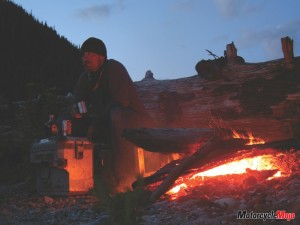 It states: “The most popular motorcycle on the Dempster Highway was the BMW R1200GS Adventure, closely followed by Kawasaki KLR 650, although it’s noticeable that almost half of the riders were on a motorcycle manufactured by BMW. Smaller displacement (500 cc and smaller) motorcycles were rarely used. Only two respondents indicated riding smaller motorcycles, and only one of these rides were within the last 10 years. Additionally, all but two motorcycles were designed to be dirt-road-friendly to some degree.”
The D2D event is also cited in the research as an important stepping-off point for motorcyclists visiting Dawson City before riding the Dempster.
“We see in excess of 250 people each year for the dinner, and that’s when the Dawson City firefighters cook for us,” Van Nostrand says. “But, there can be as many as 400 motorcycles in town for this gathering of like-minded motorcyclists, either heading up the Dempster or heading back. We get people from all over the world attending D2D, including Europe, New Zealand and Australia.”
Blown Away
In his own interaction with the Dempster, Solaro learned just how quickly the wind could wreak havoc. “I had a south wind from Eagle Plains, and I naively thought it was the fairing cutting through the air,” he says. “But it wasn’t the fairing – it was the wind giving me an extra push. Down in a gulley, that wind caught me and literally blew me over.”
Solaro does note that “As long as the road is dry, it offers great traction.” But when he ran into some rain and snow, it was a different story. “That’s when the road surface becomes really greasy and snotty. It’s really slippery and it almost pulls you down into the surface. After a rain, it doesn’t take too long for it to firm up again, though.”
Going back to the Dempster Highway Adventure Motorcycle Research for a moment, the paper asked those who have completed the ride whether there were any issues finding fuel, and if anyone experienced serious mechanical problems.
Fuelled
About the fuel, most riders had enough thanks to large-capacity gas tanks. The only real complaint was about the fact there’s no gas station at the start of the Dempster Highway, and riders had to return to Dawson City to top up before venturing up the road.
Half the riders had no mechanical issues, while those who did suffered mainly from flat tires.
There was one more serious incident that involved a broken chain puncturing an engine case. A local Dawson City welder, TIG welded the hole closed, and with help from Van Nostrand, the anonymous motorcyclist performed further work to his machine and completed the ride, making it back home to Fort McMurray in Alberta.
Despite the rider’s trials, this comment found in the research paper reflects how most motorcyclists feel about travelling the Dempster Highway: “Awesome trip of a lifetime, and I would love to do it all over again.”
Wide-Eyed
Solaro, who says he took physical nourishment from the very surroundings during his northern motorcycle ride, would agree. “I get a wide-eyed, little-boy grin every time I think of the Dempster Highway.”
And as of late 2017, should Solaro, or any other adventure rider choose to motorcycle in the north, the Dempster Highway will take them all way to Tuktoyaktuk.